Mining Dump Trucks Market Size, Share & Trends Analysis Report By Product Type (Rigid Dump Trucks, Articulated Dump Trucks, and Others), By Payload Capacity (Small, Medium, Large), By Engine Type (Diesel, Electric, Hybrid), By Application (Open-Pit Mining, Underground Mining, and Others) and By Region (North America, Europe, Asia Pacific, Latin America, Middle East & Africa) Forecasts, 2026–2034
USD 3950
Mining Dump Trucks Market Size
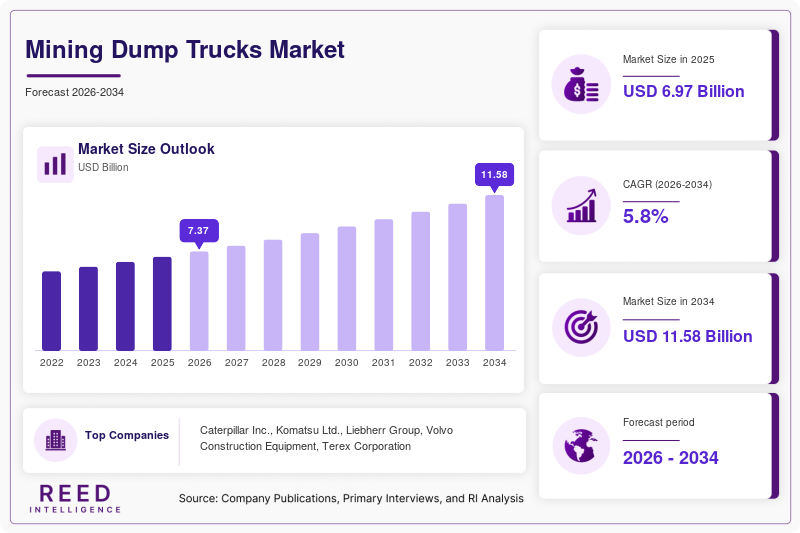
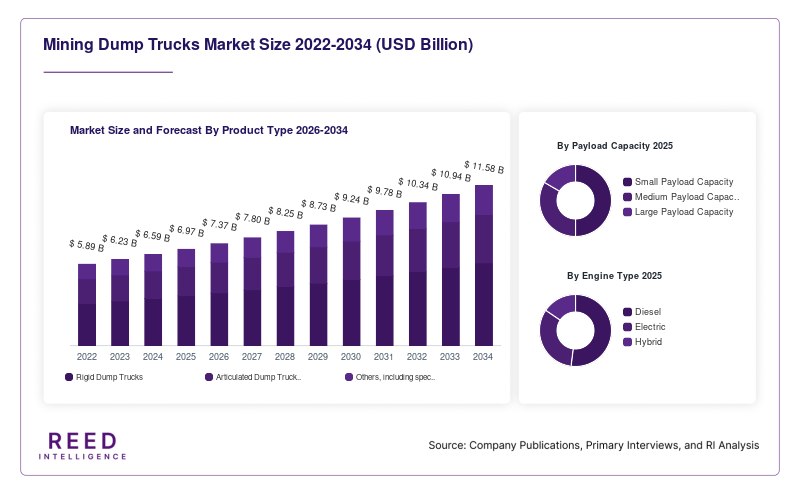
The global mining dump trucks market was valued at USD 6.97 billion in 2025 and is projected to grow from USD 7.37 billion in 2026 to USD 11.58 billion by 2034, registering a compound annual growth rate (CAGR) of 5.8% during the forecast period (2026–2034).
The Mining Dump Trucks Market comprises heavy-duty haulage vehicles designed to transport extracted minerals, ore, overburden, coal, and waste materials within mining operations. These trucks are essential to surface mining and quarrying activities, where large volumes of material must be moved between excavation areas, processing facilities, stockpiles, and disposal sites. Depending on the mine layout and operating conditions, mining dump trucks are available in rigid and articulated configurations with different payload capacities and powertrain technologies.
Market growth is supported by mineral extraction requirements, fleet replacement programs, demand for higher hauling productivity, and investments in mining infrastructure. The expansion of copper, iron ore, coal, and other mineral operations creates demand for trucks capable of operating under heavy loads, challenging terrain, and demanding production schedules. Mining operators also evaluate equipment based on payload, fuel consumption, reliability, maintenance requirements, and total cost of ownership.
Mining Dump Trucks Market Drivers
Increasing Demand for Minerals and Metals
Demand for minerals and metals used in construction, transportation, manufacturing, energy infrastructure, and industrial production supports investment in mining operations. Mining companies require dependable haulage fleets to move ore and waste materials efficiently and maintain production schedules. The extraction of iron ore, copper, coal, and other minerals therefore contributes to demand for mining dump trucks across large surface mines and selected underground operations.
Growing Focus on Mining Productivity and Operational Efficiency
Mining operators are increasingly focused on improving material movement, reducing haul-cycle times, and maintaining high equipment availability. Mining dump trucks with greater payload capacity can move larger quantities of material per cycle, depending on road conditions and site requirements. Telematics, fleet-management systems, and improved vehicle monitoring also help operators manage fuel consumption, maintenance schedules, and truck utilization.
Expansion of Automation and Advanced Haulage Technologies
Autonomous haulage and advanced vehicle-control technologies are creating opportunities for mining dump truck manufacturers. Automated systems can support consistent truck movement, fleet coordination, and operational monitoring at suitable mine sites. Komatsu's milestone of commissioning its 1,000th ultra-class autonomous haul truck in April 2026 illustrates the continued development and deployment of automated haulage technology in large-scale mining.
Mining Dump Trucks Market Restraints
High Initial Equipment Investment
Mining dump trucks involve substantial capital expenditure, particularly in ultra-class vehicles designed for high-volume surface mining. In addition to purchasing the truck, mining operators may need to invest in maintenance facilities, haul roads, tires, spare parts, fueling or charging infrastructure, and fleet-management systems. These costs can affect purchasing decisions, particularly for smaller mining operators and projects with uncertain production schedules.
High Maintenance and Operating Costs
Mining dump trucks operate under demanding conditions involving heavy loads, abrasive materials, uneven surfaces, and long operating hours. Tires, braking systems, suspension components, drivetrains, and other parts require regular inspection and maintenance. Fuel consumption and replacement components can contribute significantly to operating expenses, while equipment downtime can disrupt mine productivity and increase the cost of material movement.
Technical Challenges in Electrification and Automation
The transition toward battery-electric and automated mining trucks requires suitable site infrastructure, reliable energy systems, software integration, and specialized maintenance capabilities. Charging requirements, battery performance, operating conditions, and the need to coordinate equipment across an entire mine can complicate adoption. Mining operators must assess these factors alongside vehicle productivity, safety, and long-term operating economics before changing established fleets.
Mining Dump Trucks Market Opportunities
Development of Battery-Electric and Alternative-Power Trucks
Mining companies are exploring alternative-power haulage technologies to reduce emissions and improve energy efficiency. Battery-electric trucks and other alternative-power configurations offer manufacturers opportunities to develop new vehicle platforms, energy systems, and charging or power-supply solutions. In June 2026, BHP, Rio Tinto, and Caterpillar launched a trial involving two Cat 793 XE Early Learner battery-electric haul trucks at BHP's Jimblebar iron ore mine in Western Australia's Pilbara region.
Expansion of Autonomous Haulage Systems
Autonomous haulage creates opportunities for manufacturers to supply not only trucks but also fleet-control software, monitoring systems, and site-level integration services. Large mining operations with repetitive haul routes may benefit from coordinated vehicle movement and automated operating processes. Continued investment in autonomous systems can also generate demand for compatible trucks, digital infrastructure, and long-term technical support.
Fleet Modernization and Higher-Capacity Equipment
Mining operators periodically replace aging vehicles to improve reliability, payload performance, and maintenance efficiency. The expansion of large mines and changes in production requirements may encourage the adoption of higher-capacity trucks and updated vehicle platforms. Manufacturers that provide a range of payload classes, dependable parts availability, and comprehensive service support can address both replacement demand and new mine development.
Mining Dump Trucks Market Segmental Analysis
By Product Type
Rigid dump trucks are a major product category in mining operations, particularly at large open-pit mines that require high payload capacity and sustained material movement over established haul roads. Their robust construction and suitability for transporting ore, waste rock, and overburden make them important for large-scale extraction operations. Market demand is influenced by payload requirements, haul-road conditions, operating hours, and maintenance considerations. A separate mining truck market analysis estimated that rigid dump trucks accounted for approximately 58.4% of its market in 2025, although that figure uses a broader market definition and should not be treated as an exact share of the supplied Mining Dump Trucks Market.
Articulated dump trucks offer greater maneuverability on uneven or challenging terrain and can serve mining sites, smaller operations, and haulage environments where site conditions favor articulation. Their suitability depends on ground conditions, haul distances, payload requirements, and the material being transported. Other specialized configurations address particular operating conditions and customer requirements. The fastest-growing product type cannot be conclusively established from comparable segment-level growth estimates for the market definition used in this report.
By Payload Capacity
Large-payload mining dump trucks represent the dominant payload-capacity segment, accounting for approximately 42.3% of global market revenue in 2025 according to 's published analysis. Their adoption is supported by the requirements of large mining operations that move substantial quantities of ore, coal, and overburden. Higher payload capacity can improve material movement per cycle when matched with suitable loading equipment, haul roads, and site operating conditions.
Small- and medium-payload trucks serve operations with different production volumes, access constraints, and capital budgets. These categories can be suitable where haul routes, loading equipment, or mine layouts do not require ultra-class vehicles. Truck selection depends on operating conditions, maintenance support, and the cost of transporting each unit of material.
Large-payload trucks are expected to remain important as major surface mines seek higher haulage productivity. However, the fastest-growing payload category cannot be reliably confirmed without comparable growth estimates for all capacity segments.
By Engine Type
Diesel-powered mining dump trucks remain an important category because of their established operating infrastructure, service availability, and suitability for demanding haulage operations. Mining companies have extensive experience maintaining diesel fleets, and existing refueling and repair facilities can support continued use. Demand is influenced by fuel costs, emissions requirements, fleet age, and the operating economics of individual mine sites.
Electric mining dump trucks are gaining attention as manufacturers and mining operators explore lower-emission haulage solutions. Battery-electric trials, electric-drive platforms, and alternative energy systems are creating opportunities for technology development. In June 2026, BHP, Rio Tinto, and Caterpillar began a battery-electric haul truck trial at Jimblebar, demonstrating continued evaluation of electric haulage in large-scale mining conditions.
Hybrid and other alternative-power systems provide additional pathways for improving energy use and reducing dependence on conventional diesel operation. Adoption depends on vehicle availability, mine infrastructure, energy supply, operating cycles, and the cost of transitioning existing fleets. The fastest-growing engine-type segment cannot be conclusively identified using comparable segment-level growth figures for this market.
By Application
Open-pit mining is a major application for mining dump trucks because surface mines require substantial movement of ore, overburden, and waste rock between excavation and processing areas. Large rigid trucks are widely suited to these operations, where haulage efficiency and equipment availability directly affect production schedules. Demand is influenced by mine scale, extraction volumes, haul distances, and the development of mineral projects.
Underground mining requires haulage equipment adapted to confined spaces, ventilation requirements, turning radii, and underground operating conditions. Truck size and configuration must be matched to tunnel dimensions, loading systems, and mine layout. Other applications, including quarrying and related material transportation, provide additional demand where vehicles are suited to site conditions.
The available market summary does not provide comparable application-level shares or growth rates sufficient to establish the fastest-growing application conclusively.
By End-User
Coal mining represents the dominant end-user segment, accounting for approximately 38.6% of market revenue in 2025 according to 's published analysis. Coal operations require fleets capable of moving extracted material and overburden, particularly at large surface mines. Demand is influenced by production levels, mine development, equipment replacement cycles, and regional energy requirements.
Metal mining is another important end-user category, with haulage requirements associated with iron ore, copper, gold, and other metal extraction. Large metal mines often require high-capacity trucks and may be early adopters of autonomous fleet management and alternative-power technologies.
Mineral mining covers other mineral extraction operations with varying haulage requirements. Equipment selection depends on material characteristics, mine scale, haul distances, and site infrastructure. The fastest-growing end-user segment cannot be confirmed from comparable segment-level growth data.
Mining Dump Trucks Market Regional Analysis
North America Mining Dump Trucks Market
North America is an important market for mining dump trucks, supported by established mining operations, equipment replacement requirements, and demand for productivity improvements. The United States and Canada have significant mining activities involving metals, industrial minerals, coal, and other resources. Operators use heavy-duty haulage vehicles to transport materials across large mine sites and increasingly evaluate fleet-management and autonomous systems.
The region's demand is influenced by mine expansion, equipment age, labor availability, fuel costs, and environmental objectives. Investments in autonomous haulage and lower-emission equipment create opportunities for manufacturers that can combine reliable vehicles with digital monitoring and site-level integration. Caterpillar's May 2026 agreement with Carmeuse to deploy autonomous hauling technology across a fleet of Cat trucks at a Michigan quarry also illustrates the extension of autonomous haulage solutions into quarry operations.
Europe Mining Dump Trucks Market
Europe represents an established market for mining dump trucks, with demand associated with metal extraction, industrial minerals, and selected coal and quarrying operations. Countries with mining industries require equipment suited to local geology, mine layout, environmental standards, and operating conditions. Manufacturers compete through equipment reliability, service networks, fuel efficiency, and technology integration.
The region is also relevant to alternative-power development. In July 2025, Komatsu and Boliden began field trials of a diesel-trolley Power Agnostic 930E haul truck at the Aitik mine in Sweden. Such projects demonstrate interest in reducing the emissions associated with large-scale surface mining while retaining the operational capability required for heavy haulage.
Asia Pacific Mining Dump Trucks Market
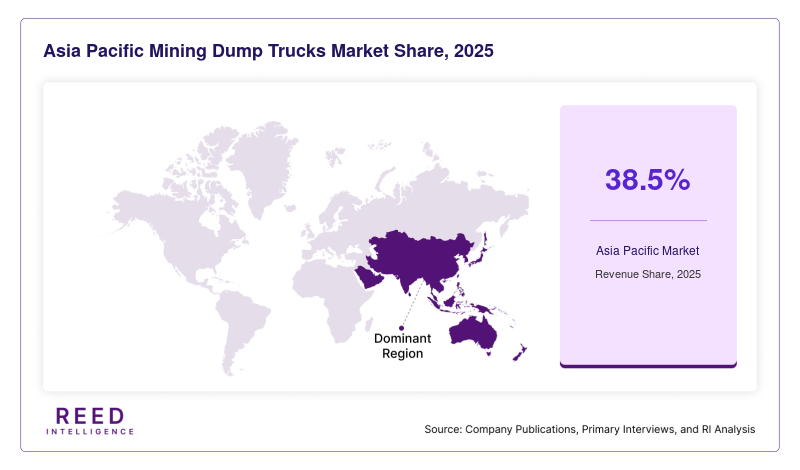
Asia Pacific is the dominant regional market for mining dump trucks, accounting for approximately 38.5% of global market revenue in 2025 according to 's published analysis. The region benefits from substantial mining activity in Australia, China, India, Indonesia, and other resource-producing markets. Demand for coal, iron ore, copper, and other minerals supports investment in haulage fleets and mining equipment.
Australia's large iron ore operations, China's mining and equipment industries, and India's coal and mineral extraction activities contribute to regional demand. Fleet modernization, higher-capacity trucks, autonomous haulage, and alternative-power technologies are influencing purchasing decisions. Asia Pacific's scale of mining activity and the diversity of its mineral resources create opportunities for manufacturers across multiple payload classes.
Latin America Mining Dump Trucks Market
Latin America offers opportunities for mining dump truck manufacturers through established metal-mining industries and new mineral projects. Chile and Peru are important copper-producing markets, while Brazil has substantial iron ore operations. These activities require haulage fleets capable of transporting large volumes of ore and waste material under demanding site conditions.
Regional demand is influenced by mine investment cycles, commodity prices, equipment financing, import requirements, and service availability. Large open-pit operations can support demand for high-payload trucks, while remote locations increase the importance of reliable parts supply and technical maintenance. Automation and improved fleet monitoring may also help operators optimize material movement.
Middle East & Africa Mining Dump Trucks Market
The Middle East & Africa region provides opportunities associated with mineral extraction, mining project development, and the modernization of existing equipment fleets. South Africa and selected African markets have established mining industries involving precious metals, industrial minerals, and other resources. New or expanding projects may require haulage equipment tailored to local terrain, operating conditions, and infrastructure.
Market development depends on investment availability, equipment affordability, fuel and energy infrastructure, parts distribution, and technical service capacity. Large mines may benefit from advanced fleet-management systems and higher-capacity trucks, while remote operations may prioritize durability and ease of maintenance.
Mining Dump Trucks Market Competitive Landscape
The Mining Dump Trucks Market includes global heavy-equipment manufacturers competing on payload capacity, vehicle durability, fuel efficiency, autonomous haulage capabilities, and after-sales service. Manufacturers are investing in fleet automation, alternative-power technologies, vehicle monitoring, and equipment designs that improve material movement under demanding mining conditions. Competition also depends on dealer networks, spare-parts availability, financing options, and the ability to support customers throughout the equipment lifecycle.
Caterpillar Inc. is a major manufacturer of mining equipment and heavy-duty haul trucks. Its mining portfolio includes rigid haul trucks and integrated technologies for fleet monitoring, equipment management, and autonomous operation. The company competes through its broad product range, established dealer and service network, and MineStar technology platform. Its ongoing work with mining operators on autonomous and battery-electric haulage demonstrates its focus on improving productivity and developing lower-emission equipment solutions.
Key Market Players
- Caterpillar Inc.
- Komatsu Ltd.
- Liebherr Group
- Volvo Construction Equipment
- Terex Corporation
- Hitachi Construction Machinery Co., Ltd.
- BelAZ
- SANY Group
- XCMG Group
- Epiroc AB
- Sandvik AB
- Bell Equipment
Mining Dump Trucks Market Recent Developments
June 2026 – BHP, Rio Tinto, and Caterpillar begin battery-electric haul truck trials BHP, Rio Tinto, and Caterpillar launched a trial involving two Cat 793 XE Early Learner battery-electric haul trucks at BHP's Jimblebar iron ore mine in Western Australia's Pilbara region. The trial is intended to evaluate battery-electric haulage under demanding mining conditions and support the industry's efforts to reduce greenhouse gas emissions from large-scale mining operations.
April 2026 – Komatsu commissions its 1,000th ultra-class autonomous haul truck Komatsu announced that it had commissioned its 1,000th ultra-class autonomous haul truck equipped with its FrontRunner Autonomous Haulage System. The milestone involved a Komatsu 930E-5AT electric-drive truck deployed at Barrick's Nevada Gold Mines operation. The announcement highlights the growing deployment of autonomous haulage systems in large-scale mining operations.
Mining Dump Trucks Market Segments
By Product Type
- Rigid Dump Trucks
- Articulated Dump Trucks
- Others, including specialized mining haulage configurations where included in the market definition
By Payload Capacity
- Small Payload Capacity
- Medium Payload Capacity
- Large Payload Capacity
By Engine Type
- Diesel
- Electric
- Hybrid
By Application
- Open-Pit Mining
- Underground Mining
- Others, including quarrying and other mining-related material transportation where included in the market definition
By Region
- North America
- Europe
- APAC
- Middle East and Africa
- LATAM