Mining Lubricants Market Size, Share, Demand Report By Type (Mineral Oil-Based Lubricants, Synthetic Lubricants, Semi-Synthetic Lubricants), By Application (Mining Equipment Lubrication, Conveyor Systems, Hydraulic Systems, Engine & Gear Lubrication), By End-Use (Surface Mining, Underground Mining, Mineral Processing Plants, Exploration Activities), By Regional Outlook and Segment Forecasts, 2026–2034
USD 3950
Market Overview
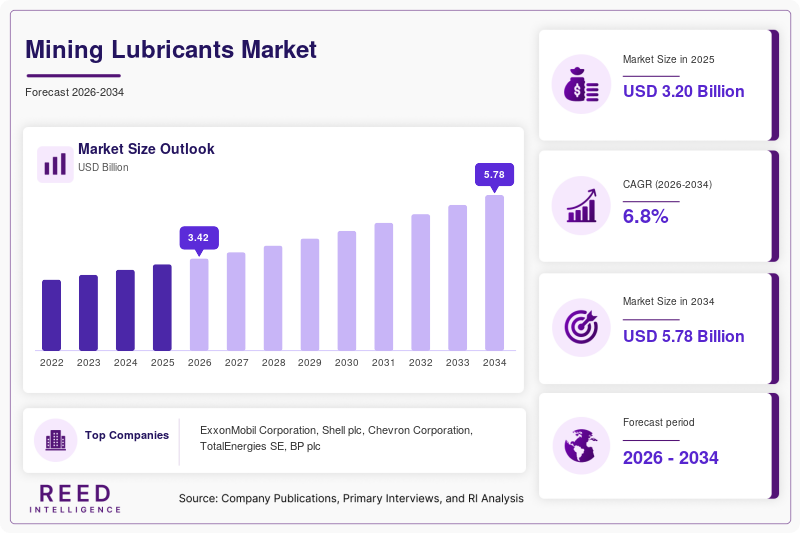
The Mining Lubricants Market size is valued at USD 3.2 billion in 2026 and is projected to reach USD 5.4 billion by 2034, expanding at a CAGR of 6.8% during 2026–2034. The market growth is primarily influenced by rising global mining activities driven by increasing demand for minerals, metals, and energy resources across industrial sectors. As mining operations become more mechanized and shift toward deeper and more complex extraction environments, the need for high-performance lubrication solutions has increased significantly. Mining lubricants play a crucial role in enhancing equipment efficiency, reducing friction, minimizing downtime, and extending machinery lifespan, which directly contributes to operational cost optimization in large-scale mining projects.
One major global factor supporting market expansion is the ongoing modernization of mining equipment fleets, particularly in emerging economies. Mining companies are increasingly investing in automated haul trucks, drilling machinery, and conveyor systems, all of which require specialized lubricants capable of withstanding extreme pressure, temperature fluctuations, and heavy load conditions. Additionally, sustainability regulations are encouraging the adoption of biodegradable and low-toxicity lubricants, further shaping product innovation and formulation strategies within the industry. Growing focus on predictive maintenance practices is also strengthening lubricant demand across both surface and underground mining operations.
Key Highlights
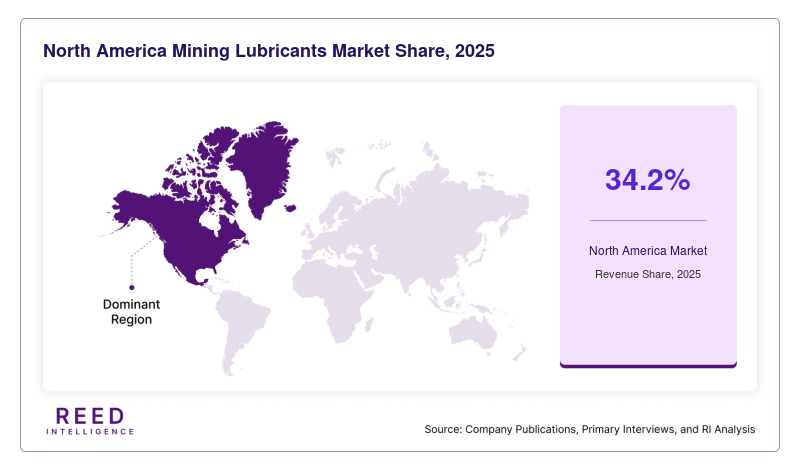
- North America dominated the market with a 34.2% share in 2025.
- Asia Pacific is expected to grow at the fastest CAGR of 11.2% during 2026–2034.
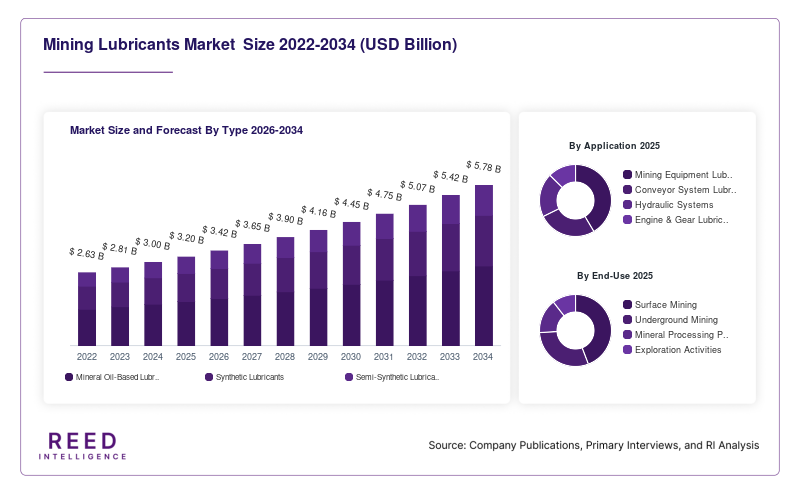
- By type, mineral oil-based lubricants accounted for the largest share of 42.8%, while synthetic lubricants are projected to grow at a CAGR of 10.6%.
- By application, mining equipment and heavy machinery lubrication led with a 39.4% share, whereas conveyor system lubrication is expected to expand at a CAGR of 9.8%.
- The United States remained the dominant country, with market values of USD 510 million in 2024 and USD 560 million in 2025.
Market Trends
Shift Toward High-Performance Synthetic Lubricants
The Mining Lubricants Market is witnessing a steady transition from conventional mineral-based products to synthetic and semi-synthetic formulations. This shift is driven by the need for enhanced thermal stability, longer service intervals, and improved performance under extreme mining conditions such as high load pressure and abrasive environments. Synthetic lubricants offer superior oxidation resistance and reduced viscosity breakdown, which helps mining operators achieve lower maintenance frequency and improved equipment uptime. Additionally, these lubricants support energy efficiency by minimizing friction losses in heavy machinery. The growing adoption of automated mining systems and electric mining equipment further strengthens the demand for advanced lubricant solutions designed for precision performance and longer lifecycle stability.
Integration of Predictive Maintenance and Smart Lubrication Systems
Another notable trend in the Mining Lubricants Market is the increasing integration of predictive maintenance technologies and smart lubrication monitoring systems. Mining companies are deploying IoT-enabled sensors and condition monitoring platforms to track lubricant performance in real time, enabling timely replenishment and preventing equipment failure. This trend is closely aligned with digital transformation initiatives in the mining sector, where operational efficiency and cost reduction are key priorities. Smart lubrication systems help detect contamination, viscosity changes, and wear patterns, allowing maintenance teams to make data-driven decisions. As mining operations become more complex and remote, automated lubrication systems are expected to play a critical role in improving reliability and reducing unplanned downtime.
Market Drivers
Expansion of Global Mining Operations and Resource Extraction
The Mining Lubricants Market is significantly driven by the continuous expansion of mining activities across coal, iron ore, copper, and precious metal segments. Increasing industrialization and infrastructure development are fueling demand for raw materials, prompting mining companies to scale up extraction capacities. As mining operations expand into deeper and harsher geological environments, equipment faces higher mechanical stress, leading to increased lubricant consumption. Heavy-duty machinery such as excavators, crushers, and drilling rigs require specialized lubrication to ensure smooth operation under extreme pressure and temperature conditions. This rising operational intensity directly contributes to higher demand for advanced lubrication solutions designed for durability and efficiency.
Rising Focus on Equipment Efficiency and Cost Optimization
Another key driver supporting the Mining Lubricants Market is the growing emphasis on operational efficiency and cost reduction in mining activities. Equipment downtime can lead to significant financial losses, prompting companies to adopt high-performance lubricants that enhance machine reliability and reduce maintenance cycles. Mining operators are increasingly focusing on extending equipment lifespan through proper lubrication management, which minimizes wear and tear on critical components. Additionally, lubricant manufacturers are developing formulations that reduce fuel consumption and improve energy efficiency, further supporting cost optimization strategies. The adoption of condition-based maintenance practices is also strengthening lubricant demand, as companies aim to reduce unexpected breakdowns and improve productivity.
Market Restraint
Volatility in Raw Material Prices and Supply Chain Disruptions
The Mining Lubricants Market faces challenges due to fluctuations in raw material prices, particularly base oils and additive components derived from petroleum products. Price instability directly impacts production costs for lubricant manufacturers, leading to margin pressures and inconsistent pricing structures in the market. Additionally, global supply chain disruptions caused by geopolitical tensions, transportation constraints, and refining capacity limitations further complicate procurement processes. These challenges affect the timely availability of lubricant products, especially in remote mining locations where logistics infrastructure is limited. Smaller manufacturers often struggle to maintain competitive pricing, which can hinder market penetration and slow adoption in cost-sensitive regions.
Market Opportunities
Development of Environmentally Sustainable Lubricants
A significant opportunity in the Mining Lubricants Market lies in the growing demand for environmentally sustainable and biodegradable lubricant solutions. Mining operations are increasingly subject to environmental regulations that encourage the reduction of soil and water contamination risks. This has led to rising interest in eco-friendly lubricant formulations derived from renewable sources. Manufacturers are investing in research and development to create products that offer high performance while minimizing ecological impact. The adoption of green mining practices is expected to accelerate the demand for sustainable lubrication solutions, particularly in regions with strict environmental compliance standards such as Europe and North America.
Expansion in Emerging Mining Economies
Another key opportunity is the rapid expansion of mining activities in emerging economies across Asia Pacific, Latin America, and Africa. Countries in these regions are witnessing increased investments in mineral exploration and extraction due to rising industrial demand and infrastructure development. This expansion creates substantial demand for mining lubricants used in heavy machinery and processing equipment. Local governments are also encouraging foreign investment in mining projects, which is expected to enhance equipment modernization and lubricant consumption. As mining companies establish new operations in these regions, lubricant suppliers have significant opportunities to expand distribution networks and strengthen regional market presence.
Segmental Analysis
By Type
Mineral oil-based lubricants accounted for the largest share of 42.8% in 2025, primarily due to their cost efficiency, wide availability, and established usage across traditional mining machinery. These lubricants are widely used in surface mining operations where equipment operates under moderate stress conditions and maintenance cycles are predictable. Their affordability makes them highly suitable for large-scale mining companies operating in cost-sensitive regions. Despite the growing shift toward advanced formulations, mineral oil-based products continue to dominate due to their proven reliability in standard mining environments.
Synthetic lubricants are expected to witness the fastest growth with a CAGR of 10.6%, driven by their superior performance characteristics, including high thermal stability, oxidation resistance, and extended lubrication cycles. These properties make them ideal for modern mining operations that rely on automated and high-load machinery. Synthetic lubricants are increasingly preferred in deep underground mining and remote operations where equipment downtime is costly. Their ability to perform under extreme pressure and temperature variations significantly enhances operational efficiency and reduces long-term maintenance expenses.
By Application
Mining equipment lubrication held the largest share of 39.4% in 2025, driven by widespread use in excavators, loaders, drilling rigs, crushers, and haul trucks. These machines operate under extreme mechanical stress, requiring continuous lubrication to ensure smooth functioning and reduce wear and tear. Efficient lubrication is essential for maintaining operational reliability, especially in high-intensity mining environments where equipment failure can result in significant production losses. The dominance of this segment is strongly linked to the large-scale deployment of heavy machinery across global mining sites.
Conveyor system lubrication is projected to grow at a CAGR of 9.8%, supported by increasing automation in material handling and transportation systems within mining operations. Conveyor systems are essential for efficiently moving extracted minerals across processing facilities, reducing manual handling requirements. The continuous operation of these systems necessitates advanced lubrication solutions that minimize friction, prevent mechanical failure, and extend equipment lifespan. Growing investments in automated mining infrastructure are further accelerating demand for specialized conveyor lubrication systems.
By End-Use
Surface mining accounted for the largest share of 45.1% in 2025, driven by extensive use of large-scale machinery in open-pit mining operations. This segment involves continuous extraction processes that require heavy-duty equipment such as draglines, shovels, and trucks, all of which depend heavily on lubrication for optimal performance. Surface mining operations generate significant demand for lubricants due to high equipment utilization rates and exposure to abrasive environmental conditions such as dust and temperature fluctuations.
Underground mining is expected to register the fastest growth with a CAGR of 10.2%, supported by increasing demand for deep mineral extraction. Underground environments present complex operational challenges, including limited accessibility, high pressure, and humidity, which require advanced lubrication solutions with extended durability. Equipment used in underground mining must operate reliably under constrained conditions, increasing demand for high-performance synthetic lubricants. Rising exploration activities for rare minerals and metals further support segment growth.
Regional Analysis
North America
North America accounted for a significant 34.2% share of the Mining Lubricants Market in 2025, and the region is projected to grow at a stable CAGR during 2026–2034, supported by technologically advanced mining operations and strong adoption of automated equipment. The presence of large-scale mining companies and well-established supply chains has strengthened lubricant consumption across surface and underground mining activities. Increasing deployment of high-performance machinery has further reinforced the demand for specialized lubrication solutions.
The United States dominates the regional landscape due to its extensive mineral extraction activities and early adoption of predictive maintenance technologies. A key growth factor in this region is the increasing integration of digital monitoring systems within mining fleets, which enables optimized lubricant usage and reduced operational downtime. Canada also contributes significantly, supported by its strong focus on metal and oil sands mining, requiring durable lubrication systems for harsh climatic conditions.
Europe
Europe holds a steady share of the global Mining Lubricants Market, driven by stringent environmental regulations and a strong emphasis on sustainable industrial practices. The region’s mining sector is highly regulated, which encourages the adoption of eco-friendly and low-emission lubrication products. Demand is also supported by modernization initiatives in mining operations, particularly in Eastern Europe, where mineral extraction activities remain important.
Germany leads the regional market due to its advanced engineering capabilities and focus on industrial efficiency. A major growth factor is the increasing adoption of biodegradable lubricants in compliance with environmental directives across the European Union. Additionally, Russia contributes substantially due to its vast mineral reserves and large-scale mining activities in remote areas, where high-performance lubricants are essential for equipment reliability.
Asia Pacific
Asia Pacific is expected to register the fastest CAGR of 11.2% during 2026–2034, driven by rapid industrialization, infrastructure development, and large-scale mining expansion. The region’s growing demand for coal, iron ore, copper, and rare earth metals has significantly increased mining operations. This expansion has resulted in higher consumption of lubricants for heavy-duty mining equipment operating under extreme conditions.
China dominates the regional market due to its extensive mining industry and continuous investment in automation and mechanization of mining processes. A key growth factor is the rising deployment of advanced mining machinery and increasing focus on operational efficiency. India and Australia also contribute to growth, supported by rising mineral exploration activities and increasing adoption of synthetic lubricants for improving equipment lifespan and reducing maintenance costs.
Middle East & Africa
The Middle East & Africa region is witnessing steady growth in the Mining Lubricants Market due to expanding mineral exploration projects and increasing investments in mining infrastructure. The region’s mining activities are concentrated in precious metals, diamonds, and industrial minerals, which require reliable lubrication systems for heavy machinery operating in challenging environments. Growing foreign investments are further enhancing mining capacity across several African nations.
South Africa remains the dominant country in the region due to its well-established mining sector and extensive extraction of gold, platinum, and coal. A key growth factor is the increasing modernization of mining equipment to improve productivity in deep mining operations. Additionally, countries in the Middle East are gradually expanding mining activities, particularly in phosphate and industrial mineral extraction, supporting lubricant demand growth.
Latin America
Latin America holds a notable share of the Mining Lubricants Market, driven by strong mining activities in copper, lithium, gold, and silver segments. The region benefits from abundant mineral reserves and increasing global demand for battery materials, particularly lithium. Mining companies are investing in advanced equipment, which is driving lubricant consumption across both surface and underground operations.
Chile is the leading country in the region due to its dominance in copper production and large-scale mining infrastructure. A key growth factor is the increasing use of high-performance lubricants to support equipment operating in arid and high-temperature environments. Peru and Brazil also contribute significantly, supported by rising exploration activities and growing foreign investments in mining projects.
Competitive Landscape
The Mining Lubricants Market is moderately consolidated, with key players focusing on product innovation, strategic partnerships, and expansion into emerging mining regions. Leading companies are investing in advanced formulation technologies to develop lubricants that enhance equipment efficiency and comply with environmental regulations. One of the prominent market leaders continues to strengthen its position through continuous R&D investment and expansion of distribution networks across Asia Pacific and Latin America. Recent developments include the introduction of next-generation synthetic lubricant lines designed for high-load mining equipment, improving thermal stability and reducing maintenance frequency.
Key Players
- ExxonMobil Corporation
- Shell plc
- Chevron Corporation
- TotalEnergies SE
- BP plc
- Fuchs Petrolub SE
- PetroChina Company Limited
- Idemitsu Kosan Co., Ltd.
- Phillips 66 Company
- Valvoline Inc.
- Indian Oil Corporation Limited
- Repsol S.A.
- Lukoil Oil Company
- Sinopec Lubricant Company
- Amsoil Inc.
Recent Developments
- In 2025, several lubricant manufacturers expanded their production capacities to meet rising demand from large-scale mining projects in Asia Pacific and Latin America, focusing on synthetic lubricant innovations for heavy-duty applications.
- In 2024, leading industry players introduced environmentally friendly lubricant formulations designed to reduce soil contamination risks in mining zones while maintaining high performance under extreme operating conditions.
- In 2026, strategic partnerships between lubricant suppliers and mining equipment manufacturers increased, enabling the integration of condition monitoring systems and smart lubrication technologies into next-generation mining machinery.
Mining Lubricants Market Segments
By Type
- Mineral Oil-Based Lubricants
- Synthetic Lubricants
- Semi-Synthetic Lubricants
By Application
- Mining Equipment Lubrication
- Conveyor System Lubrication
- Hydraulic Systems
- Engine & Gear Lubrication
By End-Use
- Surface Mining
- Underground Mining
- Mineral Processing Plants
- Exploration Activities
By Region
- North America
- Europe
- APAC
- Middle East and Africa
- LATAM