Mining Rubber Market Size, Share & Trends Analysis Report By Product Type (Conveyor Belts, Hose Assemblies, Seal Rings, and Other Rubber Products), By End-Use Industry (Coal Mining, Metal Mining, Mineral Processing, and Others) and By Region (North America, Europe, Asia Pacific, Latin America, Middle East & Africa) Forecasts, 2026–2034
USD 3950
Mining Rubber Market Size
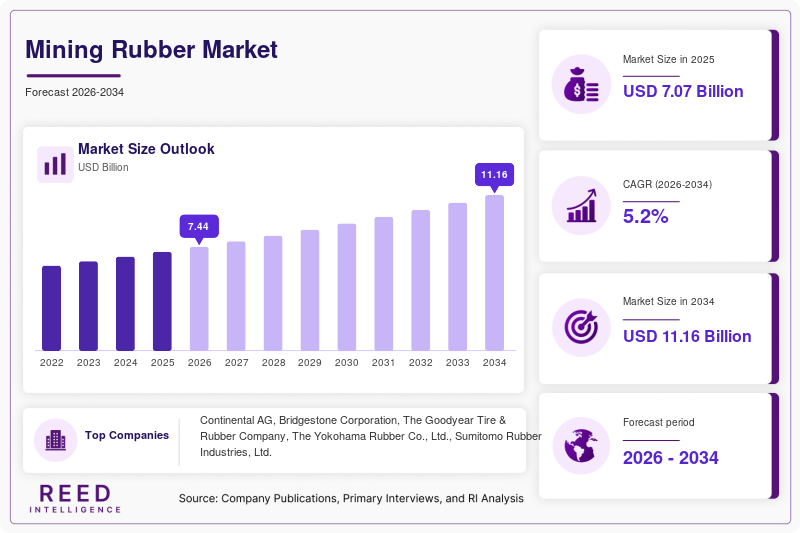
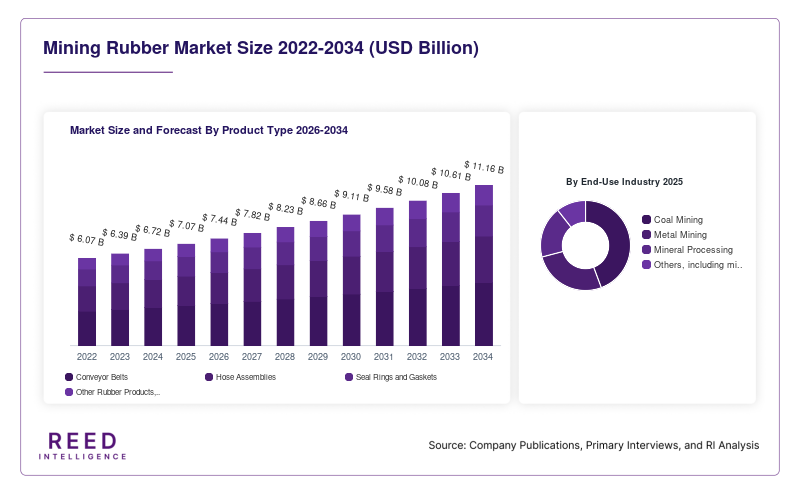
The global mining rubber rarket was valued at USD 7.07 billion in 2025 and is projected to grow from USD 7.44 billion in 2026 to USD 11.16 billion by 2034, registering a compound annual growth rate (CAGR) of 5.2% during the forecast period (2026–2034).
The Mining Rubber Market comprises rubber and elastomer products used in mining, mineral extraction, material handling, and mineral processing operations. These products include conveyor belts, hydraulic hose assemblies, sealing components, protective linings, and other specialized rubber products designed to withstand abrasion, impact, pressure, heat, chemicals, and demanding operating conditions.
Market growth is supported by expanding mineral production, increasing mechanization, equipment replacement requirements, and greater emphasis on operational safety and productivity. Mining companies depend on durable rubber components to maintain continuous material movement, reduce equipment downtime, and improve the reliability of machinery operating in harsh environments.
Mining Rubber Market Drivers
Increasing Mining and Mineral Processing Activities
Growing demand for iron ore, copper, coal, gold, lithium, nickel, and other minerals is encouraging mining companies to expand production and improve processing capacity. These activities increase the need for conveyor belts, hydraulic hoses, rubber linings, and sealing components. New mining projects and expansions also create demand for original equipment installations and replacement products throughout the operational lifecycle.
Growing Focus on Equipment Reliability and Maintenance
Mining operations experience substantial wear caused by abrasive materials, heavy loads, vibration, and exposure to chemicals. Rubber components must be replaced or maintained to prevent unexpected failures and production interruptions. Increasing adoption of preventive maintenance programs supports recurring demand for durable mining rubber products that improve equipment availability and reduce total operating costs.
Advancements in Rubber Materials and Product Engineering
Improvements in synthetic rubber formulations, reinforcement materials, abrasion resistance, and heat tolerance are supporting the development of products suited to demanding mining environments. Advanced materials can improve service life and reduce replacement frequency. Manufacturers are also developing specialized products for high-pressure hydraulic systems, long-distance conveying, and mineral processing applications.
Mining Rubber Market Restraints
Volatility in Raw Material Prices
Mining rubber manufacturers depend on natural rubber, synthetic rubber, carbon black, reinforcing fabrics, steel cords, and other industrial inputs. Fluctuations in raw material prices, energy costs, and transportation expenses can increase production costs and pressure profit margins. Smaller manufacturers may face difficulties passing these increases on to mining customers under long-term supply agreements.
Harsh Operating Conditions and Product Failure Risks
Mining equipment operates under extreme mechanical and environmental conditions. Rubber products can deteriorate because of cuts, abrasion, excessive heat, chemical exposure, and repeated pressure cycles. Premature failure may result in costly downtime, safety concerns, and emergency replacement requirements, increasing the importance of rigorous testing and product quality assurance.
Capital Expenditure and Procurement Constraints
Mining rubber demand is influenced by mining investment, commodity prices, and the timing of infrastructure projects. When mining companies postpone expansions or reduce capital expenditure, demand for new equipment and associated rubber components may weaken. Procurement teams may also prioritize lower-cost alternatives, creating pricing pressure for premium products.
Mining Rubber Market Opportunities
Expansion of Mining Operations in Emerging Economies
Mining investment across India, Indonesia, Australia, Africa, and Latin America creates opportunities for suppliers of conveyor belts, hose assemblies, seals, and protective linings. New mines and mineral processing facilities require extensive material-handling infrastructure, while established operations generate recurring replacement demand. Local manufacturing, distribution, and maintenance partnerships can help suppliers strengthen their regional presence.
Development of Sustainable and Recyclable Rubber Products
Mining companies are placing greater emphasis on waste reduction, resource efficiency, and responsible material management. Opportunities exist in extending product life, recycling used mining tires and conveyor belts, recovering rubber materials, and developing products that support circular-economy initiatives. Suppliers offering traceable recycling services and lower-impact material solutions may gain an advantage in procurement decisions.
Smart Monitoring and Predictive Maintenance
The integration of sensors, digital inspection systems, and data analytics can help mining operators identify wear, damage, and unsafe operating conditions earlier. Suppliers can develop value-added offerings that combine rubber products with monitoring, maintenance planning, repair, and replacement services. These solutions can improve uptime while creating recurring service opportunities beyond traditional product sales.
Mining Rubber Market Segmental Analysis
By Product Type
Conveyor belts represent the dominant product segment in the Mining Rubber Market. They are essential for transporting extracted minerals, ore, and other materials between mining, crushing, processing, and shipping operations. Their widespread use in continuous material-handling systems supports consistent demand for both new installations and replacement products. Durable rubber compounds, reinforced structures, and improved splice designs are important areas of product development.
Other specialized rubber products, including lining materials and protective components, are gaining importance as mining operators seek to reduce equipment wear and extend machinery service life. Based on the cited third-party market estimate, lining materials and other specialized rubber products have the fastest projected growth among product categories, at approximately 5.8% CAGR through 2034. Hose assemblies are also expected to expand steadily as hydraulic equipment becomes more complex and maintenance requirements increase.
By End-Use Industry
Metal mining is an important growth segment because of demand for copper, gold, nickel, and other metals used in industrial production, infrastructure, electronics, and energy-transition technologies. Mining operations require rubber products for material handling, hydraulic systems, slurry transfer, equipment sealing, and protective applications.
Based on the cited third-party market estimate, metal mining is the fastest-growing end-use segment, with projected growth of approximately 6.2% CAGR through 2034. Mineral processing is another significant growth area as operators expand onsite processing capabilities and improve material recovery. Coal mining continues to generate demand for fire-resistant conveyor belts and specialized components, although its longer-term growth is affected by changing energy policies and regional coal-production trends.
Mining Rubber Market Regional Analysis
North America Mining Rubber Market
North America is a major market for mining rubber products, supported by mining operations across the United States and Canada. Copper, gold, coal, nickel, and other mineral extraction activities require reliable conveyor systems, hydraulic hoses, seals, and protective linings. Demand is also supported by established maintenance practices and the need to meet stringent operational and safety requirements.
Mining companies in the region increasingly emphasize equipment availability, predictive maintenance, and lifecycle cost management. These priorities create opportunities for suppliers of premium rubber products and integrated maintenance services. Replacement demand remains important because mining machinery and material-handling systems operate under demanding conditions.
Europe Mining Rubber Market
Europe represents an established market for mining rubber, with demand associated with mining operations, mineral processing facilities, industrial equipment, and specialized mining machinery. Requirements for fire-resistant conveyor belts, durable sealing systems, and high-performance elastomers support the use of engineered rubber products in applications where equipment reliability and safety are essential.
The region's focus on industrial efficiency, environmental compliance, and resource management creates opportunities for products with longer service lives and improved recyclability. Suppliers that can demonstrate product performance, regulatory compliance, and effective maintenance support are positioned to serve established mining customers and specialized equipment manufacturers.
Asia Pacific Mining Rubber Market
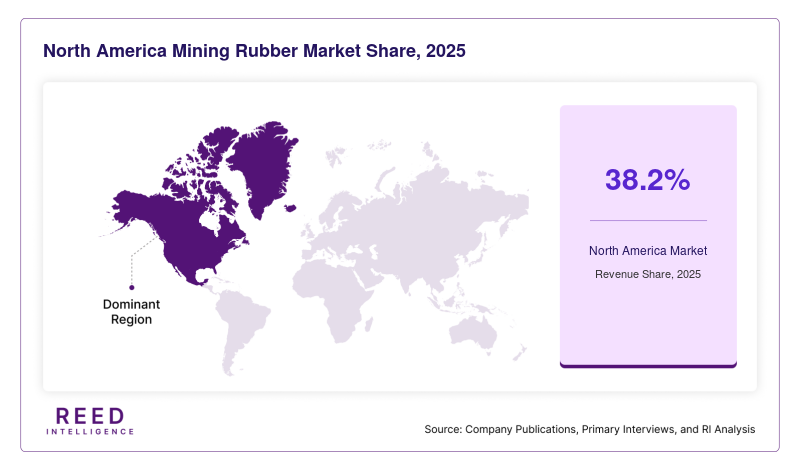
Asia Pacific is the dominant regional market, accounting for an estimated 38.2% of global Mining Rubber Market revenue in 2025, according to Dataintelo's published market analysis. The region's position is supported by extensive mining and mineral processing activities in China, Australia, India, and Indonesia. Demand for coal, iron ore, copper, nickel, and other minerals creates requirements for conveyor belts, hydraulic hose assemblies, seals, and wear-resistant rubber components.
Industrial manufacturing capabilities and a broad network of mining equipment suppliers further support regional demand. Mining investment, infrastructure development, and the expansion of mineral processing capacity contribute to product consumption. Suppliers are also investing in manufacturing capacity and technical support to serve regional mining customers and strengthen supply-chain resilience.
Latin America Mining Rubber Market
Latin America is an important market for mining rubber products because of large-scale copper, lithium, gold, and other mineral extraction activities. Chile and Peru are significant copper-producing markets, while lithium extraction in Argentina and Chile supports demand for equipment and material-handling infrastructure. Mining operations require abrasion-resistant conveyor belts, durable hose assemblies, seals, and specialized rubber linings.
The region offers opportunities for suppliers serving new mining projects and established operations seeking to improve productivity. Demand can be influenced by commodity-price movements, infrastructure investment, operating conditions, and the pace of new project development. Local service capabilities and dependable replacement-product availability are important factors for suppliers competing in the region.
Middle East & Africa Mining Rubber Market
The Middle East & Africa region benefits from mineral extraction activities across South Africa, Zambia, Guinea, Tanzania, and other mining markets. Gold, platinum, copper, bauxite, and other minerals support demand for industrial rubber products used in material transport, hydraulic equipment, and machinery protection. Mining infrastructure development and the expansion of selected mineral projects provide opportunities for suppliers.
Demand varies considerably across countries according to mining investment, infrastructure availability, political conditions, and local manufacturing capacity. Suppliers that provide reliable distribution, technical assistance, and maintenance services can support mining operators in remote locations. Recycling and responsible management of used mining tires and conveyor belts also offer opportunities as operators increase their focus on environmental performance.
Mining Rubber Market Competitive Landscape
The Mining Rubber Market is characterized by global industrial rubber manufacturers, conveyor-belt suppliers, mining tire manufacturers, and specialized component producers. Competition is based on product durability, abrasion and cut resistance, performance under demanding operating conditions, material innovation, product availability, and after-sales support.
Manufacturers are increasingly emphasizing lifecycle cost reduction, customized rubber compounds, recycling programs, and digital maintenance solutions. Long-term relationships with mining companies and equipment manufacturers can strengthen supplier positions, while regional production and distribution networks help reduce delivery delays and improve customer service.
Continental AG is an established supplier of industrial rubber products and conveying solutions. Its ContiTech business serves material-handling applications with conveyor belt technologies designed for demanding operating environments. Product development focuses on durability, operational efficiency, splice integrity, and reduced maintenance requirements. The company's mining-related portfolio supports applications where reliable material transportation and minimized downtime are essential.
Key Market Players
- Continental AG
- Bridgestone Corporation
- The Goodyear Tire & Rubber Company
- The Yokohama Rubber Co., Ltd.
- Sumitomo Rubber Industries, Ltd.
- Michelin
- Gates Corporation
- Trelleborg AB
- Fenner Dunlop
- BKT (Balkrishna Industries Limited)
- Titan International, Inc.
Mining Rubber Market Recent Developments
- May 2026 -Continental launches VersaFlex single-ply conveyor belt Continental's ContiTech announced VersaFlex, a single-ply conveyor belt designed for above-ground mining applications. The product emphasizes strength, rip and tear resistance, splice integrity, and a lightweight construction intended to support operational uptime and reduce maintenance requirements.
- May 2026 -Yokohama Rubber announces new mining and construction tire plants Yokohama Rubber announced plans to build off-the-road tire manufacturing plants in Odisha, India, and Mexico. The planned investments are intended to expand production capacity for mining and construction machinery tires, including giant OTR tires, following the company's acquisition of Goodyear's OTR tire business.
Mining Rubber Market Segments
By Product Type
- Conveyor Belts
- Hose Assemblies
- Seal Rings and Gaskets
- Other Rubber Products, including chute liners, hopper liners, impact pads, vibration-isolation components, and specialized molded rubber parts
By End-Use Industry
- Coal Mining
- Metal Mining
- Mineral Processing
- Others, including mining exploration, mining equipment manufacturing, and mining services
By Region
- North America
- Europe
- APAC
- Middle East and Africa
- LATAM