Mining Tester Market Size, Share & Demand Report By Type (Portable Testers, Fixed Testing Systems, AI-Enabled Testing Systems), By Application (Mineral Analysis, Environmental Monitoring, Structural Testing), By End-Use (Mining Companies, Research Institutions, Government Agencies) By Region & Segment Forecasts, 2026–2034
USD 3950
Market Overview
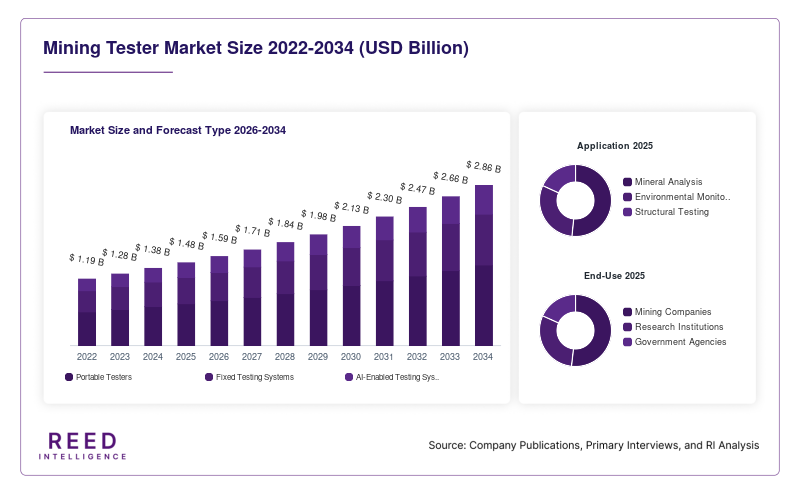
The global Mining Tester Market was valued at approximately USD 1.48 billion in 2026 and is projected to reach USD 2.67 billion by 2034, expanding at a CAGR of 7.6% during the forecast period (2026–2034). Mining testers are critical instruments used to evaluate mineral composition, structural integrity, environmental impact, and operational safety across mining activities. These tools play an essential role in ensuring regulatory compliance, optimizing extraction processes, and minimizing environmental risks.
One of the key global factors supporting market growth is the rising demand for critical minerals such as lithium, cobalt, and rare earth elements, driven by the expansion of electric vehicles and renewable energy infrastructure. This surge has intensified exploration activities, increasing the need for advanced testing solutions that can deliver accurate and rapid analysis in harsh mining environments
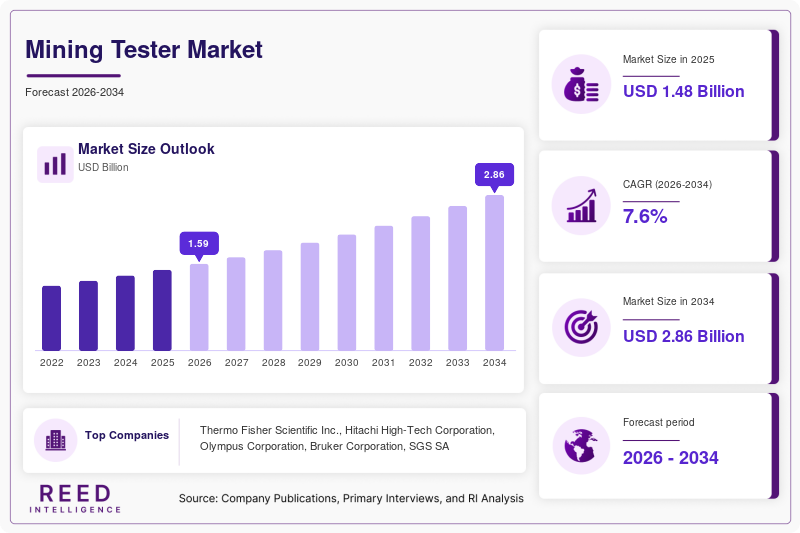
Key Highlights
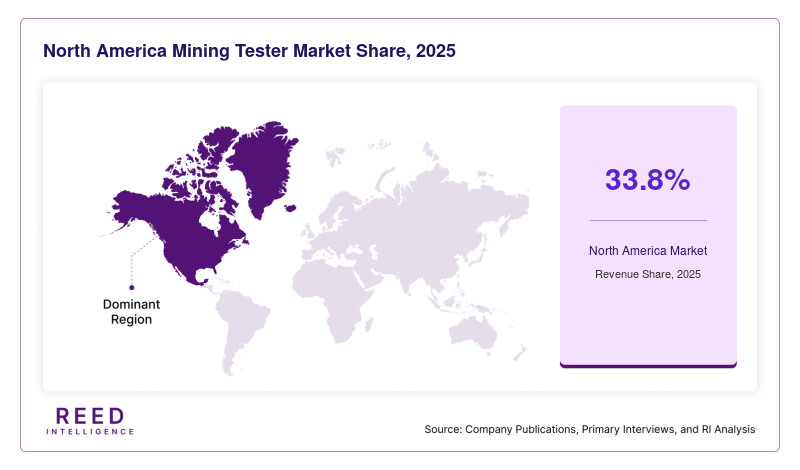
- North America dominated the market with a 33.8% share in 2025.
- Asia Pacific is expected to grow at the fastest CAGR of 9.1% during 2026–2034.
- By equipment type, portable testers accounted for the largest share of 36.9%.
- while AI-enabled testing systems are projected to grow at a CAGR of 10.5%.
- By application, mineral analysis led with a 42.3% share, whereas environmental monitoring is expected to expand at a CAGR of 9.8%.
- The United States remained the dominant country, with market values of USD 490 million in 2024 and USD 525 million in 2025.
Market Trends
Integration of AI and Automation in Mining Testing
The integration of artificial intelligence and automation technologies is transforming the mining tester market by improving accuracy, efficiency, and predictive capabilities. Advanced testing systems now incorporate machine learning algorithms that analyze geological data in real time, enabling faster decision-making and reducing reliance on manual interpretation. Automated testing equipment is increasingly deployed in remote and hazardous mining environments, minimizing human exposure to risks while ensuring consistent data collection. These systems also enable predictive maintenance by identifying equipment wear and potential failures before they occur. As mining companies focus on digital transformation, the adoption of AI-powered testers is expected to grow steadily, particularly in large-scale mining operations where efficiency gains translate into significant cost savings.
Rising Demand for Portable and Field-Deployable Testing Devices
Portable mining testers are gaining traction due to their flexibility and ability to deliver on-site analysis. These compact devices allow mining operators to conduct immediate testing without transporting samples to laboratories, significantly reducing turnaround time. Advances in handheld spectroscopy and sensor technologies have improved the accuracy and reliability of portable testers, making them suitable for a wide range of applications, including mineral identification and environmental assessment. This trend is particularly prominent in emerging markets, where infrastructure limitations make centralized testing less feasible. As exploration activities expand into remote regions, the demand for lightweight, durable, and easy-to-use testing equipment is expected to increase, supporting market growth.
Market Drivers
Increasing Exploration of Critical Minerals
The growing global demand for critical minerals such as lithium, nickel, and cobalt is driving extensive exploration activities. These minerals are essential for manufacturing batteries, renewable energy systems, and advanced electronics. As mining companies intensify their exploration efforts, the need for precise and efficient testing solutions has increased significantly. Mining testers enable accurate identification of mineral composition, helping companies optimize extraction strategies and reduce operational costs. Governments across various regions are also supporting mineral exploration through favorable policies and investments, further boosting demand for testing equipment. This driver is expected to remain strong throughout the forecast period as the transition toward clean energy continues to accelerate.
Stringent Environmental and Safety Regulations
Regulatory frameworks governing mining operations have become increasingly stringent, emphasizing environmental protection and worker safety. Mining testers play a crucial role in ensuring compliance with these regulations by monitoring parameters such as air quality, water contamination, and structural stability. Companies are required to conduct regular testing and reporting, driving the adoption of advanced testing solutions. Additionally, the focus on sustainable mining practices has led to increased investment in environmental monitoring equipment. This driver is particularly significant in developed regions, where regulatory compliance is strictly enforced, but it is also gaining importance in developing markets as environmental awareness rises.
Market Restraint
High Initial Investment and Maintenance Costs
One of the primary challenges facing the mining tester market is the high cost associated with acquiring and maintaining advanced testing equipment. Modern mining testers equipped with AI capabilities, high-precision sensors, and automation features require substantial capital investment, which can be a barrier for small and medium-sized mining companies. In addition to the initial purchase cost, ongoing expenses related to calibration, maintenance, and software updates further increase the total cost of ownership.
This restraint has a significant impact on market adoption, particularly in developing regions where budget constraints limit investment in advanced technologies. Smaller mining operations often rely on traditional testing methods or outsourced laboratory services, which may not provide the same level of efficiency and accuracy. For example, a mid-sized mining company operating in a remote region may delay upgrading its testing equipment due to financial constraints, potentially affecting operational efficiency and compliance.
Despite these challenges, vendors are working to address cost concerns by offering modular solutions and leasing options. However, the high upfront investment remains a key barrier that could slow market growth in certain segments.
Market Opportunities
Expansion of Mining Activities in Emerging Economies
Emerging economies in Asia, Africa, and Latin America are witnessing increased mining activities driven by industrialization and infrastructure development. These regions are rich in natural resources, attracting investments from global mining companies. As exploration and extraction activities expand, the demand for reliable testing equipment is expected to rise significantly. Mining testers are essential for ensuring efficient resource utilization and compliance with environmental standards. Governments in these regions are also investing in modernizing mining infrastructure, creating opportunities for equipment manufacturers to introduce advanced testing solutions. This trend presents a substantial growth opportunity for market players seeking to expand their global footprint.
Development of Smart and Connected Testing Solutions
The emergence of smart mining technologies is creating opportunities for the development of connected testing solutions. Mining testers integrated with IoT platforms can transmit real-time data to centralized systems, enabling remote monitoring and analysis. This capability enhances operational efficiency and supports data-driven decision-making. Additionally, connected systems facilitate predictive maintenance and reduce downtime, providing significant cost benefits to mining operators. As digitalization becomes a priority in the mining industry, the demand for smart testing solutions is expected to grow. Companies that invest in developing innovative, connected products are likely to gain a competitive advantage in the market.
Segmental Analysis
By Type
Portable testers dominated the market in 2024, accounting for approximately 36.9% of the total share. Their widespread adoption is attributed to their convenience, flexibility, and ability to perform on-site analysis. These devices are particularly useful in remote mining locations where access to laboratory facilities is limited. Portable testers enable rapid decision-making by providing immediate results, reducing delays associated with sample transportation. Additionally, advancements in sensor technology have improved the accuracy and reliability of these devices, making them suitable for a wide range of applications, including mineral identification and environmental monitoring.
AI-enabled testing systems are expected to be the fastest-growing subsegment, with a projected CAGR of 10.5% during the forecast period. These systems leverage machine learning algorithms to analyze complex data sets, enabling predictive insights and enhanced accuracy. The growing focus on automation and digital transformation in the mining industry is driving the adoption of AI-enabled solutions. Companies are increasingly investing in these advanced systems to improve operational efficiency, reduce costs, and enhance safety.
By Application
Mineral analysis emerged as the dominant application segment, holding a 42.3% share in 2024. This segment’s growth is driven by the increasing demand for accurate identification and quantification of minerals. Mining testers play a crucial role in determining the composition and quality of extracted materials, enabling companies to optimize extraction processes and maximize resource utilization. The rising demand for critical minerals further supports the growth of this segment, as accurate analysis is essential for meeting industry requirements.
Environmental monitoring is projected to be the fastest-growing application segment, with a CAGR of 9.8% during the forecast period. Increasing environmental regulations and the need for sustainable mining practices are driving demand for testing solutions that monitor air, water, and soil quality. Mining companies are investing in advanced testing equipment to ensure compliance and minimize environmental impact. This trend is expected to continue as environmental concerns gain prominence globally.
By End-Use
Mining companies accounted for the largest share of the market in 2024, driven by their direct involvement in exploration and extraction activities. These companies rely heavily on testing equipment to ensure operational efficiency, safety, and compliance with regulations. The increasing scale of mining operations and the need for accurate data further support the dominance of this segment. Large mining companies, in particular, are investing in advanced testing solutions to enhance productivity and reduce costs.
Research institutions are expected to be the fastest-growing end-use segment, with a CAGR of 8.7% during the forecast period. These institutions play a critical role in developing new testing technologies and improving existing methods. Increased funding for research and development, along with collaborations between academia and industry, is driving growth in this segment. The focus on innovation and technological advancement is expected to create new opportunities for market players.
Regional Analysis
North America
North America held a dominant share of 33.8% in 2025 and is expected to grow at a CAGR of 6.9% during the forecast period. The region’s well-established mining industry, coupled with strong regulatory frameworks, drives the demand for advanced testing solutions. High adoption of automation and digital technologies further supports market growth. Mining companies in the region are increasingly investing in innovative testing equipment to enhance operational efficiency and ensure compliance with environmental standards.
The United States leads the regional market due to its extensive mining activities and technological advancements. A key growth factor is the increasing focus on critical mineral exploration to reduce dependence on imports. Government initiatives supporting domestic mining have encouraged investments in testing equipment, strengthening the market outlook.
Europe
Europe accounted for a significant market share in 2025 and is projected to grow at a CAGR of 6.5% through 2034. The region’s emphasis on sustainable mining practices and environmental protection drives the adoption of advanced testing solutions. Strict regulations require mining companies to conduct regular testing, boosting demand for reliable equipment.
Germany is the dominant country in this region, supported by its strong industrial base and technological expertise. A unique growth factor is the region’s focus on recycling and circular economy practices, which require advanced testing to assess material quality and composition.
Asia Pacific
Asia Pacific is expected to witness the fastest growth, with a CAGR of 9.1% during the forecast period. Rapid industrialization and increasing demand for minerals drive mining activities in the region. Governments are investing in infrastructure development, further supporting market growth.
China dominates the regional market due to its large-scale mining operations and strong manufacturing capabilities. A key growth factor is the country’s focus on securing raw materials for its expanding industrial sector, leading to increased adoption of advanced testing solutions.
Middle East & Africa
The Middle East & Africa region is experiencing steady growth, driven by the expansion of mining activities and resource exploration. The market is expected to grow at a CAGR of 7.2% during the forecast period. Increasing investments in mining infrastructure and technological adoption support market development.
South Africa is the leading country in this region, benefiting from its rich mineral resources. A unique growth factor is the increasing involvement of international mining companies, which brings advanced technologies and boosts demand for testing equipment.
Latin America
Latin America holds a moderate share of the global market and is projected to grow at a CAGR of 7.0% through 2034. The region’s abundant natural resources and growing mining sector drive demand for testing solutions. Governments are focusing on improving mining regulations, further supporting market growth.
Brazil leads the regional market, supported by its extensive mining industry. A key growth factor is the increasing export of minerals, which requires strict quality testing to meet international standards, driving the adoption of advanced mining testers.
Competitive Landscape
The mining tester market is characterized by the presence of several established players focusing on innovation and technological advancements. Companies are investing in research and development to introduce advanced testing solutions that meet evolving industry requirements. Strategic partnerships, mergers, and acquisitions are common as players seek to expand their market presence and enhance their product portfolios.
A leading player in the market is Thermo Fisher Scientific, known for its comprehensive range of testing solutions and strong global presence. The company has recently introduced advanced portable analyzers with enhanced accuracy and connectivity features, strengthening its position in the market. Other key players are focusing on developing AI-enabled and IoT-integrated testing systems to gain a competitive edge. The market is expected to remain competitive, with innovation and product differentiation playing a crucial role in determining success.
Key Players List
- Thermo Fisher Scientific
- Hitachi High-Tech Corporation
- Olympus Corporation
- Bruker Corporation
- SGS SA
- Bureau Veritas
- Intertek Group plc
- ALS Limited
- Agilent Technologies
- Shimadzu Corporation
- PerkinElmer Inc.
- FLSmidth & Co. A/S
- Sandvik AB
- Caterpillar Inc.
- Hexagon AB
Recent Developments
- In 2025, Thermo Fisher Scientific launched a new handheld mining tester with enhanced AI capabilities for real-time mineral analysis.
- In 2024, Hitachi High-Tech Corporation introduced an advanced XRF analyzer designed for improved accuracy in field conditions.
- In 2025, SGS SA expanded its testing services portfolio by integrating digital monitoring solutions for mining operations.
Mining Tester Market Segments
Type
- Portable Testers
- Fixed Testing Systems
- AI-Enabled Testing Systems
Application
- Mineral Analysis
- Environmental Monitoring
- Structural Testing
End-Use
- Mining Companies
- Research Institutions
- Government Agencies
By Region
- North America
- Europe
- APAC
- Middle East and Africa
- LATAM