Minoxidil Market Size, Share & Trends Analysis Report By Product Type (Topical Solution, Foam, and Others), By Application (Hair Loss Treatment, Alopecia, and Others), By Gender (Male, Female) and By Region (North America, Europe, Asia Pacific, Latin America, Middle East & Africa) Forecasts, 2026–2034
USD 3950
Minoxidil Market Size
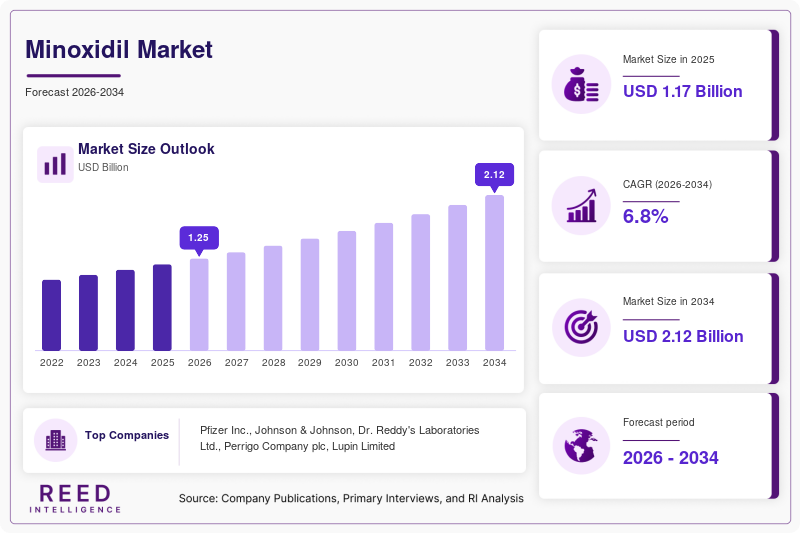
The global minoxidil market was valued at USD 1.17 billion in 2025 and is projected to grow from USD 1.25 billion in 2026 to USD 2.12 billion by 2034, registering a compound annual growth rate (CAGR) of 6.8% during the forecast period (2026–2034).
The Minoxidil Market comprises pharmaceutical and topical hair-growth products containing minoxidil, a vasodilator that is widely used as a treatment for androgenetic alopecia and other hair-loss conditions. Products are available primarily as topical solutions and foams, with different concentrations and formulations designed for male and female consumers.
Market growth is supported by the increasing prevalence of androgenetic alopecia, growing consumer awareness of hair-loss treatments, broader over-the-counter availability, and increasing acceptance of topical therapies. Minoxidil has become an established treatment option for pattern hair loss, allowing consumers to access treatment through pharmacies, online stores, specialty retailers, and other distribution channels.
Minoxidil Market Drivers
Rising Prevalence of Androgenetic Alopecia
The increasing prevalence of male and female pattern hair loss is a major factor supporting demand for minoxidil products. Hair loss becomes more common with age and can affect both men and women, creating a large addressable consumer population. Greater awareness of available treatment options is encouraging more consumers to seek clinically established therapies such as minoxidil.
Increasing Over-the-Counter Availability
The availability of minoxidil through over-the-counter channels in many markets has increased consumer access to treatment. Consumers can purchase topical formulations through pharmacies, online retailers, and other commercial channels without the need for a traditional prescription in applicable markets. This accessibility supports wider adoption and allows manufacturers to reach consumers directly.
Growing Consumer Awareness of Hair-Loss Treatments
Increasing awareness of hair-loss conditions and treatment options is supporting demand for minoxidil. Consumers are increasingly researching hair-growth products through online platforms, healthcare providers, and digital health services. Social media, e-commerce, and direct-to-consumer marketing are also increasing visibility of hair-loss treatment products and encouraging consumers to explore available options.
Minoxidil Market Restraints
Potential Side Effects and Skin Irritation
Topical minoxidil can cause application-site reactions such as itching, dryness, scaling, irritation, or burning in some users. These effects can discourage continued use or affect consumer preference for particular formulations. The possibility of adverse reactions also reinforces the importance of appropriate product labeling and consumer guidance.
Requirement for Continued Use
Minoxidil treatment generally requires consistent and continued use to maintain benefits. Consumers may discontinue treatment because of the time required to observe results, application inconvenience, or perceived lack of effectiveness. This requirement can affect treatment adherence and create challenges for manufacturers seeking to retain long-term customers.
Availability of Alternative Hair-Loss Treatments
Consumers have access to other pharmaceutical, cosmetic, procedural, and hair-restoration approaches. These include prescription therapies, combination products, supplements, hair-transplant procedures, and emerging treatments. Competition from alternative solutions can influence consumer spending and limit the growth of individual minoxidil product categories.
Minoxidil Market Opportunities
Expansion of Female Hair-Loss Treatment Products
Growing awareness of female pattern hair loss provides opportunities for manufacturers to expand products and marketing strategies aimed at women. Increasing recognition of hair loss as a concern among female consumers can broaden the addressable market. Formulations, packaging, education, and distribution strategies specifically designed for women can support additional demand.
Growth of E-Commerce and Telemedicine Channels
Online pharmacies, direct-to-consumer platforms, and telemedicine services are creating new distribution opportunities for minoxidil products. Digital channels can make treatment information and products more accessible while enabling recurring purchases and subscription-based delivery models. These channels also allow manufacturers and healthcare platforms to reach consumers who may not regularly visit traditional pharmacies.
Development of New Formulations and Delivery Formats
Manufacturers have opportunities to develop improved topical solutions, foams, sprays, and other delivery formats that address consumer preferences for convenience and ease of application. Product differentiation through formulation characteristics, packaging, and complementary hair-care positioning can help companies compete in an increasingly accessible and competitive market.
Minoxidil Market Segmental Analysis
By Product Type
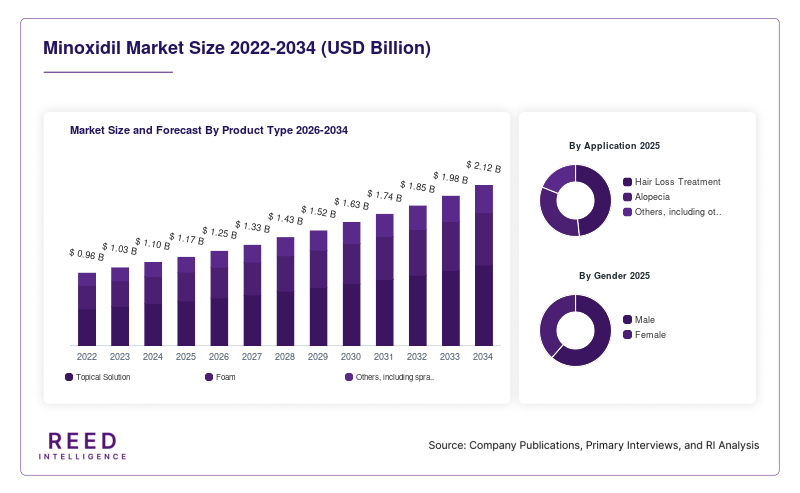
Topical solution represents the dominant product-type segment in the global Minoxidil Market, accounting for approximately 58.2% of market revenue in 2025, according to 's published market analysis. Topical solutions have an established position because of their widespread availability, familiarity among consumers, and use across different hair-loss treatment populations.
Foam formulations provide an alternative delivery format designed to improve convenience and consumer experience. estimates that foam products will grow at approximately 8.4% CAGR over its stated forecast period, faster than topical solutions. The increasing preference for convenient formulations supports the potential for foam products to gain market share during the forecast period.
Other formulations, including sprays and specialized topical products, provide additional opportunities for manufacturers seeking to differentiate their offerings. Product development is increasingly focused on application convenience, packaging, and consumer-specific preferences.
By Application
Hair loss treatment represents the dominant application segment, accounting for approximately 61.5% of global market revenue in 2025 according to 's published analysis. The segment benefits from the widespread use of minoxidil for androgenetic alopecia and pattern hair loss. Increasing awareness of hair-loss conditions and the accessibility of OTC products support continued demand.
Alopecia represents another important application area, with products used by consumers seeking to manage different forms of hair thinning and hair loss. The broader awareness of alopecia and increasing consultation with dermatologists and digital healthcare providers can support demand for established treatment options.
Other applications provide additional opportunities where minoxidil is incorporated into specialized hair-growth or dermatological product offerings. The available market analysis does not provide sufficient comparable data to establish a separate fastest-growing application conclusively.
By Gender
Male consumers represent an important market segment because androgenetic alopecia is highly prevalent among men. Minoxidil products have historically been widely marketed for male pattern hair loss, and established consumer awareness supports continued demand.
Female consumers represent a growing opportunity as awareness of female pattern hair loss increases. projects that the female segment's share will increase from approximately 31.6% in 2025 to 36.2% by 2034. Increasing recognition of female hair loss and targeted product positioning are expected to support this expansion.
The growing female consumer segment provides manufacturers with opportunities to develop targeted formulations, educational campaigns, packaging, and distribution strategies addressing specific consumer needs.
Minoxidil Market Regional Analysis
North America Minoxidil Market
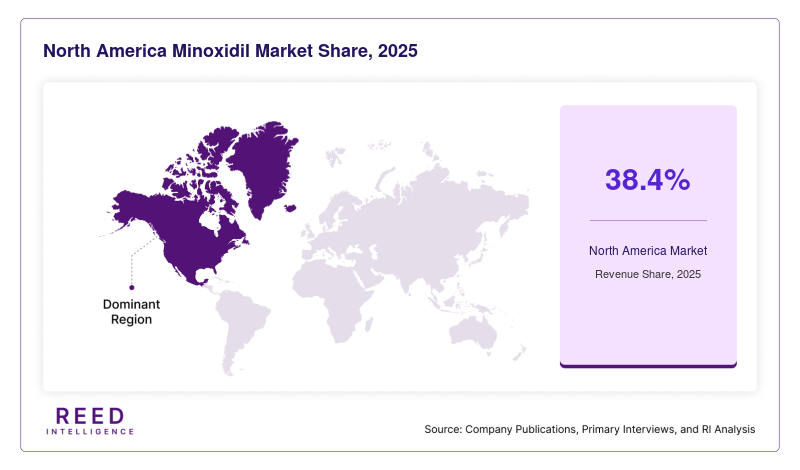
North America is the dominant regional market for Minoxidil, accounting for 38.4% of global market revenue in 2025, according to 's published market analysis. The region benefits from established consumer awareness of hair-loss treatments, widespread availability of OTC minoxidil formulations, developed pharmacy networks, and strong access to dermatological services.
The United States represents a major market within the region, supported by the established presence of branded and generic minoxidil products. E-commerce, telemedicine, and direct-to-consumer healthcare services are also providing additional routes through which consumers can access hair-loss treatments.
Europe Minoxidil Market
Europe represents an established market for minoxidil products, supported by consumer awareness of hair-loss treatments, pharmacy networks, and demand for dermatological and personal-care products. The region's healthcare infrastructure and established pharmaceutical distribution systems provide manufacturers with access to a large consumer base.
Market development is influenced by national regulatory requirements, OTC availability, consumer preferences, and the penetration of online pharmacy channels. Increasing interest in convenient topical formulations and female hair-loss treatment products may provide additional opportunities.
Asia Pacific Minoxidil Market
Asia Pacific is an important growth market for minoxidil products, supported by rising awareness of hair-loss conditions, increasing healthcare expenditure, expanding pharmaceutical distribution networks, and growing e-commerce adoption. China, India, Japan, South Korea, and other markets contribute to regional demand.
The region offers opportunities for manufacturers because consumers are increasingly seeking accessible hair-loss treatments through pharmacies and online channels. Digital healthcare and direct-to-consumer distribution can further expand product reach. However, regulatory frameworks, consumer purchasing power, and treatment preferences vary considerably across countries.
Latin America Minoxidil Market
Latin America provides opportunities for the Minoxidil Market through increasing awareness of hair-loss treatments and expanding access to pharmaceutical and personal-care products. Consumers increasingly use pharmacies and online channels to purchase topical hair-growth treatments.
Market development depends on healthcare access, consumer purchasing power, product availability, regulatory requirements, and the presence of local pharmaceutical manufacturers. E-commerce expansion may improve product availability in markets where traditional distribution networks have more limited reach.
Middle East & Africa Minoxidil Market
The Middle East & Africa region offers opportunities associated with improving healthcare access, expanding pharmacy networks, and increasing consumer interest in hair and dermatological treatments. Minoxidil products can benefit from greater awareness of hair-loss conditions and increased access to OTC pharmaceutical products.
Adoption varies significantly across countries because of differences in healthcare infrastructure, regulatory systems, consumer income, and distribution capabilities. Online retail and pharmacy modernization may create additional channels for product expansion.
Regional share note: North America's 38.4% share of global Minoxidil Market revenue in 2025 is a third-party estimate published by . The figure is source-specific and not independently audited. Other market research providers report different market sizes and regional estimates because of differences in market definitions and methodologies.
Minoxidil Market Competitive Landscape
The Minoxidil Market includes multinational pharmaceutical companies, generic-drug manufacturers, consumer healthcare companies, and specialized hair-care brands. Competition is shaped by product efficacy, formulation variety, brand recognition, regulatory compliance, distribution reach, pricing, and consumer trust. Companies are increasingly focusing on online distribution, targeted formulations, female-oriented products, and digital healthcare channels.
Pfizer Inc. is a major pharmaceutical company with a long-standing association with minoxidil through its Rogaine brand portfolio. Rogaine has established strong consumer recognition in the hair-loss treatment market and has been marketed in topical formulations for men and women. Pfizer's pharmaceutical expertise, brand recognition, distribution capabilities, and established consumer presence support its competitive position in the market. identifies Pfizer as a leading company in the competitive landscape.
Key Market Players
- Pfizer Inc.
- Johnson & Johnson
- Dr. Reddy's Laboratories Ltd.
- Perrigo Company plc
- Lupin Limited
- Teva Pharmaceutical Industries Ltd.
- Mylan N.V.
- Cipla Inc.
- Sun Pharmaceutical Industries Ltd.
- Apotex Inc.
- Actavis Generics
- Aurobindo Pharma Limited
Minoxidil Market Recent Developments
- September 2026- Multiple new minoxidil topical products appear in FDA labeling records U.S. FDA labeling records show continued additions and updates for topical minoxidil products during 2026. Examples include 5% minoxidil topical products and hair-regrowth formulations recorded in July, August, and September 2026. These records illustrate continued activity among manufacturers and marketers in the OTC minoxidil category and the availability of multiple formulations and brands.
- August 2026- Additional 5% minoxidil products recorded in U.S. FDA labeling data FDA labeling records from August 2026 include additional topical minoxidil products, including aerosol foam and solution formulations. The records include products associated with Perrigo and other manufacturers, demonstrating ongoing competition and product activity within the OTC hair-regrowth treatment category.
Minoxidil Market Segments
By Product Type
- Topical Solution
- Foam
- Others, including sprays and other topical formulations
By Application
- Hair Loss Treatment
- Alopecia
- Others, including other hair-growth and dermatological applications where included in the market definition
By Gender
- Male
- Female
By Distribution Channel
- Online Stores
- Pharmacies
- Specialty Stores
- Others, including supermarkets, hypermarkets, clinics, and direct-to-consumer channels
By Region
- North America
- Europe
- APAC
- Middle East and Africa
- LATAM