Mint Menthol Market Size, Share & Trends Analysis Report By Source (Natural Mint, Synthetic Menthol, and Others), By Application (Confectionery & Chewing Gum, Pharmaceuticals, Cosmetics & Personal Care, Food & Beverages, and Others) and By Region (North America, Europe, Asia Pacific, Latin America, Middle East & Africa) Forecasts, 2026–2034
USD 3950
Mint Menthol Market Size
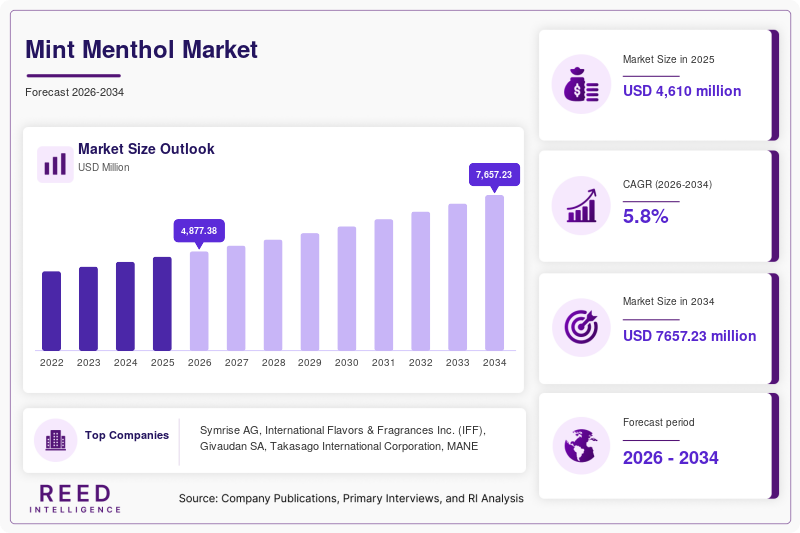
The global mint menthol market was valued at USD 4,610 million in 2025 and is projected to grow from USD 4,877 million in 2026 to USD 7,670 million by 2034, registering a compound annual growth rate (CAGR) of 5.8% during the forecast period from 2026 to 2034.
The Mint Menthol Market includes natural mint ingredients, menthol derived from mint oils, synthetic menthol, and related cooling and flavoring ingredients used across consumer and industrial applications. Menthol is valued for its characteristic mint aroma, cooling sensation, and functional properties. It is widely used in confectionery, chewing gum, pharmaceuticals, oral care, cosmetics, personal care, food and beverages, and other formulations.
Market demand is influenced by the continued use of mint flavors in everyday consumer products, the need for menthol in topical and respiratory pharmaceutical formulations, and demand for cooling sensations in personal care products. Natural mint-derived ingredients benefit from consumer interest in botanical ingredients, while synthetic menthol provides manufacturers with an alternative for applications requiring consistent specifications, scalable supply, and predictable formulation performance.
Mint Menthol Market Drivers
Growing Demand for Mint-Flavored Confectionery and Chewing Gum
Mint and menthol remain important ingredients in chewing gum, breath mints, candies, and other confectionery products because they provide recognizable flavor and cooling sensations. Regular consumer purchases support recurring demand from manufacturers. Product innovation in sugar-free gum, breath-freshening products, and differentiated flavor combinations further encourages the use of mint-derived ingredients and menthol-based cooling systems.
Increasing Applications in Pharmaceuticals and Personal Care
Menthol is widely used in topical formulations, cough and cold products, lozenges, inhalation products, oral care, and selected personal care applications. Its cooling sensation and characteristic aroma make it useful in formulations intended to provide freshness or temporary soothing effects. Continued demand for oral hygiene products, topical products, and respiratory care formulations supports the use of natural and synthetic menthol.
Mint Menthol Market Restraints
Volatility in Natural Mint Crop Production and Prices
Natural mint supply depends on agricultural conditions, crop yields, water availability, input costs, and harvesting practices. Adverse weather or changes in cultivated acreage can affect mint oil availability and prices. Manufacturers that depend heavily on natural ingredients may face procurement uncertainty and cost fluctuations, which can influence production planning and product pricing.
Regulatory and Quality Requirements
Menthol used in pharmaceutical, food, oral care, and cosmetic applications must meet relevant purity, safety, and quality requirements. Differences in regulatory standards and product specifications across markets can increase testing, documentation, and compliance costs. Manufacturers must also manage ingredient consistency and traceability, particularly when supplying pharmaceutical-grade or other tightly specified formulations.
Mint Menthol Market Opportunities
Expansion of Natural and Sustainably Sourced Ingredients
Consumer and manufacturer interest in botanical ingredients creates opportunities for natural mint oils and responsibly sourced menthol-related materials. Suppliers can differentiate themselves through traceability, sustainable cultivation, improved extraction efficiency, and partnerships with agricultural communities. Better farming practices and post-harvest processing may also help reduce quality variability and strengthen long-term supply reliability.
Innovation in Cooling Ingredients and Specialized Formulations
Advances in cooling technologies and flavor formulation create opportunities across oral care, confectionery, personal care, and pharmaceuticals. Manufacturers can develop ingredients with tailored cooling intensity, sensory duration, and compatibility with different product formulations. Specialized cooling solutions may also allow formulators to achieve desired sensory effects in products where conventional mint flavor or menthol characteristics need to be adjusted.
Mint Menthol Market Segmental Analysis
By Source
Natural mint ingredients are important to the market because they provide mint oils and menthol-rich materials used in flavoring, oral care, confectionery, and other applications. Natural ingredients appeal to manufacturers seeking botanical sourcing and recognizable mint profiles. However, production depends on agricultural yields, cultivation practices, and extraction efficiency. Synthetic menthol provides a complementary supply source, allowing manufacturers to obtain consistent ingredient specifications and support large-volume formulations.
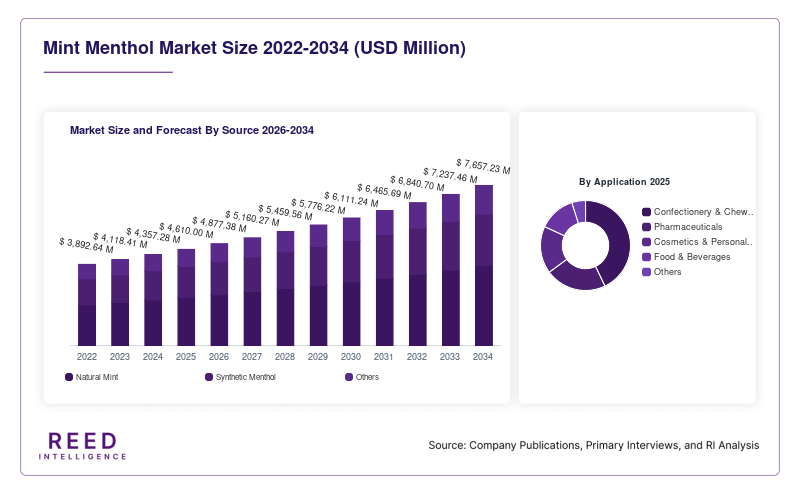
According to the published estimate matching the supplied market valuation, natural mint accounted for 54.6% of the market in 2025, making it the dominant source segment. The report also identifies synthetic menthol and other sources as part of the market. This percentage is a third-party estimate and depends on the source's segment definitions. A separately verifiable fastest-growing source segment and its CAGR are unavailable.
By Application
Confectionery and chewing gum are major applications because mint flavors and menthol-based cooling effects are widely used in chewing gum, breath mints, candies, and related products. These applications benefit from recurring consumer demand and the role of mint in freshness-oriented products. Pharmaceuticals represent another important use, including selected topical products, lozenges, and respiratory formulations. Cosmetics and personal care products also use mint-derived ingredients for fragrance, cooling, and sensory effects.
Confectionery & Chewing Gum was the leading application in 2025, accounting for an estimated 38.2% of global market revenue, according to the published market estimate aligned with the supplied market size. Food & Beverages represents another application area with opportunities in flavor innovation and cooling formulations.
Mint Menthol Market Regional Analysis
Asia Pacific Mint Menthol Market
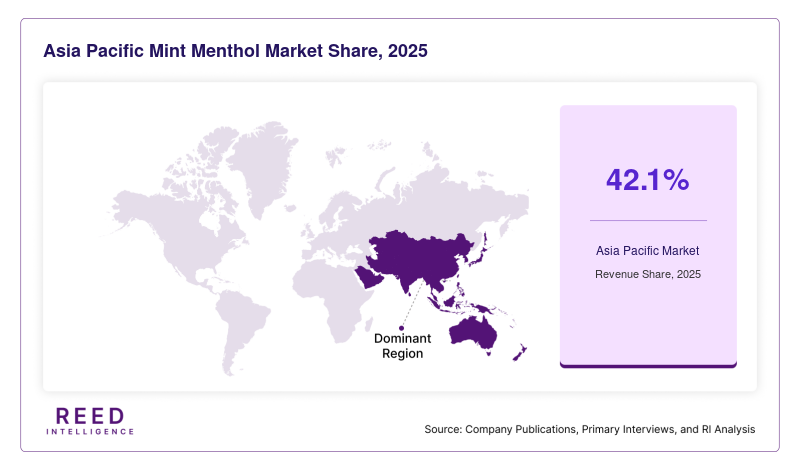
Asia Pacific dominated the Mint Menthol Market in 2025, accounting for an estimated 42.1% of global market revenue. Applying this share to the supplied 2025 global market size of USD 4,610 million gives a derived regional market value of approximately USD 1,940.81 million. This value is calculated from the third-party regional share and your supplied global market size; it is not separately reported regional revenue. The region's position is supported by India's substantial natural mint cultivation and menthol production, along with ingredient processing and consumption across China and other Asian markets.
Regional demand is supported by the presence of mint ingredient suppliers, pharmaceutical manufacturers, confectionery producers, and personal care industries. India is particularly important to the natural mint supply chain, while China contributes to ingredient processing and demand across consumer and industrial applications. Future development will depend on crop yields, sustainable sourcing, manufacturing capacity, consumer-product demand, and the competitiveness of natural and synthetic ingredients. The published estimate identifies Asia Pacific as the dominant region, but its share should be treated as a third-party market estimate.
North America Mint Menthol Market
North America is an established market for mint and menthol ingredients, supported by demand from chewing gum, confectionery, pharmaceuticals, oral care, and personal care manufacturers. The United States is a major consumption market and also has domestic peppermint cultivation. Ingredient suppliers serve manufacturers requiring consistent flavor profiles, cooling performance, and product specifications for large-volume applications.
Market growth is influenced by demand for breath-freshening products, topical formulations, oral hygiene products, and specialized cooling ingredients. Procurement is also affected by natural mint crop availability, imports, ingredient prices, and competition from synthetic menthol.
Europe Mint Menthol Market
Europe represents an established market for mint and menthol ingredients, with demand from confectionery, pharmaceutical, cosmetics, personal care, and oral care manufacturers. Germany, France, the United Kingdom, Italy, and other European markets contribute through consumer-product manufacturing and ingredient formulation. Product safety, ingredient quality, regulatory compliance, and supply traceability are important considerations for companies serving the region.
Market development is influenced by consumer demand for freshness-oriented products, the use of menthol in pharmaceutical formulations, and innovation in personal care and flavor applications. Natural ingredients may benefit from sourcing and traceability initiatives, while synthetic menthol remains relevant for applications requiring consistent specifications.
Latin America Mint Menthol Market
Latin America offers opportunities for mint and menthol ingredients through confectionery, food and beverage, pharmaceutical, and personal care applications. Brazil and Mexico are important consumer and manufacturing markets, while the region's agricultural and processing capabilities may contribute to the broader natural ingredient supply chain. Demand is influenced by consumer spending, product formulation trends, and the development of local manufacturing.
Market growth can be affected by currency movements, ingredient import costs, agricultural conditions, and differences in regulatory requirements. Suppliers that offer reliable quality, competitive pricing, and distribution support may improve access to regional manufacturers.
Middle East & Africa Mint Menthol Market
The Middle East & Africa market is supported by demand for confectionery, pharmaceutical products, oral care, and personal care formulations containing mint or menthol ingredients. Population growth, retail development, and investment in consumer-product manufacturing influence regional demand. Importers and distributors play an important role in connecting ingredient suppliers with local manufacturers.
Future development depends on affordability, ingredient availability, regulatory requirements, distribution infrastructure, and growth in local manufacturing. Natural and synthetic ingredients may serve different procurement and formulation needs depending on price and product specifications.
Mint Menthol Market Competitive Landscape
The Mint Menthol Market includes suppliers of natural mint oils, synthetic menthol, flavor and fragrance ingredients, and specialized cooling technologies. Competition is based on ingredient quality, sensory performance, purity, supply consistency, price, sustainable sourcing, and technical support. Natural ingredient suppliers must manage agricultural variability, while synthetic menthol producers compete through manufacturing scale, product consistency, and production efficiency.
Symrise AG is an important participant in the market, supplying menthol, mint derivatives, natural mint oils, and cooling ingredients for oral care, confectionery, personal care, and pharmaceutical applications. Its capabilities include synthetic menthol production and natural ingredient sourcing. The company also works with agricultural partners on mint supply-chain sustainability initiatives.
Key Market Players
- Symrise AG
- International Flavors & Fragrances Inc. (IFF)
- Givaudan SA
- Takasago International Corporation
- MANE
- BASF SE
- V. Mane Fils
- Berjé Inc.
- AOS Products Pvt. Ltd.
- Hindustan Mint & Agro Products Pvt. Ltd.
Mint Menthol Market Recent Developments
February 2025 -Symrise introduced Optacool® Fuji for oral care applications: Symrise announced a new cooling substance designed for a broad range of oral care products. The company described the ingredient as offering adjustable cooling intensity to support different formulation needs. The development illustrates continued innovation in cooling technologies used alongside or as alternatives to conventional mint and menthol sensory profiles.
April 2026 -Berjé reported elevated U.S. mint oil prices: Berjé's published market update stated that U.S. mint oils remained at elevated price levels and that buyers were balancing sourcing decisions against regional price differences and application requirements. The update reflects supply and procurement conditions affecting natural mint ingredients, rather than a new product launch.
Mint Menthol Market Segments
By Source
- Natural Mint
- Synthetic Menthol
- Others
By Application
- Confectionery & Chewing Gum
- Pharmaceuticals
- Cosmetics & Personal Care
- Food & Beverages
- Others
By Region
- North America
- Europe
- APAC
- Middle East and Africa
- LATAM