Mist Eliminator Market Size, Share Demand Report By Type (Vane Mist Eliminators, Fiber-Bed Mist Eliminators, Hybrid Mist Eliminators), By Application (Oil & Gas Processing, Chemical Manufacturing, Power Generation, Pharmaceutical Manufacturing), By End-Use Industry (Chemical Processing, Oil & Gas, Water & Wastewater Treatment), By Region & Segment Forecasts, 2026–2034
USD 3950
Market Overview
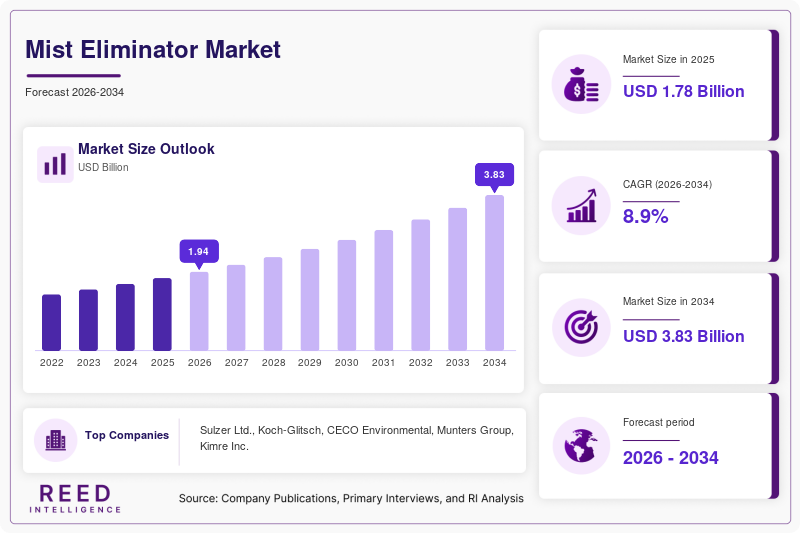
The global Mist Eliminator Market was valued at approximately USD 1.78 billion in 2026 and is projected to reach USD 3.54 billion by 2034, expanding at a CAGR of 8.9% during 2026–2034. The market continues to gain momentum as industries seek efficient gas-liquid separation technologies that improve operational efficiency, reduce emissions, and comply with increasingly stringent environmental regulations. Mist eliminators play a critical role in removing liquid droplets from gas streams in chemical processing, power generation, oil and gas refining, fertilizer production, desalination plants, and pharmaceutical manufacturing facilities.
A major global factor supporting market expansion is the growing emphasis on industrial emission control and environmental sustainability. Governments and regulatory agencies across developed and developing economies are enforcing stricter standards for air quality and process efficiency. As a result, industrial facilities are investing in advanced separation equipment to reduce particulate emissions and recover valuable process fluids. Technological improvements in wire mesh, vane, and fiber-bed mist elimination systems have also enhanced operational performance while reducing maintenance requirements.
Key Highlights
- North America dominated the market with a 35.1% share in 2025.
- Asia Pacific is expected to grow at the fastest CAGR of 10.8% during 2026–2034.
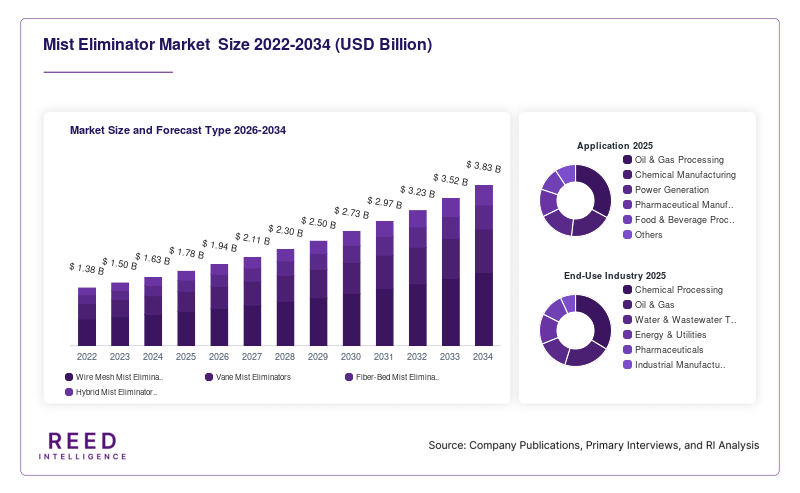
- By type, wire mesh mist eliminators accounted for the largest share of 42.8%.
- while fiber-bed mist eliminators are projected to grow at a CAGR of 10.9%.
- By application, oil and gas processing led with a 39.6% share.
- whereas pharmaceutical manufacturing is expected to expand at a CAGR of 11.3%.
- By end-use industry, chemical processing held the largest share of 33.7%.
- while water and wastewater treatment is forecast to grow at a CAGR of 10.7%.
- The United States remained the dominant country, with market values of USD 432 million in 2024 and USD 471 million in 2025.
Market Trends
Integration of High-Efficiency Separation Technologies
Industrial operators are increasingly adopting high-efficiency mist elimination systems capable of removing ultra-fine droplets from process streams. Advanced wire mesh configurations, hybrid vane systems, and fiber-bed technologies are becoming preferred solutions in facilities where product recovery and emission reduction are critical operational priorities. These technologies help manufacturers improve separation performance while reducing pressure drop and energy consumption. The trend is particularly evident in chemical plants, refineries, and fertilizer manufacturing facilities where operational reliability directly affects profitability. Equipment suppliers are responding by developing customized designs that address complex process conditions, enabling broader adoption across multiple industrial environments and supporting long-term market growth.
Growing Demand for Sustainable Industrial Operations
Sustainability initiatives are influencing purchasing decisions across industrial sectors, creating stronger demand for efficient mist elimination solutions. Companies are investing in equipment that minimizes emissions, recovers valuable process liquids, and supports environmental compliance objectives. Modern mist eliminators contribute to resource conservation by preventing product losses and reducing contamination in downstream systems. As industrial operators pursue carbon reduction strategies and circular economy initiatives, separation technologies are becoming integral components of plant modernization projects. The increasing integration of digital monitoring systems into mist eliminators is also improving predictive maintenance capabilities, enabling facilities to enhance operational performance while supporting sustainability targets and regulatory compliance requirements.
Market Drivers
Expansion of Oil and Gas Processing Infrastructure
The continuous development of upstream, midstream, and downstream oil and gas infrastructure is a major factor driving demand for mist eliminators. Refineries, gas processing plants, and petrochemical facilities require effective gas-liquid separation systems to maintain process efficiency and protect critical equipment. Mist eliminators help prevent liquid carryover, reduce corrosion risks, and improve product purity across multiple processing stages. Rising investments in refining capacity expansions and natural gas processing projects are generating substantial demand for advanced separation technologies. Emerging economies are particularly active in expanding energy infrastructure, creating a favorable environment for market growth throughout the forecast period and increasing adoption across both new and existing facilities.
Stringent Environmental and Emission Regulations
Regulatory pressure related to industrial emissions is accelerating the adoption of mist elimination systems across various sectors. Environmental agencies continue to establish stricter standards governing airborne contaminants, particulate matter, and process emissions. Industries are investing in separation technologies to comply with these requirements while maintaining efficient operations. Mist eliminators assist facilities in reducing emissions and improving overall environmental performance. Compliance-related investments are especially strong in chemical manufacturing, power generation, and industrial processing sectors. As regulations become more comprehensive across developing economies, demand for advanced emission-control equipment is expected to increase further, supporting sustained growth of the global market.
Market Restraint
High Installation and Maintenance Costs in Specialized Applications
Despite favorable growth prospects, the market faces challenges associated with the relatively high installation and maintenance costs of specialized mist elimination systems. Industries operating under extreme temperature, pressure, or corrosive conditions often require customized solutions manufactured from advanced materials. These systems can involve significant capital expenditures, making adoption more difficult for small and medium-sized enterprises. In addition, periodic maintenance, cleaning, and replacement of separation components contribute to ongoing operational costs. Facilities with limited budgets may delay upgrades or continue using conventional equipment despite efficiency limitations. For example, smaller chemical processing plants in developing regions often prioritize production expansion over process optimization investments, slowing adoption rates. Cost concerns may therefore restrict market penetration in certain price-sensitive industries, particularly where regulatory enforcement remains limited and immediate financial returns are difficult to quantify.
Market Opportunities
Rising Investments in Water and Wastewater Treatment Facilities
Global investments in water treatment infrastructure are creating substantial opportunities for mist eliminator manufacturers. Rapid urbanization, industrial expansion, and increasing concerns regarding water quality are driving the construction of new treatment facilities worldwide. Mist eliminators are widely used in evaporation systems, desalination plants, and industrial wastewater treatment operations to improve process efficiency and prevent contamination. Governments and private operators are allocating significant resources toward modernizing aging water infrastructure and expanding treatment capacity. As demand for clean water continues to rise, advanced separation technologies are expected to become increasingly important, generating new revenue opportunities for equipment suppliers and supporting long-term market expansion.
Increasing Adoption Across Pharmaceutical Manufacturing
The pharmaceutical sector is emerging as an attractive growth avenue for mist eliminator providers. Pharmaceutical production processes require high levels of purity, contamination control, and process reliability. Mist elimination systems help maintain clean operating environments and improve product quality throughout manufacturing operations. Expansion of pharmaceutical production facilities, particularly in Asia Pacific and North America, is increasing demand for advanced separation technologies. Growing investments in biotechnology, vaccine production, and specialty drug manufacturing are further contributing to market opportunities. Manufacturers capable of delivering high-performance systems that meet strict regulatory requirements are likely to benefit from rising demand within this rapidly expanding industry segment.
Segmental Analysis
By Type
Wire mesh mist eliminators represented the dominant subsegment and accounted for approximately 42.8% of total market revenue in 2024. Their widespread adoption stems from cost-effectiveness, operational reliability, and suitability across a broad range of industrial applications. These systems are extensively used in chemical plants, refineries, power stations, and gas processing facilities where efficient removal of liquid droplets is essential. The technology offers low pressure drop characteristics and straightforward installation, making it attractive for both new projects and retrofit applications. Continuous improvements in material durability and design optimization have enhanced performance under demanding operating conditions. As industries continue emphasizing efficiency and emission control, wire mesh solutions remain the preferred choice across many industrial environments.
Fiber-bed mist eliminators are projected to record the fastest growth, expanding at a CAGR of 10.9% during 2026–2034. Growth is primarily driven by their ability to capture extremely fine liquid droplets that conventional technologies may not effectively remove. Industries requiring high-purity process streams increasingly favor these systems due to superior separation efficiency. Demand is especially strong in pharmaceutical manufacturing, specialty chemicals, and high-performance industrial applications. Advances in fiber materials and filtration media are further improving operational effectiveness while reducing maintenance requirements. As environmental regulations become stricter and industries pursue greater process optimization, adoption of fiber-bed technologies is expected to accelerate significantly.
By Application
Oil and gas processing accounted for the largest application segment, holding approximately 39.6% of market revenue in 2024. Mist eliminators play a critical role in protecting compressors, turbines, and downstream equipment from liquid carryover while improving product quality and operational efficiency. The extensive use of separation systems throughout exploration, production, transportation, and refining activities supports the segment’s dominant position. Rising investments in energy infrastructure and growing global energy demand continue to reinforce equipment requirements. Facilities increasingly prioritize technologies that minimize maintenance costs and improve process reliability. These factors collectively contribute to the sustained leadership of oil and gas processing within the overall market.
Pharmaceutical manufacturing is anticipated to emerge as the fastest-growing application segment, registering a CAGR of 11.3% through 2034. Expansion of pharmaceutical production facilities and increasing regulatory requirements regarding product purity are key factors driving demand. Mist eliminators help maintain contamination-free processing environments while improving manufacturing consistency. Growth in biologics, vaccines, and specialty drug production is creating additional opportunities for advanced separation solutions. Manufacturers are investing heavily in modern production technologies that support quality assurance and compliance objectives. This favorable industry environment is expected to accelerate deployment of high-performance mist elimination systems throughout pharmaceutical operations worldwide.
By End-Use Industry
Chemical processing held the leading position among end-use industries, accounting for approximately 33.7% of global revenue in 2024. Chemical production facilities rely extensively on mist eliminators to improve separation efficiency, reduce emissions, and protect critical process equipment. The industry’s diverse operating environments create substantial demand for reliable gas-liquid separation technologies. Growing production of specialty chemicals, industrial chemicals, and petrochemical derivatives continues to support market expansion. Companies increasingly seek solutions that enhance productivity while ensuring compliance with environmental regulations. As process complexity increases across modern chemical facilities, demand for efficient mist elimination systems remains strong.
Water and wastewater treatment is expected to be the fastest-growing end-use segment, advancing at a CAGR of 10.7% during the forecast period. Growing concerns regarding water scarcity and environmental sustainability are driving investments in treatment infrastructure worldwide. Mist eliminators improve process performance in evaporation systems, desalination facilities, and industrial wastewater operations. Government funding initiatives and private-sector investments are expanding treatment capacity across both developed and emerging economies. Increasing emphasis on resource recovery and operational efficiency is encouraging adoption of advanced separation technologies. These trends are expected to create substantial growth opportunities within the water and wastewater treatment sector.
Regional Analysis
North America
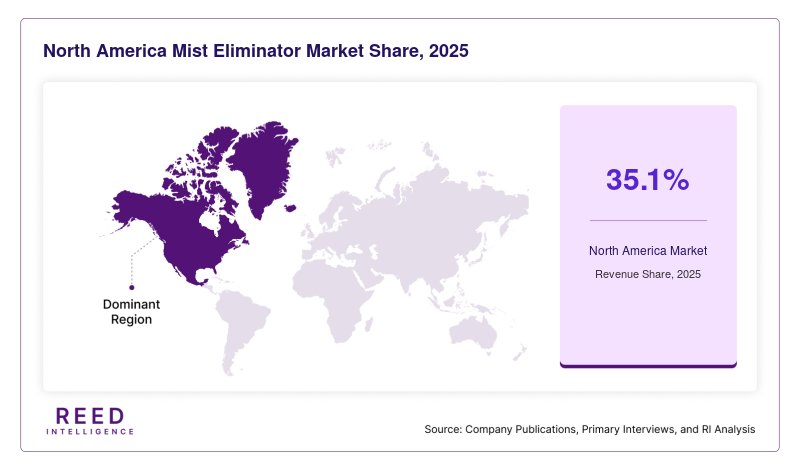
North America accounted for approximately 35.1% of the global Mist Eliminator Market in 2025 and continues to represent the largest regional market. The region is projected to expand at a CAGR of 8.1% through 2034, supported by advanced industrial infrastructure and strong regulatory compliance requirements. Demand remains particularly strong across refining, petrochemical, power generation, and chemical processing sectors. Companies are increasingly investing in modern separation systems to enhance efficiency and reduce operational losses.
The United States remains the dominant contributor to regional revenue generation. A key growth factor is the extensive modernization of industrial facilities aimed at improving emission control performance. Major investments in refinery upgrades, natural gas processing infrastructure, and industrial automation projects continue to support adoption. The presence of leading equipment manufacturers and engineering service providers further strengthens regional market development.
Europe
Europe represented nearly 27.4% of global market revenue in 2025 and is forecast to grow at a CAGR of 7.8% during the assessment period. Industrial sustainability initiatives and strict environmental regulations are driving the adoption of advanced mist elimination technologies throughout the region. Demand is particularly notable in chemical manufacturing, energy production, and industrial wastewater treatment applications where compliance standards remain highly stringent.
Germany leads the European market due to its extensive industrial manufacturing base and focus on engineering excellence. A unique growth factor is the increasing implementation of resource-efficiency programs across industrial facilities. Companies are investing in equipment capable of reducing emissions and recovering valuable process materials. This focus on operational efficiency continues to stimulate demand for modern mist eliminator systems.
Asia Pacific
Asia Pacific held approximately 24.6% of the global market in 2025 and is expected to register the fastest CAGR of 10.8% through 2034. Rapid industrialization, infrastructure development, and expansion of manufacturing activities are driving substantial demand across multiple industries. Countries throughout the region continue to invest heavily in chemical processing, refining, and water treatment projects, creating favorable conditions for market expansion.
China remains the largest market within Asia Pacific. A key growth factor is the ongoing expansion of large-scale petrochemical and industrial manufacturing facilities. Government initiatives promoting cleaner production processes and environmental protection are encouraging companies to adopt advanced separation technologies. Continuous investments in industrial modernization are expected to sustain strong regional growth throughout the forecast period.
Middle East & Africa
The Middle East & Africa accounted for around 7.1% of global revenue in 2025 and is anticipated to grow at a CAGR of 8.7% through 2034. The region benefits from significant investments in oil and gas production, refining, and petrochemical operations. Industrial diversification programs are also increasing demand for process equipment designed to improve efficiency and environmental performance.
Saudi Arabia dominates the regional market owing to its extensive hydrocarbon processing infrastructure. A distinctive growth factor is the ongoing development of integrated petrochemical complexes designed to enhance downstream value creation. These projects require advanced gas-liquid separation solutions to maintain operational reliability and product quality, supporting continued demand for mist eliminators.
Latin America
Latin America captured approximately 5.8% of the global market in 2025 and is projected to expand at a CAGR of 8.3% through 2034. Industrial development, energy sector investments, and improvements in environmental compliance are contributing to increased adoption of separation technologies. Demand is steadily growing across chemical manufacturing, mining operations, and wastewater treatment facilities.
Brazil remains the leading country in the regional market. An important growth factor is the expansion of industrial processing and resource-based industries requiring reliable emission-control equipment. Investments in infrastructure modernization and environmental management programs are encouraging facilities to upgrade process systems, creating favorable conditions for market growth across the country.
Competitive Landscape
The Mist Eliminator Market remains moderately consolidated, with several international manufacturers competing through technological innovation, product customization, and strategic expansion initiatives. Companies focus on developing advanced separation solutions capable of meeting increasingly demanding industrial requirements. Product performance, durability, and energy efficiency continue to serve as key competitive differentiators.
Sulzer Ltd. maintains a leading position due to its extensive portfolio of separation technologies and strong global presence. The company continues to invest in product innovation and engineering capabilities to strengthen its market position. Recent developments include expanded process separation offerings designed for high-efficiency industrial applications. Other notable participants include Koch-Glitsch, CECO Environmental, Munters Group, and Kimre Inc. These companies are actively pursuing partnerships, facility expansions, and technology upgrades to enhance competitiveness. Market participants are also focusing on customized solutions tailored to specific operating conditions within chemical processing, refining, and water treatment industries. Increasing demand for sustainable industrial operations is expected to encourage continued investment in research and development activities throughout the competitive landscape.
Key Players
- Sulzer Ltd.
- Koch-Glitsch
- CECO Environmental
- Munters Group
- Kimre Inc.
- Begg Cousland Envirotec
- Hilliard Corporation
- MECS Global
- AMACS Process Tower Internals
- Air Quality Engineering
- Bionomic Industries
- Otto H. York Company
- GEA Group
- DuPont Clean Technologies
- HAT International
Recent Developments
- Sulzer Ltd. introduced an upgraded high-capacity mist elimination solution designed to improve separation efficiency in refinery applications.
- Koch-Glitsch expanded its process equipment manufacturing capabilities to support increasing demand from petrochemical and gas processing industries.
- CECO Environmental launched an enhanced emission-control platform integrating advanced mist elimination technologies for industrial facilities.
- Munters Group expanded its industrial air treatment portfolio through new separation system developments targeting chemical processing customers.
- Kimre Inc. introduced advanced fiber-bed media technology focused on improving fine droplet capture efficiency in specialty industrial applications.
Mist Eliminator Market Segments
Type
- Wire Mesh Mist Eliminators
- Vane Mist Eliminators
- Fiber-Bed Mist Eliminators
- Hybrid Mist Eliminators
Application
- Oil & Gas Processing
- Chemical Manufacturing
- Power Generation
- Pharmaceutical Manufacturing
- Food & Beverage Processing
- Others
End-Use Industry
- Chemical Processing
- Oil & Gas
- Water & Wastewater Treatment
- Energy & Utilities
- Pharmaceuticals
- Industrial Manufacturing
By Region
- North America
- Europe
- APAC
- Middle East and Africa
- LATAM