Miticides for Fruits Vegetables Market Size, Share & Demand Report By Type (Chemical Miticides, Bio-based Miticides), By Application (Fruits, Vegetables), By Formulation (Liquid, Dry) By Region & Segment Forecasts, 2025–2034
USD 3950
Market Overview
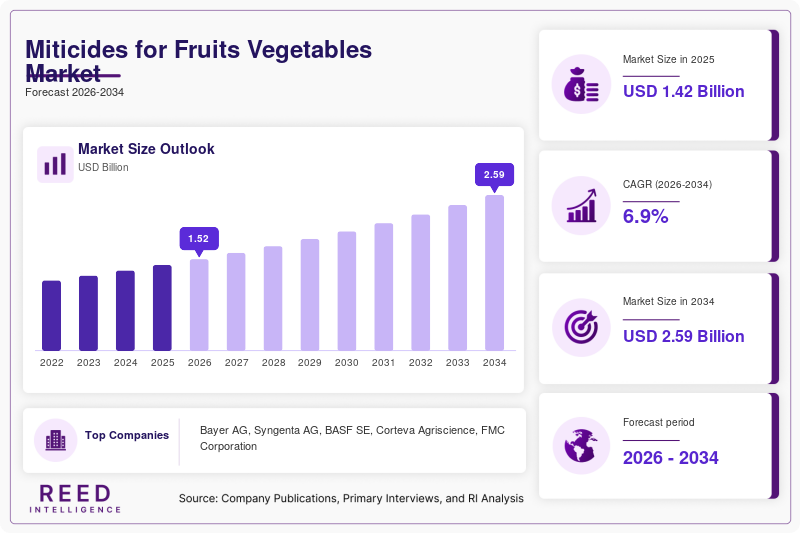
The Miticides for Fruits Vegetables Market size was estimated at USD 1.42 billion in 2025 and is projected to reach USD 1.53 billion in 2026, reflecting consistent adoption across both developed and emerging agricultural economies. By 2034, the market is forecast to reach USD 2.78 billion, growing at a CAGR of 6.9% from 2025 to 2034. Increasing concerns regarding pest infestations, particularly mites that significantly reduce fruit and vegetable yields, are driving demand for effective miticides.
One of the primary growth factors is the expansion of commercial fruit and vegetable farming, especially in Asia Pacific and Latin America. These regions are experiencing increased export-oriented cultivation, requiring high-quality produce free from pest damage. Another key factor is the rising adoption of integrated pest management (IPM) practices, where miticides play a crucial role in controlling mite populations while minimizing environmental impact. Additionally, technological advancements in agrochemical formulations, such as bio-based and low-residue miticides, are further supporting market growth.
Key Highlights
- Market size was valued at USD 1.42 billion in 2025 and is projected to reach USD 2.78 billion by 2034, registering a CAGR of 6.9% during the forecast period.
- North America dominated the market with a significant share, while Asia Pacific is expected to witness the fastest growth with a strong CAGR through 2034.
- By product type, chemical-based miticides held the largest market share, whereas bio-based miticides are projected to grow at the fastest CAGR.
- In terms of application, fruits accounted for the highest share, while vegetables are anticipated to expand at a notable growth rate over the forecast period.
- Rising adoption of integrated pest management (IPM) practices is driving market demand globally.
- Increasing consumer preference for high-quality and residue-free fruits and vegetables is further supporting market growth.
Market Trends
Increasing Adoption of Bio-Based Miticides
The market is experiencing a shift toward bio-based miticides as growers seek environmentally sustainable pest control solutions. These products are derived from natural sources such as plant extracts, microbial agents, and essential oils. Regulatory bodies are encouraging the use of eco-friendly alternatives, leading to reduced reliance on synthetic chemicals. Bio-based miticides offer lower toxicity and minimal residue levels, making them suitable for export-oriented agriculture. Additionally, consumers are demanding pesticide-free produce, which is influencing farmers to adopt organic and sustainable crop protection methods. This trend is expected to continue as innovation in biological formulations improves efficacy and shelf life.
Integration of Precision Agriculture Technologies
Precision agriculture is transforming the application of miticides by enabling targeted and efficient usage. Technologies such as drones, sensors, and satellite imaging are helping farmers detect mite infestations early and apply treatments only where needed. This reduces chemical usage and lowers operational costs while improving crop health. Data-driven decision-making tools are also assisting in optimizing application timing and dosage. The integration of digital platforms with crop protection strategies is gaining traction, especially among large-scale commercial farms. This trend is expected to enhance productivity and reduce environmental impact, further driving the growth of the miticides market.
Market Drivers
Rising Incidence of Mite Infestations in High-Value Crops
The increasing prevalence of mite infestations in fruits and vegetables is a major driver for the market. Mites such as spider mites and broad mites can cause severe damage by feeding on plant tissues, leading to reduced yield and quality. Climate change is exacerbating this issue by creating favorable conditions for mite reproduction and spread. Farmers are increasingly relying on miticides to protect crops and maintain profitability. High-value crops such as berries, tomatoes, and cucumbers are particularly vulnerable, which is driving demand for specialized solutions. The economic impact of infestations is encouraging consistent usage of miticides.
Growth in Global Horticulture Production
The expansion of horticulture production worldwide is significantly contributing to market growth. Increasing population and changing dietary preferences are driving demand for fresh fruits and vegetables. Governments are promoting horticulture as a means to improve farmer income and ensure food security. This has led to increased cultivation area and adoption of advanced farming practices. Miticides are essential in maintaining crop health and ensuring high yields. Export markets also require stringent quality standards, further boosting the demand for effective pest control solutions.
Market Restraint
Stringent Regulatory Frameworks and Environmental Concerns
One of the major restraints in the Miticides for Fruits Vegetables Market is the stringent regulatory environment governing agrochemical usage. Regulatory authorities across regions are imposing strict guidelines on the approval, usage, and residue levels of miticides. Many synthetic miticides are facing restrictions or bans due to their potential environmental and health impacts. This creates challenges for manufacturers in terms of compliance and product development costs. Additionally, the lengthy approval process for new formulations can delay market entry.
The impact of these regulations is particularly evident in developed regions where compliance requirements are more stringent. For example, certain chemical miticides have been restricted in Europe due to concerns about soil contamination and effects on beneficial insects. This has forced companies to invest heavily in research and development of safer alternatives. While this shift supports sustainability, it also increases production costs and limits product availability in the short term. Farmers may face higher costs and limited choices, which can hinder market growth.
Market Opportunities
Expansion in Emerging Agricultural Economies
Emerging economies present significant growth opportunities for the miticides market. Countries in Asia Pacific, Africa, and Latin America are increasing their agricultural output to meet domestic and export demand. Rising awareness about crop protection and government support programs are encouraging farmers to adopt modern agricultural inputs. Infrastructure development and access to financing are also improving, enabling the use of advanced pest control solutions. These regions offer untapped potential due to large cultivation areas and increasing adoption rates, making them attractive markets for manufacturers.
Development of Innovative Formulations and Delivery Systems
Innovation in miticide formulations and delivery systems is creating new growth avenues. Companies are focusing on developing products with improved efficacy, longer residual action, and reduced environmental impact. Advanced delivery systems such as microencapsulation and controlled-release technologies are enhancing product performance. These innovations help in reducing application frequency and improving cost efficiency for farmers. Additionally, compatibility with precision agriculture tools is increasing the adoption of advanced formulations. Continuous research and development are expected to drive product differentiation and expand market opportunities.
Segmental Analysis
By Type
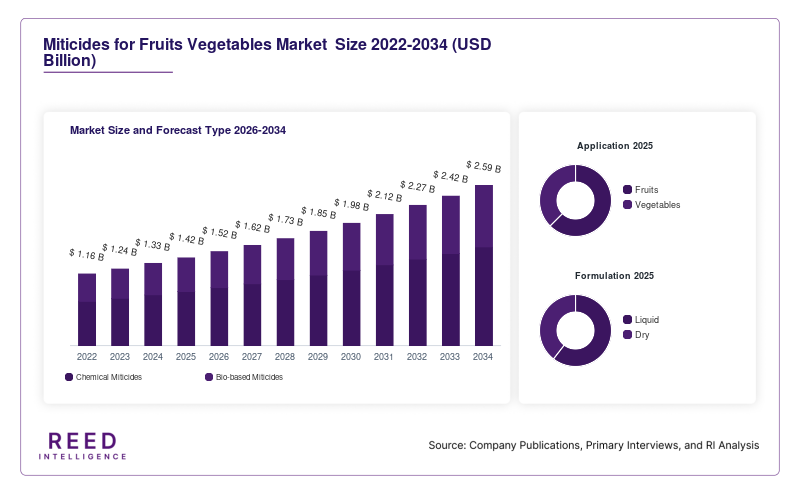
The chemical miticides segment dominated the market in 2024, accounting for approximately 62% share. These products are widely used due to their high efficacy and quick action against mite infestations. Chemical miticides are preferred by farmers dealing with severe infestations, as they provide immediate results. The availability of a wide range of formulations and cost-effectiveness further support their dominance. However, concerns about environmental impact and regulatory restrictions are influencing usage patterns.
The bio-based miticides segment is expected to register the fastest CAGR of 8.3% during the forecast period. Growth is driven by increasing demand for sustainable agricultural practices and regulatory support for eco-friendly products. These miticides are gaining popularity among organic farmers and export-oriented producers. Advances in formulation technology are improving their effectiveness, making them a viable alternative to chemical products.
By Application
Fruits accounted for the largest share of 58% in 2024, driven by the high susceptibility of fruit crops to mite infestations. Crops such as apples, grapes, and berries require intensive pest management to maintain quality and yield. The high economic value of fruit crops encourages farmers to invest in effective miticide solutions. Additionally, export requirements for residue-free produce are driving the adoption of advanced products.
Vegetables are projected to be the fastest-growing segment, with a CAGR of 7.5%. The increasing consumption of vegetables and expansion of greenhouse farming are key growth factors. Vegetables such as tomatoes, cucumbers, and peppers are highly vulnerable to mites, necessitating regular application of miticides. The adoption of modern farming practices is further supporting segment growth.
By Formulation
Liquid formulations dominated the market with a 55% share in 2024, owing to their ease of application and uniform coverage. These formulations are widely used in both open-field and greenhouse farming. Liquid miticides can be easily mixed with water and applied using standard spraying equipment, making them convenient for farmers.
Dry formulations are expected to grow at the fastest CAGR of 7.2%. These products offer advantages such as longer shelf life and reduced transportation costs. They are particularly suitable for regions with limited storage facilities. Increasing adoption of advanced formulation technologies is enhancing their effectiveness and driving market growth.
Regional Analysis
North America
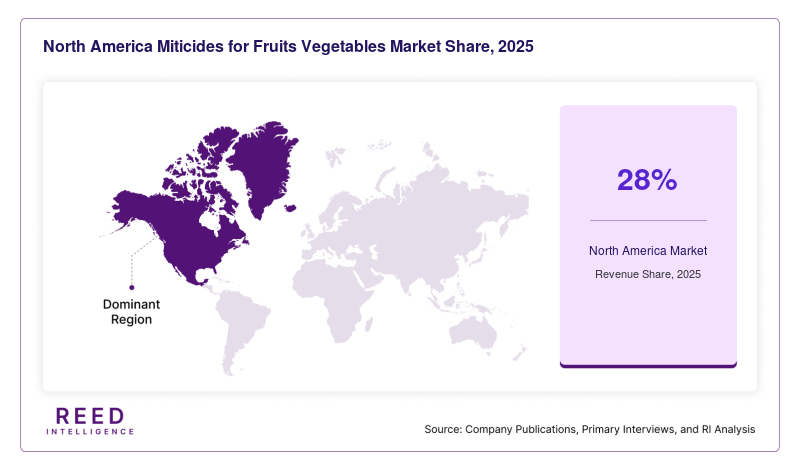
North America accounted for approximately 28% market share in 2025, with a projected CAGR of 5.8% through 2034. The region benefits from advanced agricultural practices and high adoption of crop protection solutions. The presence of large-scale commercial farms and strong distribution networks supports consistent demand for miticides. Additionally, the focus on high-quality produce for domestic consumption and export markets is driving product usage.
The United States dominates the regional market due to its extensive horticulture industry. A key growth factor is the increasing adoption of precision farming technologies, which enable efficient application of miticides. Farmers are investing in advanced tools to improve yield and reduce costs, contributing to steady market growth.
Europe
Europe held a 24% share in 2025 and is expected to grow at a CAGR of 5.5%. The market is characterized by stringent regulatory standards and a strong focus on sustainability. Demand for bio-based and low-residue miticides is increasing as farmers comply with environmental regulations. The region also has a well-established fruit and vegetable production sector.
Germany is a leading country in the region, supported by its advanced agricultural infrastructure. A unique growth factor is the emphasis on organic farming practices, which is driving demand for eco-friendly miticides. Government initiatives promoting sustainable agriculture are further supporting market expansion.
Asia Pacific
Asia Pacific dominated the market with a 32% share in 2025 and is projected to grow at the fastest CAGR of 7.8%. The region’s large agricultural base and increasing population are driving demand for fruits and vegetables. Rapid urbanization and rising incomes are also contributing to higher consumption of fresh produce.
China leads the regional market due to its extensive cultivation area and strong agricultural output. A key growth factor is the expansion of export-oriented farming, which requires high-quality produce. Farmers are increasingly adopting miticides to meet international standards and improve crop yields.
Middle East & Africa
The Middle East & Africa region accounted for 8% of the market in 2025 and is expected to grow at a CAGR of 6.2%. The market is driven by increasing investments in agriculture and efforts to improve food security. Limited arable land and water scarcity are encouraging the adoption of efficient farming practices.
South Africa is a dominant country in the region, supported by its well-developed horticulture sector. A unique growth factor is the adoption of greenhouse farming, which requires effective pest control solutions. This is boosting demand for miticides in controlled environments.
Latin America
Latin America held an 8% market share in 2025 and is projected to grow at a CAGR of 6.7%. The region is a major exporter of fruits and vegetables, which drives demand for high-quality crop protection solutions. Favorable climatic conditions support large-scale cultivation.
Brazil leads the market in Latin America due to its extensive agricultural activities. A key growth factor is the increasing focus on export markets, which require stringent quality standards. Farmers are adopting miticides to ensure compliance and maintain competitiveness.
Competitive Landscape
The Miticides for Fruits Vegetables Market is moderately consolidated, with several global and regional players competing on product innovation and distribution networks. Leading companies are focusing on developing eco-friendly and high-performance miticides to meet evolving regulatory requirements and consumer preferences. Strategic partnerships, mergers, and acquisitions are common strategies to expand market presence.
A leading player in the market is Bayer AG, which continues to invest in research and development to enhance its product portfolio. The company recently introduced a new bio-based miticide designed for sustainable agriculture. Other major companies are also expanding their presence in emerging markets and strengthening their distribution channels to capture growth opportunities.
Key Players List
- Bayer AG
- Syngenta AG
- BASF SE
- Corteva Agriscience
- FMC Corporation
- UPL Limited
- Sumitomo Chemical Co., Ltd.
- Nufarm Limited
- Adama Agricultural Solutions Ltd.
- Nissan Chemical Corporation
- Arysta LifeScience Corporation
- American Vanguard Corporation
- Valent Biosciences LLC
- Certis USA LLC
- Koppert Biological Systems
Recent Developments
- In 2024, a major agrochemical company launched a new bio-based miticide targeting organic farming applications.
- In 2023, a leading player expanded its production capacity in Asia Pacific to meet rising demand.
- In 2024, a strategic partnership was formed between two companies to develop advanced miticide formulations for precision agriculture.
Miticides for Fruits Vegetables Market Segments
Type
- Chemical Miticides
- Bio-based Miticides
Application
- Fruits
- Vegetables
Formulation
- Liquid
- Dry
By Region
- North America
- Europe
- APAC
- Middle East and Africa
- LATAM