Miticides Market Size, Share & Trends Analysis Report By Source (Chemical Miticides, Biological Miticides), By Mode of Application (Foliar Spray, Soil Treatment), By Crop Type (Fruits and Vegetables, Cereals and Grains, Oilseeds and Pulses, and Others) and By Region (North America, Europe, Asia Pacific, Latin America, Middle East & Africa) Forecasts, 2026–2034
USD 3950
Miticides Market Size
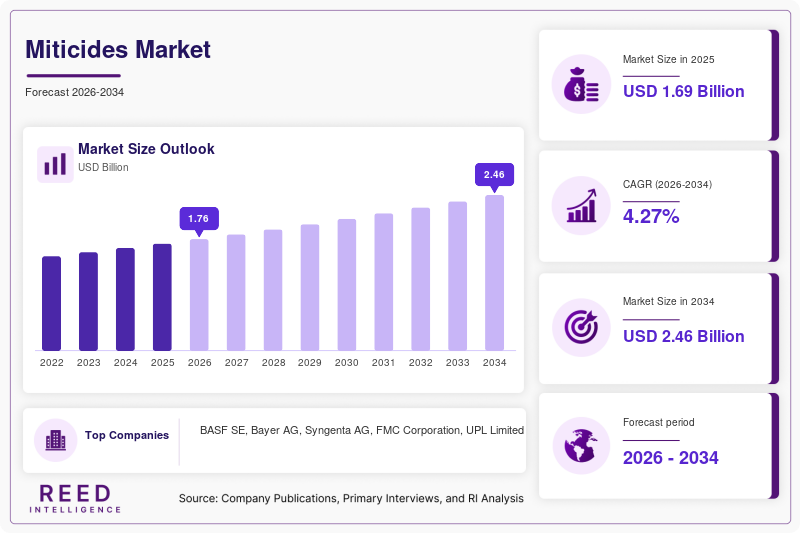
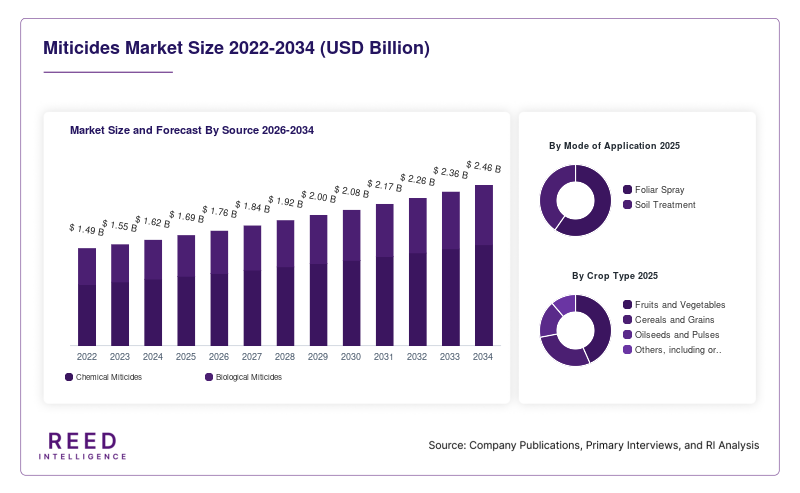
The global miticides market was valued at USD 1.69 billion in 2025 and is projected to grow from USD 1.76 billion in 2026 to USD 2.46 billion by 2034, registering a compound annual growth rate (CAGR) of 4.27% during the forecast period (2026–2034).
The Miticides Market comprises agricultural crop-protection products designed to control mites that damage crops, ornamental plants, and other cultivated vegetation. These products help manage mite infestations that can reduce crop yields, affect plant health, and lower the commercial quality of agricultural produce. Miticides are used across horticulture, fruit and vegetable production, field crops, greenhouses, and specialized cultivation environments.
Market growth is supported by increasing demand for crop protection, the economic impact of mite infestations, and the need to maintain crop quality and productivity. Mites can reproduce rapidly under favorable environmental conditions and may develop resistance to certain active ingredients, encouraging farmers to adopt effective pest-management strategies and rotate products with different modes of action.
Miticides Market Drivers
Increasing Crop Losses Caused by Mite Infestations
Mite infestations can damage leaves, stems, and fruit, affecting crop growth, appearance, and productivity. These effects are particularly important in high-value horticultural crops, where even limited surface damage can reduce marketability. Farmers increasingly rely on miticides to protect crop quality, manage pest populations, and limit losses during critical growing periods.
Growing Demand for High-Quality Fruits and Vegetables
Demand for visually appealing and high-quality fruits and vegetables is supporting the use of effective crop-protection solutions. Mites can cause visible blemishes and reduce the quality of marketable produce, creating economic pressure on growers to manage infestations. Commercial horticulture and greenhouse production therefore represent important areas of demand for miticides.
Expansion of Commercial Agriculture and Crop Protection Practices
The expansion of commercial farming, protected cultivation, and intensive horticultural production is increasing the importance of reliable pest-management programs. Farmers need products that can control mites across different crop varieties and growing conditions. Miticides support these efforts by helping manage infestations and maintain agricultural productivity as crop-protection practices become more systematic.
Miticides Market Restraints
Regulatory Restrictions and Environmental Concerns
Miticides are subject to regulatory requirements covering product registration, permitted uses, application instructions, and potential risks to human health and the environment. Manufacturers must provide appropriate safety and efficacy data to obtain and maintain approvals. Changes in regulatory requirements can increase development costs and restrict the use of particular active ingredients or formulations.
Development of Resistance in Mite Populations
Repeated use of the same active ingredient or mode of action can contribute to resistance in mite populations. Resistance may reduce product effectiveness and require growers to change treatment schedules, rotate products, or use integrated pest-management approaches. These challenges can increase crop-protection costs and create ongoing research requirements for manufacturers.
High Product Development and Compliance Costs
Developing new miticides requires research, field testing, formulation development, safety assessments, and regulatory submissions. These processes can take considerable time and financial investment. Smaller manufacturers may face difficulties competing with established agrochemical companies that have larger research and development budgets, extensive distribution networks, and established regulatory capabilities.
Miticides Market Opportunities
Growing Adoption of Biological Miticides
Biological miticides offer opportunities for manufacturers developing crop-protection solutions based on biological organisms, naturally derived substances, or other biological control mechanisms. Their use can complement integrated pest management programs and support growers seeking alternatives to conventional chemical treatments. Continued product development and appropriate application guidance may expand their use in horticulture and protected cultivation.
Expansion of Greenhouse and Protected Cultivation
Greenhouse production creates opportunities for targeted mite-control products because crops grown in protected environments may require close pest monitoring and carefully managed treatment programs. Vegetables, berries, ornamentals, and other high-value crops can be particularly sensitive to mite damage. Manufacturers offering products suited to greenhouse conditions and crop-specific requirements may benefit from this demand.
Development of New Active Ingredients and Integrated Pest Management Solutions
Research into new active ingredients, improved formulations, and alternative modes of action creates opportunities to address resistance and improve mite control. Manufacturers can also strengthen their offerings through resistance-management guidance and products compatible with integrated pest management. These approaches can help growers balance pest-control effectiveness with crop safety and responsible pesticide use.
Miticides Market Segmental Analysis
By Source
Chemical miticides represent the dominant source segment in the global market. Their position is supported by established use in commercial crop protection, broad availability, and the ability of certain active ingredients to deliver rapid control of targeted mite populations. Their effectiveness across a range of agricultural and horticultural settings supports continued demand.
Biological miticides are an important alternative and complementary category. Interest in these products is supported by the development of integrated pest management programs and demand for crop-protection approaches that can reduce reliance on conventional chemicals. Biological products may be especially relevant in greenhouse cultivation and other settings where growers closely manage pest populations and application practices. The biological segment is expected to grow significantly, although a comparable, independently verified growth rate is not available in the cited market summary.
By Mode of Application
Foliar spray represents the dominant application segment in the cited market analysis. Foliar applications allow growers to treat plant surfaces where many mite infestations occur, including leaf undersides and other exposed plant areas. This method is widely applicable across horticultural crops and can be integrated into existing crop-protection routines.
Soil treatment offers an alternative for specific mite-control requirements and pest life cycles. It may be used where the target pest or crop-management approach makes soil-directed application suitable. The cited market analysis identifies soil treatment as a method expected to record high growth, but a comparable numerical segment CAGR is not available in the accessible summary.
By Crop Type
Fruits and vegetables represent the dominant crop-type segment in the cited market analysis. These crops can be particularly vulnerable to mite damage because infestations may affect both plant health and the visual quality of harvested produce. Their commercial value and sensitivity to surface blemishes support demand for effective mite-management solutions.
Cereals and grains also contribute to market demand because mite-related crop damage can affect yields and farm profitability. Oilseeds and pulses provide additional applications, while ornamental plants and other cultivated crops may require specialized products depending on the pest species and growing environment.
The cited market analysis indicates that cereals and grains are expected to grow significantly over the forecast period. However, the available source does not provide a comparable numerical growth rate sufficient to establish the fastest-growing crop segment conclusively.
Miticides Market Regional Analysis
North America Miticides Market
North America is identified as the dominant regional market in the cited Miticides Market analysis. The region benefits from established agricultural production, commercial horticulture, and substantial cultivation of fruits, vegetables, and oilseeds. Growers use miticides to protect crop quality and reduce losses associated with mite infestations. Integrated pest management, product innovation, and regulatory oversight also influence product selection and market development. a published market analysis estimated that North America accounted for 34% of global miticides market revenue in 2025.
Europe Miticides Market
Europe is an important market for miticides, supported by commercial fruit and vegetable production, greenhouse cultivation, and established crop-protection distribution networks. Growers must manage mite populations while meeting regulatory requirements and crop-quality expectations. These factors support demand for both conventional miticides and alternatives suitable for integrated pest management.
Product registration requirements and environmental considerations influence the availability and use of active ingredients across European markets. Manufacturers must adapt product portfolios to local crop needs, permitted uses, and regulatory standards.
Asia Pacific Miticides Market
Asia Pacific represents an important growth market due to the region’s large agricultural base, horticultural production, and demand for crop-protection products. China and India are major agricultural markets, while other countries contribute through fruit and vegetable cultivation, commercial farming, and protected cultivation. The scale and diversity of agricultural production create opportunities for both chemical and biological miticides.
A published market analysis identifies Asia Pacific as the region with the highest growth potential, citing a projected CAGR of approximately 8.0% for its stated forecast period. This estimate is source-specific and should not be interpreted as a verified growth rate for every country or crop segment in the region.
Latin America Miticides Market
Latin America offers opportunities for the miticides market through its agricultural production and cultivation of commercially valuable crops. Demand is influenced by crop mix, seasonal pest pressure, export quality requirements, and the availability of effective crop-protection products. Producers of fruits, vegetables, and other susceptible crops may require miticides as part of broader pest-management programs.
Market development also depends on product registration, farm purchasing power, distribution coverage, and access to technical guidance. Manufacturers that provide crop-specific application information and products suited to local production conditions may be better positioned to serve regional growers.
Middle East & Africa Miticides Market
The Middle East & Africa region presents opportunities associated with agricultural modernization, horticulture, greenhouse production, and the need to protect crops under varied climatic conditions. Mite-management requirements differ across countries according to crop types, growing environments, and seasonal pest pressures.
Market growth may be influenced by product affordability, regulatory frameworks, distribution infrastructure, and access to agronomic support. Protected cultivation and high-value crop production can create demand for specialized pest-control solutions, although adoption varies substantially across markets.

Miticides Market Competitive Landscape
The Miticides Market includes established agrochemical manufacturers and specialized biological crop-protection companies. Competition is shaped by product efficacy, active-ingredient portfolios, resistance-management requirements, regulatory approvals, research and development capabilities, and distribution networks. Companies seek to address crop-specific pest pressures through new formulations, expanded product registrations, and solutions designed for conventional and integrated pest management programs.
BASF SE is a major agricultural solutions company with a crop-protection portfolio that includes products for managing pests and diseases. In the miticides market, product development and crop-specific solutions help address mite infestations in horticultural and other agricultural applications. The company’s competitive position is supported by research and development capabilities, technical expertise, and an established global presence in agricultural inputs.
Key Market Players
- BASF SE
- Bayer AG
- Syngenta AG
- FMC Corporation
- UPL Limited
- Gowan Company LLC
- Valent BioSciences
- Certis USA
- BioWorks Inc.
- ADAMA Agricultural Solutions Ltd.
- Sumitomo Chemical Co. Ltd.
Miticides Market Recent Developments
- March 2026-Health Canada registers Nealta Miticide for greenhouse ornamentals Health Canada’s Pest Management Regulatory Agency granted registration for Nealta Miticide, containing cyflumetofen, to control spider mites on greenhouse ornamentals. The decision expands the approved use of the product and reflects continued regulatory evaluation of crop-protection products for specific pest-control applications.
- December 2025-Syngenta receives federal registration for Atexzo insecticide/miticide Syngenta announced that Atexzo, powered by PLINAZOLIN technology, received federal registration from the U.S. Environmental Protection Agency for use on golf courses, sod farms, and athletic turf. The product targets several pests, including bermudagrass mites, and represents an expansion of pest-control options for turf-management applications.
Miticides Market Segments
By Source
- Chemical Miticides
- Biological Miticides
By Mode of Application
- Foliar Spray
- Soil Treatment
By Crop Type
- Fruits and Vegetables
- Cereals and Grains
- Oilseeds and Pulses
- Others, including ornamental plants and other cultivated crops where included in the market definition
By Region
- North America
- Europe
- APAC
- Middle East and Africa
- LATAM