Mixed Fruit Jam Market Size, Share & Trends Analysis Report By Product Type (Premium Mixed Fruit Jam, Standard Mixed Fruit Jam, Organic Mixed Fruit Jam), By Application (Household Consumption, Food Service, Bakery and Pastry), By Distribution Channel (Supermarkets and Hypermarkets, Specialty Stores, Online Retail) and By Region (North America, Europe, Asia Pacific, Latin America, Middle East & Africa) Forecasts, 2026–2034
USD 3950
Mixed Fruit Jam Market Size
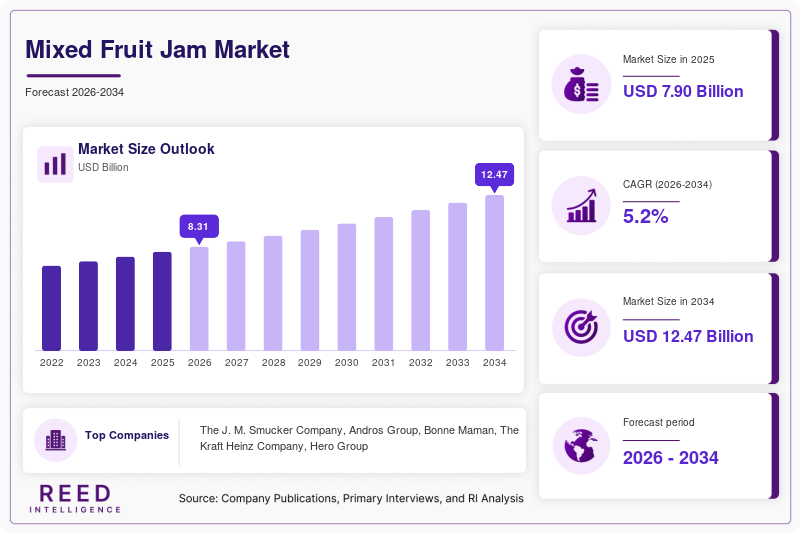
The global mixed fruit jam market was valued at USD 7.90 billion in 2025 and is projected to grow from USD 8.31 billion in 2026 to USD 12.47 billion by 2034, registering a compound annual growth rate (CAGR) of 5.2% during the forecast period from 2026 to 2034.
The Mixed Fruit Jam Market comprises fruit-based spreads manufactured using combinations of fruits, sweeteners, pectin, and other permitted ingredients. These products are consumed in households, bakeries, foodservice establishments, hotels, and commercial food-processing operations. Mixed fruit jam is used as a spread for bread and toast, a filling for pastries and bakery products, and an ingredient in desserts, snacks, and other prepared foods.
Market growth is supported by demand for convenient breakfast foods, increasing consumption of packaged spreads, expanding modern retail infrastructure, and the availability of different flavors, packaging formats, and price points. Manufacturers are offering standard, premium, and organic products to meet varying consumer preferences. Reduced-sugar formulations, clean-label positioning, fruit-content differentiation, and convenient packaging are also relevant product-development directions in the broader fruit-spread category.
Mixed Fruit Jam Market Drivers
Increasing Demand for Convenient Packaged Foods
Busy lifestyles and demand for easy-to-prepare breakfast and snack options support consumption of packaged fruit spreads. Mixed fruit jam offers a convenient accompaniment to bread, toast, crackers, and other foods while also serving as a versatile ingredient in household baking. Wider supermarket availability, packaged-food distribution, and growth in urban households can support continued market demand.
Expansion of Bakery, Pastry, and Foodservice Applications
Commercial bakeries, cafés, hotels, restaurants, and food manufacturers use fruit jam as a filling, topping, or flavor component in pastries, cakes, cookies, doughnuts, and desserts. Expansion of bakery retail and foodservice operations creates opportunities for manufacturers supplying bulk formats and consistent-quality fruit preparations. Demand from commercial users can complement household consumption and diversify revenue opportunities for producers.
Mixed Fruit Jam Market Restraints
Concerns About Sugar Content and Product Composition
Mixed fruit jam commonly contains added sugar, which may discourage some health-conscious consumers who are reducing sugar intake. Greater attention to nutrition labels and ingredient transparency can create pressure to reformulate products. Reduced-sugar alternatives may require adjustments to ingredients, processing, texture, preservation, and shelf-life management, potentially increasing production complexity and formulation costs.
Fluctuating Fruit and Packaging Costs
Fruit availability and prices can change because of weather conditions, seasonal production, crop disease, transportation disruption, and agricultural input costs. Sugar, glass jars, plastic containers, labels, and logistics also contribute to production expenses. Manufacturers may face margin pressure when these costs rise faster than retail prices, particularly in competitive mass-market segments where consumers are sensitive to price increases.
Mixed Fruit Jam Market Opportunities
Growth of Premium and Organic Fruit Spreads
Premiumization provides opportunities for manufacturers to differentiate products through fruit quality, distinctive flavor combinations, ingredient sourcing, packaging, and brand positioning. Organic and specialty offerings can appeal to consumers seeking particular production standards or differentiated food products. Success depends on credible product claims, suitable certification, consistent quality, and pricing that reflects the target customer's willingness to pay.
Expansion of Online Retail and Emerging Markets
Online grocery platforms and direct-to-consumer channels can improve access to specialty flavors, premium products, and imported brands. Growing modern retail coverage in emerging markets may also introduce packaged jam to more consumers and improve product availability beyond traditional retail outlets. Manufacturers can use channel-specific packaging, promotional strategies, and regional flavor preferences to reach additional consumer groups.
Mixed Fruit Jam Market Segmental Analysis
By Product Type
Standard mixed fruit jam serves consumers seeking familiar flavors, convenient packaging, and accessible pricing. Premium mixed fruit jam competes through product quality, distinctive fruit blends, texture, packaging, and brand positioning. Organic mixed fruit jam appeals to consumers looking for certified organic ingredients and particular sourcing standards. The performance of each category depends on retail pricing, ingredient costs, consumer preferences, and the strength of brand and private-label offerings.
A published market-specific estimate identifies premium mixed fruit jam as the dominant product segment, with an estimated 38.5% share in 2025. The estimate is reported by Dataintelo and should be treated as a third-party market estimate rather than independently audited industry data. Organic products are identified in the same source as a faster-growing category, with a reported CAGR of 8.4% for 2026–2034. These figures depend on that publisher's segment definitions and methodology.
By Application
Household consumption is an important application because mixed fruit jam is commonly used for breakfast, snacks, sandwiches, and home baking. Foodservice demand comes from restaurants, hotels, cafés, and other establishments incorporating jam into menus and prepared foods. Bakery and pastry applications include fillings and toppings for cakes, croissants, doughnuts, cookies, and other products manufactured by retail and industrial bakeries.
The relative performance of each application depends on household purchasing patterns, bakery production, foodservice activity, and demand from commercial food manufacturers. Dataintelo reports bakery and pastry as a notable application category, but a sufficiently comparable and independently verified leading-segment share and fastest-growing application CAGR cannot be confirmed across the available sources. Accordingly, no additional application-level percentages are presented as established facts.
By Distribution Channel
Supermarkets and hypermarkets play an important role by offering broad product assortments, shelf visibility, promotional pricing, and access to established jam brands. Specialty stores serve consumers seeking premium, organic, imported, or niche food products. Online retail provides convenient purchasing, home delivery, and opportunities for product discovery, although shipping costs and packaging requirements can affect the economics of selling glass jars and other fragile products.
Other channels include convenience stores, independent grocery retailers, wholesalers, and foodservice distributors. Channel performance varies by country, shopping habits, retailer concentration, and logistics infrastructure.

Mixed Fruit Jam Market Regional Analysis
Asia Pacific Mixed Fruit Jam Market
Asia Pacific is identified as the dominant region in Dataintelo's market-specific Mixed Fruit Jam Market report, accounting for an estimated 42.3% of global revenue in 2025. Applying this reported share to the supplied 2025 global market size of USD 7.90 billion gives an indicative regional value of approximately USD 3.34 billion. This regional value is derived by calculation, not an independently reported regional revenue figure. Both figures should be treated as third-party estimates.
Regional demand is supported by urbanization, wider availability of packaged foods, modern grocery retail, and use of jam in household breakfasts and bakery products. India, China, Japan, and Southeast Asian markets have different consumption patterns and price sensitivities, creating opportunities for standard, premium, and specialty products. Market expansion will depend on affordability, distribution reach, local taste preferences, product quality, and the ability of manufacturers to manage ingredient costs. Dataintelo projects Asia Pacific to grow faster than the global market, but its reported regional CAGR remains a publisher estimate rather than an independently validated industry figure.
Europe Mixed Fruit Jam Market
Europe represents an established market for jams and fruit preserves, supported by longstanding consumption traditions, developed grocery distribution, and a strong bakery and pastry sector. Consumers have access to established brands, regional specialties, premium products, and retailer private labels. Demand for fruit spreads is influenced by breakfast habits, home baking, specialty food purchases, and commercial use in pastries and desserts.
Product formulation, ingredient transparency, packaging, and nutrition labeling are important competitive considerations. Producers may find opportunities in premium flavors, organic offerings, reduced-sugar products, and convenient packaging. However, market maturity, private-label competition, and changing dietary preferences can constrain volume growth.
North America Mixed Fruit Jam Market
North America is an important market for packaged fruit spreads, supported by established grocery chains, recognized brands, foodservice distribution, and household use in breakfast and baking applications. The United States is a major market, while Canada and Mexico contribute through their respective retail and food manufacturing industries. Product choice spans standard jam, premium fruit spreads, organic products, and alternatives with reduced or no added sugar.
Competition is influenced by brand loyalty, promotions, shelf placement, ingredient sourcing, and pricing. Manufacturers can pursue opportunities through differentiated flavors, convenient packaging, premium positioning, and products that respond to changing nutrition preferences. Nevertheless, consumer scrutiny of sugar content and competition from peanut butter, honey, chocolate spreads, and other breakfast toppings may affect demand.
Latin America Mixed Fruit Jam Market
Latin America offers opportunities as supermarkets, convenience stores, and packaged-food distribution expand in urban markets. Brazil, Mexico, and other countries contribute to demand through household consumption, bakery applications, and foodservice. Product affordability, familiar fruit flavors, pack sizes, and access to established retailers are important factors influencing purchasing behavior.
Regional market development is affected by household purchasing power, currency movements, fruit and sugar costs, and uneven distribution infrastructure. Manufacturers may benefit from local sourcing, suitable price points, regional flavor preferences, and partnerships with retailers and commercial bakeries.
Middle East & Africa Mixed Fruit Jam Market
The Middle East & Africa market is influenced by urban population growth, grocery retail development, tourism, hospitality, and demand from bakeries and foodservice establishments. Imported brands and locally distributed products compete across different price points. Consumer preferences vary considerably across countries, making regional distribution and product positioning important to market access.
Potential opportunities include supplying hotels, cafés, bakeries, supermarkets, and specialty food retailers with products suited to local purchasing preferences. However, import dependence, transportation costs, currency fluctuations, and differences in household purchasing power may constrain growth.

Mixed Fruit Jam Market Competitive Landscape
The Mixed Fruit Jam Market includes multinational food companies, established preserve brands, regional manufacturers, and private-label suppliers. Competition is based on taste, fruit quality, product consistency, brand recognition, price, packaging, retail availability, and the ability to meet consumer preferences for premium or alternative formulations.
The J. M. Smucker Company is a major North American participant in the fruit-spread category, with a broad portfolio of jams, jellies, preserves, and fruit spreads. Its product range includes traditional flavors, natural fruit spreads, and reduced-sugar or sugar-free options. The company competes through brand recognition, broad retail distribution, and products designed for household and foodservice uses.
Key Market Players
- The J. M. Smucker Company
- Andros Group
- Bonne Maman
- The Kraft Heinz Company
- Hero Group
- Wilkin & Sons Limited
- St. Dalfour
- Dabur India Limited
- Hindustan Unilever Limited
- B&G Foods, Inc.
- Orkla ASA
Mixed Fruit Jam Market Recent Developments
- December 2025 – Reliance Consumer Products relaunches SIL mixed fruit jam
Reliance Consumer Products relaunched the SIL foods brand as part of its packaged-food expansion in India. The portfolio included mixed fruit jam made with eight fruits and promoted as containing 22% more fruit, available in 100 g, 200 g, and 500 g packs. The launch highlights competition in value-oriented packaged spreads in the Indian market. - March 2026 – Smucker’s refreshes its fruit-spread packaging
The J. M. Smucker Company announced its first major fruit-spread packaging redesign in nearly 30 years. The refreshed jars feature more prominent gingham branding, brighter flavor-specific colors, and larger fruit imagery. The company said the recipe and product quality would remain unchanged. This is a packaging and brand-positioning development for the wider jam and fruit-spread category.
Mixed Fruit Jam Market Segments
By Product Type
- Premium Mixed Fruit Jam
- Standard Mixed Fruit Jam
- Organic Mixed Fruit Jam
- Other Products
By Application
- Household Consumption
- Food Service
- Bakery and Pastry
- Other Applications
By Distribution Channel
- Supermarkets and Hypermarkets
- Specialty Stores
- Online Retail
- Other Channels
By Region
- North America
- Europe
- APAC
- Middle East and Africa
- LATAM