Mixed Inhibitor Market Size, Share & Trends Analysis Report By Type (Organic Mixed Inhibitors, Inorganic Mixed Inhibitors), By Application (Oil & Gas, Water Treatment, Chemical Processing, Power Generation, and Others), By End-User (Industrial, Commercial, Residential) and By Region (North America, Europe, Asia Pacific, Latin America, Middle East & Africa) Forecasts, 2026–2034
USD 3950
Mixed Inhibitor Market Size
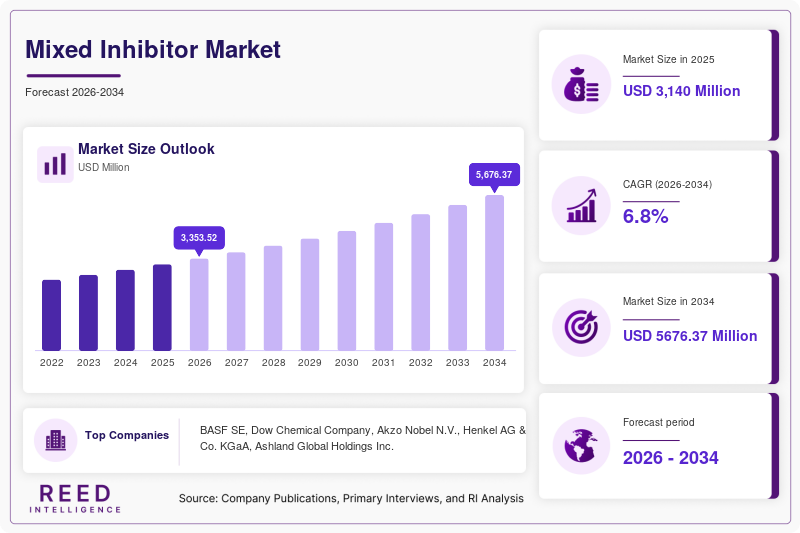
The global mixed inhibitor market was valued at USD 3,140 Million in 2025 and is projected to reach USD 5,676.37 Million by 2034, expanding at a CAGR of 6.8% from 2026 to 2034. The market is estimated to reach USD 3,353.52 Million in 2026, supported by increasing demand for corrosion and scale control across oil & gas, water treatment, chemical processing, and power generation industries.
Mixed inhibitors are formulated to address multiple equipment-protection challenges, particularly corrosion and scale formation, within industrial systems. They are increasingly used across oil and gas production, industrial and municipal water treatment, chemical processing, power generation, and other water-intensive applications where simultaneous control of mineral deposition and metal degradation is required. The market is moving toward higher-performance organic and hybrid formulations as industrial operators seek longer treatment intervals, improved operational reliability, and compliance with increasingly stringent environmental requirements.
The market is characterized by the presence of large diversified chemical manufacturers and specialized water-treatment and oilfield-chemical suppliers. Companies are increasingly differentiating through customized formulations, technical support, digital monitoring, and environmentally compliant chemistries. Asia Pacific represents the leading regional market, while North America remains an important market supported by established oil and gas production and industrial water-treatment infrastructure.
Mixed Inhibitor Market Drivers
Expansion of Oil & Gas Production and Infrastructure
Growing upstream oil and gas activity is increasing demand for mixed inhibitor solutions that protect production wells, flowlines, water injection systems, and other equipment from simultaneous corrosion and scale formation. Deepwater, unconventional, and high-salinity production environments require more sophisticated inhibitor formulations capable of maintaining performance under demanding temperature, pressure, and water-chemistry conditions.
Increasing Industrial Water Recycling and Treatment
Industrial water scarcity and the expansion of closed-loop and recycled-water systems are increasing the requirement for effective scale and corrosion control. Higher concentrations of dissolved minerals in recycled water can accelerate deposition and corrosion, encouraging industrial operators to adopt combined inhibitor programs for cooling systems, pipelines, heat exchangers, and other water-intensive equipment.
Growing Environmental and Regulatory Requirements
Environmental regulations restricting hazardous or heavy-metal-containing treatment chemistries are encouraging manufacturers and end users to transition toward organic, zinc-free, chromium-free, and other environmentally compliant inhibitor formulations. This trend is supporting innovation in biodegradable and lower-toxicity chemistry while creating replacement opportunities for legacy inhibitor systems.
Mixed Inhibitor Market Restraints
Volatility in Raw Material Prices
Mixed inhibitor formulations depend on specialty chemicals, phosphonates, polymers, amines, and other raw materials whose prices can fluctuate with energy costs, feedstock availability, transportation expenses, and supply-chain disruptions. Such volatility can place pressure on manufacturers' margins and increase treatment costs for industrial customers.
Environmental Restrictions on Conventional Chemistries
Although regulation is supporting demand for sustainable formulations, restrictions on certain conventional inhibitor components can also increase formulation, testing, certification, and compliance costs. Suppliers must continually adapt product portfolios to meet different regulatory requirements across regions and applications.
Availability of Alternative Treatment Technologies
Advanced filtration, electrochemical monitoring, water-treatment technologies, mechanical cleaning, and other approaches can reduce dependence on chemical inhibitors in selected applications. Increasing adoption of integrated treatment systems may therefore limit inhibitor consumption in certain mature industrial installations.
Mixed Inhibitor Market Opportunities
Development of Biodegradable and Sustainable Inhibitors
The transition toward environmentally compatible chemistry presents opportunities for suppliers developing biodegradable phosphonate alternatives, bio-based polymers, zinc-free formulations, and lower-toxicity inhibitor systems. Sustainable formulations can gain market share as customers seek to reduce environmental impact while maintaining corrosion and scale-control performance.
Expansion Across Emerging Asian Markets
Rapid industrialization in China, India, Southeast Asia, and other emerging markets is creating opportunities across oil and gas, chemical manufacturing, power generation, and industrial water treatment. New industrial facilities increasingly require sophisticated water and asset-protection systems, supporting demand for customized mixed inhibitor solutions.
Digital Monitoring and Customized Treatment Programs
Integration of inhibitor chemistry with real-time monitoring, automated dosing, analytical services, and digital optimization provides suppliers with opportunities to move beyond commodity chemical sales. Customized treatment programs can improve chemical efficiency while helping customers reduce downtime, maintenance costs, and equipment failures.
Mixed Inhibitor Market Segmental Analysis
By Type
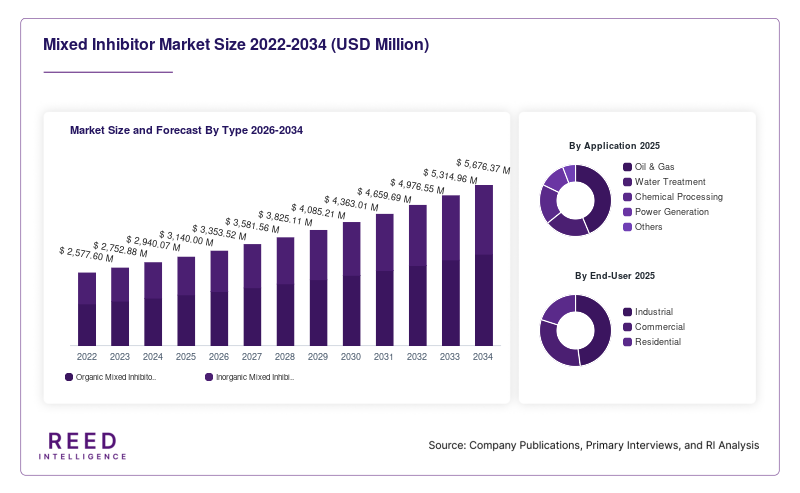
Organic mixed inhibitors dominated the market with approximately 62.1% share in 2025. Their strong position is supported by performance advantages in demanding oil and gas, chemical processing, and power-generation environments. Organic formulations offer effective scale control, corrosion protection, temperature tolerance, and increasing compatibility with environmental requirements. The segment is projected to grow at approximately 7.1% CAGR, making it the faster-growing type segment.
Inorganic mixed inhibitors accounted for approximately 37.9% share in 2025. Silicate-, molybdate-, and phosphate-based chemistries continue to be used in water treatment and industrial cooling applications where cost-effectiveness and compatibility with existing systems are important considerations. However, environmental restrictions on certain inorganic components are encouraging substitution toward organic alternatives in developed markets. The segment is projected to grow at approximately 6.3% CAGR.
By Application
Oil & Gas was the dominant application segment, accounting for approximately 35.2% of market revenue in 2025. Mixed inhibitors are used for production well protection, flowline corrosion mitigation, water injection, produced-water systems, and scale control. Increasing deployment in complex upstream environments is supporting continued demand, with the segment projected to reach approximately USD 1.92 billion by 2034.
Water Treatment represented approximately 28.6% share in 2025. Demand is supported by municipal water infrastructure, industrial cooling systems, recycled-water loops, desalination facilities, and water reuse programs. Growing water scarcity and increased recycling of industrial water are encouraging the use of more robust mixed inhibitor programs. The segment is projected to grow at approximately 6.7% CAGR.
Chemical Processing accounted for approximately 19.8% share in 2025. Petrochemical facilities, specialty chemical manufacturers, and pharmaceutical plants use mixed inhibitors to protect heat exchangers, process equipment, cooling systems, and other capital-intensive infrastructure. Expansion of chemical manufacturing capacity, particularly in Asia Pacific, is expected to support growth.
Power Generation represented approximately 12.1% share in 2025. Mixed inhibitors are used in boiler-water systems, economizers, cooling towers, and other water-handling equipment. Demand is supported by the need to improve equipment reliability and manage corrosion and scale under high-temperature and high-pressure operating conditions.
The Others segment accounted for approximately 4.3% share in 2025 and includes applications such as food processing equipment, HVAC systems, marine environments, and metalworking fluids. The segment is expected to experience comparatively slower growth as many niche applications are relatively mature.
By End-User
Industrial end-users dominated the market with approximately 71.2% share in 2025. The segment includes oil and gas operations, petrochemical facilities, specialty chemical manufacturers, power plants, and other large industrial installations requiring continuous and high-volume inhibitor treatment. Industrial applications are projected to grow at approximately 6.9% CAGR.
Commercial end-users accounted for approximately 21.4% share in 2025. The segment includes municipal utility systems, hospitality facilities, shopping centers, offices, and other medium-scale facilities using mixed inhibitors in cooling towers, HVAC systems, and closed-loop water systems. The segment is projected to grow at approximately 6.6% CAGR.
Residential end-users represented approximately 7.4% share in 2025, making it the smallest end-user segment. Applications include radiant heating systems, domestic hot-water systems, ground-source heat-pump loops, and shared residential cooling infrastructure. The segment is expected to grow at approximately 6.2% CAGR.
Mixed Inhibitor Market Regional Analysis
North America Mixed Inhibitor Market
North America represents a major market for mixed inhibitors, supported by mature oil and gas production, shale operations, industrial water treatment, and extensive chemical-processing infrastructure. The region has strong demand for advanced corrosion and scale-control formulations as operators seek to extend equipment life and comply with environmental requirements. North America accounted for approximately 28.3% market share in 2025.
Europe Mixed Inhibitor Market
Europe represents a technologically advanced market characterized by stringent environmental requirements and strong demand for sustainable and compliant inhibitor chemistry. Replacement of conventional formulations and increasing adoption of biodegradable, low-toxicity, and heavy-metal-free products are supporting market opportunities across industrial water treatment and chemical processing.
Asia Pacific Mixed Inhibitor Market
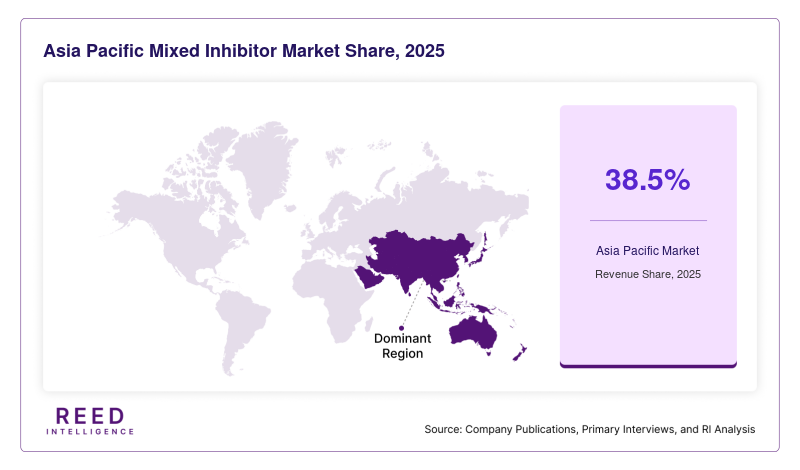
Asia Pacific dominated the Mixed Inhibitor Market with 38.5% of global revenue in 2025. Growth is supported by rapid industrialization, expanding oil and gas production, chemical manufacturing, power-generation infrastructure, and increasing water-treatment requirements across China, India, Southeast Asia, and other emerging economies. Petrochemical and industrial complexes throughout the region require mixed inhibitors for cooling-water systems, heat exchangers, pipelines, and process equipment.
Latin America Mixed Inhibitor Market
Latin America presents growth opportunities driven by oil and gas development, particularly offshore production, alongside chemical-processing and industrial water-treatment expansion. Brazil's deepwater and pre-salt activities create demand for corrosion and scale-control solutions capable of operating under demanding subsea and high-salinity conditions.
Middle East & Africa Mixed Inhibitor Market
Middle East & Africa represents an important opportunity region because of its concentration of oil and gas production, petrochemical facilities, desalination infrastructure, and water-intensive industrial operations. Expansion of integrated energy projects and water-treatment infrastructure is expected to support demand for mixed inhibitor formulations through the forecast period.
Regional Share Note: The Asia Pacific share of approximately 38.5% in 2025 is based on the third-party Dataintelo market estimate and is presented separately from the global market-size figures provided for this report.
Mixed Inhibitor Market Competitive Landscape
The Mixed Inhibitor Market is moderately consolidated, with leading chemical and water-treatment companies competing through broad product portfolios, formulation expertise, technical services, geographic distribution, and customized treatment programs. Major participants are increasingly focusing on sustainable chemistry, digital monitoring, corrosion-management services, and integrated treatment solutions. BASF SE and Dow Chemical Company are identified as leading companies in the market, while Akzo Nobel, Henkel, Ashland, Ecolab, Kemira, Solenis, Cortec, Baker Hughes, and other specialized suppliers maintain significant positions.
BASF SE maintains a leading position through a broad portfolio of chemicals supporting water treatment, corrosion protection, scale control, oil and gas, and industrial applications. In May 2026, BASF strengthened its North American water-treatment portfolio by introducing NSF/ANSI/CAN 60-certified sodium metabisulfite and sodium sulfite grades for municipal, industrial, and formulated water-treatment applications. BASF states that its water-treatment portfolio supports corrosion protection and scale-control applications in addition to dechlorination, oxygen scavenging, and pH control.
Key Market Players
- BASF SE
- Dow Chemical Company
- Akzo Nobel N.V.
- Henkel AG & Co. KGaA
- Ashland Global Holdings Inc.
- Ecolab Inc.
- Kemira Oyj
- Solenis LLC
- Cortec Corporation
- ChemTreat Inc.
Mixed Inhibitor Market Recent Developments
- May 2026- BASF introduced NSF/ANSI/CAN 60-certified sodium metabisulfite and sodium sulfite grades in North America. The products are intended for municipal, industrial, and formulated water-treatment applications, with BASF highlighting their relevance to corrosion protection, scale control, oxygen scavenging, and other water-treatment processes. The development strengthens BASF's portfolio of certified chemistry for regulated water-treatment applications.
- April 2026 -Baker Hughes received publication of a patent application covering additives designed to enhance wear-control performance of oilfield corrosion inhibitors. The application describes inhibitor formulations combining components such as fatty acids, surfactants, imidazoline, phosphate esters, and quaternary amines, highlighting continued development of multifunctional chemistry for oilfield corrosion protection.
Mixed Inhibitor Market Segments
By Type
- Organic Mixed Inhibitors
- Inorganic Mixed Inhibitors
By Application
- Oil & Gas
- Water Treatment
- Chemical Processing
- Power Generation
- Others
By End-User
- Industrial
- Commercial
- Residential
By Region
- North America
- Europe
- APAC
- Middle East and Africa
- LATAM