Mixed Reality Market Size, Share & Trends Analysis Report By Component (Hardware and Software), By Application (Automotive & Aerospace, Healthcare, Entertainment, E-commerce & Retail, and Others) and By Region (North America, Europe, Asia Pacific, Latin America, Middle East & Africa) Forecasts, 2026–2034
USD 3950
Mixed Reality Market Size
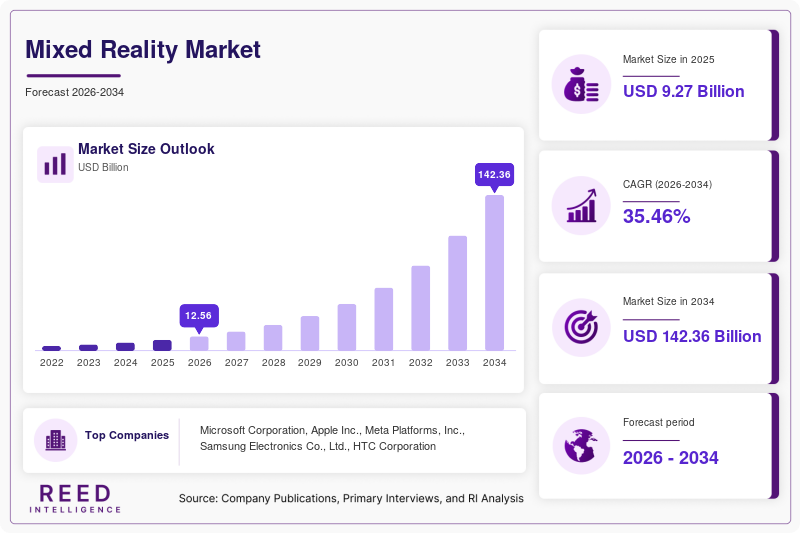
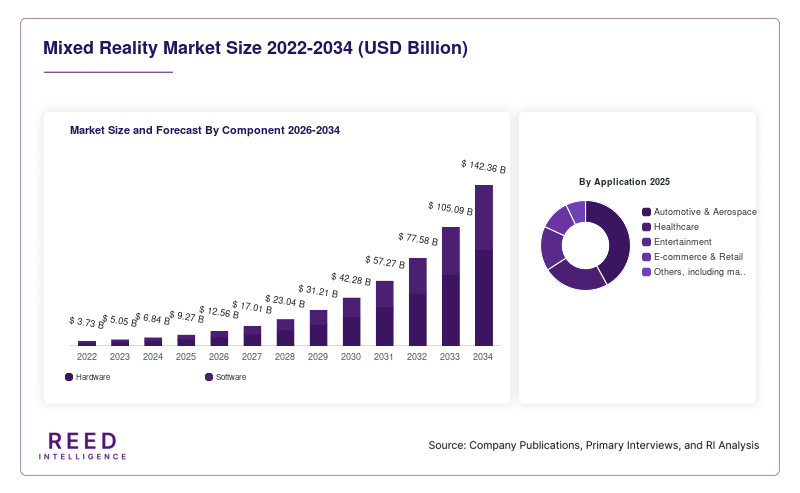
The global mixed reality market was valued at USD 9.27 billion in 2025 and is projected to grow from USD 12.56 billion in 2026 to USD 142.36 billion by 2034, registering a compound annual growth rate (CAGR) of 35.46% during the forecast period from 2026 to 2034.
The Mixed Reality Market comprises hardware, software, and related solutions that combine physical environments with interactive digital content. Mixed reality technologies use spatial mapping, environmental sensing, motion tracking, advanced displays, and real-time computing to position digital objects within a user's surroundings. These capabilities allow users to interact with virtual content while remaining aware of their physical environment.
Mixed reality is gaining attention across manufacturing, automotive, aerospace, healthcare, education, entertainment, retail, and defense. Businesses use the technology for product design, virtual prototyping, employee training, remote assistance, equipment maintenance, and digital-twin visualization. Healthcare organizations can use mixed reality for anatomical visualization, medical education, and surgical planning, while retailers can provide immersive product demonstrations and interactive shopping experiences.
Mixed Reality Market Drivers
Increasing Adoption of Immersive Technologies Across Industries
Organizations are increasingly evaluating mixed reality for training, simulation, product development, remote collaboration, and technical support. The technology allows workers to view interactive 3D models and digital instructions within real environments. In manufacturing and aerospace, this can support equipment assembly, design reviews, and maintenance training. Healthcare and education organizations are also exploring immersive visualization to explain complex concepts and improve practical learning experiences.
Advancements in Spatial Computing, Artificial Intelligence, and Hardware
Improvements in spatial tracking, depth sensing, display resolution, processing performance, and gesture recognition are expanding the capabilities of mixed reality devices. Artificial intelligence can enhance object recognition, contextual assistance, and interaction with digital environments. Better integration of hardware and software enables more realistic and responsive experiences, creating opportunities for enterprise applications, immersive entertainment, and collaborative engineering. These advancements may encourage organizations to move beyond pilot projects toward broader deployments.
Mixed Reality Market Restraints
High Device Costs and Infrastructure Requirements
Mixed reality headsets and supporting systems can require substantial initial investment. Enterprise deployments may also involve software licenses, application development, network upgrades, device management, and employee training. Organizations must evaluate these expenses against measurable improvements in productivity, safety, training efficiency, or customer engagement. High total ownership costs can slow adoption among small and medium-sized businesses and organizations with limited technology budgets.
User Comfort, Privacy, and Technical Limitations
Device weight, battery life, field of view, visual fatigue, and extended-use comfort can affect user acceptance. Mixed reality systems may also collect spatial, visual, and behavioral data, creating privacy and cybersecurity concerns. Technical limitations, including inconsistent tracking in complex environments and difficulties integrating applications with existing systems, can complicate deployment. Addressing these issues is essential for organizations seeking reliable, scalable mixed reality solutions.
Mixed Reality Market Opportunities
Expansion of Industrial Training, Digital Twins, and Remote Assistance
Manufacturing, construction, automotive, and aerospace companies can use mixed reality to visualize equipment, guide workers through procedures, and support remote technical assistance. Digital twins and interactive 3D models can help engineering teams review designs and simulate production workflows before physical implementation. Vendors that develop industry-specific applications, integrate with enterprise software, and demonstrate operational benefits may find opportunities to expand adoption.
Growing Applications in Healthcare, Education, and Retail
Mixed reality creates opportunities in medical education, anatomical visualization, clinical planning, immersive learning, virtual product demonstrations, and interactive shopping. Healthcare providers can use 3D visualization to explain anatomy and support professional training, while educators can develop interactive lessons around complex subjects. Retailers can explore immersive product visualization and spatial shopping experiences. More affordable hardware and easier application development could expand adoption across these industries.
Mixed Reality Market Segmental Analysis
By Component
Hardware represents a fundamental component of the Mixed Reality Market because immersive experiences require head-mounted displays, cameras, spatial sensors, processors, tracking systems, and related equipment. Hardware performance influences display quality, responsiveness, tracking accuracy, field of view, battery life, and user comfort. Enterprise users often evaluate device durability and compatibility with industrial or clinical workflows, while consumer users place greater emphasis on comfort, price, content availability, and ease of use.
Hardware is identified as the dominant component in a published market analysis. Software is also strategically important because it enables application development, spatial mapping, digital-twin integration, content creation, and collaboration. Software can offer recurring revenue opportunities as organizations expand deployments and require customized applications. However, the fastest-growing component and its precise CAGR cannot be confirmed across the same market definition from independently comparable data.
By Application
Automotive and aerospace applications include virtual prototyping, engineering design, assembly planning, maintenance, and workforce training. Mixed reality allows teams to visualize complex components and interact with 3D models in real-world settings. Healthcare applications include medical education, anatomical visualization, surgical planning, and clinical training. Entertainment applications include immersive gaming and interactive experiences, while e-commerce and retail use cases focus on product visualization, virtual demonstrations, and spatial shopping.
Industrial and manufacturing applications are also important because mixed reality can support guided assembly, equipment servicing, quality inspection, and remote expert assistance. A published market analysis identifies industrial and manufacturing applications as the largest category, with an estimated 32.5% share in 2025 under its own market definition. This figure is not independently verified for the market valuation used in this report.
Mixed Reality Market Regional Analysis
North America Mixed Reality Market
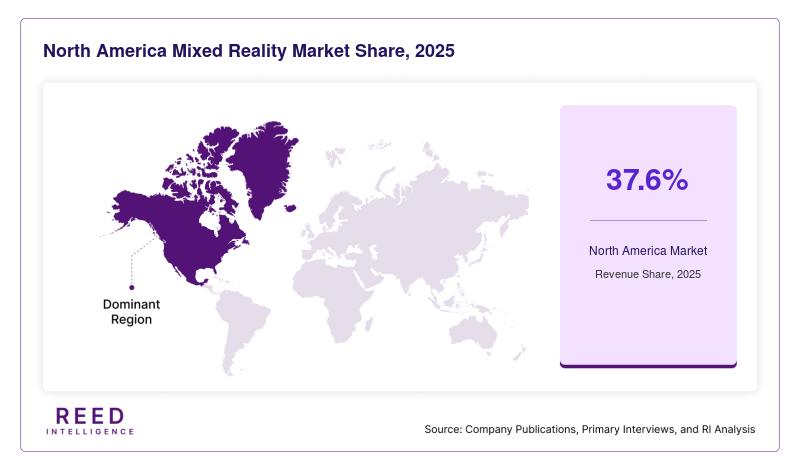
North America is the dominant region in the Mixed Reality Market, with a reported 37.6% revenue share in 2025 according to IMARC Group's market estimate. This is a third-party estimate from a report that uses a different global market valuation from the USD 9.27 billion supplied for this report, so the percentage should be treated as indicative rather than an independently reconciled share of the supplied market size. Regional leadership is supported by technology investment, research and development capabilities, enterprise adoption, and the presence of major spatial computing and immersive technology companies. The United States is a major contributor, with mixed reality applications across healthcare, aerospace, manufacturing, entertainment, education, and defense.
The regional outlook is supported by enterprise digital transformation, investment in immersive hardware and software, and the development of industry-specific applications. Businesses are exploring mixed reality for training, engineering collaboration, remote support, and digital-twin visualization. Continued product innovation and improved developer ecosystems may support wider use. However, high device costs, privacy requirements, and the need to demonstrate measurable business benefits remain important considerations.
Europe Mixed Reality Market
Europe is an established market for mixed reality technologies, supported by advanced manufacturing, automotive engineering, aerospace capabilities, healthcare infrastructure, and research institutions. Germany, the United Kingdom, France, and other European markets offer opportunities for applications in product design, factory training, maintenance, medical education, and immersive retail. Industrial organizations can use mixed reality to visualize engineering models, train employees, and support collaboration across geographically distributed teams.
Regional adoption depends on enterprise investment, application availability, workforce training, data protection, and integration with existing systems. Automotive and industrial companies are particularly relevant potential users because of their need for precise visualization and complex technical training.
Asia Pacific Mixed Reality Market
Asia Pacific offers substantial growth opportunities as countries invest in digital transformation, advanced manufacturing, consumer electronics, healthcare modernization, and immersive entertainment. China, Japan, South Korea, and India are important markets, with different strengths in hardware production, software development, industrial applications, and digital content. Mixed reality can support factory training, engineering visualization, educational experiences, and interactive consumer applications.
Regional development is influenced by hardware affordability, local content availability, developer ecosystems, connectivity, and enterprise readiness. Manufacturing scale and technology investment may support adoption, while cost-sensitive buyers may require more affordable devices and practical business cases.
Latin America Mixed Reality Market
Latin America presents opportunities for mixed reality adoption in manufacturing, education, healthcare training, retail, and technical services. Brazil and Mexico are relevant markets for enterprise digitalization and immersive applications. Universities and training institutions can use 3D learning environments, while industrial organizations can explore remote assistance and interactive technical guidance. Retailers may also use mixed reality for product visualization and customer engagement.
Adoption may be constrained by hardware costs, limited access to specialized expertise, connectivity differences, and the cost of developing localized applications. Partnerships with regional system integrators, training providers, and software developers can help organizations implement practical use cases. A comparable independently verified regional market share and CAGR for Latin America are unavailable for the precise market definition used here.
Middle East & Africa Mixed Reality Market
The Middle East & Africa market is influenced by investment in smart infrastructure, healthcare modernization, digital education, construction, and industrial technology. The United Arab Emirates and Saudi Arabia are relevant markets for immersive applications in architecture, real estate, training, tourism, and large infrastructure projects. Mixed reality can help organizations visualize buildings and equipment, deliver technical training, and support collaboration across complex projects.
Market development varies according to technology budgets, digital infrastructure, local content, and access to skilled implementation partners. Organizations may prioritize targeted applications with clear benefits, such as construction visualization, industrial maintenance, and professional training.
Mixed Reality Market Competitive Landscape
The Mixed Reality Market includes hardware manufacturers, operating-system and platform developers, enterprise software providers, spatial computing companies, and specialist application developers. Competition centers on display quality, spatial tracking, device comfort, processing performance, software ecosystems, enterprise integration, and the availability of compelling applications.
Microsoft Corporation has played a significant role in enterprise mixed reality through its HoloLens devices and associated software ecosystem. Its broader enterprise technology portfolio, including cloud and collaboration services, has supported mixed reality-related development and industrial applications. Enterprise adoption depends on device availability, software support, integration requirements, and the practical value delivered in training and operational workflows.
Key Market Players
- Microsoft Corporation
- Apple Inc.
- Meta Platforms, Inc.
- Samsung Electronics Co., Ltd.
- HTC Corporation
- Magic Leap, Inc.
- Canon Inc.
- Seiko Epson Corporation
- Unity Technologies
- PTC Inc.
Mixed Reality Market Recent Developments
- October 2025 -Apple upgrades Vision Pro with the M5 chip: Apple introduced an updated Vision Pro featuring the M5 chip and a redesigned Dual Knit Band. The announcement highlighted improved display rendering, faster performance, extended battery life, and additional spatial experiences through visionOS 26. These upgrades demonstrate continued development in spatial computing hardware and user experience.
- June 2025 -Apple previews visionOS 26: Apple announced new spatial widgets, enhanced Personas, spatial scenes, shared spatial experiences, and enterprise APIs for Vision Pro. The update also introduced support for immersive video from selected action cameras and additional developer capabilities. These features expand opportunities for consumer, collaborative, and enterprise spatial applications.
Mixed Reality Market Segments
By Component
- Hardware
- Software
By Application
- Automotive & Aerospace
- Healthcare
- Entertainment
- E-commerce & Retail
- Others, including manufacturing, education, defense, construction, and industrial training
By Region
- North America
- Europe
- APAC
- Middle East and Africa
- LATAM