Mixed Signal Market Size, Share & Trends Analysis Report By Product Type (Analog Signal Processing, Digital Signal Processing, Mixed-Mode Integrated Circuits, and Others), By Application (Consumer Electronics, Industrial Automation, Telecommunications, Automotive, Healthcare, and Others) and By Region (North America, Europe, Asia Pacific, Latin America, Middle East & Africa) Forecasts, 2026–2034
USD 3950
Mixed Signal Market Size
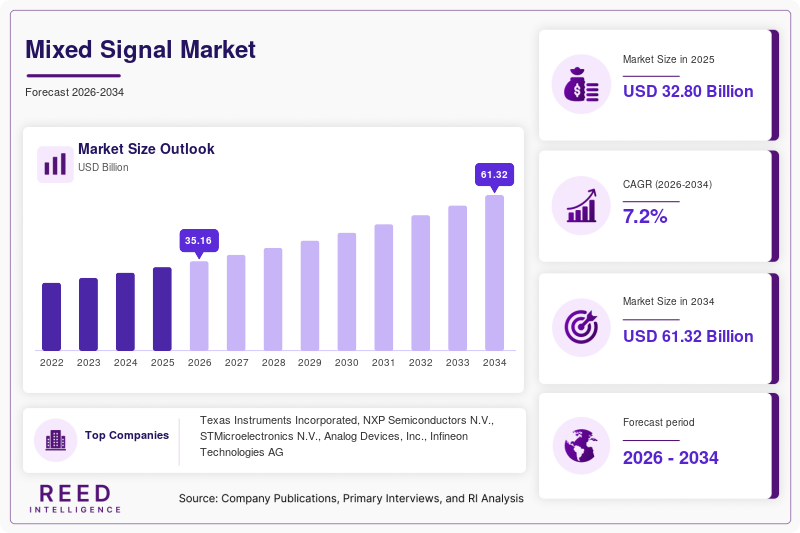
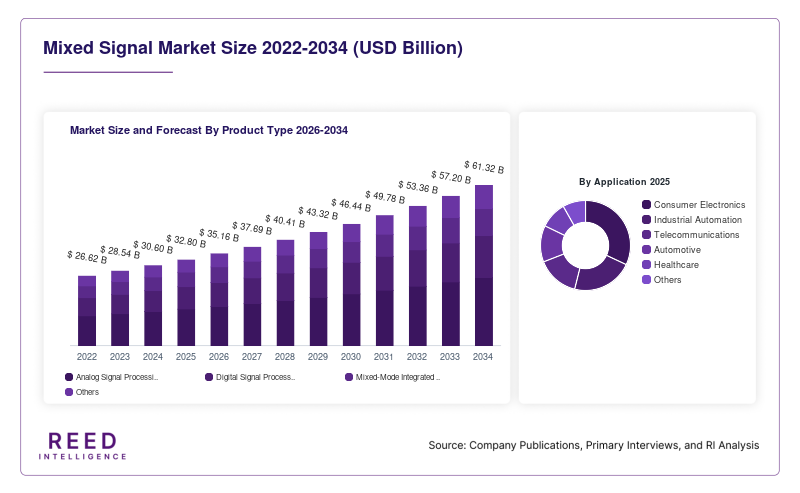
The global mixed signal Market was valued at USD 32.80 Billion in 2025 and is estimated to reach USD 35.16 Billion in 2026. The market is projected to reach USD 61.32 Billion by 2034, expanding at a CAGR of 7.2% during the forecast period 2026–2034.
The Mixed Signal Market includes semiconductor and integrated circuit technologies that combine analog and digital signal-processing functions within a common device or system. These technologies are essential for converting, conditioning, processing, and transmitting signals generated by sensors, communication systems, control systems, and electronic devices.
The market is expanding as electronics become increasingly connected, intelligent, and automated. Consumer electronics, industrial automation, telecommunications infrastructure, electric vehicles, advanced driver-assistance systems, healthcare equipment, and smart industrial systems require mixed signal components to bridge physical-world inputs with digital processing architectures.
Mixed Signal Market Drivers
Rapid IoT and Connected Device Adoption
The expansion of the Internet of Things is increasing demand for mixed signal components capable of connecting sensors and physical devices with digital processors and communication networks. Smart home devices, industrial sensors, wearables, connected appliances, and intelligent monitoring systems increasingly require efficient analog-to-digital and digital-to-analog signal conversion.
Growth of Automotive Electronics and Electrification
The increasing electronic content of modern vehicles is creating significant demand for mixed signal solutions. Electric vehicles, advanced driver-assistance systems, radar, battery-management systems, infotainment, vehicle networking, and software-defined vehicle architectures require integrated analog and digital processing capabilities. Automotive electronics therefore represent an important growth area for mixed signal semiconductor suppliers.
Expansion of 5G and Advanced Communication Infrastructure
The deployment of 5G networks and high-speed communication infrastructure is increasing requirements for high-performance data converters, RF interfaces, signal processors, and mixed signal transceivers. Higher bandwidth and increasingly complex communication systems are encouraging semiconductor manufacturers to develop devices capable of handling high-speed analog and digital signals within increasingly compact architectures.
Mixed Signal Market Restraints
Complexity of Mixed Signal Design
Mixed signal semiconductor development requires expertise in both analog and digital circuit design. Managing noise, signal integrity, power consumption, thermal characteristics, process variations, and interference can increase development complexity and engineering costs.
High Semiconductor Development and Manufacturing Costs
Advanced mixed signal products require substantial investment in semiconductor design, testing, fabrication, packaging, and qualification. Increasing technology requirements can raise capital requirements and create barriers for smaller semiconductor manufacturers.
Supply Chain and Semiconductor Manufacturing Constraints
Mixed signal semiconductor production remains exposed to fluctuations in semiconductor manufacturing capacity, raw-material availability, fabrication constraints, geopolitical uncertainty, and logistics disruptions. Such factors can affect lead times and production costs across the supply chain.
Mixed Signal Market Opportunities
Expansion of Edge AI and Intelligent Devices
The increasing deployment of artificial intelligence at the edge is creating opportunities for mixed signal technologies that combine sensing, signal conversion, processing, and connectivity. Edge AI devices require efficient integration of analog inputs with digital processing and machine-learning capabilities.
Growth of AI Data Centers and High-Speed Infrastructure
The rapid expansion of AI computing infrastructure is creating demand for advanced power monitoring, high-speed data conversion, connectivity, and signal-management technologies. Semiconductor suppliers are increasingly developing mixed signal solutions for data-center power delivery, telemetry, high-speed communications, and optical infrastructure.
Increasing Demand for Energy-Efficient Semiconductor Solutions
Energy efficiency is becoming increasingly important across consumer, automotive, industrial, and telecommunications applications. Mixed signal devices that reduce power consumption while improving signal accuracy, integration, and processing performance can benefit from increasing demand for energy-efficient electronic architectures.
Mixed Signal Market Segmental Analysis
By Product Type
Mixed-Mode Integrated Circuits represented the largest product segment, accounting for approximately 38.5% of the market in 2025. Their ability to integrate analog and digital functionality supports broad deployment across consumer electronics, industrial systems, automotive electronics, and telecommunications equipment. Analog Signal Processing also maintains a substantial position due to demand for signal conditioning and sensor-interface applications.
Digital Signal Processing continues to benefit from increasing data-processing requirements, while specialized mixed signal products serve application-specific requirements across healthcare, communications, industrial, and automotive systems.
By Application
Consumer Electronics represents the largest application segment, accounting for approximately 35.8% of the market. Smartphones, wearables, smart appliances, personal electronics, and connected devices require mixed signal components to process sensor inputs, manage power, and connect analog signals with digital processors.
Industrial Automation is another major application area as factories adopt connected sensors, intelligent controllers, robotics, machine monitoring, and automated production systems. Telecommunications demand is supported by 5G infrastructure, while automotive applications are expanding through electric vehicles, ADAS, radar, and software-defined vehicle architectures.
Mixed Signal Market Regional Analysis
Asia Pacific Mixed Signal Market
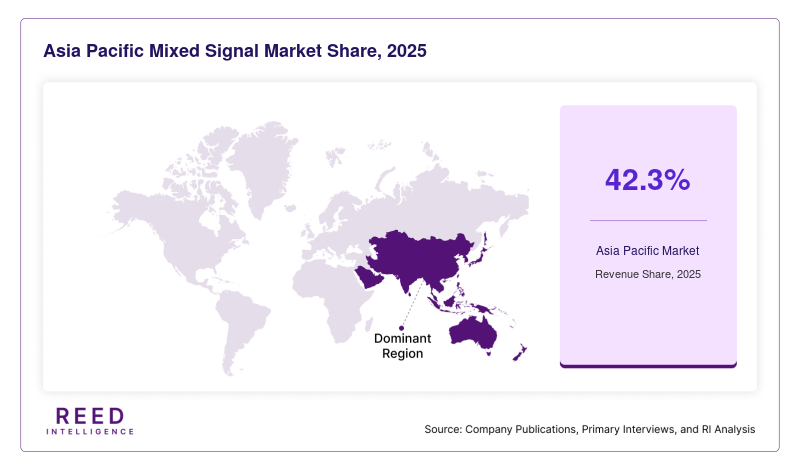
Asia Pacific dominated the global Mixed Signal Market with approximately 42.3% revenue share in 2025. The region benefits from its strong consumer electronics manufacturing base, semiconductor production capabilities, expanding telecommunications infrastructure, and growing adoption of industrial automation and electric vehicles. China, Taiwan, South Korea, Japan, and other Asian economies contribute substantially to regional demand and manufacturing activity.
North America Mixed Signal Market
North America represents a major market supported by established semiconductor companies, strong demand for advanced computing and telecommunications technologies, automotive electronics, industrial automation, and AI infrastructure. The region benefits from significant semiconductor R&D activity and the presence of leading mixed signal technology suppliers.
Europe Mixed Signal Market
Europe maintains a strong position due to its automotive manufacturing ecosystem, industrial automation capabilities, semiconductor expertise, and increasing investments in electrification and energy-efficient technologies. Germany, France, Italy, and other European markets contribute significantly to regional demand.
Latin America Mixed Signal Market
Latin America is expected to experience steady growth as digital infrastructure, consumer electronics penetration, industrial modernization, and telecommunications investment expand. Increasing adoption of connected technologies is creating additional opportunities for mixed signal semiconductor solutions.
Middle East & Africa Mixed Signal Market
The Middle East & Africa market is supported by investments in telecommunications, digital infrastructure, industrial modernization, smart-city projects, healthcare technology, and connected systems. Adoption remains smaller than in Asia Pacific, North America, and Europe but provides opportunities for long-term market expansion.
Mixed Signal Market Competitive Landscape
The Mixed Signal Market is competitive and includes large semiconductor manufacturers with extensive analog, digital, embedded-processing, RF, data-conversion, and power-management portfolios. Leading companies compete through product innovation, semiconductor manufacturing capabilities, application-specific solutions, strategic partnerships, acquisitions, and expansion into automotive, industrial, telecommunications, and AI infrastructure applications.
Texas Instruments is one of the leading participants in the mixed signal industry, with extensive portfolios covering data converters, analog components, embedded processing, microcontrollers, signal-chain products, and power-management technologies. In 2026, the company expanded its mixed signal and embedded-processing capabilities through new products and strategic initiatives. Its acquisition agreement for Silicon Labs further strengthens its position in embedded wireless connectivity and mixed signal solutions.
Key Market Players
- Texas Instruments Incorporated
- NXP Semiconductors N.V.
- STMicroelectronics N.V.
- Analog Devices, Inc.
- Infineon Technologies AG
- Renesas Electronics Corporation
- Microchip Technology Inc.
- ON Semiconductor Corporation
- Broadcom Inc.
- MediaTek Inc.
- Realtek Semiconductor Corp.
Mixed Signal Market Recent Market Developments
- October, 2026 -Texas Instruments introduced a high-performance ADC for AI data centers. Texas Instruments announced the ADC34DSO75, a 3 GSPS analog-to-digital converter designed for nanosecond-level telemetry and continuous monitoring of power-rail events in AI data centers. The development demonstrates increasing demand for high-speed mixed signal solutions in AI infrastructure.
- March, 2026 -STMicroelectronics expanded its 800 VDC AI data-center power portfolio. ST introduced new 12V and 6V architectures incorporating analog and mixed signal technologies alongside power semiconductors and microcontrollers to support next-generation AI data-center infrastructure.
Mixed Signal Market Segments
By Product Type
- Analog Signal Processing
- Digital Signal Processing
- Mixed-Mode Integrated Circuits
- Others
By Application
- Consumer Electronics
- Industrial Automation
- Telecommunications
- Automotive
- Healthcare
- Others
By Region
- North America
- Europe
- APAC
- Middle East and Africa
- LATAM