Mixer Grinder Market Size, Share & Trends Analysis Report By Product Type (Stand Mixer, Traditional Mixer, and Portable/Compact Mixer), By Application (Residential, Commercial, and Foodservice), By Distribution Channel (Online Stores, Multi-brand Stores, Exclusive Stores, and Others) and By Region (North America, Europe, Asia Pacific, Latin America, Middle East & Africa) Forecasts, 2026–2034
USD 3950
Mixer Grinder Market Size
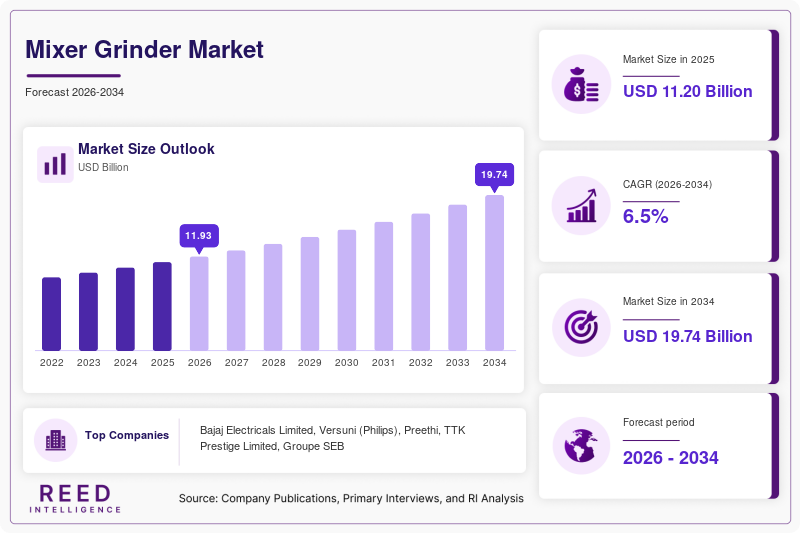
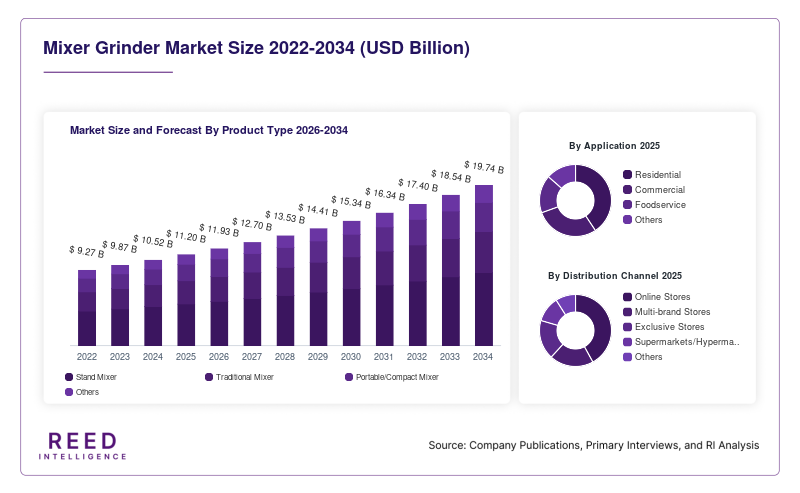
The global mixer grinder market was valued at USD 11.20 Billion in 2025 and is estimated to reach USD 11.93 Billion in 2026. The market is projected to reach approximately USD 19.74 Billion by 2034, expanding at a CAGR of 6.5% during 2026–2034.
Mixer grinders are multifunctional kitchen appliances designed to perform several food-preparation tasks using motor-driven blades, jars, and attachments. Depending on the configuration, products can perform wet grinding, dry grinding, blending, mixing, chopping, juicing, and batter preparation. The category includes traditional mixer grinders, stand mixers, portable or compact models, heavy-duty appliances, and multifunctional juicer-mixer combinations.
Demand is particularly strong in Asia Pacific, where mixer grinders are deeply integrated into household food preparation and are frequently used for spices, chutneys, batters, coconut products, and other ingredients. India represents a particularly important market because of high-frequency household usage and expanding appliance penetration.
Mixer Grinder Market Drivers
Growing Urbanization and Demand for Convenient Food Preparation:
Urban consumers increasingly prefer appliances that reduce preparation time and manual effort. Mixer grinders combine multiple kitchen functions in a single appliance, making them attractive for households with limited preparation time and increasing demand for convenient cooking solutions. Rising urbanization and household income are therefore supporting market expansion.
Increasing Adoption of Multifunctional Kitchen Appliances:
Consumers are increasingly purchasing appliances that can perform several functions rather than relying on separate devices. Mixer grinders equipped with multiple jars, food processors, juicers, specialized blades, and different speed settings provide greater versatility and encourage replacement and upgrading of conventional appliances.
Rising Middle-Class Household Spending:
Increasing disposable incomes, expanding middle-class populations, and growing appliance penetration are supporting purchases of branded and premium kitchen appliances. In developing economies, rising electrification and improved access to organized retail are also helping extend mixer-grinder adoption into semi-urban and rural markets.
Mixer Grinder Market Restraints
High Competition and Price Sensitivity:
The market contains numerous established brands and regional manufacturers competing across budget, mid-range, and premium price categories. Strong price competition can restrict margins, particularly in emerging markets where consumers remain highly sensitive to appliance prices.
Motor Noise and Durability Concerns:
Mixer grinders operate at high rotational speeds and can generate considerable noise and vibration. Consumers increasingly expect quieter motors, improved thermal management, durable jars, and longer product life, increasing the engineering and manufacturing requirements for manufacturers.
Availability of Low-Cost Alternatives:
Low-cost appliances from regional manufacturers and unorganized suppliers can create pricing pressure for established brands. In price-sensitive markets, consumers may prioritize purchase price over advanced features, making premium product adoption more challenging.
Mixer Grinder Market Opportunities
Growth of Online Retail and Direct-to-Consumer Sales:
The expansion of e-commerce is providing manufacturers with wider geographic reach and allowing consumers to compare products, specifications, reviews, and prices more easily. Online distribution is particularly significant in India, where recent market research estimates that online channels represented approximately 70% of mixer-grinder revenue in 2026.
Development of Smart and Energy-Efficient Appliances:
Manufacturers have opportunities to integrate smart sensors, preset operating modes, improved motor controls, low-noise technologies, and energy-efficient motors. Philips' Avance Collection mixer grinder, for example, uses a 750W turbo-power motor with a smart sensor designed to regulate speed for performance and lower noise.
Expansion into Emerging Markets:
Increasing appliance penetration, rising household incomes, urbanization, and growth in modern retail provide opportunities across Southeast Asia, Latin America, the Middle East, and Africa. Manufacturers can address these markets with compact, affordable, energy-efficient, and multifunctional models.
Mixer Grinder Market Segmental Analysis
By Product Type
Traditional Mixer represents a major product category because of its widespread use for grinding, blending, wet grinding, dry grinding, chutney preparation, and batter processing. Traditional mixer grinders remain particularly important in Asian markets where daily food preparation involves fresh spices, pastes, batters, and other ingredients.
Stand Mixer products are increasingly used by consumers seeking greater versatility and hands-free food preparation. Stand mixers are particularly relevant for mixing, whipping, kneading, and baking applications, while multifunctional models can address broader food-preparation requirements.
Portable/Compact Mixer products are gaining attention among urban consumers, nuclear families, students, and consumers with smaller kitchens. Compact designs offer easier storage and portability and can appeal to consumers seeking lower-cost appliances for basic food preparation.
Others include heavy-duty mixer grinders, juicer mixer grinders, handheld formats, and specialized multifunctional appliances. These products serve consumers requiring higher processing capacity or additional functions.
By Application
Residential is the leading application segment because mixer grinders are widely used in household kitchens for routine food preparation. Applications include spice grinding, chutney preparation, wet grinding, batter making, blending, pureeing, and juice preparation. High household penetration in Asia Pacific makes residential consumption particularly important.
Commercial applications include restaurants, cafés, bakeries, catering businesses, and other foodservice establishments. Commercial users generally require appliances with higher motor power, larger capacities, stronger components, and longer operating cycles.
Foodservice demand is being supported by the expansion of restaurants, cloud kitchens, catering businesses, and organized foodservice operations. Heavy-duty appliances can provide higher throughput and durability for professional users.
Others include institutional kitchens, small food-processing operations, hospitality establishments, and specialized culinary applications.
By Distribution Channel
Online Stores are becoming an increasingly important distribution channel because consumers can compare product specifications, prices, reviews, warranties, and features without visiting physical stores. In India, online channels were estimated to account for approximately 70% of market revenue in 2026.
Multi-brand Stores remain important because consumers can physically compare multiple brands and models and receive assistance from sales personnel. These outlets remain particularly relevant for consumers who prefer physical product demonstrations.
Exclusive Stores allow manufacturers to control product presentation, branding, customer service, and promotional activity. Premium and established brands use exclusive retail networks to strengthen direct consumer engagement.
Supermarkets/Hypermarkets and Others provide additional distribution opportunities through high-traffic retail environments, department stores, appliance dealers, and regional retailers.
Mixer Grinder Market Regional Analysis
North America Mixer Grinder Market
North America represents an established mixer-grinder market supported by high household appliance penetration, replacement demand, premium kitchen-appliance purchases, and growing interest in multifunctional food-preparation equipment. Demand is also supported by commercial foodservice establishments and consumers seeking convenient cooking solutions.
Europe Mixer Grinder Market
Europe represents a mature market characterized by strong demand for premium kitchen appliances, energy-efficient products, compact designs, and multifunctional equipment. Consumers increasingly value appliance durability, convenience, noise reduction, and advanced controls. The commercial foodservice sector also contributes to regional demand.
Asia Pacific Mixer Grinder Market
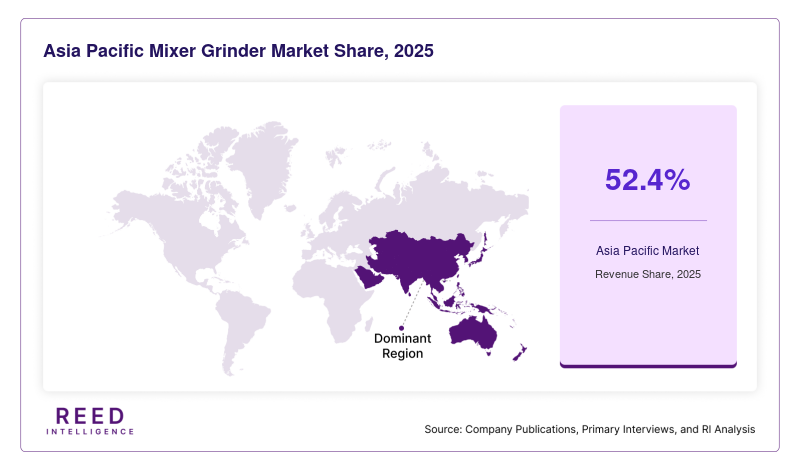
Asia Pacific is the dominant region in the Mixer Grinder Market, accounting for approximately 52.4% of global market share in 2025. The region's leadership is supported by strong household demand in India, China, Indonesia, Vietnam, and other Asian markets. Mixer grinders are deeply integrated into food preparation, particularly for spices, chutneys, batters, coconut-based foods, and other fresh ingredients. India functions as a major demand center and manufacturing hub, while rising disposable incomes and urbanization continue to expand appliance penetration.
Asia Pacific is also expected to remain among the fastest-growing regional markets. The region benefits from expanding organized retail, e-commerce penetration, domestic manufacturing capabilities, and increasing adoption of premium and multifunctional kitchen appliances.
Latin America Mixer Grinder Market
Latin America offers growth opportunities due to rising urbanization, household modernization, increasing disposable income, and expanding retail networks. Mixer grinders are relevant to regional food-preparation practices involving blending, grinding, sauces, and other ingredients. E-commerce expansion is also improving product accessibility.
Middle East & Africa Mixer Grinder Market
The Middle East & Africa market is supported by urbanization, rising household purchasing power, modernization of kitchens, and growth in hospitality and foodservice industries. Demand for compact and multifunctional appliances is expected to increase as modern retail and online distribution expand.
Mixer Grinder Market Competitive Landscape
The Mixer Grinder Market is highly competitive, with global appliance companies and strong regional brands competing across price, motor power, durability, functionality, design, distribution, and after-sales service. Companies are increasingly differentiating products through higher-wattage motors, specialized jars, multifunctional attachments, low-noise technologies, safety systems, and premium designs. Major participants include Bajaj Electricals, Philips/Versuni, TTK Prestige, Groupe SEB, Bosch, Crompton, Butterfly Gandhimathi, Preethi, and other regional manufacturers.
Bajaj Electricals maintains a broad mixer-grinder portfolio covering budget and premium products. Its current lineup includes models with 500W, 750W, and 1000W copper-wound motors, multiple jar configurations, stainless-steel blades, and specialized product series. The company emphasizes durability, motor performance, and products designed around Indian cooking requirements.
Key Market Players
- Bajaj Electricals Limited
- Versuni (Philips)
- Preethi
- TTK Prestige Limited
- Groupe SEB
- Bosch
- Crompton Greaves Consumer Electricals
- Butterfly Gandhimathi Appliances Limited
- Havells India Limited
- Maharaja Whiteline
Recent Market Developments
August 2026 -INALSA Launches Triton 900 Mixer Grinder and Food Processor:
INALSA launched the Triton 900 Mixer Grinder and Food Processor in India in August 2026. The product combines a 900W copper-wound motor, three-speed control, pulse function, three stainless-steel jars, and a 1.5-liter food-processing attachment. The launch highlights the industry's shift toward multifunctional appliances that combine grinding and food-processing functions in a single product.
February 2026 -TTK Prestige Unveils Endura 6-Jar Mixer Grinder:
TTK Prestige unveiled its Endura 6-Jar Mixer Grinder at the HT City Unwind Delhi event in February 2026. The product expands Prestige's heavy-duty mixer-grinder portfolio with a six-jar configuration designed for multiple food-preparation applications. The launch reflects increasing competition around high-capacity and multifunctional mixer grinders in India's premium appliance segment.
Mixer Grinder Market Segments
By Product Type
- Stand Mixer
- Traditional Mixer
- Portable/Compact Mixer
- Others
By Application
- Residential
- Commercial
- Foodservice
- Others
By Distribution Channel
- Online Stores
- Multi-brand Stores
- Exclusive Stores
- Supermarkets/Hypermarkets
- Others
By Region
- North America
- Europe
- APAC
- Middle East and Africa
- LATAM