Mixer Wagons Market Size, Share & Trends Analysis Report By Product Type (Vertical Mixer Wagons, Horizontal Mixer Wagons, Self-Propelled Mixer Wagons, and Others), By Application (Dairy Farming, Beef Farming, Other Livestock Farming, and Others) and By Region (North America, Europe, Asia Pacific, Latin America, Middle East & Africa) Forecasts, 2026–2034
USD 3950
Mixer Wagons Market Size
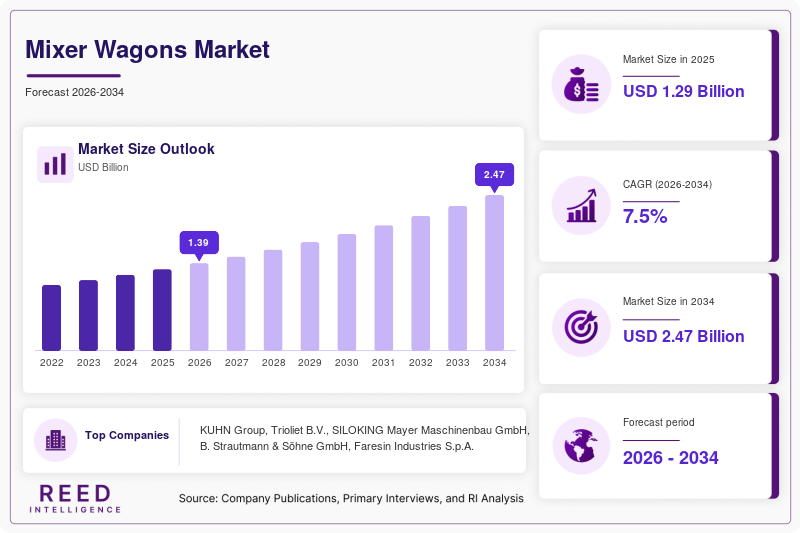
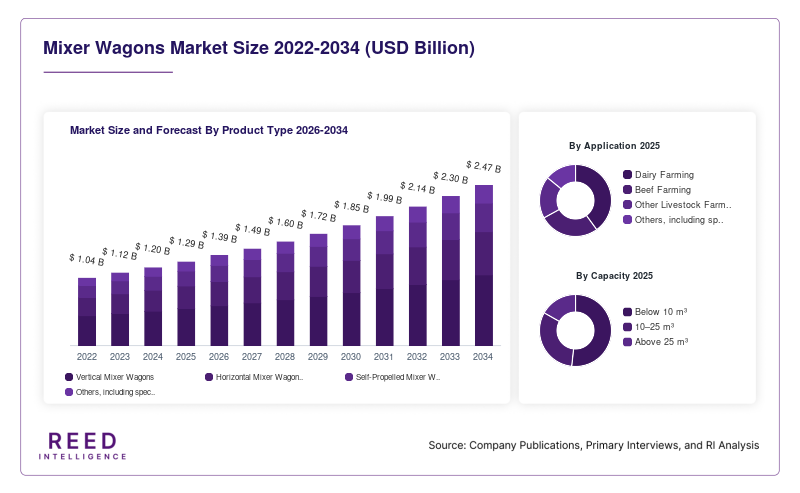
The global mixer wagons market was valued at USD 1.29 billion in 2025 and is projected to grow from USD 1.39 billion in 2026 to USD 2.47 billion by 2034, registering a compound annual growth rate (CAGR) of 7.5% during the forecast period (2026–2034).
The Mixer Wagons Market comprises agricultural machinery used to weigh, mix, and distribute total mixed ration (TMR) for livestock, particularly dairy and beef cattle. These machines combine forage, silage, hay, grains, and nutritional supplements to prepare uniform feed mixtures that support consistent animal nutrition and efficient farm management.
Market growth is supported by increasing livestock production, the expansion of commercial dairy farms, agricultural mechanization, and growing emphasis on feed efficiency. Livestock producers depend on mixer wagons to improve feeding consistency, reduce manual labor, manage feed quantities, and streamline daily feeding operations.
Mixer Wagons Market Drivers
Increasing Demand for Dairy and Livestock Products
Growing consumption of milk, dairy products, and meat is encouraging livestock producers to expand herd sizes and improve feeding efficiency. Commercial livestock operations require reliable equipment to prepare and distribute consistent rations. Mixer wagons help farms combine different feed ingredients, improve feeding workflows, and manage daily livestock nutrition requirements.
Growing Agricultural Mechanization
The transition from manual feeding methods to mechanized livestock management is supporting demand for mixer wagons. Farms increasingly invest in machinery that can reduce labor requirements, improve operational consistency, and support larger herds. Trailed and self-propelled mixer wagons provide options for farms with different investment capacities and operating requirements.
Increasing Focus on Feed Quality and Precision
Consistent feed preparation is important for maintaining livestock nutrition and managing feed utilization. Mixer wagons equipped with electronic weighing systems and feed management technologies allow farmers to measure ingredients and prepare rations more accurately. Improvements in weighing accuracy and digital controls are encouraging adoption among commercially operated dairy and beef farms.
Mixer Wagons Market Restraints
High Initial Equipment Investment
Mixer wagons can require significant upfront investment, particularly self-propelled models and high-capacity equipment. Small and medium-sized farms may find it difficult to justify the purchase when herd sizes and operating budgets are limited. Financing availability and expected productivity improvements influence purchasing decisions.
Maintenance and Operating Costs
Mixer wagons require regular maintenance of augers, cutting blades, weighing systems, hydraulic components, and other mechanical parts. Fuel consumption, repairs, and replacement components contribute to total ownership costs. These expenses can affect adoption among farms operating with limited maintenance budgets or restricted access to specialized technicians.
Dependence on Farm Profitability
Equipment purchases are influenced by milk prices, livestock feed costs, farm income, and broader agricultural investment conditions. When profitability weakens, farmers may postpone machinery upgrades or continue using existing equipment. Such delays can affect demand for new mixer wagons, particularly in price-sensitive agricultural markets.
Mixer Wagons Market Opportunities
Expansion of Commercial Livestock Farms
The expansion of commercial dairy and beef operations creates opportunities for mixer wagon manufacturers. Larger herds require more efficient feed preparation and distribution systems, supporting demand for medium- and high-capacity machinery. Suppliers that offer adaptable equipment and accessible after-sales services can serve farms at different stages of mechanization.
Development of Precision Feeding Technologies
Electronic weighing, automated controls, digital ration management, and connected equipment provide opportunities to improve feeding accuracy and operational productivity. Manufacturers can differentiate their products through technologies that help farmers monitor feed quantities, standardize feeding routines, and reduce unnecessary ingredient use.
Growth of Self-Propelled and Automated Equipment
Self-propelled mixer wagons can help larger farms streamline loading, mixing, and feed distribution. Semi-autonomous operating features and improved machine controls offer further opportunities to reduce operator workload and improve daily feeding efficiency. Equipment manufacturers that combine automation with reliable mixing performance may benefit from changing livestock-farm requirements.
Mixer Wagons Market Segmental Analysis
By Product Type
Horizontal mixer wagons represent the dominant product segment in a published market estimate, accounting for approximately 60% of global market revenue in 2024. Their adoption is supported by their mixing capabilities and suitability for preparing feed rations for commercial livestock operations. Product selection also depends on farm size, feed ingredients, maintenance requirements, and operating preferences.
Vertical mixer wagons remain important because they can process different forage and silage ingredients and serve a range of farm sizes. Self-propelled mixer wagons appeal to large commercial operations seeking to combine feed preparation and distribution in one machine. The fastest-growing product type cannot be conclusively identified from comparable segment-level growth estimates.
By Application
Dairy farming is a core application for mixer wagons because dairy cattle require consistent feeding schedules and carefully managed nutritional intake. Mechanized feed preparation enables farms to combine forage, silage, concentrates, and supplements into uniform rations while improving daily feeding efficiency.
Beef farming also contributes to demand as commercial operators seek to improve feed utilization and manage livestock growth. Other livestock applications provide additional opportunities where machine design and feed requirements are compatible. The dominant application share and fastest-growing application cannot be independently established from the available comparable data.
By Capacity
Mixer wagons below 10 m³ generally serve smaller livestock operations and farms with lower daily feeding requirements. Medium-capacity equipment, including 10–25 m³ models, offers a balance between feed volume and operational flexibility for medium-sized and larger farms.
Wagons above 25 m³ are designed for high-volume feeding operations and large herds. Demand for these machines is influenced by herd size, feeding frequency, available storage and loading infrastructure, and the need to reduce the number of mixing cycles. The fastest-growing capacity segment cannot be reliably confirmed without comparable market data.
Mixer Wagons Market Regional Analysis
North America Mixer Wagons Market
North America is an established market for mixer wagons, supported by commercial dairy and beef production, agricultural mechanization, and demand for efficient livestock feeding systems. The United States is a key contributor, while Canada also supports demand through its livestock sector. Producers increasingly prioritize equipment reliability, accurate ration preparation, and reduced labor requirements.
Europe Mixer Wagons Market
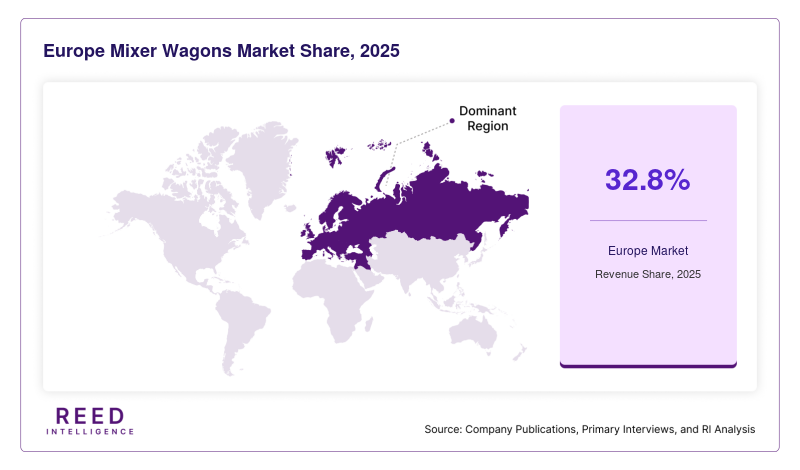
Europe is the dominant regional market, accounting for approximately 32.8% of global Mixer Wagons Market revenue in 2025, according to Dataintelo's published market analysis. The region benefits from established dairy farming infrastructure, commercial livestock operations, developed agricultural machinery distribution networks, and demand for technologically advanced feeding equipment. Germany, France, Ireland, and the Netherlands are important markets.
Asia Pacific Mixer Wagons Market
Asia Pacific is an important growth market, supported by livestock-sector expansion, increasing demand for dairy products, and gradual modernization of agricultural operations. China, India, and Australia contribute to regional demand, while adoption varies according to farm size, financing availability, and mechanization levels. A separate published estimate identifies Asia Pacific as the fastest-growing regional market, with a projected CAGR of approximately 9% over its stated forecast period.
Latin America Mixer Wagons Market
Latin America offers opportunities through its established cattle industry and growing need for efficient feed preparation. Brazil and Argentina are important livestock markets. Adoption depends on farm investment, equipment affordability, agricultural financing, and access to machinery servicing and replacement components.
Middle East & Africa Mixer Wagons Market
The Middle East & Africa region offers opportunities associated with livestock development and investment in commercial dairy operations. Demand is influenced by farm modernization, access to equipment financing, and the availability of technical support. High acquisition costs and limited service infrastructure may constrain adoption in some markets.
Regional share note: Europe's 32.8% share is a third-party estimate for 2025 published by Dataintelo. The regional share is not independently audited, and different research providers use different market definitions and estimates.
Mixer Wagons Market Competitive Landscape
The Mixer Wagons Market includes specialized agricultural machinery manufacturers competing on mixing performance, equipment capacity, weighing accuracy, product durability, and after-sales support. Manufacturers are developing advanced feeding equipment to meet the needs of small farms and large commercial livestock operations.
KUHN Group is an established agricultural machinery manufacturer offering equipment for crop production and livestock farming. Its livestock equipment portfolio includes mixer wagons designed to improve feed preparation and operational efficiency. The company has also introduced the ANTEA range of semi-autonomous, self-propelled mixer-feeders, incorporating automation, connectivity, and feed ration management features.
Key Market Players
- KUHN Group
- Trioliet B.V.
- SILOKING Mayer Maschinenbau GmbH
- B. Strautmann & Söhne GmbH
- Faresin Industries S.p.A.
- Storti S.p.A.
- Alltech (KEENAN)
- Jaylor International
- DeLaval
- RMH Lachish Industries
- Supreme International Limited
Mixer Wagons Market Recent Developments
August 2026 – KUHN introduces the ANTEA mixer-feeder range KUHN introduced ANTEA, a new range of semi-autonomous, self-propelled mixer-feeders designed to improve livestock feeding efficiency. The range combines automation, connectivity, mixing performance, and feed management features to support more precise ration preparation and simplify daily farm operations.
July 2026 – Trioliet introduces a new DEDB weighing system Trioliet announced a Double Ended Differential Beam (DEDB) weighing system for tandem-axle mixer wagons. The five-point weighing configuration is designed to improve measurement accuracy and stability during feed loading and mixing. The system also makes load-cell replacement easier, helping reduce maintenance time and equipment downtime.
Mixer Wagons Market Segments
By Product Type
- Vertical Mixer Wagons
- Horizontal Mixer Wagons
- Self-Propelled Mixer Wagons
- Others, including specialized stationary and multi-auger mixing configurations
By Application
- Dairy Farming
- Beef Farming
- Other Livestock Farming
- Others, including specialized livestock feed preparation operations
By Capacity
- Below 10 m³
- 10–25 m³
- Above 25 m³
By Distribution Channel
- Direct Sales
- Dealers and Distributors
- Online Sales and Other Channels
By Region
- North America
- Europe
- APAC
- Middle East and Africa
- LATAM