Mixing Valves Market Size, Share & Trends Analysis Report By Type (Thermostatic Mixing Valves, Manual Mixing Valves, Pressure-Balancing Mixing Valves, and Others), By Application (Residential, Commercial, Industrial, and Others) and By Region (North America, Europe, Asia Pacific, Latin America, Middle East & Africa) Forecasts, 2026–2034
USD 3950
Mixing Valves Market Size
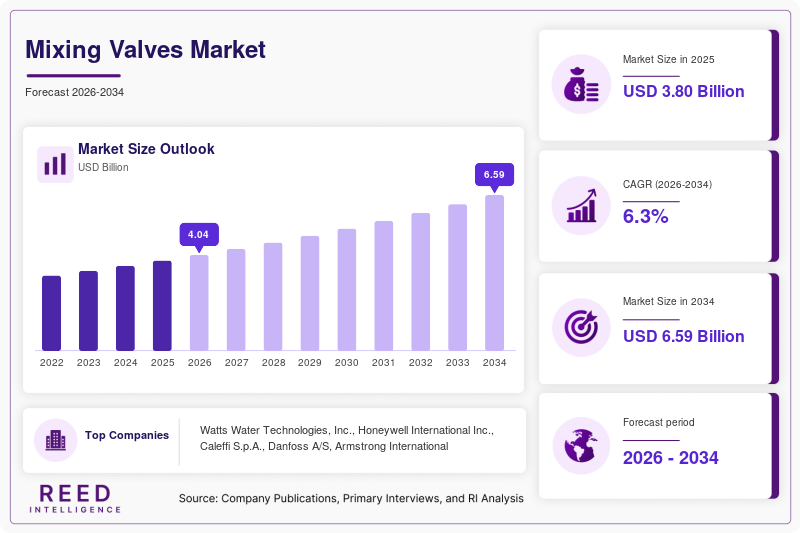
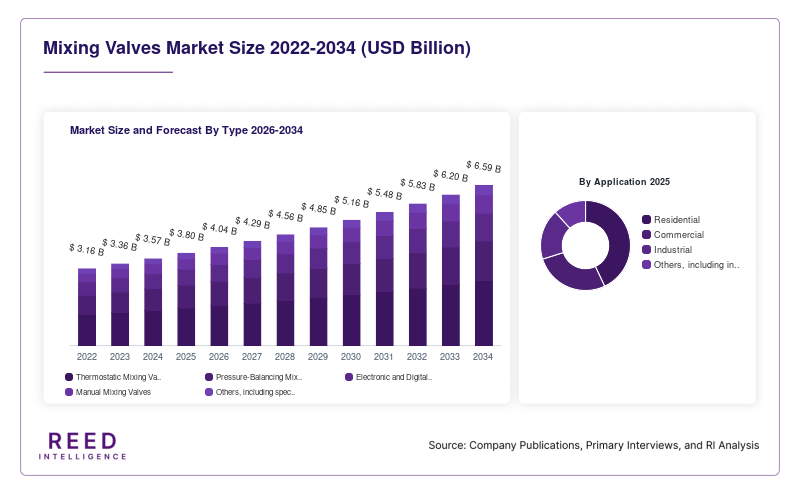
The global mixing valves market was valued at USD 3.80 billion in 2025 and is projected to grow from USD 4.04 billion in 2026 to USD 6.59 billion by 2034, registering a compound annual growth rate (CAGR) of 6.3% during the forecast period (2026–2034).
The Mixing Valves Market comprises valves designed to blend hot and cold water or combine different fluid streams to achieve a desired outlet temperature or fluid condition. These valves are used in plumbing systems, water heaters, heating and cooling equipment, industrial processes, and other applications requiring controlled fluid mixing. By regulating temperature and flow, mixing valves help improve system performance, maintain comfort, and reduce the risk of scalding in water distribution systems.
Market growth is supported by increasing construction activity, rising demand for energy-efficient water-heating systems, and growing emphasis on temperature control and water safety. Residential buildings use mixing valves in showers, water heaters, and domestic hot-water systems, while commercial facilities such as hospitals, hotels, schools, and office buildings require dependable temperature regulation across multiple outlets. Industrial applications also rely on mixing valves to maintain process conditions and protect equipment.
Mixing Valves Market Drivers
Increasing Construction and Infrastructure Development
Residential construction, commercial building development, and infrastructure modernization support demand for mixing valves. New buildings require reliable hot-water distribution and temperature-control systems, particularly in bathrooms, kitchens, healthcare facilities, and shared-use environments. Mixing valves help regulate outlet temperatures and support consistent operation across plumbing installations, making them an important component of modern building systems.
Growing Focus on Water Safety and Temperature Control
Mixing valves help reduce the risk of scalding by regulating the temperature of delivered water. This is especially important in healthcare facilities, schools, hotels, and residential environments serving children, older adults, and other users who may be vulnerable to excessively hot water. Increasing attention to plumbing safety and temperature-control requirements supports the use of thermostatic and pressure-balancing valves.
Increasing Adoption of Energy-Efficient Water-Heating Systems
Energy-efficient water heaters and modern hot-water systems require appropriate temperature management to support safe and effective operation. Mixing valves can help maintain suitable delivery temperatures while allowing hot water to be stored or generated at different temperatures, depending on system design. Their use in modern plumbing and heating installations supports demand for reliable, accurately controlled fluid-mixing equipment.
Mixing Valves Market Restraints
High Initial Costs of Advanced Mixing Valves
Thermostatic and specialized mixing valves can cost more than basic manual valves because they require additional control mechanisms, precision components, and materials. The initial cost may affect purchasing decisions in price-sensitive residential and commercial projects. In some applications, buyers may prioritize lower-cost alternatives where advanced temperature regulation or safety functions are not considered essential.
Maintenance and Replacement Requirements
Mixing valves may require periodic inspection, cleaning, calibration, or replacement of internal components to maintain performance. Mineral deposits, corrosion, sediment, and wear can affect temperature regulation and flow. Maintenance requirements can increase ownership costs, particularly in areas with hard water or in commercial facilities where valves operate frequently and must meet stringent safety expectations.
Variations in Plumbing Standards and Installation Practices
Mixing valve specifications and installation requirements can vary across countries, building types, and applications. Manufacturers must adapt products to local plumbing codes, water-system designs, and safety standards. Differences in installer expertise and system configuration can also affect product selection and performance, potentially increasing the complexity of market expansion and product distribution.
Mixing Valves Market Opportunities
Expansion of Smart and Thermostatic Temperature-Control Solutions
Advances in thermostatic control, sensor technology, and connected building systems create opportunities for more precise temperature regulation. Manufacturers can develop valves that offer improved control stability, simplified adjustment, and compatibility with modern heating and plumbing installations. These solutions may appeal to commercial buildings and residential users seeking better water safety and system efficiency.
Modernization of Existing Plumbing Infrastructure
Renovation of aging residential, commercial, and institutional buildings creates demand for replacement valves and upgraded temperature-control systems. Retrofitting projects may require compact designs, compatibility with existing pipework, and products that can be installed with limited disruption. Manufacturers offering adaptable valves and dependable replacement components can benefit from plumbing modernization and maintenance activity.
Growing Demand from Healthcare and Commercial Facilities
Hospitals, care facilities, hotels, schools, and other commercial buildings require dependable hot-water temperature management across multiple outlets. Mixing valves can support safer water delivery and consistent system performance in these environments. Opportunities exist for manufacturers that provide products suited to high-use installations, centralized hot-water systems, and applications with specific temperature-control requirements.
Mixing Valves Market Segmental Analysis
By Type
Thermostatic Mixing Valves represent the dominant type segment in the cited market estimate, accounting for approximately 42.3% of global market revenue in 2025. Their adoption is supported by the need for accurate temperature regulation, scald prevention, and dependable hot-water delivery across residential, commercial, and institutional buildings. These valves automatically adjust the proportion of hot and cold water to maintain a target outlet temperature, making them useful in showers, water heaters, healthcare facilities, and public washrooms.
Pressure-balancing mixing valves remain important in plumbing installations where changes in water pressure can affect outlet temperature. They help maintain a more consistent shower temperature when supply pressure fluctuates and are widely relevant to residential and light-commercial systems. Manual mixing valves serve applications where direct adjustment is suitable and lower equipment complexity is preferred.
Electronic and digital mixing valves provide opportunities for more precise temperature control, monitoring, and integration with building-management systems. estimates that digital mixing valves will be the fastest-growing type segment, with a projected CAGR of approximately 9.2% during its stated forecast period. This growth outlook is associated with increasing interest in automated building systems, improved temperature control, and connected water-management technologies.
By Application
Residential applications represent the dominant application segment in the cited market analysis, accounting for approximately 44.2% of global revenue in 2025. Demand is supported by the installation of mixing valves in showers, domestic hot-water systems, bathrooms, and residential heating equipment. New housing construction, home renovations, and increasing attention to safe water temperatures support continued use in residential plumbing systems.
Commercial applications also contribute significantly to demand. Hotels, hospitals, schools, office buildings, and public facilities require dependable temperature regulation across multiple outlets. These settings often prioritize consistent performance, scald prevention, ease of maintenance, and compliance with applicable plumbing standards.
Industrial applications require mixing valves to regulate fluid temperatures in selected process systems and specialized installations. Demand depends on process requirements, operating conditions, materials compatibility, and the precision of temperature control. identifies industrial applications as a relatively fast-growing application segment, with a projected CAGR of approximately 6.9% over its stated forecast period. This estimate is source-specific and should not be treated as a universal growth rate across all industrial valve applications.
Mixing Valves Market Regional Analysis
North America Mixing Valves Market
North America is a significant market for mixing valves, supported by established plumbing infrastructure, commercial construction, healthcare facilities, and demand for reliable hot-water temperature regulation. The United States is an important contributor, with demand across residential buildings, hospitals, hotels, and institutional facilities. Canada also contributes through building modernization and the adoption of temperature-control equipment in plumbing and heating systems.
The region's market is influenced by plumbing standards, anti-scald protection requirements, product certification, and replacement demand from existing buildings. Manufacturers compete through product reliability, installation flexibility, precise temperature regulation, and solutions that support commercial and institutional water systems.
Europe Mixing Valves Market
Europe represents an established market for mixing valves, supported by developed building infrastructure, established plumbing and heating industries, and emphasis on energy efficiency and water safety. Residential and commercial buildings use mixing valves to manage hot-water temperatures, while industrial users require controlled fluid mixing in selected applications.
Germany, France, the United Kingdom, and Italy are important markets for plumbing and heating equipment. Demand is influenced by renovation activity, building performance requirements, water-system modernization, and the use of thermostatic and digital controls. Manufacturers offering durable products, efficient installation, and compatibility with modern heating systems can address these requirements.
Asia Pacific Mixing Valves Market
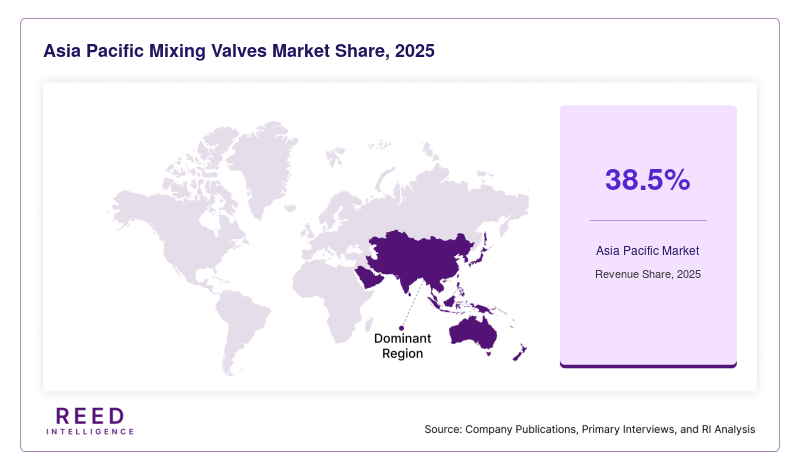
Asia Pacific is the dominant regional market, accounting for approximately 38.5% of global Mixing Valves Market revenue in 2025, according to 's published market analysis. Regional demand is supported by urbanization, residential construction, commercial real estate development, and investment in healthcare and hospitality infrastructure. China, India, and Southeast Asian countries offer opportunities as new buildings and infrastructure projects incorporate modern plumbing and temperature-control systems.
The region's expansion is also influenced by rising awareness of water safety, the development of modern heating and hot-water systems, and demand for reliable plumbing components. Adoption varies according to construction activity, local building requirements, product affordability, and access to qualified installers. projects Asia Pacific to remain an important growth market over its stated forecast period, although its regional growth estimate is specific to that report's methodology.
Latin America Mixing Valves Market
Latin America offers opportunities for mixing valve manufacturers through residential development, commercial construction, hospitality investment, and upgrades to existing water systems. Brazil and Mexico are important markets where demand can arise from housing, hotels, healthcare facilities, and commercial buildings.
Market growth depends on construction activity, purchasing power, plumbing standards, and the availability of distribution and installation services. Affordable products that provide dependable temperature regulation and can be integrated into existing plumbing systems may be attractive to contractors and building owners.
Middle East & Africa Mixing Valves Market
The Middle East & Africa region offers opportunities through commercial property development, hospitality projects, healthcare infrastructure, and modernization of residential water systems. Mixing valves are relevant to buildings requiring reliable hot-water delivery and temperature regulation, including hotels, hospitals, and institutional facilities.
Demand is influenced by investment in construction, water-system design, product affordability, and the availability of technical support. Adoption may vary significantly across countries, depending on infrastructure development, plumbing requirements, and the use of advanced water-temperature control technologies.
Mixing Valves Market Competitive Landscape
The Mixing Valves Market includes plumbing component manufacturers, heating-system specialists, and companies providing temperature-control equipment for residential, commercial, and industrial applications. Competition is shaped by temperature accuracy, pressure stability, product durability, installation flexibility, safety certifications, and maintenance requirements. Manufacturers are increasingly offering digital controls, connected monitoring, and solutions designed to improve temperature management in complex hot-water systems.
Watts Water Technologies develops products and systems for plumbing, water quality, flow control, and heating applications. Its mixing valve portfolio includes thermostatic valves, master mixing valves, and digital mixing solutions for commercial, institutional, and industrial facilities. The company competes through its broad product range, established distribution network, and focus on safe and reliable water-temperature control. Its Powers brand also offers mixing and tempering solutions designed for plumbing safety and hot-water distribution.
Key Market Players
- Watts Water Technologies, Inc.
- Honeywell International Inc.
- Caleffi S.p.A.
- Danfoss A/S
- Armstrong International
- Bradley Corporation
- Leonard Valve Company
- Zurn Industries, LLC
- ThermOmegaTech, Inc.
- Cash Acme
Mixing Valves Market Recent Developments
August 2026 -Caleffi introduces the LEGIOMIX®evo digital mixing valve Caleffi announced the LEGIOMIX®evo digital mixing valve for domestic hot-water temperature management. The product focuses on precise temperature control, simplified commissioning, and maintenance features, including automated self-cleaning cycles designed to help limit scale buildup. The solution also supports integration with building-management systems and remote monitoring options, reflecting the industry's continued movement toward digitally controlled water-temperature systems.
February 2025 -Caleffi showcases next-generation digital mixing technology at AHR Expo Caleffi announced that it would showcase the LEGIOMIX®evo digital mixing valve at the 2025 AHR Expo in Orlando. The product was presented as a next-generation plumbing solution, highlighting advances in digital temperature control for domestic hot-water systems. The announcement reflects continued product development in digitally controlled mixing valves for modern plumbing installations.
Mixing Valves Market Segments
By Type
- Thermostatic Mixing Valves
- Pressure-Balancing Mixing Valves
- Electronic and Digital Mixing Valves
- Manual Mixing Valves
- Others, including specialized mixing valves for specific plumbing, heating, and industrial applications
By Application
- Residential
- Commercial
- Industrial
- Others, including institutional facilities and specialized water-temperature control systems
By Region
- North America
- Europe
- APAC
- Middle East and Africa
- LATAM