MMA Solid Surface Market Size, Share & Trends Analysis Report By Product Type (Acrylic Sheets, Solid Surface Countertops, and Other Products), By Application (Bathrooms, Kitchens, Medical Facilities, and Other Applications) and By Region (North America, Europe, Asia Pacific, Latin America, Middle East & Africa) Forecasts, 2026–2034
USD 3950
MMA Solid Surface Market Size
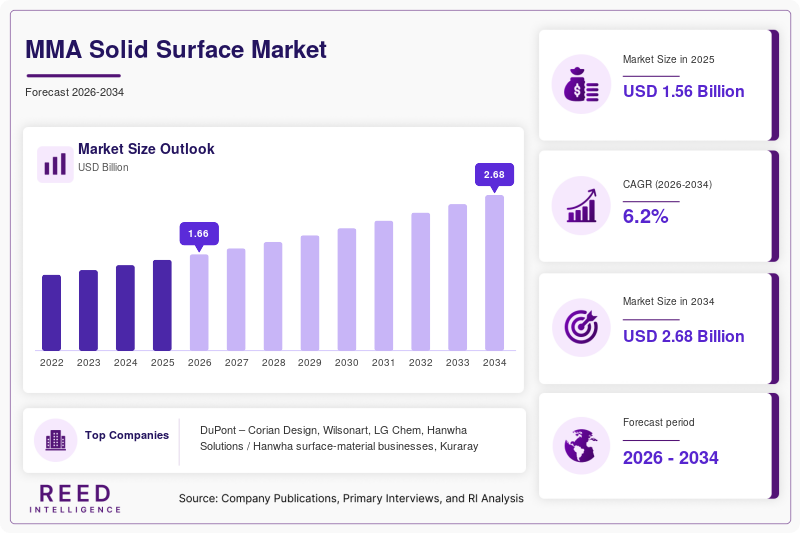
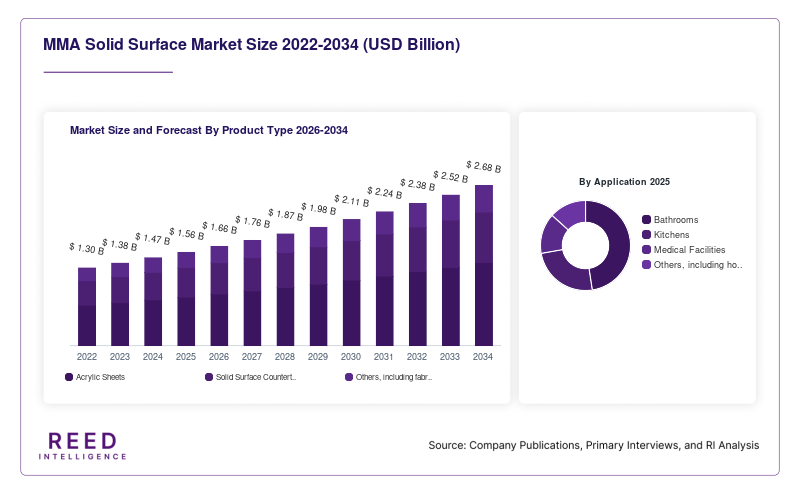
The global MMA solid surface market was valued at USD 1.56 billion in 2025 and is projected to grow from USD 1.66 billion in 2026 to USD 2.68 billion by 2034, registering a compound annual growth rate (CAGR) of 6.2% during the forecast period from 2026 to 2034.
The MMA Solid Surface Market comprises engineered surface materials made using methyl methacrylate (MMA)-based acrylic resins and related formulations. These materials are used to manufacture countertops, bathroom vanities, wall cladding, reception desks, integrated sinks, laboratory worktops, and other interior architectural elements. Their principal advantages include design flexibility, color consistency, repairability, and the ability to create visually continuous surfaces with minimal visible joints.
Demand is influenced by residential construction, kitchen and bathroom renovation, commercial property development, and investment in healthcare infrastructure. Architects, interior designers, fabricators, contractors, and building-material distributors are important participants in the value chain. Manufacturers compete through product design, surface performance, customization options, installation support, and distribution coverage.
MMA Solid Surface Market Drivers
Growth in Residential Construction and Renovation
Residential construction and home improvement activities support demand for acrylic solid surfaces in kitchens, bathrooms, utility areas, and customized furniture. Homeowners increasingly consider appearance, durability, ease of maintenance, and design continuity when selecting interior materials. Renovation projects also create opportunities to replace aging countertops and vanity tops with customizable engineered surfaces.
Increasing Demand from Commercial and Healthcare Facilities
Hotels, restaurants, offices, retail environments, laboratories, and healthcare facilities require surfaces that can combine visual appeal with practical maintenance. Solid surfaces can be fabricated into integrated designs and are available in finishes suited to a range of commercial interiors. In healthcare settings, smooth, nonporous products may support cleaning protocols when selected and maintained in accordance with manufacturer specifications and facility requirements.
Design Flexibility and Product Customization
MMA-based solid surfaces can be fabricated into curved forms, integrated sinks, seamless counters, and customized architectural features. Manufacturers continue to develop colors, patterns, textures, and stone-inspired designs that offer alternatives to natural materials. These features appeal to designers seeking coordinated interiors and custom installations.
MMA Solid Surface Market Restraints
Competition from Alternative Surface Materials
MMA solid surfaces compete with quartz, granite, marble, porcelain, compact laminate, and other engineered materials. Alternative products may offer different advantages in scratch resistance, heat tolerance, perceived luxury, or purchase price. This broad competitive environment can limit pricing power and make material selection sensitive to project budgets and performance requirements.
Raw Material Price Volatility
The cost of methyl methacrylate and other formulation inputs can affect manufacturing costs and product pricing. Changes in energy costs, transportation expenses, supply availability, and currency movements may place pressure on manufacturers and distributors. Companies must manage procurement, inventory, production efficiency, and pricing to maintain margins.
Installation and Fabrication Requirements
Specialized cutting, joining, finishing, and installation processes can add labor costs and require trained fabricators. Product quality depends partly on correct fabrication and installation practices. In markets where skilled installers or established distribution networks are limited, these requirements may slow adoption.
MMA Solid Surface Market Opportunities
Expansion in Emerging Construction Markets
Urbanization, new housing, hospitality development, and modernization of commercial buildings create opportunities in Asia Pacific, Latin America, and parts of the Middle East and Africa. Suppliers can pursue growth through local distributors, fabricator partnerships, specification support, and products tailored to regional price and design preferences.
Sustainable Product Development
Recycled-content formulations, production scrap recovery, waste reduction, and more efficient manufacturing offer opportunities to improve environmental performance. Manufacturers that provide credible material disclosures and documented sustainability attributes may be better placed to serve projects with environmental procurement requirements. The actual recyclability and environmental benefits depend on product composition, collection infrastructure, and available processing systems.
Specialized Healthcare and Commercial Applications
Healthcare, laboratory, food-service, hospitality, and institutional projects create opportunities for surfaces designed around specific cleaning, fabrication, and durability requirements. Product differentiation may come from application-specific designs, integrated components, technical documentation, and support for architects and contractors.
MMA Solid Surface Market Segmental Analysis
By Product Type
Acrylic sheets are an important product category because they provide material flexibility for fabrication into countertops, wall panels, vanities, furniture components, and customized architectural features. Their ability to support a wide range of colors, patterns, and finishes makes them useful in both residential and commercial projects. The referenced Dataintelo market analysis identifies acrylic sheets as the leading product category, with an estimated 42.5% share in 2025. This is a third-party estimate and should be interpreted within that source's market definition.
Solid surface countertops are another significant category, particularly in kitchen remodeling, bathroom installations, hospitality interiors, and commercial spaces. Their appeal comes from customizable designs, integrated sinks, and the ability to repair or refinish some surface damage, subject to product specifications and maintenance guidance.
Other products include fabricated panels and specialized components designed for particular architectural or institutional applications. Their demand depends on project specifications, design requirements, and the availability of suitable fabrication and installation services.
Dominant segment: Acrylic sheets, according to the cited third-party market estimate.
Fastest-growing segment: A reliably comparable, independently verified growth rate by product type was not available; therefore, a fastest-growing product category cannot be confirmed.
By Application
Kitchen applications benefit from renovation activity and demand for customized countertops, islands, backsplashes, and integrated surface elements. Design preferences, project budgets, durability requirements, and the availability of trained installers influence material selection.
Bathroom applications include vanity tops, washbasins, shower surrounds, and wall panels. The ability to coordinate colors and create integrated forms can be attractive for residential, hospitality, and institutional projects. Commercial bathroom renovations can also support demand for durable and easy-to-maintain surface solutions.
Medical facilities use selected solid surface products for worktops, counters, and interior fixtures where seamless fabrication and cleaning requirements are important. Product selection must be based on the facility's hygiene protocols, technical specifications, and applicable standards; a solid surface alone does not guarantee antimicrobial or infection-control performance.
Other applications include hospitality, food service, retail, offices, and other commercial interiors. These uses tend to emphasize design consistency, maintenance, and the ability to fabricate distinctive fixtures.
Dominant application: The source reviewed describes kitchens and bathrooms as major end-use categories, but a definitive dominant application cannot be confirmed without a consistently defined, independently verified market-share comparison.
Fastest-growing application: No sufficiently reliable, comparable application-level growth estimate was available to identify a confirmed fastest-growing segment.
MMA Solid Surface Market Regional Analysis
North America MMA Solid Surface Market
North America benefits from established kitchen and bathroom renovation markets, commercial construction, and demand for premium interior finishes. Architects, fabricators, distributors, and home improvement channels provide routes to market for engineered surface products. Healthcare, hospitality, and retail projects also create demand for materials that can be customized to fit particular design and maintenance requirements.
The region's competitive environment includes established surface brands and alternative materials such as quartz, natural stone, and porcelain. Product performance, price, distribution coverage, installer expertise, and the availability of coordinated colors and accessories influence purchasing decisions.
Europe MMA Solid Surface Market
European demand is supported by residential refurbishment, commercial interior design, hospitality projects, and healthcare infrastructure. Product appearance, durability, maintenance, and documented environmental characteristics can be important in material specification. Manufacturers that provide credible sustainability information and long-lasting design options may be well placed to serve environmentally conscious projects.
Competition from other engineered and natural surfaces remains significant. Building requirements, national market preferences, renovation cycles, and the purchasing power of residential and commercial customers influence regional adoption. Distribution partnerships and technical support can help suppliers reach architects, contractors, and specialist fabricators.
Asia Pacific MMA Solid Surface Market
Asia Pacific benefits from urbanization, housing construction, commercial development, and expanding demand for modern kitchen and bathroom interiors. China, India, Japan, and South Korea represent important markets for building materials and interior finishing products, although demand and product preferences vary by country. Regional manufacturing capabilities and supply chains can also support product availability.
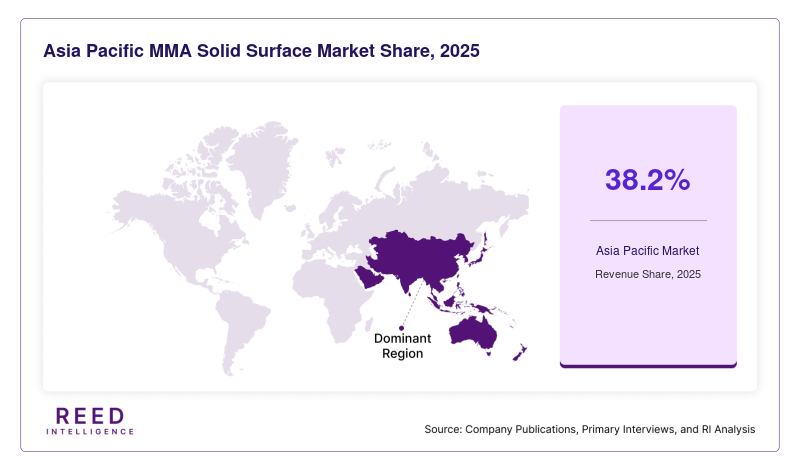
According to the referenced Dataintelo analysis, Asia Pacific accounted for an estimated 38.2% of global MMA solid surface revenue in 2025, making it the dominant region in that source's market assessment. This is a third-party estimate rather than an independently audited figure; its applicability depends on the source's definition and regional coverage. It should not be used to calculate regional revenue from the report's global market values without confirming that the underlying methodologies are comparable.
Latin America MMA Solid Surface Market
Latin America offers opportunities through residential renovation, urban housing development, hospitality investment, and modernization of commercial interiors. Demand for solid surfaces is influenced by construction activity, household purchasing power, imported material costs, and access to qualified installers. Brazil and Mexico are relevant markets to monitor because of their construction and interior-design sectors.
Price competition from ceramic, laminate, natural stone, and other surface products can constrain adoption. Suppliers may improve market access by partnering with regional distributors and fabricators, offering designs suited to local preferences, and providing clear installation and maintenance guidance.
Middle East & Africa MMA Solid Surface Market
The Middle East & Africa region presents opportunities from hospitality development, commercial construction, healthcare investment, and premium residential projects. Hotel interiors, reception areas, bathroom installations, and customized fixtures may create demand for materials that combine design flexibility with practical maintenance requirements.
Market growth varies considerably by country and project type. Import dependence, transportation costs, distributor coverage, and competition from alternative materials influence product availability and final installation costs. Suppliers may benefit from project-specification partnerships, dependable delivery, and local technical support.
MMA Solid Surface Market Competitive Landscape
The MMA Solid Surface Market is shaped by material manufacturers, branded surface suppliers, distributors, and specialist fabricators. Competition centers on surface aesthetics, durability, color range, fabrication flexibility, technical support, distribution coverage, and price. Companies also seek to distinguish their offerings through recycled-content options, coordinated product collections, and designs that replicate natural stone.
DuPont's Corian® Solid Surface brand is an established participant in the engineered surface category. The brand's offering emphasizes design flexibility, integrated forms, repairability, and applications across residential and commercial interiors. Its strategy includes extending design collections, supporting architects and fabricators, and incorporating recycled content in selected products.
Key Market Players
- DuPont – Corian Design
- Wilsonart
- LG Chem
- Hanwha Solutions / Hanwha surface-material businesses
- Kuraray
- Aristech Surfaces
- Meganite
- Regional acrylic solid surface manufacturers
- Specialty solid surface fabricators and suppliers
MMA Solid Surface Market Recent Developments
-
August 2026 -DuPont expands Corian Design distribution coverage. DuPont announced an enhanced distribution alignment with Hallmark Building Supplies and Parksite to improve regional product availability, logistics, and customer support across selected Mid-Atlantic and Midwest markets. The announcement also stated that the network would support the company's 2026 Nature in Motion collection. This is relevant to the market because distribution and access to samples, technical resources, and surface products influence specification and purchasing.
-
August 2025 -Wilsonart introduces new engineered surface designs. Wilsonart announced new Quartz and Solid Surface collections featuring expanded veining, movement, and stone-inspired patterns. The launch reflects competition through visual differentiation and design flexibility across engineered surfaces.
MMA Solid Surface Market Segments
By Product Type
- Acrylic Sheets
- Solid Surface Countertops
- Others, including fabricated panels, integrated surface components, and specialty solid surface products where included in the market definition
By Application
- Bathrooms
- Kitchens
- Medical Facilities
- Others, including hospitality, food service, retail, offices, and institutional interiors
By Region
- North America
- Europe
- APAC
- Middle East and Africa
- LATAM