MO (Metal Organic) Source Market Size, Share & Trends Analysis Report By Product Type (Trimethylaluminum (TMA), Trimethylgallium (TMG), Trimethylindium), By Application (LEDs, Solar Cells, Semiconductors), By End-User Industry (Electronics, Renewable Energy, Automotive) and By Region (North America, Europe, Asia Pacific, Latin America, Middle East & Africa) Forecasts, 2026–2034
USD 3950
MO Metal Organic Source Market Size
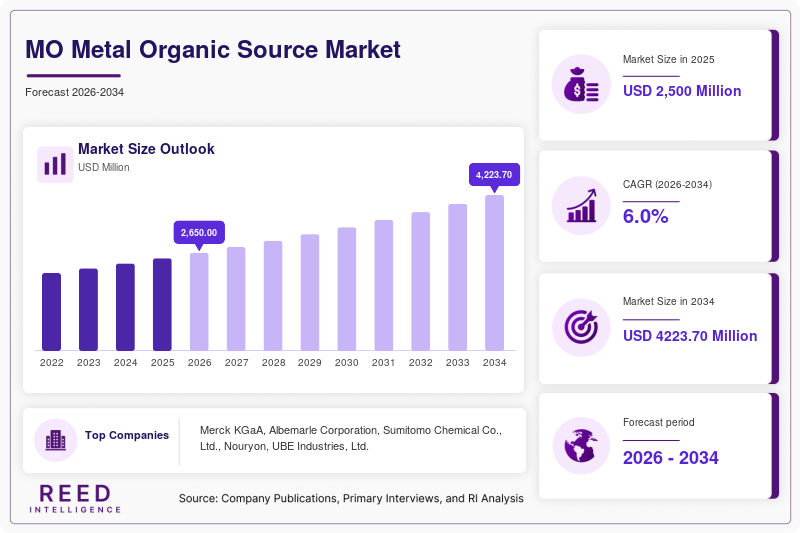
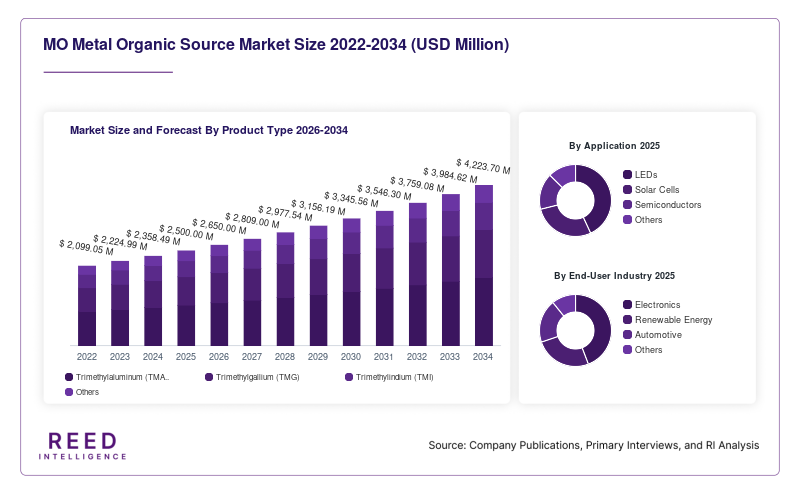
The global MO (Metal Organic) Source Market was valued at USD 2,500 Million in 2025 and is estimated to reach USD 2,650 Million in 2026. The market is projected to grow significantly and reach approximately USD 4,223.70 Million by 2034, expanding at a CAGR of 6.0% during 2026–2034.
MO (Metal Organic) Sources are high-purity metal-organic compounds containing metals such as gallium, indium, aluminum, zinc, and magnesium combined with organic ligands. These materials serve as critical precursors for depositing highly controlled semiconductor and functional-material layers. Major commercial products include trimethylgallium (TMGa), triethylgallium (TEGa), trimethylindium (TMIn), trimethylaluminum (TMAl), dimethylzinc, and other specialized organometallic compounds. They are widely used in LEDs, solar cells, compound semiconductor devices, semiconductor lasers, optical communication components, power devices, and advanced deposition technologies.
The market is characterized by high technical barriers, stringent purity requirements, complex handling procedures, and qualification requirements from semiconductor manufacturers. Production is concentrated among specialized chemical suppliers, while demand is increasingly influenced by investment in GaN and other compound semiconductor manufacturing, MicroLED displays, power electronics, and advanced semiconductor fabrication. Asia Pacific remains the leading regional market because of its strong concentration of semiconductor, LED, display, and compound semiconductor manufacturing capacity.
MO Metal Organic Source Market Drivers
Expansion of Semiconductor and Compound Semiconductor Manufacturing:
The continued expansion of semiconductor fabrication and compound semiconductor production is a major driver for MO source demand. High-purity organometallic compounds are essential inputs for epitaxial deposition and thin-film formation used in GaN, GaAs, InP, and related semiconductor technologies. Growth in power electronics, RF devices, optical communications, and advanced semiconductor applications is therefore increasing demand for specialized MO sources.
Growth of LED and MicroLED Technologies:
LED, MiniLED, and MicroLED manufacturing require high-purity metal-organic precursors for epitaxial layer formation. Increasing adoption of high-efficiency lighting, automotive displays, consumer electronics displays, and next-generation MicroLED technologies is creating additional demand for TMG, TMI, and TMAl-based materials.
Increasing Demand for High-Purity Deposition Materials:
The transition toward smaller semiconductor geometries and increasingly precise deposition processes is raising the importance of precursor purity, vapor-pressure stability, controlled decomposition, and low impurity levels. Suppliers are consequently investing in advanced purification, analytical testing, and customized precursor formulations to meet increasingly stringent semiconductor specifications.
MO Metal Organic Source Market Restraints
High Production and Qualification Costs:
MO sources require specialized synthesis, purification, analytical testing, packaging, and transportation infrastructure. Semiconductor customers also require lengthy qualification processes before new precursor materials can be introduced into production, increasing commercialization costs and limiting the speed at which new suppliers can enter the market.
Handling and Safety Challenges:
Many metal-organic compounds are highly volatile, pyrophoric, and reactive with air or moisture. Their production, storage, transportation, and use therefore require specialized equipment, inert-atmosphere systems, trained personnel, and strict safety procedures. These requirements increase operational complexity and costs.
Raw-Material and Supply-Chain Vulnerabilities:
The industry depends on high-purity metals, organic synthesis reagents, specialty gases, and specialized packaging systems. Supply disruptions and fluctuations in critical metal prices can affect production costs and availability, while the concentration of supply among a relatively small number of qualified producers creates additional supply-chain risks.
MO Metal Organic Source Market Opportunities
Growing Adoption of GaN and Advanced Power Electronics:
The expansion of GaN-based power devices for electric vehicles, fast charging, renewable-energy systems, data centers, and power-management applications creates opportunities for MO source suppliers. Increasing compound semiconductor wafer capacity is expected to support demand for gallium- and aluminum-based precursors.
Emergence of Advanced ALD and CVD Applications:
Beyond traditional MOCVD and MOVPE applications, advanced ALD, PEALD, CVD, and area-selective deposition processes are expanding the addressable market for metal-organic precursor chemistry. New semiconductor architectures require highly controlled deposition at increasingly small dimensions, creating opportunities for customized precursor formulations.
Localization of Semiconductor Material Supply Chains:
Governments and semiconductor manufacturers are increasingly seeking regional sources for critical semiconductor chemicals. Investments in semiconductor fabs in India, the United States, Europe, Japan, South Korea, and China are creating opportunities for local production and supply partnerships for high-purity MO sources.
MO Metal Organic Source Market Segmental Analysis
By Product Type
Trimethylaluminum (TMA) represents one of the most important MO source categories because of its use as an aluminum precursor in ALD and CVD processes. TMA is used to form aluminum oxide films in semiconductor manufacturing and solar-cell passivation, as well as aluminum-containing compound semiconductor layers in LED and optoelectronic applications. Industry estimates identify TMA as the largest product category, with one market-specific estimate placing its share at approximately 38.4% in 2025.
Trimethylgallium (TMG) is a critical precursor for gallium-containing compound semiconductor materials and is extensively used in MOCVD processes for GaN and related epitaxial structures. Demand is supported by LEDs, RF devices, power electronics, and other compound semiconductor applications. Gallium-based precursors collectively represent a major share of global metal-organic CVD precursor consumption.
Trimethylindium (TMI) is primarily used for indium-containing semiconductor layers and is important in applications such as InGaN-based LEDs, laser diodes, optical devices, and advanced compound semiconductor structures. Growth in optoelectronics and high-performance displays is supporting demand for high-purity TMI.
Others include specialized organometallic sources used for zinc, magnesium, and other metal-containing thin films. Demand from advanced deposition processes and emerging semiconductor architectures is expected to broaden the product mix during the forecast period.
By Application
Semiconductors represent a major application area for MO sources because these materials are essential for controlled deposition and epitaxial growth in advanced semiconductor manufacturing. Increasing investment in compound semiconductor fabs, GaN power devices, RF components, optical communication devices, and advanced electronic systems is supporting demand.
LEDs remain an important application for metal-organic sources, particularly TMG, TMI, and TMAl. The materials are used to form epitaxial layers required for high-efficiency LEDs, MiniLEDs, and MicroLEDs. Continued development of advanced display technologies is creating new opportunities for high-purity precursor suppliers.
Solar Cells use MO sources such as TMA in ALD and PECVD processes to create aluminum oxide passivation layers. Increasing demand for higher-efficiency crystalline silicon solar cells is supporting the use of high-purity TMA and related deposition materials.
Others include semiconductor lasers, optical communications, specialty thin films, and emerging deposition applications. These applications are expected to gain importance as compound semiconductor technologies expand.
By End-User Industry
Electronics is expected to remain the leading end-user industry because MO sources are directly tied to semiconductor, LED, display, optoelectronics, and advanced electronic-device manufacturing. The expansion of semiconductor fabs and compound semiconductor capacity is supporting sustained demand for high-purity precursor materials.
Renewable Energy represents a growing application area through solar-cell manufacturing and advanced power electronics. TMA-based deposition processes are used in solar-cell passivation, while GaN-based power devices increasingly support renewable-energy power conversion and energy-management systems.
Automotive demand is increasing through electric-vehicle power electronics, automotive lighting, displays, sensors, and high-frequency communication components. GaN and other compound semiconductor technologies are creating additional demand for specialized MO precursors.
MO Metal Organic Source Market Regional Analysis
North America MO Metal Organic Source Market
North America represents an important market for MO sources due to its semiconductor manufacturing investments, advanced materials research, and growing demand for compound semiconductor technologies. The region also has established suppliers of metal-organic materials and strong demand from semiconductor, aerospace, communications, and renewable-energy industries.
Europe MO Metal Organic Source Market
Europe maintains demand for high-purity metal-organic sources through semiconductor manufacturing, automotive electronics, industrial technology, renewable energy, and advanced materials research. The region's emphasis on semiconductor supply-chain resilience and domestic manufacturing is expected to support the development of specialized precursor supply capabilities.
Asia Pacific MO Metal Organic Source Market
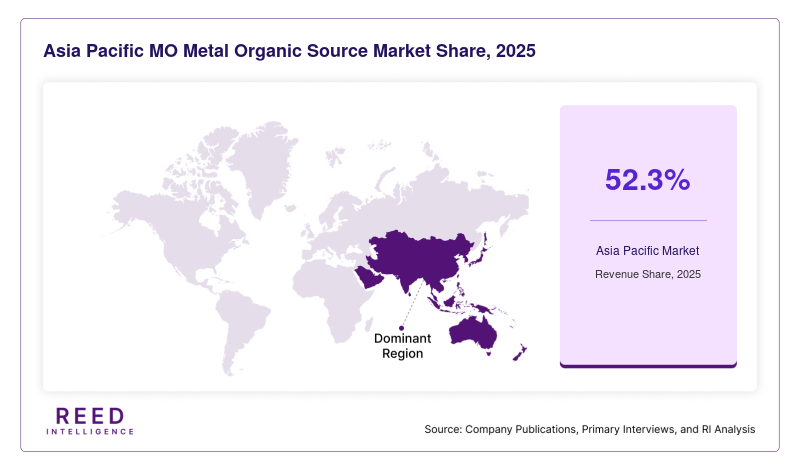
Asia Pacific is the dominant region in the MO (Metal Organic) Source Market, accounting for approximately 52.3% of global market revenue in 2025. The region's leadership is supported by the concentration of semiconductor fabrication, LED, display, and compound semiconductor manufacturing in China, Taiwan, South Korea, and Japan. Strong MOCVD activity, expanding GaN capacity, and the presence of major electronics manufacturers further strengthen regional demand.
Asia Pacific is also a major production base for MO sources, with suppliers concentrated across China, Japan, and South Korea. The continued expansion of semiconductor and MicroLED manufacturing capacity is expected to maintain the region's leading position throughout the forecast period.
Latin America MO Metal Organic Source Market
Latin America represents a comparatively smaller market but provides opportunities through solar-energy deployment, electronics manufacturing, and emerging semiconductor-related activities. Growth in renewable-energy infrastructure and increasing technology investment can support gradual expansion in demand for high-purity precursor materials.
Middle East & Africa MO Metal Organic Source Market
The Middle East & Africa market is developing through investments in renewable energy, advanced electronics, industrial technology, and semiconductor-related infrastructure. Solar-cell deployment provides an additional opportunity for TMA-based deposition applications, while broader electronics investments may gradually increase demand for specialty precursor materials.
MO Metal Organic Source Market Competitive Landscape
The MO (Metal Organic) Source Market is characterized by specialized chemical manufacturing capabilities, stringent purity requirements, high customer qualification barriers, and strong relationships with semiconductor and electronics manufacturers. Leading companies compete through precursor purity, product consistency, customized formulations, safety and delivery systems, manufacturing scale, and geographic supply-chain capabilities. Key participants include Merck, Albemarle, Sumitomo Chemical, Nouryon, UBE Industries, Lake Materials, Entegris, and other specialized suppliers.
Merck, including its SAFC Hitech/EMD Performance Materials activities, is an established supplier of high-purity metal-organic precursors for semiconductor, lighting, photovoltaic
Key Market Players
- Merck KGaA
- Albemarle Corporation
- Sumitomo Chemical Co., Ltd.
- Nouryon
- UBE Industries, Ltd.
- Entegris, Inc.
- Lake Materials Co., Ltd.
- SAFC Hitech
- Dow Inc.
- AkzoNobel
- Nata Opto-electronic Material Co., Ltd.
MO Metal Organic Source Market Recent Developments
September , 2026 – Tata Electronics and Sumitomo Chemical Sign MoU for Semiconductor Materials: Tata Electronics and Sumitomo Chemical signed an MoU to explore collaboration for supplying semiconductor materials to Tata Electronics' upcoming semiconductor fab in Dholera, Gujarat. The companies will also examine the potential local manufacture of high-purity chemicals and semiconductor materials in India. The development is relevant to the MO Source Market because it supports localization of high-purity semiconductor-material supply chains and could create additional regional demand for advanced precursor materials.
October , 2026 – Albemarle Updates TMA-SP Technical Data Sheet: Albemarle issued an updated technical data sheet for TMA-SP (Trimethylaluminum, Solar Purity Grade). The document identifies TMA-SP as an organometallic precursor used to form aluminum-oxide passivation layers through ALD and PECVD processes in solar-cell manufacturing. The specification lists metals-basis purity above 99.999%, demonstrating continued emphasis on high-purity trimethylaluminum for advanced deposition applications.
MO Metal Organic Source Market Segments
By Product Type
- Trimethylaluminum (TMA)
- Trimethylgallium (TMG)
- Trimethylindium (TMI)
- Others
By Application
- LEDs
- Solar Cells
- Semiconductors
- Others
By End-User Industry
- Electronics
- Renewable Energy
- Automotive
- Others
By Region
- North America
- Europe
- APAC
- Middle East and Africa
- LATAM