Mobile Air Conditioner Market Size, Share & Trends Analysis Report By Product Type (Single-Hose Portable Air Conditioners, Dual-Hose Portable Air Conditioners, Window-Type Mobile Air Conditioners, Compact Portable Air Conditioners), By Cooling Capacity (Below 8,000 BTU, 8,000–12,000 BTU, Above 12,000 BTU), By Application (Residential, Commercial, Industrial and Construction, Healthcare and Temporary Facilities) Forecasts 2026–2034
USD 3950
Mobile Air Conditioner Market Size
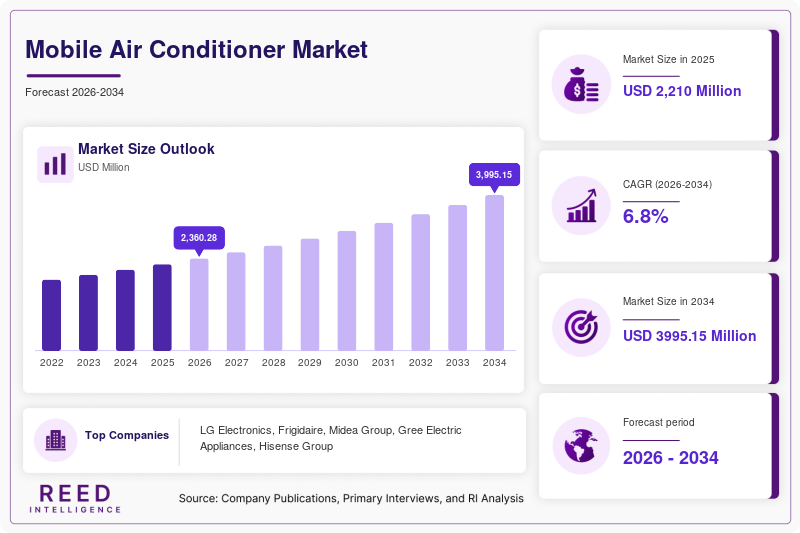
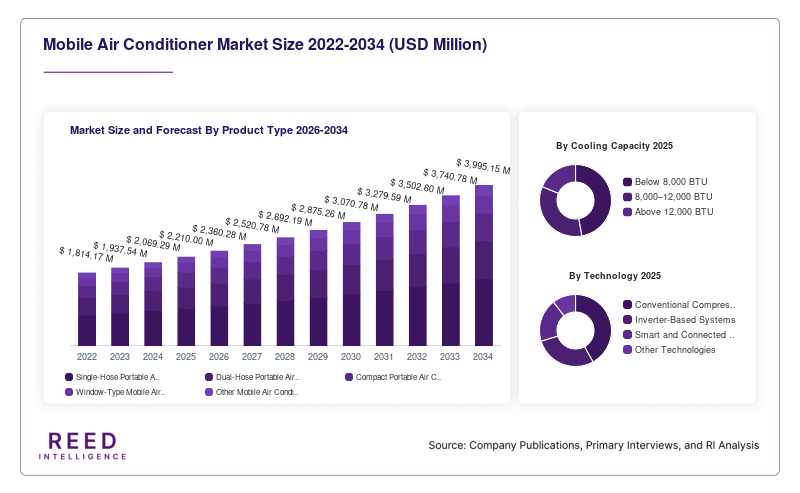
The global mobile air conditioner market was valued at USD 2,210 million in 2025 and is projected to grow from USD 2,360.28 million in 2026 to USD 3,995.15 million by 2034, registering a compound annual growth rate (CAGR) of 6.8% during the forecast period (2026–2034).
The Mobile Air Conditioner Market comprises portable and movable air-conditioning units designed to provide targeted cooling in residential, commercial, and selected industrial environments. These products offer an alternative to permanently installed cooling systems and are particularly useful in rental properties, small apartments, temporary offices, modular buildings, workshops, and locations where conventional air-conditioning installation is difficult or impractical.
Increasing temperatures, more frequent heatwaves, urbanisation, and changing residential preferences are supporting demand for flexible cooling solutions. Mobile air conditioners allow users to move cooling equipment between rooms or locations, making them suitable for temporary occupancy and changing cooling requirements. Their appeal is also supported by relatively straightforward installation compared with many fixed air-conditioning systems.
Mobile Air Conditioner Market Drivers
Increasing temperatures and heatwaves: Rising cooling requirements are encouraging households and businesses to consider mobile air conditioners for immediate and flexible temperature control.
Demand for flexible cooling solutions: Rental housing, temporary offices, small apartments, and buildings without permanent air-conditioning systems create demand for movable cooling equipment.
Growth in residential and commercial spaces: Expanding urban populations, smaller living spaces, temporary facilities, and commercial premises support adoption of compact cooling appliances.
Product innovation and energy efficiency: Inverter technology, smart controls, improved compressors, and enhanced airflow designs are helping manufacturers improve comfort and operating performance.
Mobile Air Conditioner Market Restraints
Energy consumption: Portable air conditioners can consume substantial electricity, particularly when cooling poorly insulated rooms or operating continuously in high temperatures.
Operating noise: Compressor and fan noise can reduce suitability for bedrooms, quiet workplaces, and noise-sensitive environments.
Cooling limitations: Mobile units may be less effective than appropriately sized fixed systems in large spaces, poorly insulated rooms, or environments with high heat loads.
Installation and maintenance requirements: Exhaust hoses, window sealing, condensate management, air filters, and periodic servicing can affect convenience and overall ownership costs.
Mobile Air Conditioner Market Opportunities
Energy-efficient mobile cooling: Advanced inverter compressors, improved heat exchangers, and better insulation offer opportunities to reduce energy consumption while maintaining cooling performance.
Smart and connected appliances: Wi-Fi controls, scheduling, remote operation, and integration with smart-home systems can improve convenience and product differentiation.
Commercial and temporary applications: Construction sites, temporary healthcare facilities, events, workshops, and modular buildings create opportunities for specialised mobile cooling products.
Emerging-market expansion: Rising household purchasing power, expanding urban housing, and increasing cooling needs create opportunities for manufacturers and distributors in developing markets.
Mobile Air Conditioner Market Segmental Analysis
By Product Type
Single-hose portable air conditioners are widely used because of their relatively simple installation, compact configuration, and broad availability for household cooling. They typically draw indoor air to remove heat and discharge the warm air through an exhaust hose. Their performance depends on room conditions, installation quality, cooling capacity, and the resulting pressure imbalance.
Dual-hose portable air conditioners use separate air pathways for heat rejection and condenser cooling. This configuration can improve operating efficiency in suitable conditions by reducing the amount of conditioned indoor air used for heat rejection. However, these systems may cost more and require additional installation space. A verified dominant product segment and its precise share for the supplied Mobile Air Conditioner Market definition require confirmation against a consistent dataset.
Compact portable air conditioners are also relevant to small rooms and temporary cooling applications. Their appeal comes from mobility and limited installation requirements, although cooling output and energy performance vary considerably by design. Inverter-equipped models offer potential efficiency and temperature-control benefits, while smart features can improve convenience.
By Cooling Capacity
Units below 8,000 BTU are suited to relatively small rooms and targeted cooling requirements. Their compact design can appeal to consumers living in apartments, rental properties, and smaller residential spaces. Actual suitability depends on room dimensions, insulation, sunlight exposure, occupancy, and local climate.
The 8,000–12,000 BTU category serves a broad range of small and medium-sized rooms. Units above 12,000 BTU may be preferred for larger rooms or higher heat loads, provided the product is appropriately designed for the application. The leading cooling-capacity segment and its percentage share cannot be established reliably for the exact supplied market definition from the available comparable data.
By Technology
Conventional compressor-based mobile air conditioners remain important because they are widely available across different price points and capacities. Their operating performance depends on compressor efficiency, refrigerant characteristics, heat-exchanger design, airflow, and the quality of installation.
Inverter-based systems adjust compressor output to changing cooling demand, potentially reducing energy consumption and temperature fluctuations under appropriate operating conditions. Smart and connected models add remote control, scheduling, and monitoring capabilities. Adoption of these technologies will depend on their incremental cost, energy savings, reliability, and consumer willingness to pay. A defensible numerical ranking of technology segments and their respective growth rates is not available for this market definition.
By Application
Residential applications are an important demand source as consumers seek supplementary cooling for bedrooms, home offices, apartments, and rental accommodation. Mobile air conditioners are especially relevant when permanent installation is restricted or when users need cooling in only selected rooms.
Commercial and temporary applications include small offices, retail spaces, workshops, construction facilities, and temporary buildings. These environments may value rapid deployment and the ability to relocate equipment. Healthcare and other specialised facilities may also use mobile cooling in appropriate settings, although equipment suitability depends on environmental requirements and operational conditions.
Mobile Air Conditioner Market Regional Analysis
North America Mobile Air Conditioner Market
North America is an important market for mobile air conditioners, supported by seasonal temperature extremes, established appliance retail channels, and demand for supplementary cooling in residential and commercial settings. Consumers may choose portable units for rental homes, apartments, home offices, and properties where fixed air-conditioning installation is impractical.
Market development is influenced by household purchasing power, energy-efficiency expectations, product availability, and the frequency of extreme heat. Smart controls and inverter technology provide opportunities for differentiation, while energy consumption and operating noise remain key purchase considerations. A verified North American market-share percentage specific to the supplied USD 2.21 billion global market estimate was not established from a comparable source; therefore, an exact regional value is not assigned here.
Europe Mobile Air Conditioner Market
European demand is supported by increasingly hot summers, urban housing constraints, and the need for temporary cooling in buildings without fixed air-conditioning systems. Portable units can be attractive to renters and occupants of older buildings where permanent installation may be difficult or restricted.
Germany, France, Italy, Spain, and the United Kingdom offer different demand conditions based on climate, housing design, consumer preferences, and energy costs. Efficiency requirements and refrigerant regulations also influence product design and purchasing decisions. A consistent, independently verifiable European market-share percentage for the precise Mobile Air Conditioner Market definition is unavailable here, so a regional value should not be calculated from unrelated portable cooling estimates.
Asia Pacific Mobile Air Conditioner Market
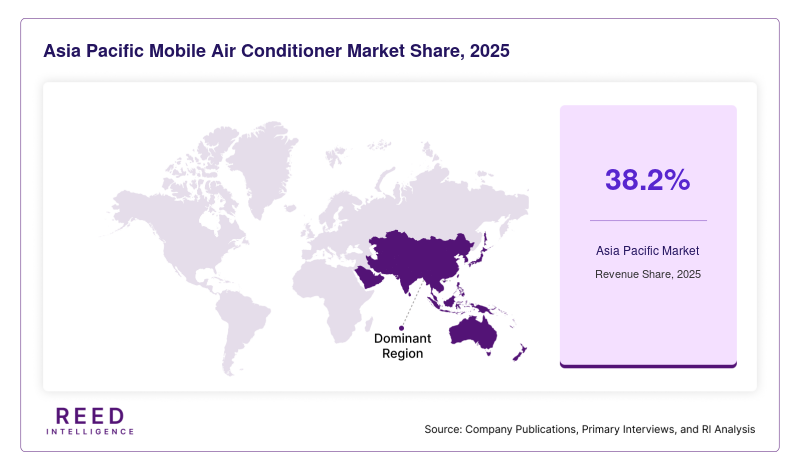
Asia Pacific is the dominant region, accounting for a reported 38.2% of the global Mobile Air Conditioner Market in 2025. Applying that share to the supplied global base-year market size of USD 2,210 million gives an estimated regional market value of USD 844.22 million in 2025. This value is calculated as 38.2% × USD 2,210 million; it is a derived estimate, not a separately verified regional revenue figure. The regional share is reported by Dataintelo’s Mobile Air Conditioner Market report. .
Demand in Asia Pacific is supported by hot and humid climates, urbanisation, expanding residential construction, and the growing need for flexible cooling in apartments and small commercial premises. China, India, Japan, and Southeast Asian countries represent varied opportunities according to household income, cooling requirements, appliance distribution, and manufacturing capacity.
Latin America Mobile Air Conditioner Market
Latin American demand is influenced by warm climates, urban population growth, household cooling requirements, and the need for flexible air conditioning in residential and commercial properties. Portable systems can be suitable where fixed installation is expensive, restricted, or not practical for temporary occupancy.
Brazil and Mexico are relevant markets because of their large populations and diverse climatic conditions. Product affordability, electricity costs, import pricing, retail distribution, and service availability influence purchasing decisions.
Middle East & Africa Mobile Air Conditioner Market
The Middle East & Africa region offers potential for mobile cooling products because of high temperatures, commercial development, temporary facilities, and demand for targeted cooling. Mobile air conditioners may be used in suitable small spaces, offices, workshops, and temporary buildings where fixed systems are unavailable or impractical.
Demand differs across countries according to climate, purchasing power, infrastructure, electricity costs, and distribution networks. In hotter environments, cooling capacity and heat-rejection performance are especially important.
Mobile Air Conditioner Market Competitive Landscape
The Mobile Air Conditioner Market includes established home-appliance manufacturers, specialist portable cooling brands, and companies that develop room air conditioners for residential and commercial use. Competition is shaped by cooling capacity, energy efficiency, portability, noise levels, refrigerant technology, smart features, pricing, and after-sales service.
Manufacturers are investing in inverter technology, improved heat exchangers, compact product design, remote controls, and easier condensate management. Retail availability and seasonal inventory also influence competition, particularly in regions where demand rises sharply during hot weather. Specialist brands compete through portability and application-specific features, while larger appliance companies leverage established manufacturing, distribution, and service networks.
Key Market Players
- LG Electronics
- Frigidaire
- Midea Group
- Gree Electric Appliances
- Hisense Group
- Haier Group
- Whirlpool Corporation
- Electrolux Group
- De'Longhi
- Honeywell
Mobile Air Conditioner Market Recent Developments
April 2025- GE Appliances expands its portable air-conditioning portfolio GE Appliances announced a new GE Profile dual-hose inverter portable air conditioner range, including 10,000 BTU and 12,000 BTU models. The company highlighted inverter operation, cooling performance, and energy-efficiency improvements. This development reflects manufacturers' efforts to improve performance while retaining the installation flexibility associated with portable air conditioners.
April 2025 -EcoFlow introduces WAVE 3 portable air conditioner and heater EcoFlow introduced its WAVE 3 portable air conditioner and heater for outdoor activities, camping, and mobile environments. The product builds on the company's portable climate-control portfolio and emphasises mobility, battery-supported operation, and smart controls. It is most relevant to the specialised outdoor and mobile cooling segment rather than conventional whole-room portable air conditioners.
Mobile Air Conditioner Market Segments
By Product Type
- Single-Hose Portable Air Conditioners
- Dual-Hose Portable Air Conditioners
- Compact Portable Air Conditioners
- Window-Type Mobile Air Conditioners, where included in the market definition
- Other Mobile Air Conditioning Systems
By Cooling Capacity
- Below 8,000 BTU
- 8,000–12,000 BTU
- Above 12,000 BTU
By Technology
- Conventional Compressor-Based Systems
- Inverter-Based Systems
- Smart and Connected Mobile Air Conditioners
- Other Technologies
By Application
- Residential
- Commercial
- Industrial and Construction
- Healthcare and Temporary Facilities
- Other Applications
By Distribution Channel
- Online Retail
- Specialty Appliance Stores
- Supermarkets and Hypermarkets
- Direct Sales and Other Channels
By Region
- North America
- Europe
- APAC
- Middle East and Africa
- LATAM