Mobile Analytics Market Size, Share Demand Report By Component (Solutions, Services), By Deployment Mode (Cloud-Based, On-Premises, Hybrid Deployment), By Application (Marketing Analytics, Customer Behavior Analytics, In-App Analytics, Revenue Analytics, Performance Analytics), By End User (Retail & E-commerce, BFSI, Media & Entertainment, Healthcare, Telecommunications, Travel & Hospitality, Others) By Region & Segment Forecasts, 2026–2034
USD 3950
Market Overview
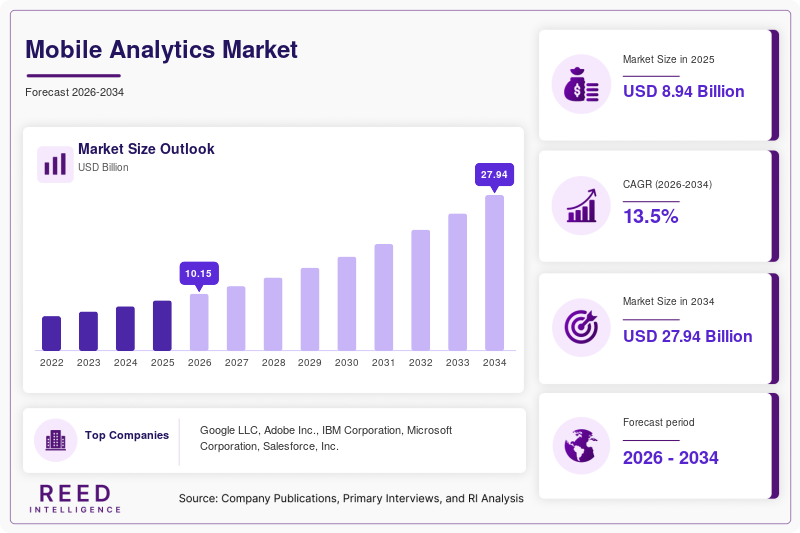
The Mobile Analytics Market size was valued at USD 8.94 billion in 2026 and is projected to reach USD 24.68 billion by 2034, registering a CAGR of 13.5% during the forecast period (2026–2034). A major factor supporting market growth globally has been the rapid increase in mobile internet usage and smartphone penetration across developed and emerging economies. Businesses across industries are increasingly prioritizing mobile-first customer engagement strategies, requiring advanced analytics capabilities to understand user behavior and optimize digital experiences. As consumers spend more time on mobile applications for shopping, entertainment, banking, healthcare, education, and communication, organizations are investing heavily in analytics platforms that provide deeper visibility into customer interactions and business outcomes.
Technological advancements in artificial intelligence, machine learning, predictive analytics, and cloud computing have further strengthened market expansion. Modern mobile analytics platforms offer sophisticated capabilities such as real-time behavioral tracking, customer journey analysis, predictive segmentation, churn forecasting, and automated performance optimization. The growing emphasis on personalized customer experiences, data-driven decision-making, and omnichannel engagement strategies continues to create favorable conditions for long-term market development.
Key Highlights
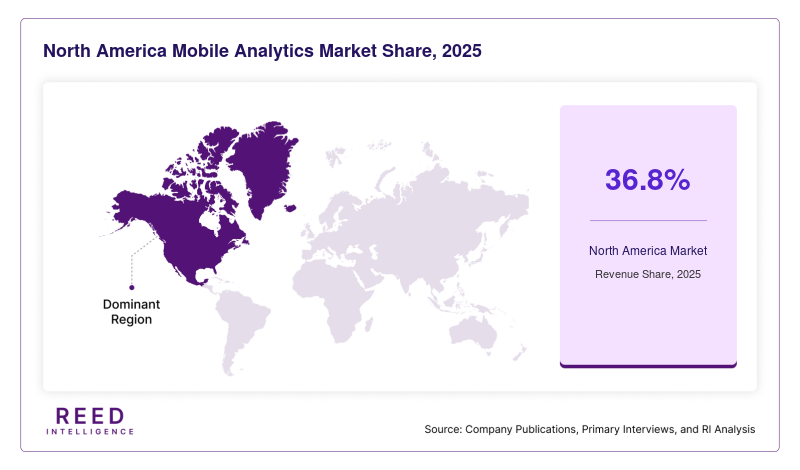
- North America accounted for the largest market share of 36.8% in 2025, while Asia Pacific is projected to register the fastest CAGR of 15.2% during 2026–2034.
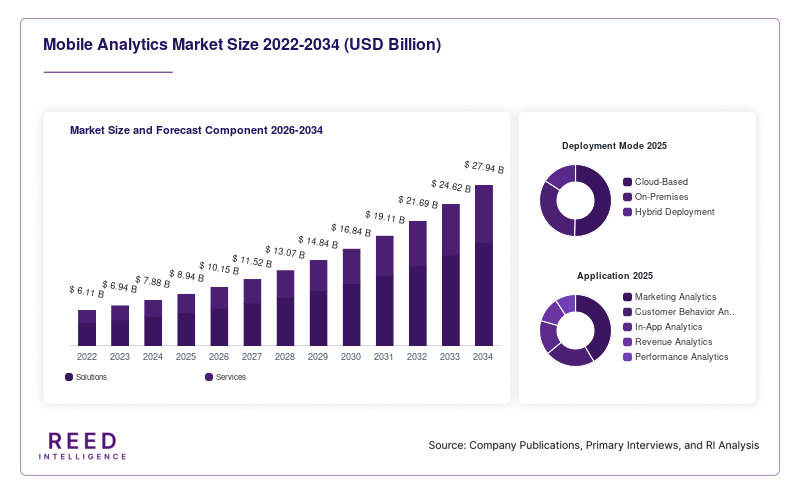
- By Component, Solutions held the dominant share of 67.4% in 2025, whereas Services are expected to expand at a CAGR of 14.6% through 2034.
- By Deployment Mode, Cloud-Based solutions represented 71.2% market share in 2025, while Hybrid Deployment is forecast to grow at a CAGR of 15.1%.
- By Application, Marketing Analytics captured 34.6% of the market in 2025, while Customer Behavior Analytics is anticipated to record a CAGR of 16.0%.
- By End User, Retail & E-commerce remained the leading segment with 24.8% share in 2025, whereas Healthcare is forecast to grow at 16.4% CAGR.
- The United States remained the dominant country, with market values of USD 2.21 billion in 2024 and USD 2.48 billion in 2025.
Market Trends
Integration of Artificial Intelligence into Mobile Analytics Platforms
The Mobile Analytics Market is witnessing increasing integration of artificial intelligence and machine learning technologies within analytics ecosystems. Businesses are moving beyond descriptive analytics toward predictive and prescriptive intelligence that can automatically identify patterns, forecast customer actions, and recommend optimization strategies. AI-powered analytics platforms are enabling organizations to improve customer acquisition campaigns, increase retention rates, and optimize application performance through automated decision-making. This trend is accelerating adoption among enterprises seeking more sophisticated analytical capabilities.
Growing Focus on Privacy-Centric Analytics Frameworks
Increasing regulatory scrutiny and evolving consumer expectations regarding data privacy are reshaping mobile analytics practices globally. Organizations are implementing privacy-centric analytics frameworks that emphasize consent management, anonymized data collection, and secure information processing. Mobile analytics vendors are introducing solutions designed to maintain analytical accuracy while complying with privacy regulations. The growing demand for responsible data management is influencing product development and shaping future market dynamics.
Market Drivers
Expansion of Mobile Commerce and Digital Transactions
The continued growth of mobile commerce platforms is creating significant demand for advanced analytics solutions. Businesses require detailed insights into customer purchasing behavior, conversion pathways, transaction performance, and engagement metrics to maximize digital revenue opportunities. Mobile analytics platforms provide critical visibility into user interactions across shopping applications and digital payment ecosystems. Increasing transaction volumes across mobile channels continue to drive market growth.
Rising Demand for Personalized User Experiences
Organizations are increasingly focused on delivering highly personalized digital experiences to improve customer satisfaction and engagement. Mobile analytics solutions enable businesses to understand user preferences, behavioral patterns, and content interactions at an individual level. These insights support targeted marketing initiatives, personalized recommendations, and customized application experiences. The growing importance of customer-centric business strategies is accelerating analytics adoption across multiple industries.
Market Restraint
Data Security and Compliance Challenges
The collection and processing of large volumes of user data create ongoing security and regulatory challenges for organizations implementing mobile analytics solutions. Compliance with evolving privacy regulations, data protection requirements, and consent management standards can increase implementation complexity. These concerns may limit adoption among organizations operating in highly regulated industries or jurisdictions with strict privacy requirements.
Market Opportunities
Increasing Adoption Across Emerging Digital Health Platforms
The expansion of mobile health applications and connected healthcare services presents substantial opportunities for mobile analytics providers. Healthcare organizations require advanced analytical capabilities to monitor patient engagement, application performance, treatment adherence, and service utilization patterns. Growing investment in digital healthcare ecosystems is expected to create new revenue opportunities throughout the forecast period.
Growth of Analytics Solutions for Super Apps
The emergence of super apps that combine multiple services within a single mobile platform is creating new opportunities for analytics vendors. These applications generate large volumes of user interaction data across diverse services including payments, messaging, transportation, commerce, and entertainment. Organizations operating super apps require sophisticated analytics platforms capable of analyzing complex customer journeys and cross-functional engagement patterns.
Segmental Analysis
By Component
The market is segmented into:
- Solutions
- Services
Solutions dominated the market with 67.4% share in 2025 due to extensive deployment of analytics software platforms capable of delivering real-time insights, customer intelligence, and performance monitoring capabilities. Organizations across industries increasingly rely on analytics solutions to optimize digital operations and enhance decision-making processes.
Services are projected to witness the fastest growth at a CAGR of 14.6% during the forecast period. Increasing implementation complexity and growing demand for consulting, integration, training, and managed analytics services will support segment expansion.
By Deployment Mode
The market includes:
- Cloud-Based
- On-Premises
- Hybrid Deployment
Cloud-Based solutions accounted for 71.2% market share in 2025 owing to their scalability, flexibility, and lower infrastructure requirements. Organizations increasingly prefer cloud environments that support rapid deployment and seamless access to analytical capabilities across distributed operations.
Hybrid Deployment is expected to record the highest CAGR of 15.1% through 2034. Businesses seeking greater control over sensitive data while maintaining cloud scalability advantages will continue driving demand for hybrid architectures.
By Application
The market is categorized into:
- Marketing Analytics
- Customer Behavior Analytics
- In-App Analytics
- Revenue Analytics
- Performance Analytics
Marketing Analytics represented 34.6% market share in 2025 because organizations increasingly utilize mobile data to optimize advertising campaigns, customer acquisition strategies, and promotional activities. Enhanced campaign measurement capabilities contributed to segment leadership.
Customer Behavior Analytics is forecast to expand at a CAGR of 16.0% during the assessment period. Growing emphasis on customer journey optimization and personalized engagement strategies will accelerate demand for behavioral intelligence solutions.
By End User
The market is segmented into:
- Retail & E-commerce
- BFSI
- Media & Entertainment
- Healthcare
- Telecommunications
- Travel & Hospitality
- Others
Retail & E-commerce held 24.8% market share in 2025 due to increasing utilization of analytics platforms for customer segmentation, shopping behavior analysis, and conversion optimization. Mobile commerce expansion continues to strengthen demand within the segment.
Healthcare is anticipated to register the fastest growth at a CAGR of 16.4% through 2034. Growing adoption of mobile health applications and digital patient engagement platforms will create increasing demand for advanced analytics capabilities.
Regional Analysis
North America
North America held 36.8% of the Mobile Analytics Market share in 2025 and is projected to expand at a CAGR of 12.4% during 2026–2034. The region benefits from extensive digital transformation initiatives, high smartphone adoption rates, and widespread utilization of cloud-based technologies. Businesses continue investing in customer intelligence platforms to improve digital engagement and operational efficiency.
The United States remained the dominant country due to its mature digital ecosystem and extensive adoption of advanced analytics technologies across enterprise sectors. Continuous innovation in digital marketing, e-commerce, and software development contributes to strong market demand.
Europe
Europe accounted for 25.6% market share in 2025 and is expected to grow at a CAGR of 12.7% through 2034. The region is characterized by increasing investment in customer experience management and data-driven business strategies. Enterprises are adopting mobile analytics solutions to optimize digital channels while maintaining compliance with evolving privacy regulations.
Germany emerged as the leading country owing to strong enterprise digitalization initiatives and widespread adoption of analytical technologies across manufacturing, retail, and financial services sectors. Increasing investment in business intelligence solutions continues to support market growth.
Asia Pacific
Asia Pacific represented 28.4% of the global Mobile Analytics Market in 2025 and is forecast to register the fastest CAGR of 15.2% during the assessment period. Rapid smartphone adoption, expanding internet connectivity, and increasing digital commerce activity are contributing to substantial market development. Organizations across the region are increasingly utilizing analytics platforms to support customer engagement strategies.
China dominated the regional market due to the large-scale adoption of mobile applications, digital payment platforms, and integrated online ecosystems. The country's expanding digital economy continues to generate significant demand for mobile analytics solutions.
Middle East & Africa
The Middle East & Africa captured 4.8% market share in 2025 and is projected to grow at a CAGR of 13.1% during 2026–2034. Increasing smartphone penetration and digital service adoption are supporting market expansion across several countries. Organizations are investing in analytics platforms to improve customer engagement and digital service delivery.
United Arab Emirates maintained regional leadership owing to strong digital transformation initiatives and increasing investment in smart services. Growing adoption of mobile applications across commercial sectors continues to support market growth.
Latin America
Latin America accounted for 4.4% share of the market in 2025 and is expected to expand at a CAGR of 13.0% through 2034. Rising internet accessibility and increasing utilization of mobile commerce platforms are contributing to greater demand for analytics solutions. Businesses are adopting analytical tools to better understand evolving consumer behavior and digital engagement trends.
Brazil remained the dominant country due to expanding e-commerce activity, increasing mobile banking adoption, and growing investment in digital customer engagement strategies. These factors continue to encourage broader analytics implementation.
Competitive Landscape
The Mobile Analytics Market remains highly competitive, with technology providers focusing on innovation, artificial intelligence integration, real-time analytics capabilities, and enhanced customer intelligence solutions. Companies continue investing in advanced analytics architectures designed to support increasingly complex digital ecosystems.
Google LLC remained a leading participant due to the widespread adoption of its analytics ecosystem across mobile applications and digital platforms worldwide. In 2025, the company expanded its AI-powered analytics capabilities by introducing enhanced predictive modeling tools designed to improve customer behavior forecasting and campaign optimization outcomes.
Other notable market participants include Adobe Inc., IBM Corporation, Microsoft Corporation, and Salesforce, Inc., which continue expanding their analytics portfolios through strategic investments, product innovation, and ecosystem integration initiatives.
Key Players List
- Google LLC
- Adobe Inc.
- IBM Corporation
- Microsoft Corporation
- Salesforce, Inc.
- Mixpanel Inc.
- Amplitude, Inc.
- AppsFlyer Ltd.
- CleverTap
- Adjust GmbH
- Singular Labs, Inc.
- Branch Metrics, Inc.
- Kochava Inc.
- Countly Ltd.
- Localytics LLC
Mobile Analytics Market Segments
Component
- Solutions
- Services
Deployment Mode
- Cloud-Based
- On-Premises
- Hybrid Deployment
Application
- Marketing Analytics
- Customer Behavior Analytics
- In-App Analytics
- Revenue Analytics
- Performance Analytics
End User
- Retail & E-commerce
- BFSI
- Media & Entertainment
- Healthcare
- Telecommunications
- Travel & Hospitality
- Others
By Region
- North America
- Europe
- APAC
- Middle East and Africa
- LATAM