Mobile Anti-Malware Market Size, Share & Trends Analysis Report By Operating System (Android OS, Apple OS, Windows OS, BlackBerry OS), By Malware Type (Trojans, Worms, Backdoors, Ransomware), By User Type (Small and Medium Organizations, Large Organizations), By Vertical (BFSI, Public/Government, Healthcare, Retail, Media and Entertainment, Utilities) and By Region (North America, Europe, Asia Pacific, Latin America, Middle East & Africa) Forecasts, 2026–2034
USD 3950
Mobile Anti-Malware Market Size
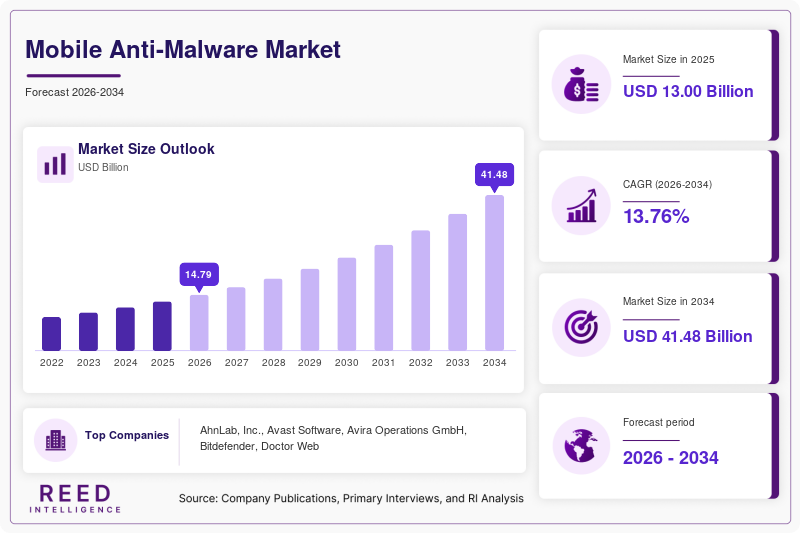
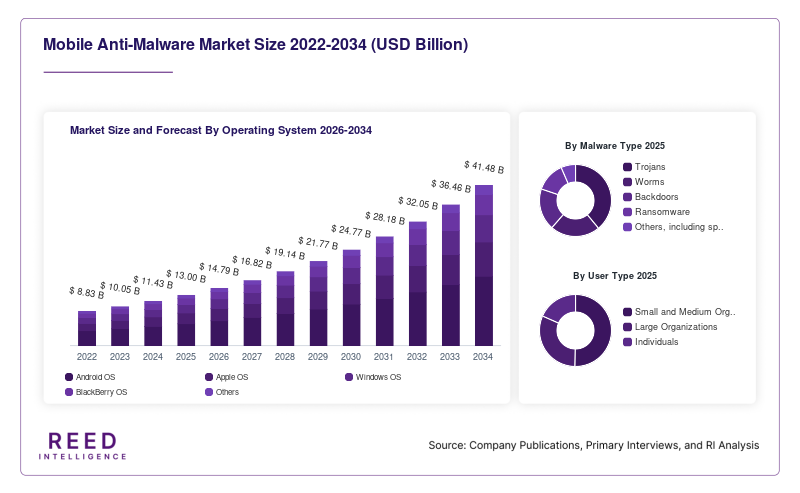
The global mobile anti-malware market was valued at USD 13.00 billion in 2025 and is projected to grow from USD 14.79 billion in 2026 to USD 41.48 billion by 2034, registering a compound annual growth rate (CAGR) of 13.76% during the forecast period from 2026 to 2034.
The Mobile Anti-Malware Market comprises software and security solutions designed to detect, prevent, isolate, and remove malicious programs targeting smartphones, tablets, and other mobile devices. These solutions protect users against viruses, spyware, ransomware, banking Trojans, adware, malicious applications, unauthorized access, and other mobile-based threats. Offerings range from consumer security applications to enterprise mobile threat defense platforms that integrate with endpoint security, identity management, network monitoring, and device compliance systems.
Market expansion is supported by rising smartphone penetration, increased mobile banking and digital payments, greater use of mobile devices for business operations, and growing adoption of bring-your-own-device (BYOD) policies. The expansion of cloud services and mobile applications has increased the volume of sensitive information accessed through mobile devices, strengthening demand for real-time threat detection and privacy protection. AI-supported malware analysis, behavioral monitoring, cloud-based threat intelligence, and automated incident response are also changing the capabilities expected from mobile security products.
Mobile Anti-Malware Market Drivers
Increasing Mobile Cybersecurity Threats
The growing volume and sophistication of attacks targeting smartphones is a primary driver of the Mobile Anti-Malware Market. Attackers increasingly use malicious applications, fake updates, phishing messages, banking Trojans, spyware, and unauthorized downloads to compromise devices and steal personal or financial information. Kaspersky reported that attacks involving banking Trojans on Android smartphones increased by 56% in 2025 compared with 2024. These threats encourage consumers and businesses to invest in stronger mobile malware detection and prevention capabilities.
Growth in Mobile Banking and Digital Transactions
The widespread use of mobile banking, digital wallets, payment applications, and online shopping has increased the amount of sensitive information stored or accessed on mobile devices. Financially motivated malware can capture login credentials, intercept verification messages, monitor user activity, and manipulate financial transactions. Banks, payment providers, and individual users therefore have stronger incentives to deploy mobile security tools that combine malware detection with phishing prevention, fraud alerts, and identity protection.
Enterprise Mobility and BYOD Adoption
Organizations increasingly rely on smartphones and tablets for email, collaboration, customer management, authentication, and remote access to corporate systems. This creates security requirements beyond traditional desktop protection. Mobile anti-malware solutions help organizations identify risky applications, detect suspicious activity, enforce device compliance, and prevent compromised endpoints from accessing sensitive resources. Demand is particularly relevant for enterprises operating under strict data-protection, financial-services, and cybersecurity requirements.
Mobile Anti-Malware Market Restraints
Availability of Built-In Mobile Security
Mobile operating systems and application ecosystems include built-in security controls such as application sandboxing, app-store screening, device permissions, and malware detection. These capabilities can reduce the need for additional standalone anti-malware products among some consumers. Vendors must demonstrate clear added value through advanced threat intelligence, broader device coverage, identity protection, enterprise administration, and detection capabilities that complement native platform protections.
Performance, Battery, and Privacy Concerns
Some users may avoid installing security applications because of concerns about battery consumption, device performance, data usage, intrusive permissions, or collection of personal information. Enterprise deployment can also raise questions about employee privacy and the visibility of personal activity on managed devices. Vendors must balance effective monitoring with transparent data handling, low resource consumption, and configurable privacy controls.
Fragmented Mobile Ecosystems
Differences in operating systems, device manufacturers, security update schedules, application permissions, and platform restrictions make it difficult to deliver identical protection across all devices. Some security capabilities available on Android may not be permitted or technically feasible on iOS. These differences can increase development and maintenance costs while complicating product deployment for organizations managing mixed-device environments.
Mobile Anti-Malware Market Opportunities
AI-Powered and Behavioral Threat Detection
AI-supported security tools can help identify suspicious application behavior, anomalous network connections, unusual permission use, and emerging threats that may evade conventional signature-based detection. Vendors can expand their offerings by combining behavioral analysis with cloud-based threat intelligence and automated remediation. On-device analysis also offers opportunities to identify threats while limiting the transfer of sensitive information to external servers.
Expansion of Enterprise Mobile Threat Defense
Businesses in banking, healthcare, government, telecommunications, and other data-intensive industries require protection for mobile endpoints that access critical systems. Vendors can capitalize on demand for centralized policy management, mobile vulnerability assessment, conditional access, risk-based authentication, and integration with extended detection and response platforms. Managed security services can also help organizations with limited internal cybersecurity expertise.
Integrated Scam, Identity, and Privacy Protection
Mobile threats increasingly extend beyond conventional malware to include fraudulent calls, malicious text messages, phishing websites, identity theft, and social-engineering attacks. This creates an opportunity for vendors to offer integrated security subscriptions covering malware scanning, scam detection, identity monitoring, privacy controls, and web protection. Such services can help vendors differentiate their products and strengthen customer retention.
Mobile Anti-Malware Market Segmental Analysis
By Operating System
Android OS is a leading operating-system segment for mobile anti-malware solutions because of its broad device base, diverse application distribution channels, and exposure to applications installed from outside official stores. The range of device manufacturers and software versions creates additional security-management requirements. Security vendors address these risks through application scanning, real-time threat detection, web protection, and analysis of suspicious behavior.
Apple OS remains important because iPhones and iPads are widely used for personal communication, financial transactions, and enterprise access. Although platform restrictions and built-in controls influence the types of third-party protection available, demand continues for compatible services such as phishing prevention, network protection, identity monitoring, and enterprise device-risk assessment. Windows OS, BlackBerry OS, and other platforms serve more specialized or legacy use cases.
By Malware Type
Trojans are a major threat category because they can disguise malicious activity as legitimate applications and enable credential theft, financial fraud, surveillance, or remote control. Banking Trojans are especially relevant to mobile security providers because they target financial applications and authentication processes. Kaspersky reported a 56% increase in Android banking-Trojan attacks during 2025, underscoring the need for enhanced detection and protection.
Ransomware, worms, backdoors, spyware, and adware also contribute to demand. Backdoors can enable persistent unauthorized access, spyware can expose sensitive communications and personal data, and ransomware can disrupt access to information. The fastest-changing threats are those that combine social engineering with credential theft and malicious application behavior; however, a verified comparative growth ranking across every malware category is not publicly established by the cited sources.
By User Type
Large organizations represent a significant customer group because they manage extensive mobile fleets and require centralized security policies, device-risk visibility, compliance reporting, and integration with corporate security platforms. Enterprises in regulated sectors often need mobile protection as part of a broader endpoint and identity-security strategy.
Small and medium organizations present opportunities for simplified, cloud-managed mobile security products that reduce the need for dedicated cybersecurity staff. Individuals remain an important audience for consumer anti-malware applications, scam protection, privacy tools, and identity security. Demand within this group is influenced by awareness of mobile threats, willingness to pay for subscriptions, and the perceived effectiveness of native device protections.
By Vertical
BFSI is a key application segment because mobile banking, payment services, and financial authentication are attractive targets for cybercriminals. Financial institutions and their customers require protection against malicious applications, credential theft, phishing, and attacks designed to intercept authentication information.
Public and government organizations, healthcare providers, retailers, utilities, and telecom and IT companies also rely on mobile devices to access sensitive systems and data. Healthcare organizations must protect patient information, retailers must secure mobile payment and customer applications, and telecom and IT providers need to safeguard mobile infrastructure and user accounts. A verified ranking of the fastest-growing vertical within this exact market definition is unavailable in the cited public sources.
Mobile Anti-Malware Market Regional Analysis
North AmericaMobile Anti-Malware Market
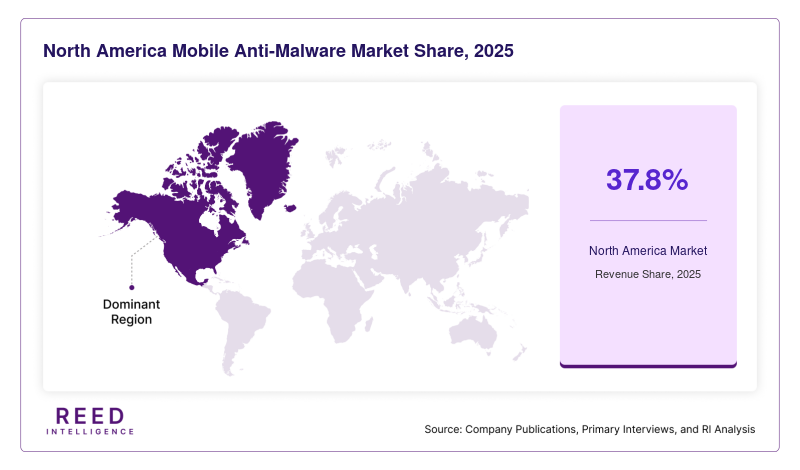
North America is a leading region in the Mobile Anti-Malware Market, supported by established cybersecurity spending, enterprise mobility adoption, a substantial base of digital financial services, and demand for managed endpoint protection. Organizations across financial services, healthcare, government, and technology increasingly require mobile threat defense that integrates with identity management, device compliance, and enterprise security platforms.
Europe Mobile Anti-Malware Market
Europe benefits from strong data-protection requirements, high adoption of digital banking, and continuing investment in enterprise cybersecurity. Organizations operating across the region need to manage mobile-device risks while meeting regulatory expectations for protecting personal and commercially sensitive information. Demand is supported by mobile security products that provide threat detection, access controls, vulnerability assessment, and centralized administration.
The market also benefits from security needs across banking, public services, healthcare, retail, and telecommunications. However, purchasing decisions vary by country, organization size, operating-system mix, and the maturity of national cybersecurity programs. A directly comparable regional market-share percentage for the exact global valuation used in this report was not independently verified.
Asia Pacific Mobile Anti-Malware Market
Asia Pacific represents an important growth opportunity due to widespread smartphone adoption, expanding digital payments, rising mobile commerce, and the increasing use of mobile devices for work and public services. Large and diverse mobile ecosystems create demand for protection against malicious applications, financial Trojans, phishing, spyware, and other threats.
Businesses and consumers across the region are increasingly dependent on mobile platforms for everyday transactions, while organizations are expanding their use of cloud applications and remote access. These trends create opportunities for consumer security subscriptions, enterprise mobile threat defense, and integrated scam-prevention services. Asia Pacific is identified as the fastest-growing region in Mordor Intelligence's separate market assessment, with a forecast CAGR of 14.46% through 2031; this is not the forecast rate for the 2026–2034 market series used here.
Latin America Mobile Anti-Malware Market
Latin America presents growth opportunities as mobile banking, digital wallets, e-commerce, and app-based services become more widely used. The increased use of mobile devices for financial transactions raises the importance of protecting users against credential theft, fake applications, malicious links, and banking Trojans.
Adoption is likely to vary with consumer purchasing power, cybersecurity awareness, enterprise investment, and the availability of affordable security products. Vendors can address the region through localized applications, low-resource security software, cloud-delivered protection, and partnerships with telecom operators, financial institutions, and managed service providers. A comparable verified market-share percentage for Latin America was not available in the cited public sources.
Middle East & Africa Mobile Anti-Malware Market
The Middle East & Africa market is supported by digital transformation initiatives, growing mobile connectivity, expanding electronic payments, and cybersecurity investment among government entities and private businesses. Mobile devices are increasingly used for financial services, enterprise communication, digital identity, and online service delivery, making malware prevention an important part of broader cybersecurity programs.
Demand can vary substantially between countries because of differences in connectivity, regulation, device affordability, and security maturity. Opportunities exist for consumer-focused protection, enterprise mobile threat defense, and managed security services that support organizations with limited in-house resources.
Mobile Anti-Malware Market Competitive Landscape
The Mobile Anti-Malware Market is competitive, with established cybersecurity companies, mobile security specialists, and endpoint-protection providers offering consumer and enterprise solutions. Competition is based on malware detection effectiveness, threat-intelligence coverage, behavioral analytics, ease of use, privacy controls, operating-system compatibility, and integration with broader security platforms.
Vendors are increasingly expanding beyond traditional virus scanning into phishing prevention, scam detection, identity protection, device-risk monitoring, and cloud-based threat intelligence. Enterprise buyers often favor solutions that integrate with endpoint detection and response, mobile device management, and conditional-access systems, while individual users often prioritize ease of use, affordability, and comprehensive protection.
Key Market Players
- AhnLab, Inc.
- Avast Software
- Avira Operations GmbH
- Bitdefender
- Doctor Web
- Emsisoft
- ESET
- F-Secure
- Kaspersky
- Lookout, Inc.
Recent Market Developments
On October 14, 2026, Google announced additional Android protections designed to help users identify and respond to mobile scams across calls, texts, and messaging applications. The announcement reflects growing emphasis on integrated mobile protection that combines scam detection with the wider Android security ecosystem.
On July 2026 , Malwarebytes announced an expanded mobile security offering for Android and iOS, including Scam Text and Call Protection. The company also announced JunkCleaner for Android, positioning the updated offering around scam defense, privacy, and reduction of potential attack exposure. This development illustrates the expansion of mobile security products beyond conventional malware scanning.
Mobile Anti-Malware Market Segments
By Operating System
- Android OS
- Apple OS
- Windows OS
- BlackBerry OS
- Others
By Malware Type
- Trojans
- Worms
- Backdoors
- Ransomware
- Others, including spyware, adware, malicious downloaders, and potentially unwanted applications
By User Type
- Small and Medium Organizations
- Large Organizations
- Individuals
By Vertical
- BFSI
- Public/Government
- Healthcare
- Retail
- Media and Entertainment
- Utilities
- Telecom and IT
- Others, including education, manufacturing, professional services, and other mobile-dependent industries
By Region
- North America
- Europe
- APAC
- Middle East and Africa
- LATAM