Mobile C-Arm Systems Market Size, Share & Trends Analysis Report By Product Type (Full-Size Mobile C-Arms and Mini C-Arms), By Application (Orthopedics and Trauma, Cardiology, Gastroenterology, Neurology, Oncology, and Others), By End User (Hospitals, Ambulatory Surgical Centers, and Specialty Clinics) and By Region (North America, Europe, Asia Pacific, Latin America, Middle East & Africa) Forecasts, 2026–2034
USD 3950
Mobile C-Arm Systems Market Size
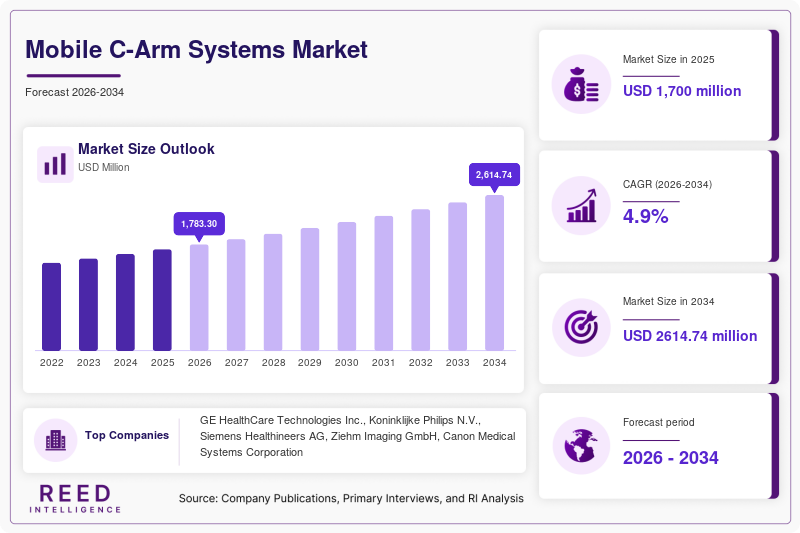
The global mobile C-Arm systems market was valued at USD 1,700 million in 2025 and is projected to grow from USD 1,783.30 million in 2026 to USD 2,614.74 million by 2034, registering a compound annual growth rate (CAGR) of 4.9% during the forecast period from 2026 to 2034.
The Mobile C-Arm Systems Market comprises portable fluoroscopic imaging equipment used to provide real-time X-ray visualization during surgical, diagnostic, and interventional procedures. These systems feature a C-shaped arm that accommodates an X-ray source and detector, enabling medical professionals to view anatomical structures during procedures without moving patients to a separate imaging department. Mobile C-arms are widely used in orthopedic surgery, trauma care, cardiovascular interventions, pain management, urology, and other image-guided procedures.
Market growth is supported by the increasing adoption of minimally invasive surgical techniques, rising demand for intraoperative imaging, and continuous improvements in detector technology, image processing, and radiation-dose management. Hospitals and ambulatory surgical centers are investing in systems that support quicker positioning, improved image clarity, and efficient operating-room workflows. Digital flat-panel detectors, motorized positioning, advanced imaging software, and three-dimensional imaging capabilities are strengthening the clinical value of modern C-arm platforms.
Mobile C-Arm Systems Market Drivers
Increasing Demand for Minimally Invasive Procedures
The growing use of minimally invasive surgery is a major driver of mobile C-arm adoption. Surgeons depend on real-time imaging to guide instruments, confirm implant placement, visualize anatomical structures, and assess procedural progress. Orthopedic fixation, trauma treatment, pain management, and vascular interventions all benefit from intraoperative fluoroscopy. As hospitals expand image-guided procedures, demand for mobile imaging systems that can be deployed across operating rooms is expected to increase.
Advancements in Imaging Technology
Improvements in flat-panel detectors, image-processing algorithms, dose-management features, and digital connectivity are enhancing mobile C-arm performance. Modern systems can deliver clearer images and more streamlined workflows, while advanced configurations provide additional imaging options for complex procedures. These improvements encourage healthcare facilities to replace older equipment and invest in systems that support a wider range of clinical applications.
Expansion of Healthcare Infrastructure
Investment in hospitals, surgical centers, and specialty healthcare facilities is creating opportunities for mobile C-arm manufacturers. Developing healthcare markets are expanding diagnostic and surgical capacity, while established healthcare systems are modernizing equipment to improve procedural efficiency. Mobile systems are particularly attractive where shared equipment, flexible room utilization, and access to intraoperative imaging are important operational considerations.
Mobile C-Arm Systems Market Restraints
High Equipment and Maintenance Costs
Advanced mobile C-arm systems require substantial initial investment, especially models with high-performance detectors, motorized movement, advanced software, and three-dimensional imaging. Ongoing servicing, replacement parts, software upgrades, and staff training can add to total ownership costs. Smaller hospitals and outpatient centers may postpone purchases or select lower-cost alternatives when budgets are limited.
Radiation Safety and Regulatory Requirements
Mobile C-arm systems use ionizing radiation, requiring appropriate dose-management procedures, operator training, equipment quality assurance, and compliance with applicable regulations. Healthcare facilities must protect patients and medical staff while maintaining sufficient image quality for clinical decision-making. These requirements can increase operating complexity and influence equipment selection.
Space and Workflow Limitations
Although mobile C-arms are designed for flexible use, larger systems can still create space and maneuverability challenges in crowded operating rooms. Equipment positioning, coordination among clinical teams, and compatibility with surgical tables and other devices can affect procedural efficiency. Hospitals may need workflow changes or additional training to realize the full benefits of advanced systems.
Mobile C-Arm Systems Market Opportunities
Growth in Ambulatory Surgical Centers
The expansion of outpatient surgery offers opportunities for compact and cost-efficient mobile C-arm systems. Ambulatory surgical centers need reliable imaging equipment that can support appropriate orthopedic, pain-management, and other image-guided procedures while maintaining efficient room turnover. Manufacturers offering easy-to-operate systems with flexible configurations can benefit from this demand.
Integration of Artificial Intelligence and Advanced Software
AI-assisted image processing, automated positioning support, workflow guidance, and improved dose optimization represent potential growth areas. Software that helps clinicians obtain consistent images and reduce unnecessary repositioning may improve operating-room efficiency. Further integration with hospital information systems and digital imaging networks can also strengthen the value proposition of connected C-arm platforms.
Demand for Advanced Intraoperative Imaging
More complex orthopedic, cardiovascular, and endovascular procedures create opportunities for systems offering enhanced image quality, larger detectors, and three-dimensional or hybrid imaging capabilities. Manufacturers that combine these functions with mobile flexibility can address clinical needs that extend beyond conventional two-dimensional fluoroscopy.
Mobile C-Arm Systems Market Segmental Analysis
By Product Type
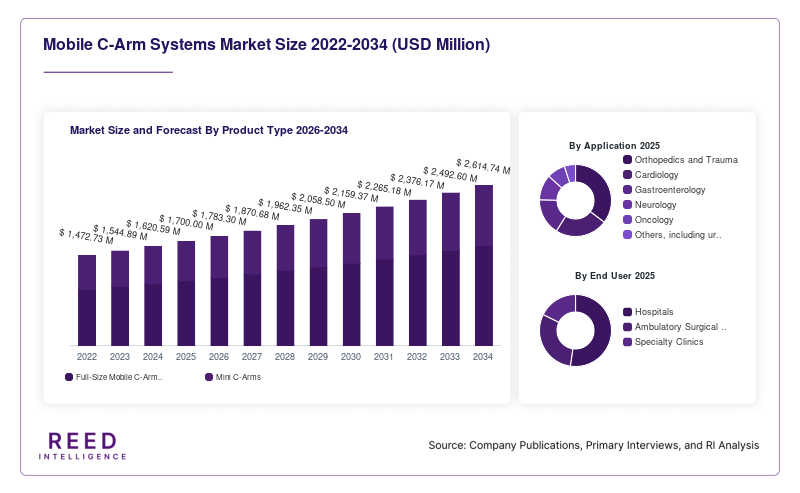
Full-size mobile C-arms are an important segment because they support a broad range of surgical and interventional procedures, including complex orthopedic, trauma, and vascular applications. Their versatility and ability to accommodate demanding imaging requirements make them valuable for hospitals with diverse clinical departments. Mini C-arms serve more specialized needs, particularly extremity imaging and selected orthopedic procedures. Their compact footprint can appeal to outpatient facilities and practices that prioritize convenient positioning and space efficiency.
Full-size mobile C-arms are expected to remain a leading product category due to their wider clinical applicability. Mini C-arms offer opportunities in specialized orthopedic settings, although a reliable, directly comparable growth-rate estimate for each product category is not independently verified here.
By Application
Orthopedics and trauma represent a key application area because real-time imaging supports fracture reduction, fixation, implant placement, and other procedures involving bones and joints. Cardiovascular interventions also require dependable intraoperative visualization, particularly where precise catheter or device positioning is necessary. Gastroenterology, neurology, oncology, urology, and pain-management procedures provide additional demand across hospitals and specialty facilities.
Orthopedics and trauma are expected to remain a dominant application category given the established role of fluoroscopy in orthopedic surgery and trauma care. The expansion of vascular and other minimally invasive interventions creates opportunities in cardiology and additional specialties. A verified comparative growth rate establishing the fastest-growing application is unavailable.
By End User
Hospitals constitute the principal end-user group because they conduct a broad mix of surgical, emergency, orthopedic, and interventional procedures. Their multiple operating rooms and specialized departments can support frequent utilization of mobile imaging equipment. Hospitals also tend to have established radiology, biomedical engineering, and clinical support teams for equipment operation and maintenance.
Ambulatory surgical centers and specialty clinics provide additional opportunities as suitable procedures increasingly move into outpatient settings. These facilities typically evaluate equipment according to clinical needs, affordability, room size, and procedural throughput. Hospitals are expected to remain the dominant end-user category, while the fastest-growing end-user segment cannot be established confidently without a comparable, independently verified dataset.
Mobile C-Arm Systems Market Regional Analysis
North America Mobile C-Arm Systems Market
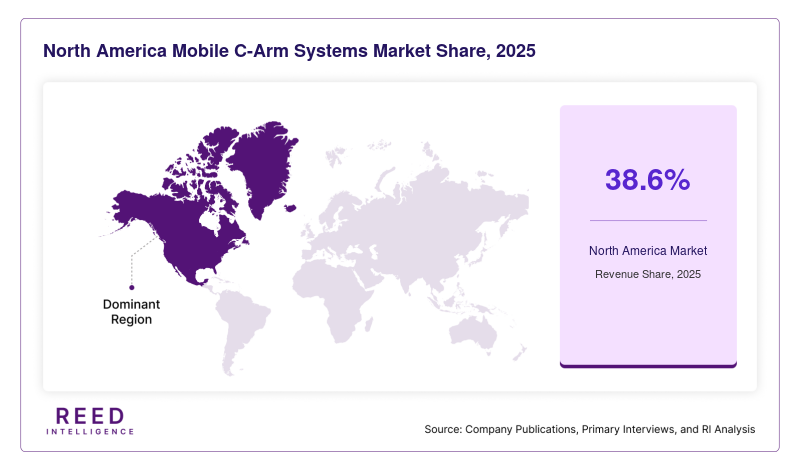
North America is identified as the leading regional market in the Custom Market Insights mobile C-arm market overview. Its position is supported by advanced healthcare infrastructure, established surgical services, access to modern medical equipment, and demand for intraoperative imaging in orthopedic and interventional procedures. The presence of major medical technology companies and established equipment-service networks also supports adoption.
One separate market estimate for the broader mobile C-arm X-ray system category places North America's 2025 share at approximately 38.6%. This is an indicative third-party estimate from a different market series and should not be treated as a verified share of the global market figures supplied in this report.
Europe Mobile C-Arm Systems Market
Europe is an established market for mobile C-arm systems, supported by advanced hospitals, specialist surgical centers, and continued interest in modernizing medical imaging equipment. Demand is influenced by the use of fluoroscopy in orthopedic, trauma, cardiovascular, and other image-guided procedures. Manufacturers also compete on image quality, dose management, workflow features, and equipment lifecycle performance.
The region offers opportunities through replacement of older systems and adoption of advanced mobile imaging technologies. Purchasing decisions vary across countries according to healthcare funding, procurement frameworks, clinical priorities, and regulatory requirements. A directly comparable European market share and verified regional growth ranking are unavailable.
Asia Pacific Mobile C-Arm Systems Market
Asia Pacific offers growth opportunities as healthcare infrastructure expands and hospitals invest in surgical and diagnostic capabilities. Demand is supported by the development of specialty hospitals, increasing access to surgical care, and the modernization of operating rooms. The region also includes a wide range of healthcare markets, creating demand for both advanced full-size systems and more affordable or compact configurations.
Adoption will depend on equipment affordability, distribution networks, clinical training, and access to technical support. Manufacturers that offer adaptable product portfolios and reliable after-sales services may be well positioned to serve different healthcare systems. A verified regional market share and a comparable fastest-growth estimate are unavailable for the exact market series used here.
Latin America Mobile C-Arm Systems Market
Latin America presents opportunities as hospitals and specialty facilities expand access to surgical imaging and upgrade medical equipment. Mobile C-arms can support orthopedic and trauma procedures, as well as other interventions requiring real-time imaging. Their portability can be useful for facilities seeking to share imaging equipment across multiple procedure rooms.
Market expansion may be constrained by capital expenditure limitations, differences in healthcare infrastructure, import costs, and uneven access to specialized service personnel. Suppliers that provide cost-conscious systems, training, and dependable maintenance support may improve adoption. A directly comparable regional market share is unavailable.
Middle East & Africa Mobile C-Arm Systems Market
The Middle East & Africa market is influenced by investment in hospital infrastructure, the expansion of specialized medical services, and efforts to improve access to modern surgical technology. Advanced healthcare facilities in parts of the Middle East can support demand for sophisticated imaging systems, while other markets may prioritize affordable equipment and essential surgical capabilities.
Future adoption will depend on healthcare investment, procurement capacity, workforce training, and local service availability. Mobile C-arms can help facilities introduce or expand intraoperative imaging where flexible equipment utilization is important. A verified regional market share and comparable regional growth rate are unavailable for this specific market series.
Mobile C-Arm Systems Market Competitive Landscape
The Mobile C-Arm Systems Market is competitive, with medical imaging manufacturers differentiating their portfolios through image quality, detector technology, dose-management features, system mobility, workflow automation, and clinical versatility. Suppliers also compete through installation support, servicing, software upgrades, and long-term relationships with hospitals and surgical centers.
Philips is a prominent participant through its Zenition family of mobile C-arm systems. Its portfolio emphasizes imaging performance, ease of use, automated workflows, and controls that help clinicians manage imaging at the operating table. In October 2025, Philips announced the 5,000th installation of its Zenition mobile surgery imaging system, highlighting the platform's international adoption.
Key Market Players
- GE HealthCare Technologies Inc.
- Koninklijke Philips N.V.
- Siemens Healthineers AG
- Ziehm Imaging GmbH
- Canon Medical Systems Corporation
- Fujifilm Holdings Corporation
- Hologic, Inc.
- Shimadzu Corporation
- Genoray Co., Ltd.
- DMS Group
Mobile C-Arm Systems Market Recent Developments
October 2025. Philips reported that the system was installed at Kolín Regional Hospital in the Czech Republic. The company said Zenition systems were being used in more than 170 countries and highlighted workflow and imaging features designed for surgical and interventional care. This is a directly relevant adoption milestone for the mobile C-arm market.
December 2025. GE HealthCare introduced a compact, cable-free C-arm designed to improve movement, access, and workflow in interventional suites. The system features lateral wide-bore cone-beam CT capabilities. Allia Moveo is an adjacent interventional imaging development rather than a conventional mobile C-arm product, but it illustrates the broader industry emphasis on C-arm mobility and advanced intraoperative visualization.
Mobile C-Arm Systems Market Segments
By Product Type
- Full-Size Mobile C-Arms
- Mini C-Arms
By Application
- Orthopedics and Trauma
- Cardiology
- Gastroenterology
- Neurology
- Oncology
- Others, including urology, pain management, and other image-guided procedures
By End User
- Hospitals
- Ambulatory Surgical Centers (ASCs)
- Specialty Clinics
By Region
- North America
- Europe
- APAC
- Middle East and Africa
- LATAM