Mobile Communication Antennas Market Size, Share & Trends Analysis Report By Type (Base Station Antennas, Small Cell Antennas, Distributed Antenna Systems, and Smart Antennas), By Technology (MIMO, Massive MIMO, Beamforming, and Other Technologies), By Application (4G/LTE, 5G, and 6G), and By Region (North America, Europe, Asia Pacific, Latin America, Middle East & Africa) Forecasts, 2026–2034
USD 3950
Mobile Communication Antennas Market Size
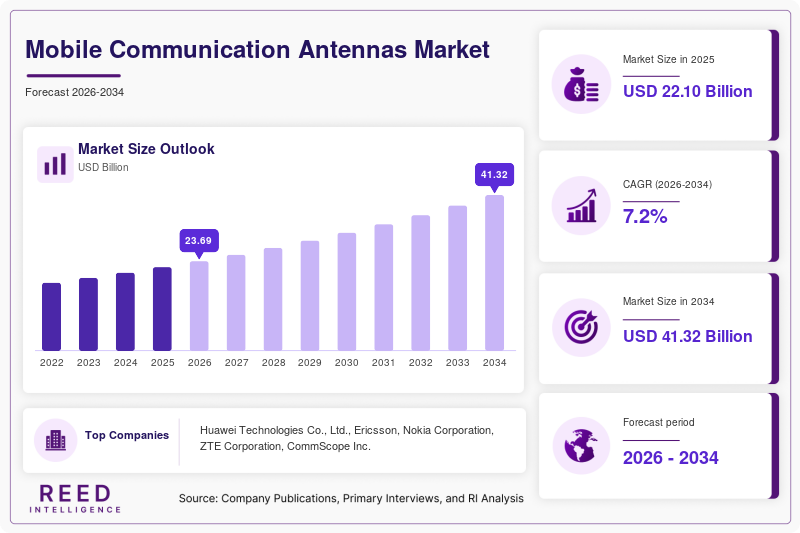
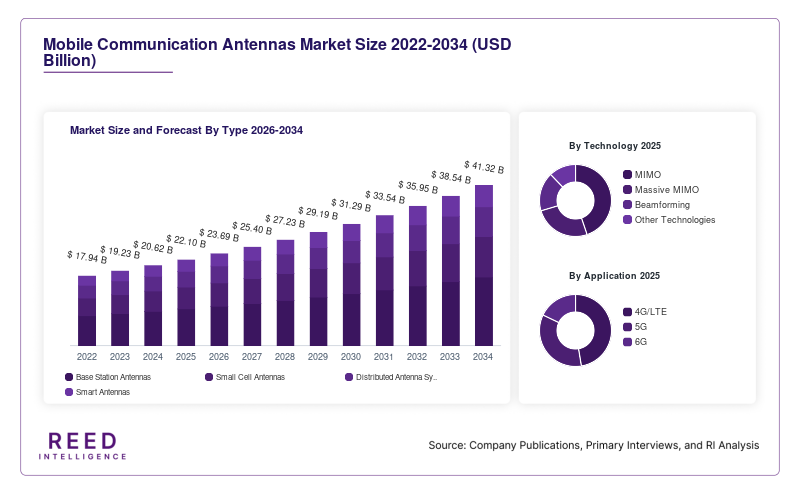
The global mobile communication antennas market was valued at USD 22.10 Billion in 2025 and is expected to reach USD 23.69 Billion in 2026, expanding to USD 41.32 Billion by 2034, registering a CAGR of 7.2% during the forecast period from 2026 to 2034.
Mobile communication antennas are critical components of wireless network infrastructure, enabling radio-frequency transmission and reception between base stations and mobile devices. The market encompasses base station antennas, small cell antennas, distributed antenna systems, smart antennas, Massive MIMO antenna arrays, and other specialized antenna solutions used across cellular networks.
The market is undergoing technological transformation as operators upgrade existing 4G infrastructure while expanding 5G and preparing networks for future 6G requirements. Antenna manufacturers are increasingly focusing on higher-order MIMO, beamforming, multi-band and multi-port configurations, improved uplink performance, energy efficiency, compact form factors, and simplified site deployment.
Mobile Communication Antennas Market Drivers
Rapid Expansion of 5G and 5G-Advanced Networks
The continued deployment of 5G networks is one of the primary drivers of the mobile communication antennas market. Operators are expanding coverage, capacity, and spectrum utilization through Massive MIMO, active antenna units, small cells, and multi-band antenna configurations. The transition toward 5G-Advanced is creating additional demand for higher-performance antenna systems capable of supporting greater bandwidth and advanced beamforming.
Increasing Mobile Data Traffic and AI-Driven Connectivity
The rapid growth of data-intensive applications, cloud services, artificial intelligence, augmented reality, video streaming, and connected devices is increasing capacity requirements across mobile networks. AI-enabled applications also create greater uplink requirements, encouraging operators to invest in antenna systems that improve uplink capacity, spectral efficiency, and network reliability. Ericsson's 2026 AI-ready antenna portfolio specifically addresses these changing traffic requirements.
Growing Adoption of Massive MIMO and Beamforming
Massive MIMO and beamforming allow operators to improve spectral efficiency, capacity, coverage, and user experience without proportionally increasing physical network infrastructure. Increasing antenna element counts and sophisticated beamforming algorithms are becoming fundamental components of advanced 5G networks and are also forming the technical foundation for emerging 6G architectures.
Mobile Communication Antennas Market Restraints
High Deployment and Infrastructure Costs
Advanced antenna systems require substantial investment in antennas, radios, towers, power systems, backhaul, installation, and network optimization. Massive MIMO and active antenna systems can be particularly capital intensive, creating challenges for operators operating in lower-revenue markets.
Limited Availability of Suitable Sites
Urban network deployment can be constrained by limited tower availability, zoning requirements, structural limitations, and difficulties obtaining new sites. Operators are therefore increasingly seeking compact, integrated, and multi-band antennas capable of supporting additional capacity without requiring substantial increases in site footprint.
Complexity of Multi-Band and Multi-Technology Integration
Mobile operators increasingly need to operate multiple frequency bands and generations of cellular technology simultaneously. Integrating 4G, 5G, 5G-Advanced, and future 6G capabilities into limited site space increases antenna design complexity and can create challenges related to interference, passive intermodulation, power consumption, and installation.
Mobile Communication Antennas Market Opportunities
Development of 6G-Ready Antenna Technologies
The transition toward 6G represents a significant long-term opportunity for antenna manufacturers. Research and commercial development are moving toward higher-frequency spectrum, denser antenna arrays, Giga-MIMO, advanced beamforming, integrated sensing, and intelligent network infrastructure. Qualcomm's 2026 research highlights the role of Giga-MIMO and dense antenna arrays in future 6G upper-mid-band deployments.
AI-Enabled and Intelligent Antennas
Integration of AI with antenna systems creates opportunities for dynamic beam management, coverage optimization, predictive network planning, and automated site configuration. Ericsson introduced AI-managed beamforming and AI-ready antenna products in 2026, demonstrating the movement toward increasingly intelligent antenna infrastructure.
Energy-Efficient and Simplified Antenna Designs
Network operators are increasingly seeking solutions that reduce energy consumption, equipment weight, installation complexity, and site operating costs. In March 2026, SoftBank and AGC demonstrated a functional beam-shaping lens antenna designed to simplify base-station antenna architecture while reducing power consumption by up to eight times compared with conventional configurations.
Mobile Communication Antennas Market Segmental Analysis
By Type
Base station antennas represent the core product category within the mobile communication antennas market because of their widespread deployment across macro-cellular networks. Operators use multi-band, multi-port, passive, active, and Massive MIMO antenna systems to support multiple generations of cellular technology. Increasing network capacity requirements and the need to improve coverage and spectrum efficiency are supporting continued investment in advanced base station antennas.
Small cell antennas are increasingly important in dense urban areas, indoor environments, enterprise networks, and high-traffic locations. They enable operators to add network capacity and improve coverage without relying exclusively on large macro sites. Increasing 5G densification and enterprise connectivity requirements are expected to support segment growth.
Distributed antenna systems are used to improve cellular coverage and capacity across large indoor and specialized environments such as airports, stadiums, shopping centers, hospitals, hotels, transportation hubs, and commercial buildings. The expansion of indoor 5G connectivity is creating new opportunities for DAS antenna solutions.
Smart antennas use adaptive beamforming and signal-processing techniques to improve wireless coverage, capacity, and interference management. The segment is benefiting from advances in Massive MIMO, AI-based beam management, and programmable network infrastructure.
By Technology
MIMO technology remains a fundamental component of modern cellular infrastructure because it enables multiple antennas to transmit and receive data simultaneously. Increasing antenna configurations and advanced signal processing are helping operators improve spectral efficiency and network capacity.
Massive MIMO is one of the most important technologies supporting advanced 5G deployments. Large antenna arrays enable spatial multiplexing and sophisticated beamforming, allowing operators to serve more users while improving network capacity and coverage. Massive MIMO is also an important foundation for emerging Giga-MIMO and 6G architectures.
Beamforming enables antennas to direct radio-frequency energy toward specific users or locations, improving signal strength and reducing interference. AI-assisted beamforming is becoming increasingly important as networks become more dynamic and data-intensive. Ericsson introduced AI-managed beamforming as part of its 2026 AI RAN portfolio.
Other technologies include advanced antenna arrays, hybrid beamforming, lens-based antenna systems, multi-band architectures, and emerging intelligent antenna technologies. These technologies are gaining attention as operators seek more compact, energy-efficient, and future-ready network infrastructure.
By Application
4G/LTE continues to represent a substantial installed base for mobile communication antennas. Operators continue to maintain and upgrade LTE infrastructure while using existing antenna systems to support coverage and capacity requirements during the transition toward newer technologies.
5G represents the leading application opportunity for advanced mobile communication antennas. Massive MIMO, active antenna units, beamforming, multi-band configurations, and higher-frequency spectrum are increasing demand for sophisticated antenna solutions. Huawei's 2026 U6GHz portfolio, for example, includes large-array antenna systems designed to expand 5G-Advanced capacity.
6G remains an emerging application but represents a significant long-term growth opportunity. Research and early commercial development are focusing on higher-frequency spectrum, larger antenna arrays, Giga-MIMO, intelligent beamforming, integrated sensing, and improved energy efficiency. ZTE and China Mobile demonstrated GigaMIMO developments at MWC Barcelona 2026, highlighting the industry's movement toward ultra-massive antenna arrays for future networks.
Mobile Communication Antennas Market Regional Analysis
North America Mobile Communication Antennas Market
North America represents a major market for mobile communication antennas due to continued 5G deployment, network densification, private wireless networks, and increasing demand for high-capacity mobile connectivity. The United States remains a major market for advanced Massive MIMO and small-cell deployments, while Canadian operators continue expanding 5G coverage and capacity.
Europe Mobile Communication Antennas Market
Europe represents an established market for mobile communication antennas, supported by 5G network modernization, spectrum deployment, network sharing, and increasing demand for efficient infrastructure. Operators are increasingly focused on reducing network energy consumption and improving site utilization, creating opportunities for integrated and energy-efficient antenna systems.
Asia Pacific Mobile Communication Antennas Market
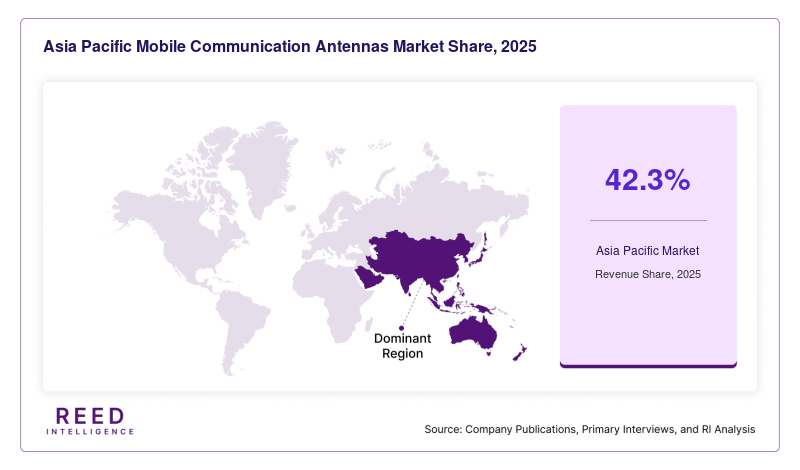
Asia Pacific was the dominant regional market for mobile communication antennas in 2025, accounting for approximately 42.3% of global market revenue. The region's leadership is supported by extensive 5G infrastructure investments, large-scale network deployments, high mobile data consumption, and a strong telecommunications equipment manufacturing ecosystem. China represents a major contributor to regional demand, while India, Japan, South Korea, and Southeast Asian countries are also expanding 5G infrastructure and advanced antenna deployments. The increasing adoption of Massive MIMO, beamforming, multi-band antennas, and emerging 5G-Advanced technologies is expected to reinforce Asia Pacific's leading position through the forecast period.
Latin America Mobile Communication Antennas Market
Latin America is experiencing increasing demand for mobile communication antennas as operators expand 4G and 5G coverage and improve network capacity. Brazil, Mexico, Argentina, Chile, and Colombia represent important markets. Continued smartphone adoption, increasing data consumption, and network modernization are expected to support antenna demand.
Middle East & Africa Mobile Communication Antennas Market
The Middle East & Africa market is benefiting from continued 5G deployment, smart-city initiatives, enterprise connectivity, and digital transformation. Gulf countries are investing heavily in advanced mobile infrastructure, while African markets are continuing to expand cellular coverage and upgrade existing networks.
Mobile Communication Antennas Market Competitive Landscape
The Mobile Communication Antennas Market is highly competitive and includes global telecommunications equipment manufacturers, specialized antenna companies, RF technology providers, and regional suppliers. Competition is increasingly centered on multi-band capability, Massive MIMO performance, uplink improvements, energy efficiency, compact designs, AI integration, and readiness for 5G-Advanced and 6G networks.
Ericsson is a major participant in the mobile communication antennas market and continues to expand its antenna portfolio for advanced cellular networks. In February 2026, the company introduced five new high-performing antennas alongside AI-ready radios and AI RAN software. Its antenna portfolio includes interleaved and passive antennas designed to improve spectrum utilization, uplink performance, carrier aggregation, and site efficiency.
Key Market Players
- Huawei Technologies Co., Ltd.
- Ericsson
- Nokia Corporation
- ZTE Corporation
- CommScope Inc.
- Amphenol Corporation
- Kathrein SE
- Rosenberger
- Comba Telecom Systems Holdings Limited
- Tongyu Communication Inc.
Mobile Communication Antennas Market Recent Developments
- February 2026, Ericsson introduced a new portfolio of AI-ready radios, antennas, and AI RAN software ahead of MWC Barcelona 2026. The company launched five new high-performing antennas, including interleaved and passive antenna solutions designed to improve spectrum utilization, uplink performance, carrier aggregation, and spectral efficiency. The portfolio also incorporated AI-managed beamforming and other AI-driven network capabilities, reflecting the increasing integration of artificial intelligence into mobile antenna infrastructure.
- March 2026- ZTE and China Mobile unveiled GigaMIMO at MWC Barcelona 2026. The technology represents an evolution of Massive MIMO using ultra-massive antenna arrays and AI integration to improve network performance. The companies demonstrated applications supporting 5G-Advanced while positioning GigaMIMO as an important technology pathway toward 6G networks.
Mobile Communication Antennas Market Segments
By Type
- Base Station Antennas
- Small Cell Antennas
- Distributed Antenna Systems
- Smart Antennas
By Technology
- MIMO
- Massive MIMO
- Beamforming
- Other Technologies
By Application
- 4G/LTE
- 5G
- 6G
By Region
- North America
- Europe
- APAC
- Middle East and Africa
- LATAM