Mobile Computing Device Market Size, Share & Demand Report By Device Type (Smartphones, Tablets, Laptops, Rugged Handheld Devices, Wearable Computing Devices), By Operating System (Android, iOS, Windows-Based Systems), By End Use (Consumer Electronics, Enterprise Mobility, Healthcare, Education), By Distribution Channel (Online Retail Platforms, Electronics Stores, Telecom Operator Stores) By Region & Segment Forecasts, 2026–2034
USD 3950
Market Overview
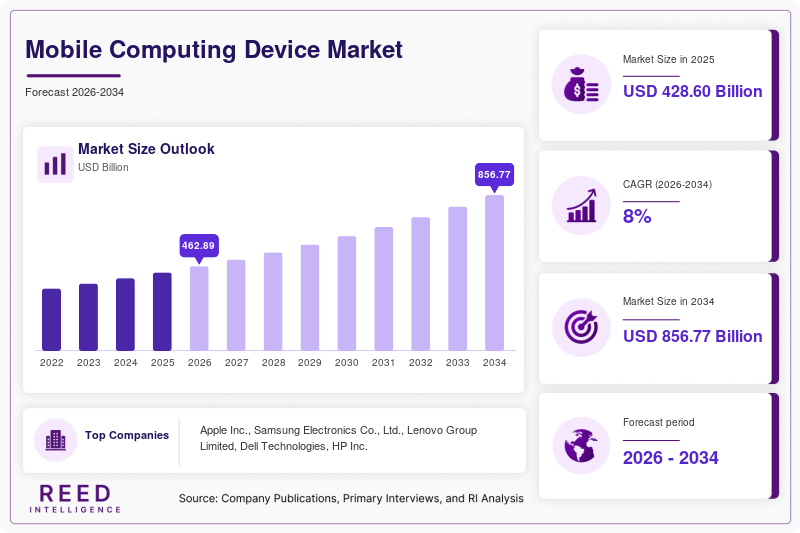
The Mobile Computing Device Market size was valued at USD 428.6 billion in 2026 and is projected to reach USD 792.4 billion by 2034, expanding at a CAGR of 8.0% during the forecast period of 2026–2034. The global Mobile Computing Device Market growth has been supported by increasing global internet penetration and rising dependence on connected digital ecosystems across enterprise and consumer applications. Expanding adoption of cloud computing, remote work infrastructure, and mobile-based communication technologies has accelerated the demand for advanced mobile computing devices worldwide.
Mobile computing devices include smartphones, tablets, laptops, rugged handheld devices, and wearable computing systems that enable wireless communication, real-time data access, and digital productivity. These devices have become essential for education, healthcare, retail, logistics, manufacturing, and entertainment industries. The increasing integration of artificial intelligence, 5G connectivity, and edge computing technologies is strengthening the market outlook across developed and emerging economies.
Key Highlights
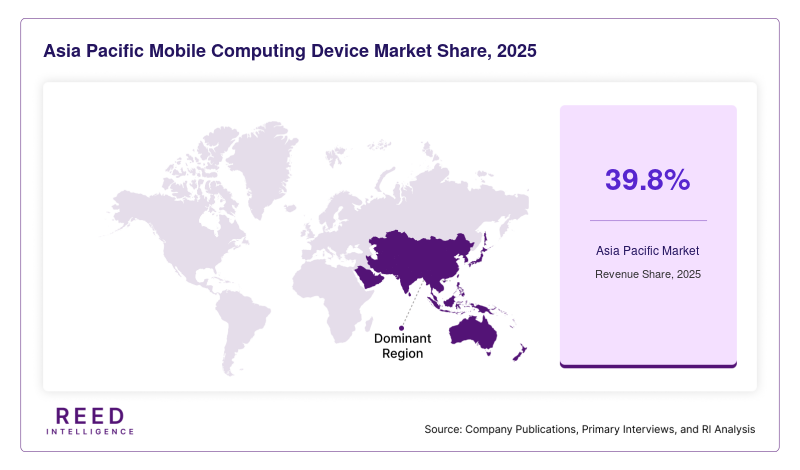
- Asia Pacific accounted for 39.8% of the global Mobile Computing Device Market share in 2025, while Middle East & Africa is projected to witness the fastest CAGR of 9.1% during 2026–2034.
- By device type, smartphones held the dominant share of 46.7% in 2025, whereas wearable computing devices are anticipated to grow at the fastest CAGR of 9.5%.
- By operating system, Android-based devices represented the leading segment with 61.3% share in 2025, while cloud-native operating systems are expected to expand at a CAGR of 8.9%.
- By end use, consumer electronics accounted for 52.4% of the market share in 2025, whereas enterprise mobility solutions are projected to register a CAGR of 8.7%.
- By distribution channel, online retail platforms dominated with 48.6% share in 2025, while direct-to-consumer brand stores are forecast to grow at a CAGR of 8.4%.
- China remained the dominant country market and was valued at USD 68.9 billion in 2024 and USD 73.4 billion in 2025.
Market Trends
Integration of Artificial Intelligence in Mobile Devices
The integration of artificial intelligence into mobile computing devices has emerged as a major trend influencing the Mobile Computing Device Market. Device manufacturers are increasingly incorporating AI-powered processors, voice assistants, image recognition tools, and predictive software functionalities.
AI-enabled mobile devices improve user experiences by optimizing battery performance, enhancing security systems, and enabling intelligent application management. Businesses are also adopting AI-powered mobile devices for enterprise productivity, workflow automation, and customer engagement solutions.
Rising Adoption of Foldable and Flexible Display Devices
The growing popularity of foldable smartphones and flexible-display tablets is reshaping the competitive landscape of the Mobile Computing Device Market. Manufacturers are focusing on innovative form factors that combine portability with enhanced screen usability.
Consumers increasingly prefer flexible display technologies for multimedia applications, gaming, productivity tasks, and multitasking capabilities. Advancements in display durability and hinge technologies are expected to support broader market penetration during the forecast period.
Market Drivers
Expansion of 5G Communication Infrastructure
The rapid expansion of global 5G communication networks has significantly driven the Mobile Computing Device Market. Consumers and enterprises are increasingly upgrading devices to support faster connectivity, lower latency, and advanced digital applications.
5G-enabled devices improve cloud computing performance, streaming quality, remote collaboration, and real-time industrial communication. Telecommunications providers and device manufacturers continue investing heavily in next-generation mobile ecosystems.
Growing Adoption of Remote and Hybrid Work Models
The increasing adoption of remote and hybrid work models has accelerated demand for laptops, tablets, and enterprise mobility solutions. Organizations are investing in portable computing systems to support flexible workforce operations and digital collaboration.
Mobile computing devices enable employees to access cloud applications, communication platforms, and enterprise software from multiple locations. This shift toward mobile productivity infrastructure continues to strengthen market demand globally.
Market Restraint
Short Product Replacement Cycles and Electronic Waste Concerns
Short product life cycles and increasing concerns regarding electronic waste remain major restraints for the Mobile Computing Device Market. Frequent product upgrades contribute to rising environmental challenges associated with discarded batteries, screens, and semiconductor components.
Regulatory agencies and environmental organizations are pressuring manufacturers to improve product sustainability, recyclability, and resource efficiency. Compliance with environmental standards may increase manufacturing costs for market participants.
Market Opportunities
Growth of Mobile Computing in Healthcare Applications
The increasing use of mobile computing devices in healthcare environments presents significant growth opportunities for the Mobile Computing Device Market. Hospitals and healthcare providers are adopting mobile devices for patient monitoring, telemedicine, digital diagnostics, and healthcare data management.
Advanced tablets, rugged handheld devices, and wearable monitoring systems are expected to improve healthcare accessibility and operational efficiency across medical facilities.
Expansion of Smart Education Infrastructure
The growing implementation of digital education platforms and connected learning systems is creating new opportunities for mobile computing device manufacturers. Educational institutions are increasingly deploying tablets, laptops, and mobile learning tools for virtual classrooms and interactive learning environments.
Governments and private educational organizations are investing in affordable mobile computing solutions to improve digital literacy and remote learning accessibility.
Segmental Analysis
By Device Type
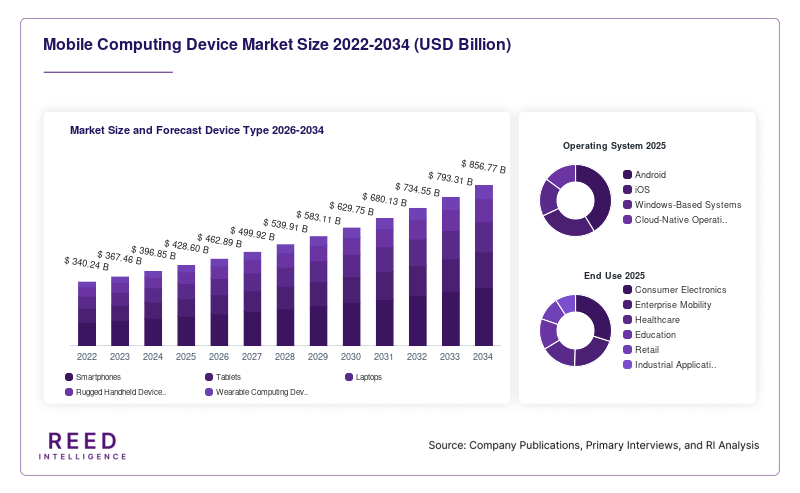
Based on device type, the Mobile Computing Device Market is segmented into smartphones, tablets, laptops, rugged handheld devices, and wearable computing devices.
Smartphones dominated the market with a 46.7% share in 2025 owing to their widespread adoption across communication, entertainment, and productivity applications. Consumers increasingly relied on smartphones for digital payments, social media engagement, and cloud connectivity.
Wearable computing devices are expected to witness the fastest CAGR of 9.5% during the forecast period. Increasing health monitoring applications, fitness tracking adoption, and integration of AI-powered wearable technologies will continue supporting segment growth.
By Operating System
Based on operating system, the market is categorized into Android, iOS, Windows-based systems, and cloud-native operating systems.
Android-based devices accounted for the leading market share of 61.3% in 2025 due to their broad device compatibility, affordability, and extensive application ecosystem. Manufacturers across multiple price categories widely adopted Android platforms.
Cloud-native operating systems are projected to grow at a CAGR of 8.9% during 2026–2034. Increasing cloud computing adoption and enterprise demand for lightweight computing systems will support segment expansion.
By End Use
Based on end use, the Mobile Computing Device Market is divided into consumer electronics, enterprise mobility, healthcare, education, retail, and industrial applications.
Consumer electronics dominated the market with a 52.4% share in 2025 due to rising consumer demand for smartphones, laptops, and multimedia devices. Increasing digital entertainment consumption and connected lifestyle trends supported segment growth.
Enterprise mobility solutions are projected to register the fastest CAGR of 8.7% during the forecast period. Businesses are increasingly adopting secure mobile computing infrastructure to improve workforce flexibility and operational efficiency.
By Distribution Channel
Based on distribution channel, the market is segmented into online retail platforms, electronics stores, telecom operator stores, direct-to-consumer brand stores, and enterprise sales channels.
Online retail platforms held the dominant share of 48.6% in 2025 owing to increasing e-commerce adoption and convenient product comparison capabilities. Consumers preferred online platforms due to wider product availability and promotional pricing strategies.
Direct-to-consumer brand stores are expected to witness the fastest CAGR of 8.4% during the forecast period. Manufacturers are increasingly strengthening direct sales strategies to improve customer engagement and brand loyalty.
Regional Analysis
Asia Pacific
Asia Pacific accounted for 39.8% of the global Mobile Computing Device Market share in 2025 and is projected to expand at a CAGR of 8.6% during 2026–2034. Rapid smartphone adoption, large consumer electronics manufacturing capabilities, and expanding internet connectivity supported regional market growth.
China remained the dominant country market due to strong electronics manufacturing infrastructure and increasing demand for advanced smartphones and tablets. Rising digital commerce and mobile payment ecosystems further contributed to market expansion.
North America
North America represented 27.4% of the global Mobile Computing Device Market share in 2025 and is anticipated to grow at a CAGR of 7.3% during the forecast period. Strong adoption of enterprise mobility solutions and advanced communication infrastructure supported regional demand.
The United States dominated the regional market owing to increasing adoption of AI-enabled devices and growing investments in hybrid work technologies across corporate sectors.
Europe
Europe captured 20.1% of the global Mobile Computing Device Market share in 2025 and is expected to grow at a CAGR of 7.1% during the forecast period. Increasing digital transformation initiatives and rising enterprise mobility adoption supported regional development.
Germany led the regional market because of expanding industrial mobility solutions and growing adoption of secure enterprise communication technologies.
Middle East & Africa
Middle East & Africa accounted for 6.8% of the global Mobile Computing Device Market share in 2025 and is projected to witness the fastest CAGR of 9.1% during 2026–2034. Expanding telecommunications infrastructure and rising smartphone penetration supported regional growth.
The United Arab Emirates remained the dominant country market owing to strong investments in smart city infrastructure and digital connectivity initiatives.
Latin America
Latin America held 5.9% of the global Mobile Computing Device Market share in 2025 and is forecast to expand at a CAGR of 7.5% during the study period. Increasing mobile internet adoption and rising demand for affordable computing devices contributed to regional market expansion.
Brazil emerged as the dominant country market due to growing digital banking adoption and increasing consumer demand for connected mobile devices.
Competitive Landscape
The Mobile Computing Device Market remains highly competitive with major technology companies focusing on product innovation, AI integration, advanced chip development, and ecosystem expansion. Manufacturers continue investing in next-generation display technologies, energy-efficient processors, and cloud-based computing platforms.
Apple Inc. remained one of the leading market participants due to its strong premium device portfolio and integrated software ecosystem. The company recently expanded AI-powered productivity features and advanced semiconductor capabilities across its mobile computing product line.
Samsung Electronics Co., Ltd. continued strengthening foldable smartphone technologies and advanced AMOLED display production. Lenovo Group Limited focused on enterprise mobility solutions and hybrid work devices, while Dell Technologies expanded AI-enabled commercial laptops. HP Inc. increased investments in lightweight computing systems for remote work and educational applications.
Key Players List
- Apple Inc.
- Samsung Electronics Co., Ltd.
- Lenovo Group Limited
- Dell Technologies
- HP Inc.
- ASUSTeK Computer Inc.
- Acer Inc.
- Huawei Technologies Co., Ltd.
- Xiaomi Corporation
- Microsoft Corporation
- Sony Group Corporation
- LG Electronics
- Panasonic Holdings Corporation
- Toshiba Corporation
- Google LLC
Recent Developments
- In 2025, Apple Inc. expanded AI-powered mobile productivity features across its device ecosystem.
- In 2024, Samsung Electronics Co., Ltd. introduced next-generation foldable mobile computing devices with enhanced display durability.
- In 2025, Lenovo Group Limited launched enterprise-focused hybrid work laptops with AI-enabled collaboration tools.
- In 2024, Dell Technologies expanded secure cloud-integrated mobile computing solutions for enterprise customers.
- In 2025, HP Inc. invested in lightweight educational computing devices designed for remote learning environments.
Mobile Computing Device Market Segments
Device Type
- Smartphones
- Tablets
- Laptops
- Rugged Handheld Devices
- Wearable Computing Devices
Operating System
- Android
- iOS
- Windows-Based Systems
- Cloud-Native Operating Systems
End Use
- Consumer Electronics
- Enterprise Mobility
- Healthcare
- Education
- Retail
- Industrial Applications
Distribution Channel
- Online Retail Platforms
- Electronics Stores
- Telecom Operator Stores
- Direct-to-Consumer Brand Stores
- Enterprise Sales Channels
By Region
- North America
- Europe
- APAC
- Middle East and Africa
- LATAM