Mobile Content Management (MCM) Software Market Size, Share & Demand Report By Deployment Type (Cloud-based, On-premise, Hybrid), By Application (Enterprise Content Sharing, Mobile Document Management, Workflow Management, Compliance and Governance), By End Use (Large Enterprises, Small and Medium Enterprises, Government Organizations, Healthcare Institutions), By Region & Segment Forecasts, 2026–2034
USD 3950
Market Overview
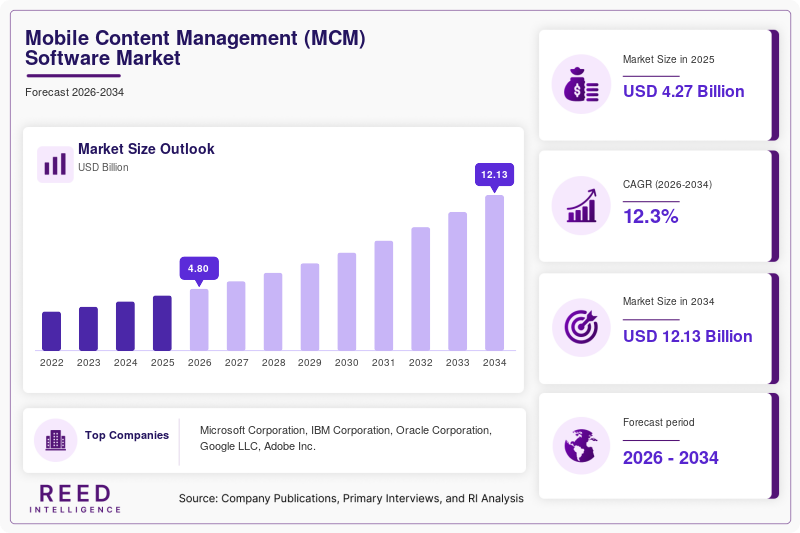
The global Mobile Content Management (MCM) Software Market size is estimated at USD 4.8 billion in 2026 and is projected to reach USD 12.1 billion by 2034, expanding at a CAGR of 12.3% during 2026–2034. The market is experiencing sustained growth as organizations increasingly adopt enterprise mobility strategies and digital workplace initiatives. Mobile content management software enables businesses to securely access, manage, distribute, and synchronize enterprise content across smartphones, tablets, and other connected devices. The growing dependence on mobile-enabled workflows has transformed MCM solutions into an important component of modern enterprise infrastructure.
A major factor supporting market growth is the widespread adoption of remote and hybrid working environments across global industries. Organizations are prioritizing secure access to business documents and collaboration tools while ensuring compliance with evolving data protection regulations. As enterprises continue to digitize operations, demand for centralized content governance, secure file sharing, and real-time document accessibility has increased significantly. The integration of cloud computing, artificial intelligence, and advanced cybersecurity technologies has further strengthened the value proposition of MCM platforms.
Key Highlights
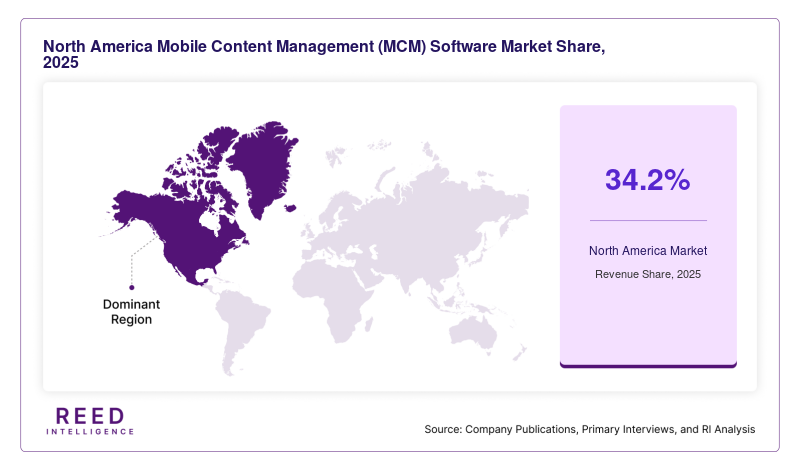
- North America dominated the market with a 34.2% share in 2025, while Asia Pacific is expected to grow at the fastest CAGR of 11.2% during 2026–2034.
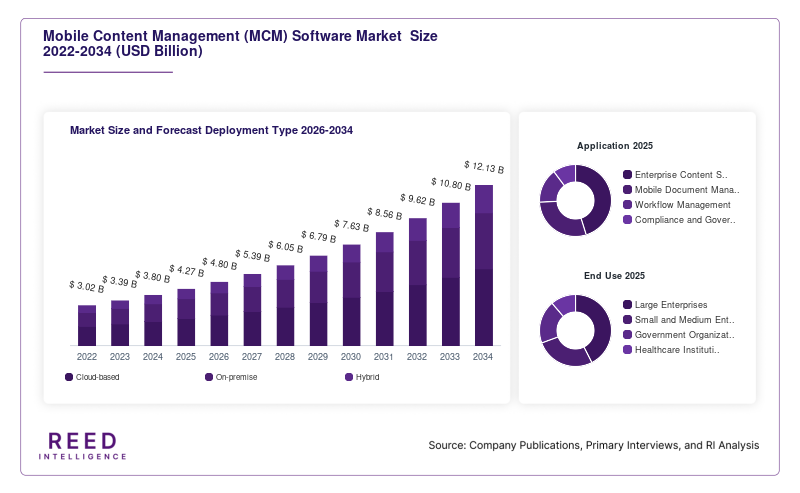
- By deployment type, cloud-based solutions accounted for the largest share of 58.6%, while hybrid deployment models are projected to grow at a CAGR of 13.1%.
- By application, enterprise content sharing led with a 39.4% share, whereas mobile document management is expected to expand at a CAGR of 12.7%.
- By end use, large enterprises held the largest share of 52.8%, while small and medium enterprises are anticipated to grow at a CAGR of 13.4%.
- The United States remained the dominant country, with market values of USD 1.02 billion in 2024 and USD 1.14 billion in 2025.
Market Trends
Rising Adoption of AI-Driven Content Intelligence
Artificial intelligence is becoming a defining trend in the Mobile Content Management (MCM) Software Market. Organizations are increasingly integrating AI-powered capabilities into content management systems to improve document organization, retrieval efficiency, and workflow automation. Intelligent search functions, automated content tagging, metadata extraction, and predictive recommendations help employees locate information quickly from mobile devices. AI technologies also enable enterprises to analyze user behavior patterns and optimize content delivery strategies. As the volume of enterprise content continues to increase, businesses are relying on intelligent content management tools to reduce manual effort and improve productivity. AI-powered document classification and automated compliance monitoring are also gaining traction, helping organizations strengthen governance practices while supporting efficient mobile access to critical business information.
Expansion of Zero-Trust Mobile Security Architectures
The increasing adoption of zero-trust cybersecurity frameworks is influencing the development of modern MCM platforms. Organizations are implementing identity-based access controls to secure enterprise content regardless of user location or device type. Mobile content management providers are incorporating multi-factor authentication, biometric verification, encryption technologies, and contextual access policies into their platforms. These capabilities help organizations address growing concerns regarding cyberattacks, insider threats, and unauthorized data access. Industries such as healthcare, finance, and government are particularly focused on strengthening mobile content security due to strict regulatory requirements. The trend toward zero-trust security models is encouraging enterprises to deploy advanced MCM solutions that support secure collaboration while maintaining strong control over sensitive corporate data.
Market Drivers
Growing Enterprise Mobility Across Industries
Enterprise mobility continues to be a major growth driver for the Mobile Content Management (MCM) Software Market. Businesses increasingly depend on mobile devices to support field operations, customer service activities, sales processes, and remote workforce management. Employees require immediate access to business documents, project files, and collaboration tools regardless of location. Mobile content management platforms provide secure and efficient access to enterprise information while maintaining governance standards. Organizations across healthcare, logistics, retail, and financial services are deploying mobility solutions to improve workforce productivity and operational responsiveness. As mobile-enabled business processes become more common, demand for scalable content management platforms that support secure document sharing and synchronization continues to increase across global markets.
Increasing Compliance and Data Governance Requirements
The growing complexity of global data privacy regulations is another significant factor driving market expansion. Organizations must comply with numerous standards governing data handling, storage, and access. Mobile content management platforms help enterprises establish secure frameworks for managing digital content while maintaining regulatory compliance. Features such as encryption, access auditing, document tracking, and policy-based controls enable organizations to monitor content usage and reduce compliance risks. The increasing volume of sensitive information being accessed through mobile devices has further accelerated investment in governance-focused solutions. Businesses are prioritizing technologies that improve transparency, strengthen cybersecurity posture, and reduce the likelihood of costly regulatory violations, creating sustained demand for advanced MCM software platforms.
Market Restraint
Complex Integration Requirements and Deployment Challenges
Despite strong growth prospects, the Mobile Content Management (MCM) Software Market faces challenges associated with implementation complexity and integration requirements. Many organizations continue to operate legacy enterprise systems that were not originally designed for mobile-first environments. Integrating modern MCM platforms with enterprise resource planning systems, customer relationship management software, identity management solutions, and legacy document repositories often requires substantial customization and technical expertise. These implementation challenges can increase deployment costs and extend project timelines.
The complexity becomes even greater for multinational enterprises operating across diverse IT environments. Organizations frequently need to maintain compatibility across multiple operating systems, devices, and security frameworks while ensuring uninterrupted access to business content. Small and medium enterprises may face budget constraints that limit their ability to undertake large-scale integration projects. For example, a manufacturing company transitioning from traditional document storage systems to a mobile content management platform may require extensive system upgrades, employee training, and process redesign. Such factors can slow adoption rates and create barriers for organizations seeking rapid digital transformation.
Market Opportunities
Growing Demand for Cloud-Native MCM Platforms
The transition toward cloud computing presents substantial opportunities for market participants. Cloud-native mobile content management platforms offer flexibility, scalability, and cost efficiency compared to traditional on-premise deployments. Organizations increasingly prefer cloud-based solutions because they simplify deployment, reduce infrastructure costs, and support real-time content access from multiple locations. Cloud architectures also facilitate seamless updates, stronger disaster recovery capabilities, and improved collaboration among distributed teams.
As enterprises continue migrating workloads to cloud environments, demand for integrated content management platforms is expected to rise significantly. Vendors are investing in advanced cloud-based features such as intelligent analytics, automated governance tools, and cross-platform synchronization capabilities. These enhancements are improving the attractiveness of cloud-native MCM solutions for organizations of all sizes. Growing adoption of software-as-a-service business models is expected to create sustained opportunities for solution providers throughout the forecast period.
Accelerating Digital Transformation in Emerging Economies
Emerging economies are creating favorable conditions for long-term market growth. Countries across Asia Pacific, Latin America, the Middle East, and Africa are investing heavily in digital infrastructure, cloud technologies, and enterprise modernization initiatives. Rapid smartphone adoption and improving internet connectivity are encouraging businesses to adopt mobile-first operational strategies. Small and medium enterprises are increasingly deploying digital workplace solutions to improve productivity and competitiveness.
Government-led digitization programs are further accelerating technology adoption across public and private sectors. Organizations in emerging markets are seeking affordable and scalable content management solutions capable of supporting mobile workforces and distributed business operations. The combination of expanding digital ecosystems, rising technology awareness, and growing investment in enterprise software solutions is expected to generate significant opportunities for MCM vendors seeking geographic expansion and customer acquisition.
Segmental Analysis
Deployment Type
Cloud-based deployment represented the largest segment, accounting for approximately 58.6% of the Mobile Content Management (MCM) Software Market in 2024. Organizations prefer cloud-based solutions because they offer scalability, lower capital expenditure requirements, and simplified deployment processes. Cloud environments support real-time collaboration and centralized access to business content from multiple locations. Enterprises increasingly rely on cloud-based platforms to accommodate hybrid work models and geographically dispersed teams. The ability to integrate with productivity applications, collaboration tools, and enterprise software ecosystems has further strengthened adoption. As businesses continue to prioritize operational flexibility and digital transformation, cloud deployment remains the dominant segment within the market.
Hybrid deployment is expected to experience the fastest growth, registering a CAGR of approximately 13.1% during the forecast period. Organizations operating in highly regulated industries often require a balance between cloud accessibility and on-premise control. Hybrid architectures enable businesses to maintain sensitive information within internal environments while leveraging cloud capabilities for collaboration and mobility. This deployment model supports data sovereignty requirements and allows organizations to customize content governance policies according to operational needs. Increasing demand for flexible infrastructure strategies, coupled with growing concerns regarding data security, is encouraging enterprises to adopt hybrid deployment frameworks across global markets.
Application
Enterprise content sharing emerged as the dominant application segment, capturing approximately 39.4% of market revenue in 2024. Businesses increasingly depend on secure content sharing platforms to facilitate collaboration among distributed teams and external stakeholders. Mobile content management software enables employees to access, distribute, and edit business documents securely through mobile devices. The growing importance of real-time communication and workflow efficiency has increased demand for content-sharing capabilities. Organizations across healthcare, financial services, manufacturing, and information technology sectors are implementing solutions that simplify document distribution while maintaining security and compliance requirements. As workforce mobility continues to expand, enterprise content sharing remains a primary use case for MCM platforms.
Mobile document management is projected to be the fastest-growing application segment, with an estimated CAGR of 12.7% during 2026–2034. Organizations increasingly require mobile access to structured and unstructured business information to support operational continuity. Mobile document management solutions allow employees to create, retrieve, edit, and approve documents from remote locations. Growing adoption of smartphones and tablets within enterprise environments has accelerated demand for mobile-centric document workflows. Businesses seeking to reduce paper-based processes and improve workforce responsiveness are investing heavily in mobile document management technologies. Enhanced integration with cloud storage platforms and collaboration tools is expected to further drive segment growth.
End Use
Large enterprises accounted for the largest share of the Mobile Content Management (MCM) Software Market, representing approximately 52.8% of revenue in 2024. These organizations manage extensive volumes of digital content across multiple business units and geographic locations. Mobile content management platforms help large enterprises maintain governance standards, improve collaboration efficiency, and support secure access to critical business information. Large organizations typically possess the financial resources and technical capabilities required to implement advanced content management infrastructures. The increasing complexity of enterprise operations and regulatory compliance requirements continues to drive investment in comprehensive MCM solutions among large corporate users.
Small and medium enterprises are expected to record the fastest growth rate, with a projected CAGR of 13.4% through 2034. The growing availability of affordable cloud-based software solutions has significantly lowered adoption barriers for smaller businesses. SMEs increasingly recognize the importance of mobile content management in supporting productivity, remote work capabilities, and customer engagement initiatives. Digital transformation programs and government support for technology adoption are further encouraging implementation. As smaller organizations continue modernizing operations and expanding digital capabilities, demand for scalable and cost-effective MCM solutions is expected to increase steadily throughout the forecast period.
Regional Analysis
North America
North America accounted for approximately 34.2% of the global Mobile Content Management (MCM) Software Market in 2025 and is expected to maintain a stable growth trajectory through 2034. The region benefits from extensive enterprise mobility adoption, mature cloud infrastructure, and strong cybersecurity investment. Organizations across multiple industries have embraced mobile-first business models, creating sustained demand for secure content management solutions. Increasing investment in digital workplace transformation and remote collaboration technologies continues to support regional market expansion.
The United States remains the dominant contributor to regional revenue generation. A key growth factor is the strong adoption of hybrid workplace strategies among large enterprises. Organizations are investing heavily in secure mobile content access solutions to improve employee productivity while maintaining compliance with data governance regulations. Continuous innovation in cloud computing and enterprise software ecosystems further strengthens market development.
Europe
Europe represented a significant portion of global market revenue in 2025 and is projected to expand steadily during the forecast period. Strong emphasis on privacy regulations and data security requirements has encouraged widespread adoption of enterprise content management technologies. Businesses across the region are investing in mobile content platforms to ensure secure information sharing and compliance with regulatory frameworks. Growing digitalization across industries also supports consistent market growth.
Germany continues to lead the regional market due to its advanced industrial economy and focus on enterprise technology modernization. A unique growth factor is the widespread implementation of digital transformation initiatives across manufacturing and engineering sectors. Organizations are increasingly deploying mobile content management solutions to improve workforce efficiency, streamline documentation processes, and support connected business operations.
Asia Pacific
Asia Pacific is expected to register the fastest growth rate, with a projected CAGR of 11.2% through 2034. Rapid digitalization, expanding cloud adoption, and increasing use of mobile devices are contributing to strong market demand. Organizations across the region are modernizing operations and investing in technologies that support workforce mobility. Rising adoption of enterprise applications and digital collaboration platforms further strengthens growth prospects.
China remains the largest market within the region. A major growth factor is large-scale enterprise digitization supported by government technology initiatives and private-sector investment. Organizations across manufacturing, finance, retail, and telecommunications sectors are implementing mobile-first business strategies. The rapid expansion of small and medium enterprises adopting cloud-based software solutions is also contributing significantly to market development.
Middle East & Africa
The Middle East & Africa market is witnessing gradual expansion as governments and enterprises increase investments in digital infrastructure. Organizations are increasingly adopting cloud technologies and mobility solutions to improve operational efficiency and enhance service delivery. Growing awareness regarding cybersecurity risks and data governance requirements is encouraging deployment of advanced content management platforms. These factors are supporting a positive long-term growth outlook for the region.
The United Arab Emirates remains the leading country within the regional market. One notable growth factor is the country's emphasis on smart government programs and digital transformation initiatives. Public sector organizations and private enterprises are investing in secure mobile content platforms to facilitate digital service delivery, workforce mobility, and enterprise collaboration. Continued infrastructure modernization is expected to strengthen market demand.
Latin America
Latin America continues to experience steady adoption of mobile content management solutions as organizations pursue modernization and operational efficiency initiatives. Increasing cloud penetration and expanding internet connectivity are enabling businesses to deploy advanced digital workplace technologies. Enterprises are gradually transitioning from traditional document management systems toward mobile-enabled content ecosystems that support remote collaboration and secure information access.
Brazil represents the largest market across the region. A key growth factor is the rising investment in enterprise software and digital business transformation projects. Organizations in sectors such as banking, telecommunications, healthcare, and retail are implementing mobile content management platforms to improve productivity and strengthen governance practices. The growing technology startup ecosystem is also contributing to increased software adoption.
Competitive Landscape
The Mobile Content Management (MCM) Software Market is moderately consolidated, with several global technology providers competing through product innovation, cloud integration capabilities, cybersecurity enhancements, and strategic partnerships. Vendors are increasingly investing in artificial intelligence, advanced analytics, and zero-trust security frameworks to differentiate their offerings and address evolving enterprise requirements.
Microsoft maintains a strong leadership position due to its extensive enterprise software ecosystem, cloud infrastructure capabilities, and integration with workplace productivity platforms. The company recently expanded AI-enabled content governance functionality across its enterprise mobility portfolio, enhancing automated classification and compliance monitoring capabilities.
Key Players
- Microsoft Corporation
- IBM Corporation
- Oracle Corporation
- Google LLC
- Adobe Inc.
- Box Inc.
- OpenText Corporation
- Citrix Systems
- VMware Inc.
- SAP SE
- Hyland Software
- M-Files Corporation
- Egnyte Inc.
- BlackBerry Limited
- Zoho Corporation
Recent Developments
- In 2025, a major enterprise software company expanded its cloud-based mobile content management infrastructure to improve platform scalability, support growing enterprise demand, and enhance content accessibility across distributed workforces.
- In 2025, a leading mobile content management provider launched an AI-powered document intelligence solution designed to automate content classification, improve search accuracy, and strengthen enterprise governance capabilities.
- In 2024, several technology vendors introduced advanced zero-trust security features within their mobile content management platforms to improve data protection, identity verification, and regulatory compliance across mobile environments.
- In 2024, a global cloud services provider expanded integration capabilities between its mobile content management platform and enterprise collaboration applications to streamline workflows and improve cross-platform content sharing.
- In 2025, a large enterprise mobility solutions company invested in advanced analytics and content monitoring technologies to enhance user activity tracking, optimize content lifecycle management, and improve operational efficiency for enterprise customers.
Mobile Content Management (MCM) Software Market Segments
Deployment Type
- Cloud-based
- On-premise
- Hybrid
Application
- Enterprise Content Sharing
- Mobile Document Management
- Workflow Management
- Compliance and Governance
End Use
- Large Enterprises
- Small and Medium Enterprises
- Government Organizations
- Healthcare Institutions
By Region
- North America
- Europe
- APAC
- Middle East and Africa
- LATAM