Mobile Continuous Patient Monitors Market Size, Share & Trends Analysis Report By Type (Portable Type, Floor Standing Type), By Application (Hospital, Home Health Care) and By Region (North America, Europe, Asia Pacific, Latin America, Middle East & Africa) Forecasts, 2026–2034
USD 3950
Mobile Continuous Patient Monitors Market Size
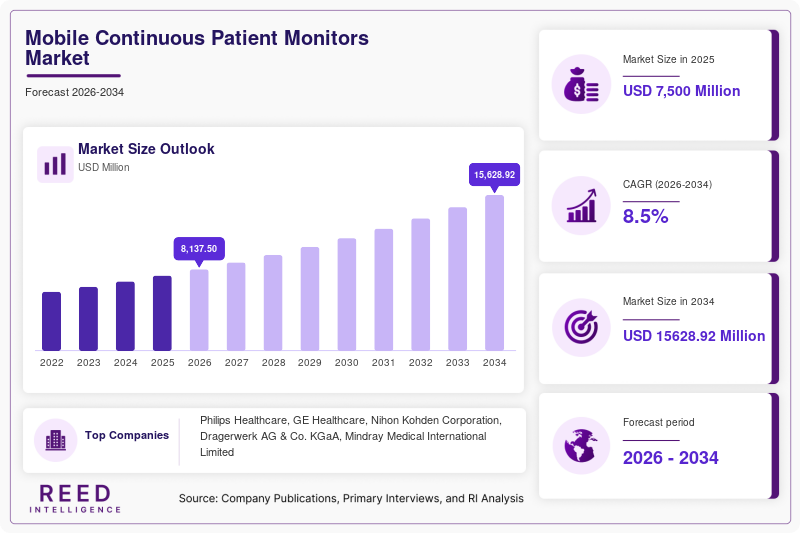
The global mobile continuous patient monitors market was valued at USD 7,500 Million in 2025 and is projected to reach USD 15,5628.92 Million by 2034, expanding at a CAGR of 8.5% from 2026 to 2034. The market is estimated to reach USD 8,137.50 Million in 2026, supported by increasing demand for continuous patient surveillance, rising chronic disease prevalence, technological advances in wireless monitoring, and the growing adoption of patient monitoring outside traditional intensive-care environments.
Mobile continuous patient monitors are portable or mobile medical monitoring systems designed to continuously track patient physiological parameters while allowing patients or caregivers greater mobility than conventional stationary monitoring systems. These devices can monitor parameters such as heart rate, oxygen saturation, respiratory rate, blood pressure, temperature, and other physiological indicators, with wireless connectivity increasingly enabling real-time transmission to centralized clinical systems.
The market is closely connected with remote patient monitoring, telehealth, hospital-at-home, wearable medical devices, and connected-care infrastructure. Advances in sensor miniaturization, wireless connectivity, battery performance, cloud platforms, and clinical decision-support software are expanding the range of applications for mobile monitoring. Healthcare providers are increasingly using continuous monitoring to support earlier identification of patient deterioration and improve continuity of care.
Mobile Continuous Patient Monitors Market Drivers
Rising Prevalence of Chronic Diseases
The increasing prevalence of cardiovascular, respiratory, metabolic, and other chronic diseases is generating demand for continuous monitoring solutions capable of tracking patients beyond conventional clinical encounters. Continuous monitoring can provide clinicians with more frequent physiological information and support earlier identification of deterioration, particularly among high-risk and elderly patients.
Expansion of Remote and Home-Based Healthcare
Healthcare delivery is increasingly shifting toward remote monitoring, hospital-at-home programs, outpatient care, and home healthcare. Mobile monitoring devices enable healthcare providers to collect physiological information while patients remain outside traditional hospital environments, supporting continuity of care and reducing the need for some routine in-person monitoring.
Advances in Sensors and Wireless Connectivity
Miniaturized sensors, Bluetooth, Wi-Fi, cellular connectivity, improved battery technology, and cloud-based data systems are making continuous monitoring devices increasingly mobile and clinically useful. These technologies allow physiological information to move from wearable or portable devices to central monitoring stations and clinician-facing applications with limited interruption.
Mobile Continuous Patient Monitors Market Restraints
High Device and Implementation Costs
Advanced continuous monitoring systems can require substantial investment in hardware, connectivity infrastructure, software integration, training, maintenance, and clinical support. Cost considerations can limit adoption among smaller hospitals and healthcare facilities with constrained capital budgets.
Regulatory and Clinical Validation Requirements
Patient monitoring devices must meet stringent regulatory, safety, cybersecurity, and clinical-performance requirements. Manufacturers must invest heavily in validation and compliance, while healthcare organizations must ensure that monitoring systems are appropriately integrated into clinical workflows.
Alarm Fatigue and Data Management Challenges
Continuous monitoring generates large volumes of physiological information and alerts. Poorly optimized alarm systems can contribute to alarm fatigue among healthcare professionals, while large datasets require reliable connectivity, analytics, interoperability, and workflow integration. Philips identifies alarm fatigue and cybersecurity among important challenges associated with modern patient-monitoring environments.
Mobile Continuous Patient Monitors Market Opportunities
Growth of AI-Enabled Patient Monitoring
Artificial intelligence and advanced pattern-recognition technologies are creating opportunities for continuous monitoring systems to move from simple measurement toward predictive clinical decision support. AI can analyze continuous physiological data and identify patterns associated with patient deterioration, potentially enabling earlier intervention.
Expansion of Wearable and Wireless Monitoring
Wearable sensors, wireless patches, monitoring watches, and tetherless devices offer opportunities to extend continuous monitoring across hospital transport, general wards, home healthcare, and hospital-to-home pathways. Masimo's Radius VSM and W1 platforms demonstrate the industry's movement toward wearable and mobile continuous monitoring.
Hospital-at-Home and Remote Patient Monitoring Programs
Expansion of hospital-at-home and remote patient monitoring programs creates additional demand for portable monitoring devices capable of transmitting clinically relevant data to healthcare providers. Increasing integration between devices, telehealth platforms, electronic medical records, and cloud-based clinical systems is expected to create new commercial opportunities.
Mobile Continuous Patient Monitors Market Segmental Analysis
By Type
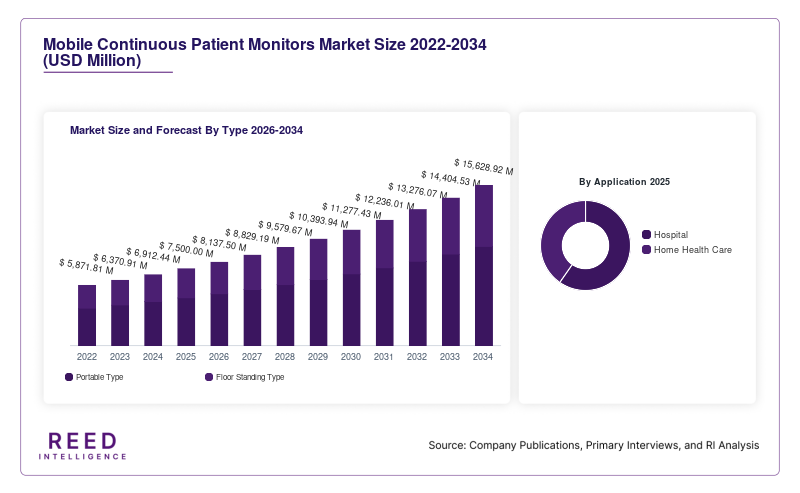
Portable Type is the dominant segment of the Mobile Continuous Patient Monitors Market. Portable monitors allow patients to remain mobile while physiological parameters are continuously observed, making them particularly suitable for patient transport, general hospital wards, emergency care, outpatient settings, and home healthcare. Current market research identifies Portable Type as a leading product category and indicates its notable market position.
The segment is benefiting from miniaturized sensors, wireless communication, improved battery performance, and increasing demand for wearable and tetherless monitoring. Portable systems are also well aligned with the broader shift toward patient-centered care because they allow monitoring without unnecessarily restricting patient movement.
Floor Standing Type monitors remain important in hospitals and other clinical environments where comprehensive monitoring of multiple physiological parameters is required. These systems can support centralized clinical workflows and high-acuity patient care while providing larger displays and integration with other hospital monitoring infrastructure.
However, the growing emphasis on patient mobility, wireless monitoring, and decentralized healthcare delivery is increasing the relative attractiveness of portable solutions. Floor-standing systems are therefore expected to maintain demand in hospital environments while portable technologies expand into additional care settings.
By Application
Hospitals represent the dominant application segment because continuous monitoring is required across intensive care, emergency departments, operating environments, general wards, patient transport, and other acute-care settings. Mobile monitoring enables clinicians to maintain continuous observation while patients are moved between departments or monitored away from fixed bedside systems. Philips, for example, offers portable IntelliVue X3 monitoring designed for uninterrupted monitoring during in-hospital transport and at the bedside.
The hospital segment is also benefiting from increasing adoption of centralized monitoring, wireless telemetry, clinical decision-support tools, and integrated electronic medical-record workflows. Demand for continuous monitoring of patients outside intensive-care settings is creating additional opportunities for mobile monitoring technologies.
Home Health Care is expected to be one of the most important growth areas for mobile continuous patient monitoring. The expansion of remote patient monitoring, hospital-at-home programs, chronic disease management, and aging-at-home models is increasing demand for devices that can continuously collect physiological information outside hospitals.
Wearable monitoring technologies are particularly relevant to this segment because they can transmit information to clinicians through connected platforms. Masimo's W1, for example, is designed to collect continuous measurements and connect with the Masimo SafetyNet platform for clinical monitoring and telehealth applications.
Mobile Continuous Patient Monitors Market Regional Analysis
North America Mobile Continuous Patient Monitors Market
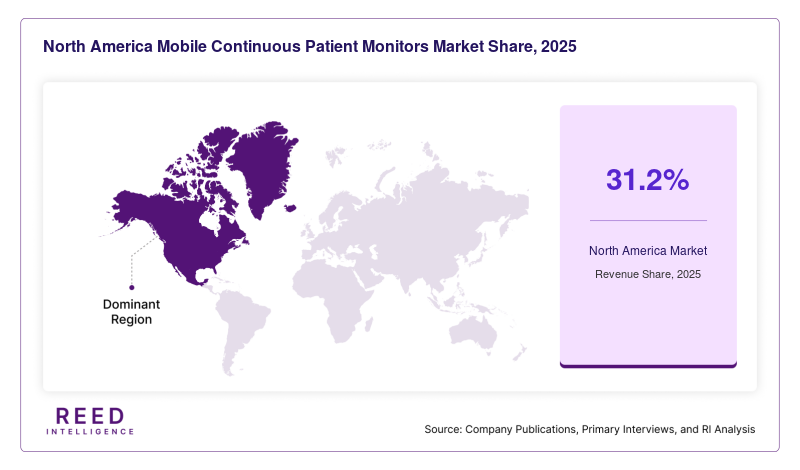
North America represents the second-largest regional market for Mobile Continuous Patient Monitors, supported by advanced healthcare infrastructure, high healthcare expenditure, strong adoption of remote patient monitoring, and the presence of major medical-device manufacturers. The region accounted for approximately 31.2% of global market revenue in 2025, according to published market estimates.
North America also benefits from strong development of AI-enabled monitoring and wireless wearable systems. Masimo's 2026 FDA clearance for AI-enabled opioid-induced respiratory depression detection on its Radius VSM wearable continuous patient monitor illustrates the region's ongoing product innovation.
Europe Mobile Continuous Patient Monitors Market
Europe represents a significant market supported by aging populations, established healthcare systems, increasing digital-health adoption, and growing demand for remote and continuous monitoring. Healthcare providers are increasingly seeking monitoring technologies that can improve clinical workflow, reduce unnecessary hospital utilization, and support patients across different care settings.
The region's regulatory environment also encourages manufacturers to demonstrate safety, clinical performance, cybersecurity, and interoperability. These requirements can increase development costs but also support demand for clinically validated monitoring systems.
Asia Pacific Mobile Continuous Patient Monitors Market
Asia Pacific is an important growth market due to expanding healthcare infrastructure, rising healthcare expenditure, increasing chronic disease prevalence, and growing adoption of digital healthcare technologies. China, Japan, South Korea, and India represent important markets, while improving connectivity and healthcare access are creating additional opportunities for mobile monitoring solutions.
The region offers substantial long-term opportunity because healthcare systems are increasingly adopting telemedicine, remote monitoring, wearable devices, and connected-care platforms. Expansion of local medical-device manufacturing can also improve availability and affordability of monitoring equipment.
Latin America Mobile Continuous Patient Monitors Market
Latin America represents an emerging market for mobile continuous patient monitoring, supported by increasing healthcare digitization, growing awareness of remote healthcare, and rising demand for chronic disease management. Adoption remains constrained by healthcare infrastructure disparities, reimbursement limitations, device costs, and connectivity gaps in certain markets.
Brazil and Mexico represent important opportunities as healthcare providers expand digital-health capabilities and seek solutions that can extend monitoring beyond conventional hospital environments.
Middle East & Africa Mobile Continuous Patient Monitors Market
Middle East & Africa presents developing opportunities for mobile continuous patient monitoring as healthcare systems invest in modern medical infrastructure, digital health, and advanced clinical technologies. Gulf countries are particularly important markets because of their relatively high healthcare investment and increasing adoption of technologically advanced medical systems.
In parts of Africa and lower-income markets, affordability, infrastructure, connectivity, and availability of trained healthcare professionals remain important barriers. Lower-cost wireless monitoring solutions and remote-care models could nevertheless support longer-term market expansion.
Mobile Continuous Patient Monitors Market Competitive Landscape
The Mobile Continuous Patient Monitors Market is competitive, with established medical-device companies focusing on portable monitoring, wireless connectivity, clinical decision support, data integration, and wearable technologies. Major companies identified in current market research include Philips Healthcare, GE Healthcare, Nihon Kohden, Dragerwerk, Mindray, OSI Systems, Schiller, CAS Medical Systems, Huntleigh Healthcare, Masimo, and Promed Group.
Philips Healthcare maintains a strong position through its broad patient-monitoring portfolio, including bedside monitors, transport monitors, patient-worn monitors, continuous monitoring systems, central monitoring solutions, and mobile patient monitoring applications. Its IntelliVue X3 supports continuous monitoring during patient transport and at the bedside, while Philips' broader architecture connects monitoring devices with central stations, clinical networks, and healthcare IT systems.
Key Market Players
- Philips Healthcare
- GE Healthcare
- Nihon Kohden Corporation
- Dragerwerk AG & Co. KGaA
- Mindray Medical International Limited
- OSI Systems, Inc.
- Schiller AG
- CAS Medical Systems
- Huntleigh Healthcare
- Heyer Medical AG
Mobile Continuous Patient Monitors Market Recent Developments
- June 2026-Masimo announced FDA 510(k) clearance for an AI-enabled opioid-induced respiratory depression detection capability integrated into its Radius VSM wearable continuous patient monitor. The feature uses smartSET pattern recognition to analyze continuous physiological data and help clinicians identify early signs of respiratory compromise in patients receiving opioid therapy. The development demonstrates the increasing integration of AI and continuous physiological-data analysis into mobile monitoring systems.
- 2026-Masimo's investor materials outlined a full 2026 U.S. and European market launch for Radius VSM, with enhanced battery life of up to 12 hours and expansion of continuous monitoring into new care areas. Masimo also announced a partnership with University Hospitals to equip 1,500 beds across Northeast Ohio with the technology, demonstrating the move toward broader continuous monitoring outside traditional high-acuity environments.
Mobile Continuous Patient Monitors Market Segments
By Type
- Portable Type
- Floor Standing Type
By Application
- Hospital
- Home Health Care
By Region
- North America
- Europe
- APAC
- Middle East and Africa
- LATAM