Mobile Credit Card Reader Market Size, Share & Trends Analysis Report By Device Type (Smartphone Readers, Tablet Readers, Wearable Readers), By Application (Retail, Hospitality, Healthcare, and Others) and By Region (North America, Europe, Asia Pacific, Latin America, Middle East & Africa) Forecasts, 2026–2034
USD 3950
Mobile Credit Card Reader Market Size
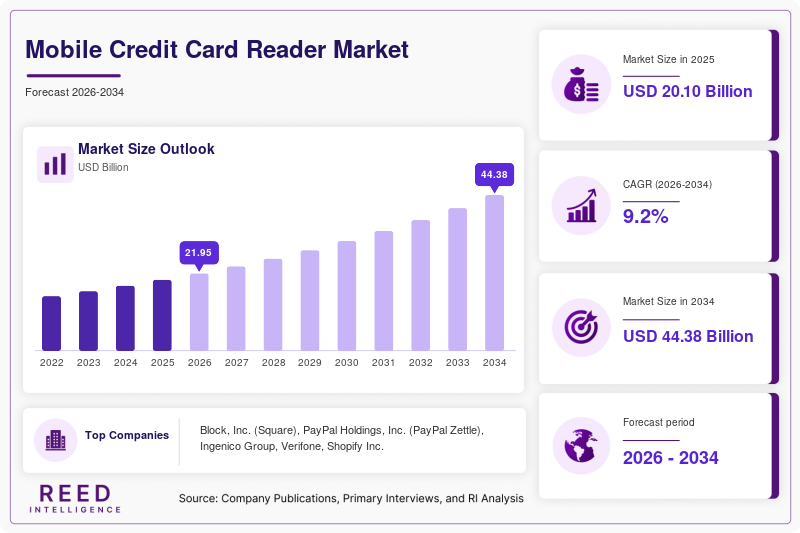
The global mobile credit card reader market was valued at USD 20.10 billion in 2025 and is projected to grow from USD 21.95 billion in 2026 to USD 44.38 billion by 2034, registering a compound annual growth rate (CAGR) of 9.2% during the forecast period (2026–2034).
The Mobile Credit Card Reader Market comprises portable electronic payment devices that enable merchants and service providers to accept card payments through smartphones, tablets, and other mobile-enabled systems. These readers support payment acceptance in retail stores, hospitality establishments, healthcare facilities, field services, and other business environments where flexible transactions are required.
Market growth is supported by the increasing adoption of digital payments, expanding small and medium-sized businesses, the growth of contactless transactions, and demand for convenient payment acceptance outside traditional checkout counters. Mobile readers enable businesses to process payments at customer locations, sales counters, temporary retail sites, and service appointments, reducing dependence on fixed point-of-sale infrastructure.
Mobile Credit Card Reader Market Drivers
Increasing Adoption of Digital and Contactless Payments
The growing use of debit cards, credit cards, and contactless payment methods is supporting demand for mobile credit card readers. Consumers increasingly expect quick and convenient payment options across retail and service environments. Businesses are adopting mobile readers that support contactless transactions and chip-based payment security, allowing them to serve customers at traditional checkout counters and mobile points of sale.
Growth of Small and Medium-Sized Businesses
Small and medium-sized businesses increasingly require affordable payment solutions that are easy to deploy and operate. Mobile credit card readers allow smaller merchants, independent professionals, food vendors, and service providers to accept electronic payments without investing in extensive fixed payment infrastructure. Flexible pricing, portable hardware, and smartphone integration can make these systems attractive to businesses with limited technology budgets.
Expansion of Mobile Commerce and Omnichannel Retail
Retailers and service providers are adopting mobile payment acceptance to support customer convenience and more flexible transaction experiences. Mobile readers can enable staff to process payments on the sales floor, support pop-up retail operations, and accept payments during delivery or on-site service visits. Their integration with inventory, billing, and customer-management software further supports adoption across omnichannel business operations.
Mobile Credit Card Reader Market Restraints
Cybersecurity and Payment Data Risks
Mobile credit card readers handle sensitive payment information and must meet applicable security standards. Cyberattacks, compromised mobile devices, insecure networks, and payment-data theft can expose merchants and customers to financial and reputational risks. Businesses may face additional costs for secure devices, software updates, compliance, and staff training, while security concerns can slow adoption among smaller merchants.
Dependence on Smartphones, Connectivity, and Software
Many mobile card readers depend on compatible smartphones or tablets, payment applications, and reliable connectivity. Device incompatibility, weak network coverage, software interruptions, and battery limitations can affect transaction processing. Merchants operating in remote areas or mobile service environments may require additional connectivity options and backup procedures, increasing the complexity of deploying mobile payment systems.
Price Competition and Transaction-Related Costs
Competition among payment providers can place pressure on hardware prices and payment-processing margins. Merchants may also need to consider transaction fees, software subscriptions, connectivity costs, and replacement expenses when choosing a solution. For low-volume businesses, the total cost of accepting card payments can influence adoption and encourage comparison with alternative payment methods.
Mobile Credit Card Reader Market Opportunities
Expansion of Cashless Payments in Emerging Markets
The expansion of digital payment infrastructure across emerging economies creates opportunities for mobile credit card reader providers. Small retailers, independent service providers, and informal businesses can use portable payment systems to broaden their acceptance of electronic transactions. Affordable hardware, simplified merchant onboarding, and integration with local payment networks may help increase adoption in underserved markets.
Integration of NFC and Advanced Payment Technologies
Advances in NFC, EMV chip technology, tokenization, and secure mobile payment applications provide opportunities to improve transaction convenience and security. Manufacturers can differentiate their products through support for multiple payment methods, improved connectivity, and compatibility with modern payment ecosystems. These features may be particularly important for merchants seeking to serve customers who use both physical cards and digital wallets.
Development of Integrated Payment and Business Management Platforms
Mobile credit card readers are increasingly connected with software for inventory, sales reporting, invoicing, customer management, and accounting. This creates opportunities for providers to offer integrated solutions rather than standalone payment hardware. Cloud-based management and analytics can help merchants monitor transactions, manage multiple locations, and streamline business operations while creating recurring software and service opportunities for suppliers.
Mobile Credit Card Reader Market Segmental Analysis
By Device Type
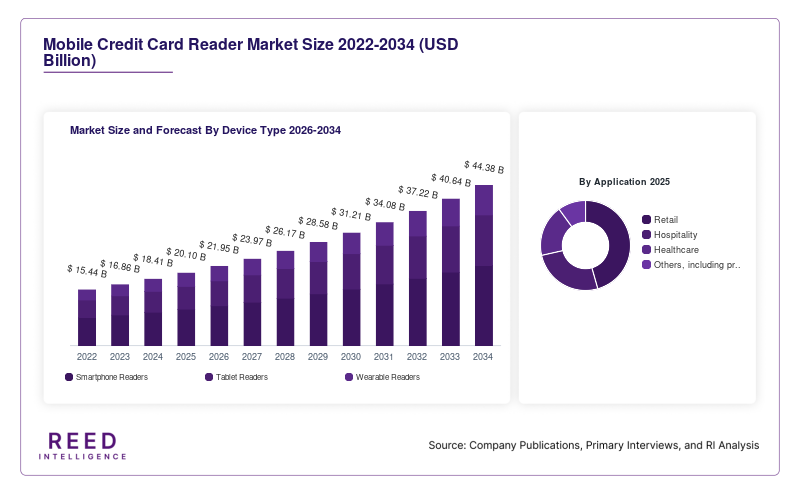
Smartphone readers represent the dominant device-type segment, accounting for approximately 54.3% of the global Mobile Credit Card Reader Market in 2025, according to Dataintelo's published market analysis. Their adoption is supported by the widespread availability of smartphones and their suitability for small merchants, independent service providers, and businesses requiring portable payment acceptance. Smartphone-connected readers can provide a relatively accessible entry point into card payments without requiring extensive fixed checkout infrastructure.
Tablet readers serve businesses that need a larger display for transaction management, customer interaction, order processing, and related business applications. They are relevant in retail and hospitality environments where payment acceptance may be integrated with inventory, billing, and customer-management functions.
Wearable readers represent a smaller device category but offer opportunities where compact, hands-free, or highly portable payment acceptance is useful. Dataintelo estimates that wearable readers will be the fastest-growing device-type segment, with a projected CAGR of 14.7% over its stated forecast period. This growth estimate is source-specific and reflects the increasing relevance of portable payment experiences in selected business environments.
By Application
Retail is a major application segment for mobile credit card readers. Retailers use mobile payment devices to process purchases at checkout counters, on sales floors, during pop-up events, and through other flexible sales arrangements. Mobile readers can support shorter queues, staff-assisted checkout, and integration with inventory and sales-management software. Dataintelo estimates that retail accounted for approximately 42.1% of market revenue in 2025.
Hospitality businesses, including restaurants, cafés, and hotels, use mobile readers to accept payments at tables, counters, and other service points. Portable payment devices help employees process transactions closer to customers and support flexible service models. Healthcare providers can use mobile readers for payments at reception desks, clinics, and other service locations, subject to applicable payment-security and privacy requirements.
Other applications include professional services, field operations, transportation, and mobile businesses that need to collect payments outside conventional retail settings. Dataintelo projects hospitality to grow at a CAGR of approximately 11.8% over its stated forecast period, making it a notable growth application in that source's estimates.
Mobile Credit Card Reader Market Regional Analysis
North America Mobile Credit Card Reader Market
North America is a major market for mobile credit card readers, supported by established card-payment infrastructure, a large merchant base, and widespread adoption of digital payment services. Businesses use mobile readers to support flexible checkout, contactless transactions, and integration with sales and payment-management platforms. The United States is an important contributor, while Canada also supports demand through retail digitization and electronic payment acceptance.
The region's market development is influenced by hardware replacement cycles, security requirements, software integration, and competition among payment providers. Providers that combine secure devices with merchant services and software capabilities can address businesses seeking more comprehensive payment solutions. Although North America is a leading region in some broader mobile card reader estimates, the regional ranking differs across published studies depending on the product definition used.
Europe Mobile Credit Card Reader Market
Europe represents an established market for mobile credit card readers, supported by developed banking systems, widespread electronic payments, and demand for contactless transactions. Retailers, hospitality businesses, and service providers use portable payment devices to improve checkout flexibility and integrate payment acceptance with business-management systems.
Market development is influenced by payment-security standards, regulatory requirements, device certification, and the need to support different payment methods across countries. Manufacturers and payment-service providers compete through product reliability, software compatibility, and integrated merchant services. Demand for Android-based payment devices and cloud-enabled management platforms also supports ongoing product upgrades.
Asia Pacific Mobile Credit Card Reader Market
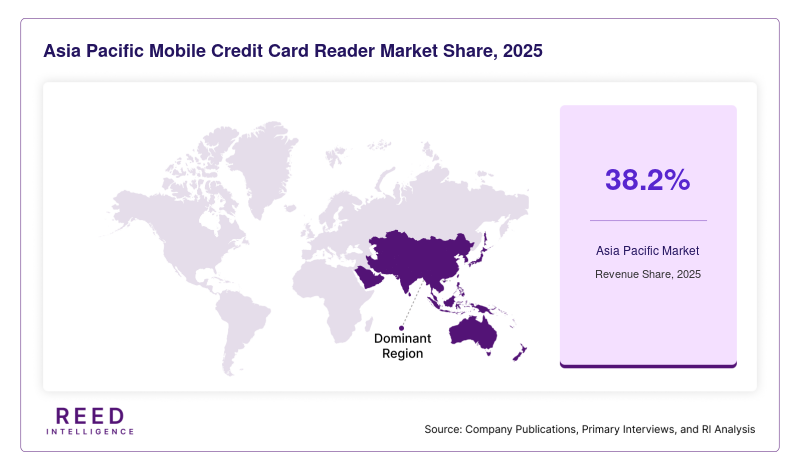
Asia Pacific is the dominant regional market for the Mobile Credit Card Reader Market, accounting for approximately 38.2% of global revenue in 2025, according to Dataintelo's published analysis. The region benefits from expanding digital payment adoption, increasing smartphone use, growing small-business activity, and the development of electronic payment infrastructure. China, India, and Southeast Asian markets provide opportunities as merchants adopt mobile payment solutions and broaden their acceptance of digital transactions.
The region's demand is influenced by local payment ecosystems, device affordability, merchant onboarding, connectivity, and the availability of payment-processing services. Smartphone-connected readers can be particularly relevant for small retailers and mobile businesses seeking flexible payment options. Dataintelo estimates that Asia Pacific will grow at a CAGR of approximately 11.3% over its stated forecast period, identifying it as an important regional growth opportunity.
Latin America Mobile Credit Card Reader Market
Latin America offers opportunities for mobile credit card reader providers as merchants expand electronic payment acceptance and modernize transaction processes. Small retailers, hospitality businesses, independent professionals, and service providers can benefit from portable payment systems that reduce dependence on fixed checkout equipment.
Regional adoption depends on payment-processing costs, merchant access to financial services, smartphone availability, connectivity, and trust in electronic payment systems. Providers that offer affordable devices, straightforward onboarding, and support for local payment requirements may be positioned to serve smaller businesses and emerging merchant segments.
Middle East & Africa Mobile Credit Card Reader Market
The Middle East & Africa region presents opportunities through the expansion of digital payments, retail modernization, and increasing demand for flexible payment acceptance. Mobile credit card readers can support merchants in retail, hospitality, tourism, and field-service environments where portable transactions are useful.
Market development varies by country and is influenced by financial inclusion, digital infrastructure, payment regulations, merchant awareness, and access to affordable hardware. Improving connectivity and investment in electronic payment services may support adoption, although transaction costs, device affordability, and differences in payment infrastructure can limit market penetration.
Mobile Credit Card Reader Market Competitive Landscape
The Mobile Credit Card Reader Market includes payment technology manufacturers, fintech platforms, merchant-service providers, and companies offering integrated hardware and software. Competition is shaped by transaction security, device portability, contactless payment capabilities, software compatibility, processing costs, and merchant support. Providers increasingly seek to differentiate their offerings through connected payment devices, cloud-based management, integrated business applications, and solutions designed for businesses of different sizes.
Ingenico is a global payment technology company that develops payment acceptance devices and services for retailers, financial institutions, and payment-service providers. Its portfolio includes mobile payment devices, integrated point-of-sale systems, and software-enabled payment solutions. The company competes through device security, payment certifications, compatibility across merchant environments, and the integration of payment hardware with cloud-based management services. In February 2026, Ingenico introduced its next-generation AXIUM payment device family and Ingenico 360 unified cloud platform, expanding its focus on connected payment devices and payment operations management.
Key Market Players
- Block, Inc. (Square)
- PayPal Holdings, Inc. (PayPal Zettle)
- Ingenico Group
- Verifone
- Shopify Inc.
- Clover Network, Inc.
- SumUp
- Miura Systems Limited
- BBPOS
- PAX Technology
Mobile Credit Card Reader Market Recent Developments
February 2026 – Ingenico launches its next-generation AXIUM payment device family and Ingenico 360 platform Ingenico announced a new generation of AXIUM payment devices alongside Ingenico 360, a unified cloud platform for managing payment operations. The device family includes mobile and other point-of-sale form factors, while the platform provides device management, transaction services, analytics, and remote monitoring. The launch reflects continued industry investment in secure, connected payment devices and integrated merchant services.
January 2025 – Verifone unveils its Victa payment device portfolio Verifone introduced its Victa hardware portfolio at the NRF Retail's Big Show, presenting Android 14-ready payment devices intended for different merchant and retail use cases. The launch reflects continued development of modern payment hardware designed to support flexible checkout environments and evolving merchant requirements.
Mobile Credit Card Reader Market Segments
By Device Type
- Smartphone Readers
- Tablet Readers
- Wearable Readers
By Application
- Retail
- Hospitality
- Healthcare
- Others, including professional services, field services, transportation, and other mobile payment environments
By Region
- North America
- Europe
- APAC
- Middle East and Africa
- LATAM