Mobile Diesel Heaters Market Size, Share & Trends Analysis Report By Type (Portable Diesel Heaters, Stationary Diesel Heaters, Industrial Diesel Heaters), By Application (Construction, Oil & Gas, Agriculture, Emergency Services, Others), By End-Use (Industrial, Commercial, Residential) and By Region (North America, Europe, Asia Pacific, Latin America, Middle East & Africa) Forecasts, 2026–2034
USD 3950
Mobile Diesel Heaters Market Size
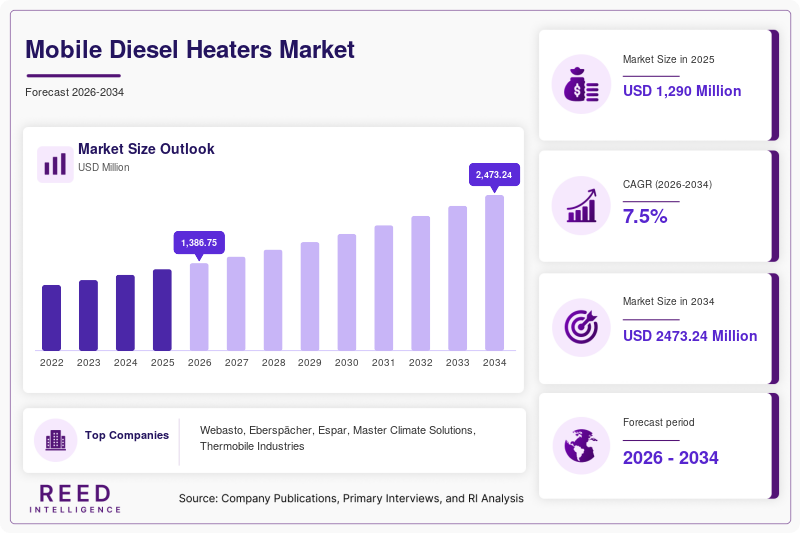
The global mobile diesel heaters market was valued at USD 1,290 Million in 2025 and is estimated to reach USD 1,386.75 Million in 2026. The market is projected to reach USD 2,473.24 Million by 2034, expanding at a CAGR of 7.5% during the forecast period 2026–2034.
The Mobile Diesel Heaters Market comprises portable heating systems designed to generate and distribute heat in locations where permanent heating infrastructure is unavailable or impractical. These systems are increasingly deployed at construction sites, industrial facilities, agricultural operations, outdoor events, emergency shelters, transportation facilities, and remote work locations.
Demand is being driven by the need for dependable heating in cold climates, expansion of construction and infrastructure projects, and increasing use of temporary heating systems in industrial and agricultural environments. Mobile diesel heaters provide high thermal output, operational flexibility, and fuel autonomy, making them suitable for locations with limited access to grid electricity.
Technological development is increasingly focused on fuel efficiency, lower emissions, improved safety controls, quieter operation, automatic temperature regulation, and compatibility with alternative paraffinic fuels such as HVO. Smart controls and remote monitoring are also creating opportunities for improved fuel management and preventive maintenance.
Mobile Diesel Heaters Market Drivers
Rising Demand from Construction and Industrial Activities
Construction and industrial operations represent major demand centers for mobile diesel heaters because heating is required to maintain worker comfort, protect equipment, support material handling, and enable continuous work during cold-weather conditions. Expansion of infrastructure projects in colder regions is consequently increasing demand for mobile heating equipment.
Growing Adoption in Agriculture and Remote Applications
Agricultural operations use mobile diesel heaters for livestock facilities, greenhouses, storage areas, and equipment protection during cold periods. Their ability to operate in locations with limited electrical infrastructure makes diesel-powered systems particularly attractive for farms and remote industrial operations.
Increasing Need for Temporary and Emergency Heating
Emergency response, disaster relief, temporary shelters, field hospitals, outdoor events, and other temporary facilities require heating systems that can be rapidly transported and deployed. Mobile diesel heaters provide an autonomous source of heat and can therefore support operations in locations where permanent heating infrastructure is unavailable.
Restraints
Environmental and Emission Concerns
Diesel combustion produces carbon emissions and other pollutants, creating pressure on manufacturers and end users to adopt cleaner technologies. Increasing environmental regulations may raise development and compliance costs for diesel heater manufacturers.
Fuel Price Volatility
Operating costs are directly influenced by diesel prices. Significant fluctuations in fuel prices can affect the total cost of ownership and may encourage some customers to consider electric, gas, hybrid, or other alternative heating technologies.
Availability of Alternative Heating Technologies
Electric heaters, heat pumps, propane systems, and hybrid heating technologies are increasingly available across commercial and industrial applications. Continued improvement in these alternatives may limit diesel heater adoption in applications where reliable electricity or alternative fuels are readily available.
Mobile Diesel Heaters Market Segmental Analysis
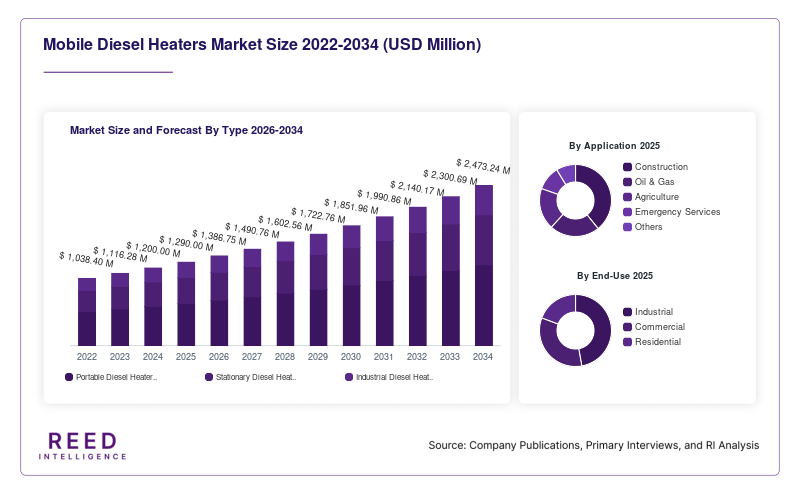
By Type: Portable Diesel Heaters represent the leading product segment, supported by their flexibility, ease of transportation, and broad deployment across construction sites, outdoor activities, emergency situations, and temporary facilities. Industrial Diesel Heaters are expected to register the fastest growth as oil & gas, mining, manufacturing, and other heavy industrial applications increasingly require high-capacity heating systems.
By Application: Construction is a major application segment because mobile heaters help maintain workable conditions and protect materials and equipment during cold-weather projects. Oil & gas and mining applications also generate substantial demand because operations frequently occur in remote and environmentally challenging locations. Agriculture and emergency services provide additional growth opportunities.
By End-Use: Industrial applications account for a significant portion of demand because large-scale construction, mining, oil & gas, and manufacturing operations require dependable heating systems. Commercial users, including event operators, logistics businesses, and service providers, represent another important market, while residential adoption is supported by recreational vehicles, workshops, garages, and other temporary heating requirements.
Mobile Diesel Heaters Market Regional Analysis
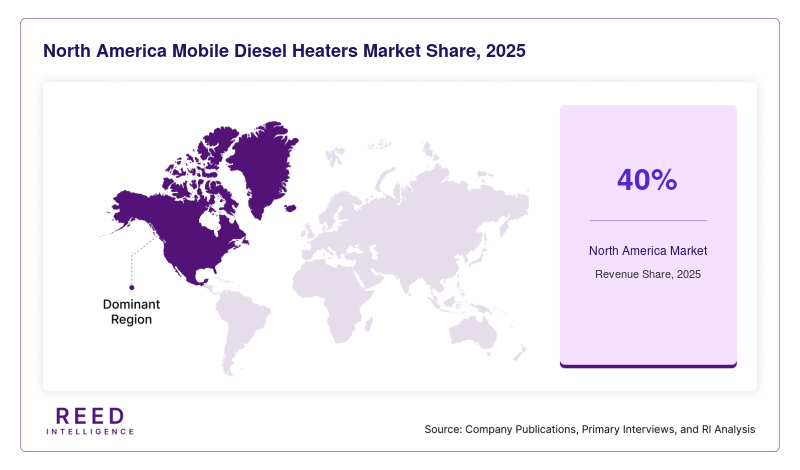
North America: North America is the dominant regional market, accounting for 40% of the global market in the reference market assessment. Strong construction, oil & gas, agriculture, logistics, and emergency-response activity, together with severe winter conditions in parts of the United States and Canada, supports demand for mobile diesel heating equipment.
Europe: Europe represents a significant market because of cold-weather construction requirements, industrial applications, agricultural operations, and demand for efficient heating systems. Environmental regulations are also encouraging manufacturers to develop lower-emission and more fuel-efficient equipment.
Asia Pacific: Asia Pacific is expected to experience strong growth as infrastructure development, industrialization, construction, agriculture, and mining activities expand. China and India provide substantial long-term opportunities because of their large construction and industrial bases.
Latin America: Latin America offers growth opportunities through construction, mining, agriculture, oil & gas, and infrastructure activities. Demand is particularly relevant in remote locations where mobile heating can operate independently of permanent heating infrastructure.
Middle East & Africa: Oil & gas, construction, mining, emergency response, and infrastructure projects contribute to demand in the region. Mobile diesel heaters are particularly useful in temporary facilities and remote operating environments where dependable heating is required.
Mobile Diesel Heaters Market Competitive Landscape
The Mobile Diesel Heaters Market is competitive and includes global thermal-management companies, specialized heating manufacturers, industrial equipment suppliers, and portable-heater producers. Competition is increasingly centered on heating efficiency, portability, reliability, emissions performance, operating noise, safety systems, digital controls, and compatibility with alternative fuels.
Webasto is a prominent thermal-management company offering diesel air heaters for commercial vehicles, recreational vehicles, marine applications, specialty vehicles, construction equipment, and agricultural machinery. Its current portfolio includes compact Air Top models featuring adjustable heating output, altitude compensation, digital controls, and compatibility with diesel and paraffinic fuels.
Key Market Players
- Webasto
- Eberspächer
- Espar
- Master Climate Solutions
- Thermobile Industries
- Dr. Heller GmbH
- Val6
- L.B. White Company
- Planar
- Kroll Energy
- Proheat
Mobile Diesel Heaters Market Recent Developments
July , 2026 Webasto introduced new Air Top Pro 25 and Air Top Go 20 air-heater offerings. The Air Top Pro 25 provides up to 2.5 kW of heating output, supports diesel, gasoline and HVO fuels, incorporates automatic altitude adjustment up to 5,500 meters, and can be installed inside a vehicle or underfloor. The Air Top Go 20 provides a lower-cost option with diesel/HVO operation and up to 2.0 kW in boost mode.
2026 Webasto expanded its current air-heater portfolio with compact systems designed for commercial vehicles, recreational vehicles, marine applications, construction and agricultural machinery. Current products emphasize efficient operation, compact installation, altitude adjustment, diagnostics, and flexible control integration.
Mobile Diesel Heaters Market Segments
By Type
- Portable Diesel Heaters
- Stationary Diesel Heaters
- Industrial Diesel Heaters
By Application
- Construction
- Oil & Gas
- Agriculture
- Emergency Services
- Others
By End-Use
- Industrial
- Commercial
- Residential
By Region
- North America
- Europe
- APAC
- Middle East and Africa
- LATAM