Mobile ECG Devices Market Size, Share & Trends Analysis Report By Product Type (Portable ECG Monitors, Handheld ECG Devices, Wearable ECG Monitors, Smartphone-Connected ECG Devices), By Application (Arrhythmia Detection, Atrial Fibrillation Monitoring, Ischemic Heart Disease Monitoring, General Cardiac Monitoring), By End User (Hospitals, Clinics, Home Healthcare, Ambulatory Care Settings) Forecasts 2026–2034
USD 3950
Mobile ECG Devices Market Size
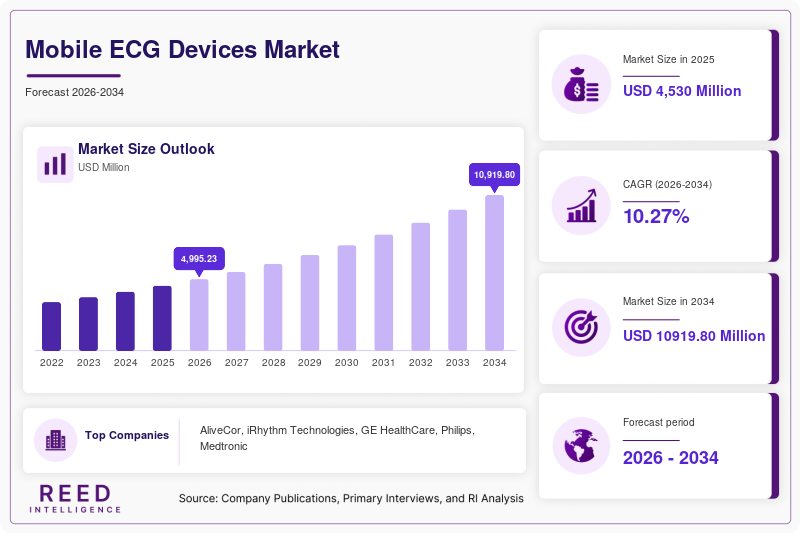
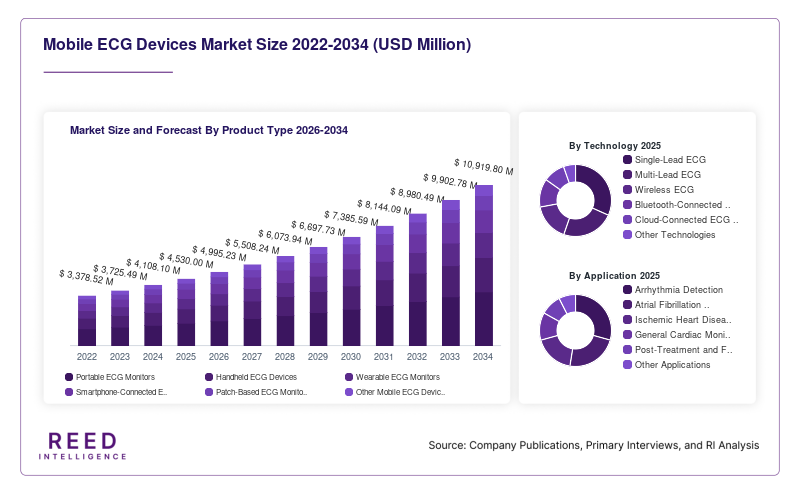
The global mobile ECG devices market was valued at USD 4,530 million in 2025 and is projected to grow from USD 4,995.23 million in 2026 to USD 10,919.80 million by 2034, registering a compound annual growth rate (CAGR) of 10.27% during the forecast period (2026–2034).
The Mobile ECG Devices Market includes portable and wearable electrocardiography systems designed to record, transmit, and analyse the electrical activity of the heart outside conventional fixed ECG settings. These devices range from handheld monitors and smartphone-connected ECG recorders to wearable patches, portable multi-lead systems, and selected remote cardiac monitoring solutions.
Demand is increasing as healthcare providers seek faster access to cardiac information, more convenient monitoring, and improved detection of intermittent arrhythmias. Mobile ECG devices can help clinicians evaluate symptoms such as palpitations, dizziness, and suspected irregular heart rhythms, particularly when an abnormality may not occur during a short, conventional ECG examination. Depending on the device and its regulatory clearance, monitoring may be performed at home, in outpatient settings, or during daily activities.
Mobile ECG Devices Market Drivers
Increasing prevalence of cardiovascular diseases: The growing burden of arrhythmias and other cardiac conditions is increasing demand for convenient ECG recording and longer-duration monitoring.
Growing adoption of remote patient monitoring: Telehealth and home-based care models are encouraging the use of connected ECG devices that can transmit cardiac recordings to healthcare professionals.
Advances in wearable technology: Miniaturised sensors, wireless communication, improved battery performance, and smartphone integration are making cardiac monitoring more accessible in everyday settings.
Demand for early detection and continuous monitoring: Mobile ECG devices can help capture intermittent cardiac events that may not be detected during a brief clinical examination, supporting timely assessment when appropriately prescribed and interpreted.
Mobile ECG Devices Market Restraints
Accuracy and clinical validation concerns: Performance can vary with device design, electrode placement, movement, signal quality, and the type of rhythm being assessed. Consumer-grade devices may not replace diagnostic-grade clinical ECG systems.
Data privacy and cybersecurity risks: Connected devices transmit sensitive health information, requiring robust security, consent management, and compliance with applicable data protection regulations.
Reimbursement and affordability challenges: Coverage differs across healthcare systems and device categories, potentially limiting adoption when patients or providers must pay out of pocket.
Integration and interpretation requirements: Incompatible digital systems, alert fatigue, and the need for qualified interpretation can create additional work for clinicians and healthcare organisations.
Mobile ECG Devices Market Opportunities
Home-based cardiac monitoring: Mobile ECG devices can expand access to cardiac assessment for patients who require follow-up monitoring without frequent hospital visits.
AI-assisted ECG interpretation: Validated algorithms may help identify potential rhythm abnormalities, prioritise recordings for review, and streamline clinical workflows.
Wearable and patch-based monitoring: Longer-duration recording formats create opportunities to detect intermittent arrhythmias and support post-treatment monitoring.
Emerging-market digital healthcare: Wider smartphone access, telemedicine adoption, and investment in connected healthcare can create opportunities for portable cardiac monitoring solutions.
Mobile ECG Devices Market Segmental Analysis
By Product Type
Portable and handheld ECG devices support convenient cardiac recordings in clinical, outpatient, and home settings. Their compact form and relatively simple operation make them suitable for spot checks and selected follow-up assessments. Smartphone-connected products can make recordings easier to store and share, although their diagnostic capabilities depend on the specific device and regulatory authorisation.
Wearable and patch-based ECG monitors are relevant when symptoms are intermittent or longer observation periods are required. They can collect data during routine activities and help clinicians investigate possible rhythm abnormalities that might not be captured in a short recording. However, wearable products differ in the number of leads, monitoring duration, signal quality, and clinical indications they support.
A definitive dominant product segment and its percentage share cannot be verified consistently across public sources, because market studies classify handheld, wearable, patch-based, Holter, and smartphone-connected devices differently. Wearable and patch-based formats are important areas of innovation, but a specific fastest-growing segment and CAGR should not be stated without a comparable dataset.
By Technology
Single-lead ECG technology is commonly used in compact handheld and wearable devices for recording cardiac rhythm. Its convenience supports spot recordings and selected rhythm-monitoring applications, but it does not provide the same diagnostic information as a standard 12-lead ECG. Multi-lead systems offer more comprehensive electrical information and may be preferred for particular clinical assessments.
Wireless and cloud-connected technologies support remote transmission, storage, review, and integration with telehealth workflows. Bluetooth connectivity can link a monitor to a smartphone or other compatible device, while cloud platforms can help healthcare teams manage recordings across distributed care settings. No consistent public dataset establishes a single dominant technology and a verified fastest-growing technology CAGR for this precise market definition.
By Application
Arrhythmia detection and atrial fibrillation monitoring are important applications because irregular heart rhythms may occur intermittently and can be difficult to capture during routine clinical visits. Mobile ECG recordings can provide additional information for clinical review, particularly when symptoms occur outside the healthcare facility.
General cardiac monitoring and post-treatment follow-up also contribute to demand. Mobile ECG devices may support monitoring after a diagnosis or intervention, depending on the patient’s clinical needs and the capabilities of the device. They should not be treated as a substitute for urgent medical evaluation when serious symptoms occur. The dominant application by revenue share and the fastest-growing application by CAGR are not reliably verifiable from a consistent public source for the market as defined here.
By End User
Hospitals and cardiology clinics use mobile ECG systems to assess symptoms, monitor selected patients, and support follow-up care. Healthcare professionals may use portable systems in outpatient consultations or connect monitoring data with broader clinical workflows. Device selection depends on clinical purpose, diagnostic requirements, patient population, integration, and regulatory status.
Home healthcare and remote patient monitoring represent important areas of opportunity as connected devices make it easier to record cardiac activity away from clinical facilities. Adoption depends on patient usability, connectivity, clinical oversight, data security, and reimbursement arrangements.
Mobile ECG Devices Market Regional Analysis
North America Mobile ECG Devices Market
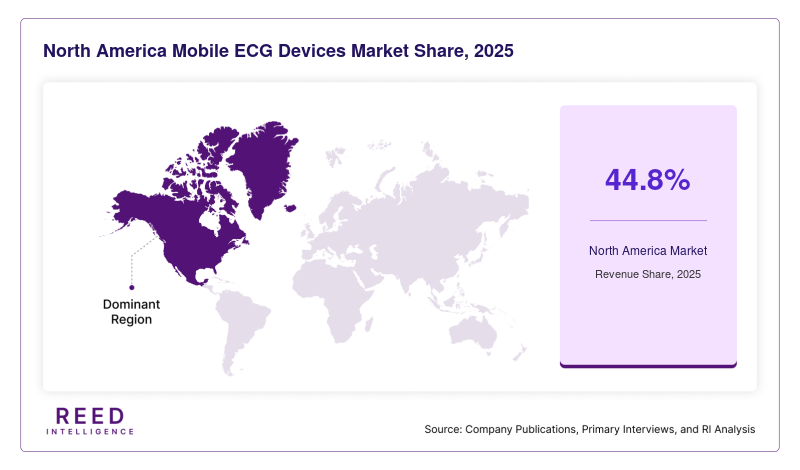
North America dominated the global Mobile ECG Devices Market in 2025, accounting for 44.78% of the global market share, with a market value of approximately USD 2.03 billion. Based on the reported regional forecast, the market is projected to reach USD 2.25 billion in 2026. Its leadership is supported by advanced healthcare infrastructure, established cardiac care services, growing adoption of remote patient monitoring, and demand for early detection of cardiac arrhythmias.
Europe Mobile ECG Devices Market
Europe represented approximately 29.11% of the global Mobile ECG Devices Market in 2025, with a reported market value of USD 1.32 billion. The market is projected to reach USD 1.44 billion in 2026. Demand is supported by established healthcare systems, growing adoption of digital health technologies, and increasing attention to the diagnosis and management of cardiac disorders.
Asia Pacific Mobile ECG Devices Market
Asia Pacific accounted for approximately 18.30% of the global Mobile ECG Devices Market in 2025, with a reported market value of USD 830 million. The regional market is projected to reach USD 900 million in 2026. Demand is supported by a large and ageing population, rising cardiovascular disease burden, expanding healthcare infrastructure, and increasing awareness of cardiac monitoring technologies.
Latin America Mobile ECG Devices Market
Latin America accounted for approximately 4.94% of the global Mobile ECG Devices Market in 2025, with a reported market value of USD 220 million. The regional market is projected to reach USD 240 million in 2026. Demand is supported by growing healthcare expenditure, greater attention to cardiovascular disease diagnosis, and expanding use of ambulatory cardiac monitoring.
Middle East & Africa Mobile ECG Devices Market
The Middle East & Africa region accounted for approximately 2.87% of the global Mobile ECG Devices Market in 2025, with a reported market value of USD 130 million. The regional market is projected to reach USD 140 million in 2026. Demand is supported by healthcare infrastructure investment, increasing awareness of cardiovascular conditions, and interest in digital health and remote patient monitoring.
Mobile ECG Devices Market Competitive Landscape
The Mobile ECG Devices Market includes medical device manufacturers, ambulatory cardiac monitoring specialists, wearable technology companies, and connected-health providers. Competition is influenced by recording accuracy, number of ECG leads, monitoring duration, device comfort, battery life, connectivity, data management, regulatory authorisation, and clinical workflow integration.
Companies compete through portable hardware, wearable and patch-based monitoring, software-assisted analysis, clinician-facing platforms, and partnerships with healthcare providers. Consumer-facing ECG features broaden awareness and access to rhythm recording, but consumer products and clinical-grade diagnostic systems may differ substantially in intended use and regulatory status. Buyers increasingly assess the quality of clinical evidence, cybersecurity, interoperability, service support, and the total cost of deployment.
Key Market Players
- AliveCor
- iRhythm Technologies
- GE HealthCare
- Philips
- Medtronic
- Baxter International
- Bittium
- Cardiac Insight
- Fukuda Denshi
- Nihon Kohden
- Omron Healthcare
Mobile ECG Devices Market Recent Developments
- October 2026 -Wellysis receives FDA clearance for S-Patch CardioAI Wellysis announced that its AI-powered S-Patch CardioAI ECG analysis software received U.S. FDA 510(k) clearance, with the clearance granted on September 25, 2026. The software is designed to analyse ECG data and assess arrhythmias, extending the S-Patch wearable monitoring solution beyond signal collection to include AI-assisted analysis. This development is relevant to the market’s growing focus on connected ECG monitoring and clinical workflow support.
- September 2026 -Peerbridge Health receives FDA clearance for Cor MDx Peerbridge Health announced FDA 510(k) clearance for Cor MDx on September 14, 2026. The wearable device records continuous, multi-channel ECG for up to 14 days for clinician review and replaces the company’s first-generation Cor device. The launch highlights ongoing development of wearable ambulatory monitoring systems intended to support cardiac assessment from hospital discharge through recovery at home and follow-up care.
Mobile ECG Devices Market Segments
By Product Type
- Portable ECG Monitors
- Handheld ECG Devices
- Wearable ECG Monitors
- Smartphone-Connected ECG Devices
- Patch-Based ECG Monitors
- Other Mobile ECG Devices
By Technology
- Single-Lead ECG
- Multi-Lead ECG
- Wireless ECG
- Bluetooth-Connected ECG
- Cloud-Connected ECG Systems
- Other Technologies
By Application
- Arrhythmia Detection
- Atrial Fibrillation Monitoring
- Ischemic Heart Disease Monitoring
- General Cardiac Monitoring
- Post-Treatment and Follow-Up Monitoring
- Other Applications
By End User
- Hospitals
- Cardiology Clinics and Physician Offices
- Home Healthcare
- Ambulatory Care Settings
- Diagnostic and Monitoring Centres
- Other End Users
By Region
- North America
- Europe
- APAC
- Middle East and Africa
- LATAM