Mobile Edge Computing (MEC) Market Size, Share & Trends Analysis Report By Component (Hardware, Software), By Organization Size (Small and Medium Enterprises, Large Enterprises), By Application (Location-Based Services, Video Surveillance, Unified Communication, Optimized Local Content Distribution, Data Analytics, Environmental Monitoring), and By Region (North America, Europe, Asia Pacific, Latin America, Middle East & Africa) Forecasts, 2026–2034
USD 3950
Mobile Edge Computing (MEC) Market Size
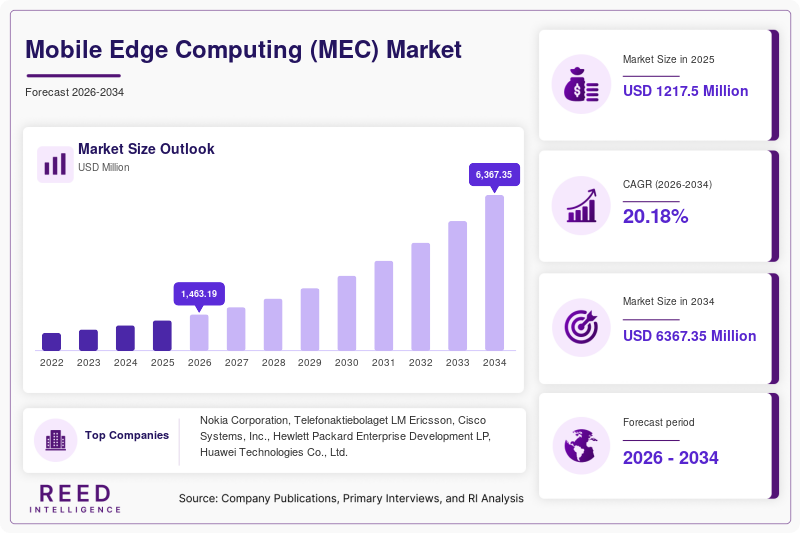
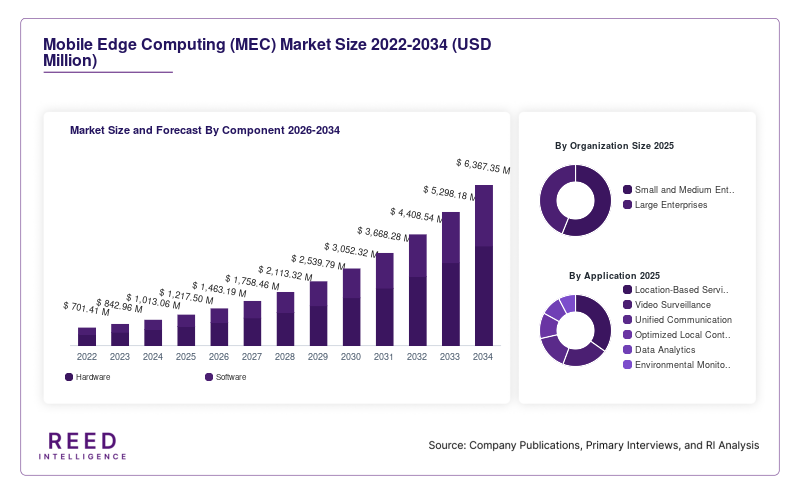
The global mobile edge computing (MEC) market was valued at USD 1,217.5 million in 2025 and is projected to grow from USD 1,463.19 million in 2026 to USD 6,367.35 million by 2034, registering a compound annual growth rate (CAGR) of 20.18% during the forecast period from 2026 to 2034.
The Mobile Edge Computing (MEC) Market encompasses technologies that bring computing, storage, and application services closer to mobile users, connected devices, and data-generation points. Instead of relying entirely on centralized cloud infrastructure, MEC distributes processing capabilities across network-edge locations, including telecom facilities, local data centers, enterprise premises, and access-network infrastructure. This architecture can reduce latency, lower backhaul traffic, improve responsiveness, and support applications that require real-time data processing.
The market is gaining importance alongside 5G deployment, connected-device proliferation, industrial automation, artificial intelligence, and Internet of Things (IoT) applications. MEC can support smart manufacturing, video analytics, location-based services, connected vehicles, augmented and virtual reality, and other applications where transmitting all data to a distant cloud may introduce unnecessary delay or network costs. Telecom operators and cloud providers are increasingly exploring distributed infrastructure and network APIs to make edge capabilities accessible to enterprise customers and application developers.
Mobile Edge Computing (MEC) Market Drivers
Expansion of 5G Networks and Demand for Low-Latency Services
The rollout of 5G networks is supporting MEC adoption by creating opportunities to combine high-speed connectivity with nearby computing resources. Applications such as industrial control, connected vehicles, real-time video analytics, cloud gaming, and immersive digital experiences may require fast responses and consistent network performance. Processing data closer to users can reduce transmission delays and unnecessary traffic through centralized infrastructure, making MEC relevant to telecom operators and enterprise technology providers.
Growth of IoT, Artificial Intelligence, and Industrial Automation
The proliferation of connected sensors, cameras, machines, and intelligent devices is generating large volumes of data that organizations need to process efficiently. MEC can enable localized analytics and AI inference, helping industrial facilities, transport networks, healthcare providers, and smart-city operators make decisions closer to where information is produced. Increasing interest in real-time monitoring, predictive maintenance, machine vision, and distributed AI is creating additional opportunities for edge infrastructure and software.
Mobile Edge Computing (MEC) Market Restraints
High Deployment and Operational Costs
MEC deployments may require distributed servers, network upgrades, orchestration software, cybersecurity systems, and ongoing technical support across numerous locations. Smaller enterprises and telecom operators with limited capital budgets may find these investments difficult to justify before application demand is established. Operating multiple edge sites can also increase energy, maintenance, software-management, and infrastructure-monitoring expenses compared with centralized computing models.
Interoperability, Security, and Management Complexity
Edge environments often involve equipment and software from multiple vendors, telecom networks, cloud platforms, and enterprise applications. Integrating these systems can create challenges involving application portability, workload orchestration, identity management, data protection, and service continuity. Because computing resources are distributed across many locations, organizations also need consistent security controls and monitoring practices. Standards, common APIs, and stronger ecosystem coordination are important for reducing these barriers.
Mobile Edge Computing (MEC) Market Opportunities
Enterprise Adoption of Edge AI and Real-Time Analytics
The expansion of AI-powered industrial inspection, autonomous systems, video analytics, and connected operations creates opportunities for MEC providers. Local processing can support applications that require rapid decisions or need to limit the transfer of sensitive data to centralized cloud environments. Vendors offering integrated compute, connectivity, AI acceleration, and management capabilities may benefit as organizations evaluate edge architectures for operationally critical workloads.
Network API Standardization and Cloud–Telecom Partnerships
Standardized APIs and partnerships between telecom operators, cloud providers, and application developers can make MEC services easier to discover, deploy, and monetize. Network capabilities such as location information, quality-on-demand, and traffic management may enable differentiated enterprise applications. Continued progress in edge orchestration, federated infrastructure, and cloud-native application development could expand the addressable market by simplifying deployment across different networks and computing environments.
Mobile Edge Computing (MEC) Market Segmental Analysis
By Component
Hardware is a foundational segment of the MEC market, encompassing edge servers, networking equipment, storage, accelerators, and supporting infrastructure used to process workloads close to users and connected devices. Hardware performance, energy efficiency, reliability, and suitability for deployment in constrained locations influence purchasing decisions. The hardware segment is identified as the leading component in the published market estimate matching the supplied global market valuation.
Software is essential for managing distributed edge resources, deploying applications, orchestrating workloads, enforcing security policies, and integrating edge infrastructure with cloud and telecom environments. As deployments become more distributed, management automation and interoperability are increasingly important. However, a comparable, independently verified fastest-growing component and its CAGR are unavailable for this market definition.
By Organization Size
Large enterprises represent an important customer group because they often operate complex networks, geographically distributed facilities, and data-intensive applications. Manufacturing companies, telecom operators, transport businesses, and multinational organizations may deploy MEC to support real-time analytics, local data processing, and operational automation. Their adoption decisions are influenced by integration with existing cloud platforms, performance requirements, security policies, and the economic benefits of localized computing.
Small and medium enterprises may benefit from managed edge services that reduce the need to build and maintain dedicated infrastructure. Telecom operators and cloud providers can make MEC more accessible through subscription-based offerings, standardized deployment tools, and managed services. The published market estimate identifies large enterprises as the leading organization-size segment. A verified fastest-growing organization-size category and its CAGR are not available in comparable public data.
By Application
Location-based services are identified as the leading application segment in the published market estimate matching the supplied global market figures. MEC can support location-aware applications by processing information closer to mobile users and network access points, helping improve responsiveness for context-sensitive services. Relevant use cases may include local content delivery, location-aware customer experiences, and applications requiring timely access to network information.
Video surveillance, unified communication, optimized local content distribution, data analytics, and environmental monitoring also offer application opportunities. Local video processing can reduce the need to transmit all recorded data to a centralized cloud, while data analytics can support faster operational decisions. A directly comparable, independently verified fastest-growing application segment and its CAGR are unavailable for this specific market definition.
Mobile Edge Computing (MEC) Market Regional Analysis
North America Mobile Edge Computing (MEC) Market
North America dominated the global Mobile Edge Computing (MEC) Market in 2025, accounting for 40.8% of global market revenue, according to Mordor Intelligence's market analysis. The region's leadership is supported by advanced 5G infrastructure, strong investment from telecommunications operators and cloud providers, and growing enterprise demand for low-latency computing, real-time analytics, and connected applications. The United States is a major contributor, driven by the presence of leading technology companies and continued development of network-edge infrastructure.
Europe Mobile Edge Computing (MEC) Market
Europe is an established market for MEC, supported by telecommunications infrastructure, industrial digitalization, enterprise cloud adoption, and regional work on interoperable edge standards. Germany, France, the United Kingdom, and other European countries have opportunities in industrial automation, connected transport, smart infrastructure, and enterprise analytics. Edge deployments may help organizations process operational data locally while supporting latency-sensitive applications and requirements around data governance.
Standardization and collaboration among telecom, cloud, and technology providers are important to the region's development. ETSI's MEC work continues to advance APIs, edge application enablement, and interoperability with open-source initiatives, while broader efforts address integration between network, cloud, and AI resources.
Asia Pacific Mobile Edge Computing (MEC) Market
Asia Pacific offers significant growth potential as countries expand 5G networks, digitize manufacturing, and invest in connected infrastructure. China, Japan, South Korea, India, and Australia represent important markets, each with different levels of telecom investment, enterprise adoption, and edge-computing maturity. Industrial automation, smart-city projects, video analytics, connected mobility, and distributed AI are relevant use cases for edge deployment.
Growth will depend on network modernization, availability of edge infrastructure, investment by telecom operators, and the ability of enterprises to justify deployment costs. Manufacturing and transport applications may provide opportunities where local processing supports rapid decisions and operational continuity.
Latin America Mobile Edge Computing (MEC) Market
Latin America presents opportunities as telecom operators, enterprises, and public-sector organizations modernize digital infrastructure. Brazil and Mexico are important markets for connectivity and enterprise technology investment, while other countries may adopt MEC as 5G availability, cloud services, and industrial digitalization expand. Potential applications include localized content delivery, video surveillance, smart infrastructure, and operational analytics.
Market adoption may be constrained by investment requirements, uneven network coverage, limited access to specialized technical expertise, and uncertainty around enterprise returns. Managed edge services and partnerships between telecom operators and cloud providers may reduce the burden on customers that do not want to operate distributed infrastructure independently. Middle East & Africa Mobile Edge Computing (MEC) Market
The Middle East & Africa market is influenced by investment in telecommunications infrastructure, smart-city initiatives, enterprise digitalization, and connected industrial operations. Some Gulf markets are developing advanced digital infrastructure and deploying 5G-based services, creating potential demand for local computing and low-latency applications. In Africa, opportunities vary by country and depend on connectivity, data-center access, enterprise investment, and the availability of technical skills.
MEC adoption will depend on infrastructure costs, network coverage, cybersecurity capabilities, and the maturity of local application ecosystems. Partnerships among telecom operators, cloud providers, system integrators, and enterprise customers can help develop practical use cases.
Mobile Edge Computing (MEC) Market Competitive Landscape
The Mobile Edge Computing (MEC) Market includes telecom operators, cloud providers, hardware manufacturers, software developers, and networking technology companies. Competition spans edge servers, orchestration software, virtualization, cloud-to-edge integration, network APIs, security, and managed services. Companies compete through performance, interoperability, reliability, global infrastructure, application support, and partnerships with network operators and enterprise customers.
Nokia Corporation is a significant participant in telecom-edge infrastructure and network technologies. Its portfolio supports telecom operators and enterprises deploying 5G and distributed computing solutions. Nokia's positioning benefits from its telecommunications expertise and work with ecosystem partners on network capabilities, application enablement, and edge-related services.
Key Market Players
- Nokia Corporation
- Telefonaktiebolaget LM Ericsson
- Cisco Systems, Inc.
- Hewlett Packard Enterprise Development LP
- Huawei Technologies Co., Ltd.
- Intel Corporation
- International Business Machines Corporation (IBM)
- Microsoft Corporation
- AT&T Inc.
- Verizon Communications Inc.
Mobile Edge Computing (MEC) Market Recent Developments
October 2026 ETSI announced the launch of its Technical Committee on Federated Network, Edge, Cloud and AI Technologies in June 2026, with its first meeting scheduled for October 7–9, 2026. The initiative aims to develop standards for integrating computing and AI resources across connectivity, cloud, edge, and device environments. This work is relevant to interoperability and the development of distributed computing services.
February 2026 SoftBank and Ericsson announced a proof of concept involving low-latency, reliable connectivity for Physical AI applications. The demonstration used SoftBank's real-time processing technology with an AI-RAN MEC platform under development and an Ericsson 5G network, allowing robots to offload AI tasks to nearby computing resources when additional processing power was needed.
Mobile Edge Computing (MEC) Market Segments
By Component
- Hardware
- Software
By Organization Size
- Small and Medium Enterprises
- Large Enterprises
By Application
- Location-Based Services
- Video Surveillance
- Unified Communication
- Optimized Local Content Distribution
- Data Analytics
- Environmental Monitoring
By Region
- North America
- Europe
- APAC
- Middle East and Africa
- LATAM