Mobile Fluid System Market Size, Share & Trends Analysis Report By Component (Pumps, Valves, Filters, Accumulators, and Others), By Application (Construction, Agriculture, Automotive, Aerospace, and Others), By End-User (OEMs, Aftermarket), By Fluid Type (Hydraulic Fluids, Coolants, Lubricants, and Others) and By Region (North America, Europe, Asia Pacific, Latin America, Middle East & Africa) Forecasts, 2026–2034
USD 3950
Mobile Fluid System Market Size
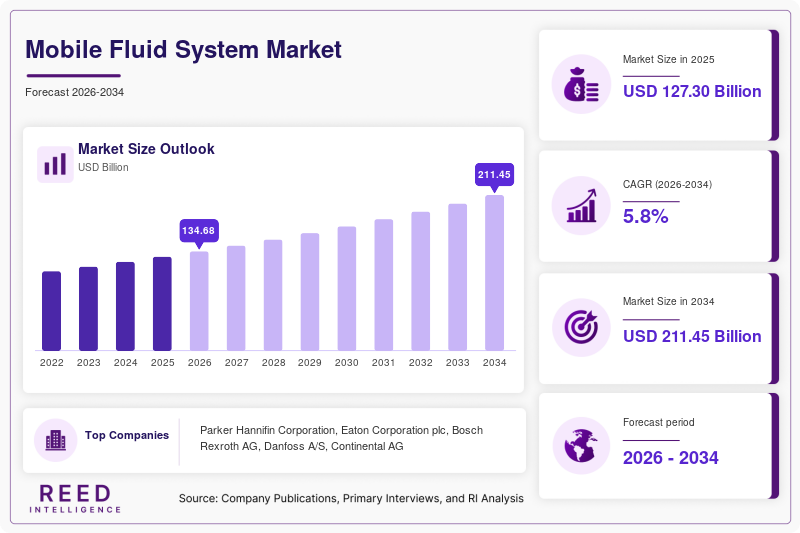
The global mobile fluid system market was valued at USD 127.30 Billion in 2025 and is projected to reach USD 134.68 Billion in 2026. The market is expected to reach approximately USD 211.45 Billion by 2034, expanding at a CAGR of 5.8% during the forecast period from 2026 to 2034.
Mobile fluid systems are integrated systems used to generate, transmit, control, filter, cool, and manage fluids in mobile machinery and transportation equipment. They include pumps, valves, filters, accumulators, fluid circuits, coolants, lubricants, and related control technologies. These systems are particularly important in construction equipment, agricultural machinery, heavy-duty vehicles, material-handling equipment, mining machinery, and other off-highway applications.
The market is being shaped by the continued expansion of construction and agricultural mechanization, increasing equipment automation, electrification of mobile machinery, and growing emphasis on energy efficiency. Advanced electro-hydraulic controls, sensors, digital monitoring, and predictive-maintenance capabilities are increasingly being incorporated into mobile fluid architectures. Asia Pacific remains the leading regional market, supported by industrialization, infrastructure investment, equipment manufacturing, and expanding construction and agricultural machinery demand.
Mobile Fluid System Market Drivers
Expansion of Construction and Infrastructure Equipment
The increasing deployment of excavators, wheel loaders, cranes, concrete pumps, and other construction machinery is a major growth driver for mobile fluid systems. Hydraulic systems remain essential for boom movement, bucket actuation, steering, lifting, and other high-force operations. Construction applications represented 32.7% of the market in 2025, making construction the largest application segment.
Growing Agricultural Mechanization
Agricultural mechanization is increasing demand for mobile fluid systems used in tractors, harvesting equipment, spraying machinery, balers, and other agricultural vehicles. Hydraulic and electro-hydraulic technologies enable precision control, automation, and improved operating efficiency. Agriculture represented approximately 28.1% of market revenue in 2025, while demand is expected to benefit from increasing equipment modernization and precision farming.
Integration of Smart and Electro-Hydraulic Technologies
Mobile equipment manufacturers are increasingly integrating electronic controls, sensors, software, telematics, and connected hydraulic components. Bosch Rexroth's eOC and eCC platforms, for example, use software-based control architectures for mobile hydraulic pumps and valves, supporting improved efficiency, automation, scalability, and machine monitoring.
Mobile Fluid System Market Restraints
High System and Component Costs
Advanced mobile fluid systems require precision-engineered pumps, valves, filters, accumulators, sensors, electronic controls, and specialized fluid-management technologies. The resulting equipment cost can be significant, particularly for smaller machinery manufacturers and cost-sensitive end users.
Raw Material and Component Price Volatility
Manufacturing mobile fluid-system components depends on metals and engineered materials such as steel, aluminum, elastomers, and specialized polymers. Fluctuations in material prices can increase manufacturing costs and place pressure on component suppliers and OEM margins.
Maintenance and Fluid Contamination Risks
Contamination can reduce hydraulic-system performance and accelerate wear in pumps, valves, cylinders, and other components. Maintaining fluid cleanliness therefore requires filtration, monitoring, fluid replacement, and preventive maintenance, increasing lifecycle management requirements for equipment operators.
Mobile Fluid System Market Opportunities
Electrification of Mobile Machinery
The transition toward electric and hybrid construction, agricultural, mining, and material-handling equipment is creating opportunities for new fluid-management architectures. Battery cooling, thermal management, electro-hydraulic actuation, and optimized auxiliary systems are expanding the role of fluid-management technologies beyond conventional diesel-powered hydraulics.
Adoption of Biodegradable and Environmentally Friendly Fluids
Environmental regulations and increasing awareness of fluid leakage and contamination are encouraging adoption of biodegradable hydraulic fluids and synthetic alternatives. These solutions can reduce environmental impact while maintaining the performance characteristics required for demanding mobile equipment applications.
Digital Fluid Monitoring and Predictive Maintenance
Connected sensors, telematics, condition monitoring, and predictive-maintenance platforms offer opportunities for manufacturers to provide higher-value fluid-management solutions. Monitoring pressure, temperature, contamination, and operating conditions can help reduce unplanned downtime and extend component service life.
Mobile Fluid System Market Segmental Analysis
By Component
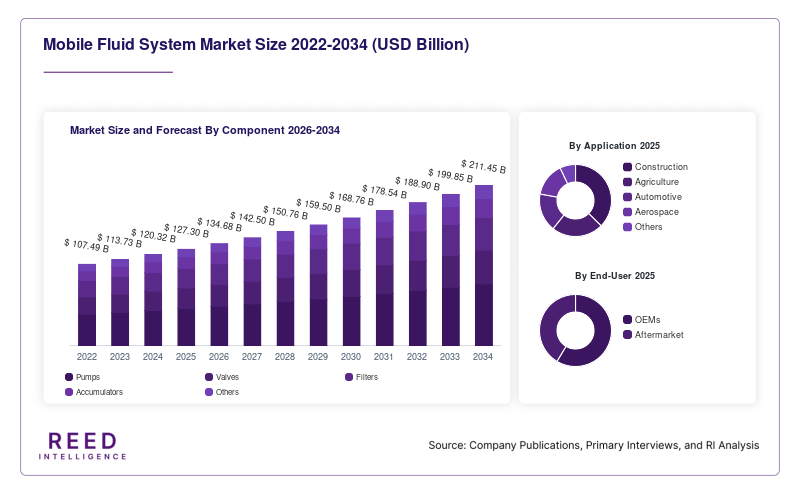
Pumps represented the dominant component segment, accounting for approximately 28.5% of market revenue in 2025. Pumps form the core of hydraulic systems by generating fluid flow and supplying pressure required for actuation and power transmission. Demand is supported by construction, agricultural, mining, and material-handling equipment. The segment is projected to grow at approximately 6.9% CAGR, supported by increasing adoption of energy-efficient variable-displacement and electronically controlled pump technologies.
Valves accounted for approximately 22.4% of the market in 2025. Valves regulate pressure, flow, and direction within fluid circuits and are increasingly incorporating electronic actuation and proportional-control capabilities.
Filters represented approximately 17.8% of market revenue. Increasing attention to fluid cleanliness, component protection, and predictive maintenance supports demand for advanced filtration solutions.
Accumulators accounted for approximately 15.2% and are used for energy storage, pressure stabilization, shock absorption, and emergency hydraulic functions. The segment is projected to grow at approximately 7.3% CAGR, making it one of the faster-growing component categories.
Others accounted for approximately 16.1%, covering additional fluid-system components and associated technologies.
By Application
Construction was the largest application segment, representing approximately 32.7% of the market in 2025. Excavators, wheel loaders, cranes, concrete pumps, and other construction equipment depend heavily on hydraulic and fluid-management systems for lifting, digging, steering, and other high-force operations.
Agriculture accounted for approximately 28.1% of the market. Tractors, harvesters, sprayers, balers, and other agricultural equipment increasingly use hydraulic and electro-hydraulic technologies for precision control and automation.
Automotive represented approximately 22.4% and is among the faster-growing applications, with an estimated 7.1% CAGR. Electrification is creating additional demand for thermal-management fluids, cooling circuits, and specialized fluid-management architectures.
Aerospace accounted for approximately 8.9%. Aerospace applications require highly reliable and tightly controlled fluid systems for flight-control, actuation, thermal, and other critical functions.
Others represented approximately 7.9%, including applications in mining, forestry, marine equipment, and other specialized mobile machinery.
By End-User
OEMs represented the dominant end-user segment, accounting for approximately 71.3% of the market in 2025. OEM demand is driven by increasing integration of fluid systems directly into new construction, agricultural, automotive, mining, and other mobile equipment platforms.
Aftermarket accounted for approximately 28.7%. The aftermarket benefits from the large installed base of mobile machinery and recurring requirements for replacement pumps, valves, filters, fluids, seals, and other components. The segment is expected to grow at approximately 6.3% CAGR, supported by preventive maintenance and extended equipment operating lifecycles.
By Fluid Type
Hydraulic Fluids represented the largest fluid-type segment, accounting for approximately 68.4% of market revenue in 2025. Hydraulic fluids are essential for power transmission, actuation, lubrication, and heat transfer in mobile hydraulic systems. Demand is increasingly shifting toward synthetic and biodegradable formulations in applications where environmental compliance and extended service life are important.
Coolants accounted for approximately 18.9% and are becoming increasingly important as mobile machinery adopts higher-performance engines, electric powertrains, batteries, and thermal-management systems.
Mobile Fluid System Market Regional Analysis
North America Mobile Fluid System Market
North America accounted for approximately 19.8% of the global Mobile Fluid System Market in 2025, supported by strong demand from construction, agriculture, industrial machinery, mining, and aftermarket service activities. The region benefits from a large installed base of mobile equipment and established hydraulic-component manufacturers.
Europe Mobile Fluid System Market
Europe represented approximately 27.1% of the global market in 2025. Germany, France, and other major industrial economies support demand through construction machinery, agricultural equipment, automotive production, and advanced industrial technologies. Environmental regulations are also encouraging the adoption of biodegradable hydraulic fluids and more efficient fluid-management technologies.
Asia Pacific Mobile Fluid System Market
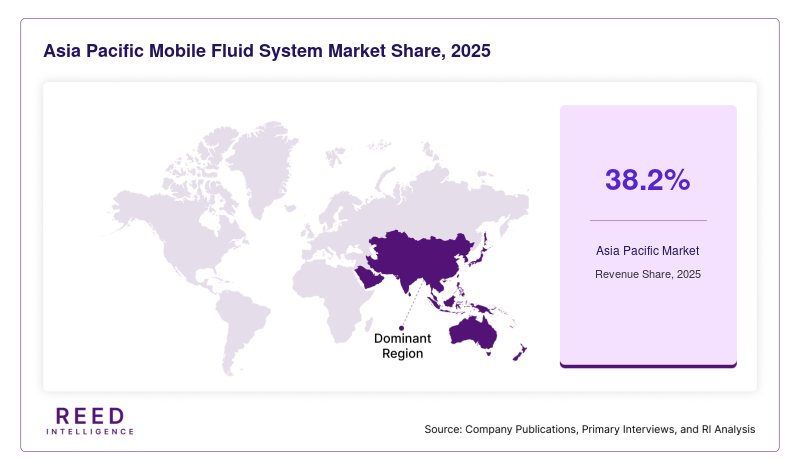
Asia Pacific was the dominant regional market, accounting for 38.2% of global revenue in 2025. The region's leadership is supported by rapid industrialization, infrastructure development, construction-equipment demand, agricultural mechanization, and the concentration of mobile-equipment and component manufacturing in China, India, Japan, South Korea, and Southeast Asia.
China represents a particularly important manufacturing and demand center, while India and Southeast Asian economies are benefiting from infrastructure development and increasing mechanization. Growing electric-vehicle and electrified-equipment adoption is also expanding opportunities for thermal-management and electronically controlled fluid systems.
Latin America Mobile Fluid System Market
Latin America represents an emerging market for mobile fluid systems, supported by agricultural mechanization, mining, construction, infrastructure development, and equipment replacement demand. Brazil and other major economies provide opportunities for hydraulic components, filtration products, lubricants, and aftermarket services.
Middle East & Africa Mobile Fluid System Market
The Middle East & Africa market is supported by construction, mining, oil and gas, infrastructure, agriculture, and heavy-equipment applications. Demand for durable fluid-management systems is expected to increase as industrial and infrastructure investments expand across selected markets.
Mobile Fluid System Market Competitive Landscape
The Mobile Fluid System Market is characterized by competition among global motion-control, hydraulic, filtration, fluid-conveyance, and mobile-equipment technology companies. Major participants are focusing on electro-hydraulic controls, digitalization, energy efficiency, filtration, electrification, compact components, and integrated solutions for next-generation mobile machinery.
Parker Hannifin is a major global motion and control technology provider and is identified as a leading company in the mobile fluid system market. The company supplies hydraulic, filtration, fluid-conveyance, and control technologies for mobile equipment. In August 2026, Parker reported record fiscal 2026 sales of USD 21.5 billion, with organic sales increasing 6.6%, demonstrating continued strength across its broad motion-and-control portfolio.
Key Market Players
- Parker Hannifin Corporation
- Eaton Corporation plc
- Bosch Rexroth AG
- Danfoss A/S
- Continental AG
- HYDAC International GmbH
- Yokohama Rubber Co., Ltd.
- Gates Corporation
- Trelleborg AB
- Freudenberg Group
Mobile Fluid System Market Recent Developments
February 2026 - Bosch Rexroth Highlights Mobile Hydraulics and Digital Technologies at CONEXPO-CON/AGG 2026 Bosch Rexroth announced that its specialists would present mobile-machine and mobile-hydraulics technologies at CONEXPO-CON/AGG 2026, focusing on hydraulic and digitally networked technologies for construction, agriculture, and off-highway equipment. The development highlights the industry's movement toward connected and more electronically controlled mobile fluid systems.
March 2026 - Parker Showcases Next-Generation Off-Highway Fluid and Control Architectures Parker showcased integrated architectures for next-generation off-highway equipment at CONEXPO-CON/AGG 2026, including advanced hydraulic work functions, sensors, software, digitalization, autonomy and diagnostics, steer-by-wire technologies, and thermal-management solutions for electrified equipment.
Mobile Fluid System Market Segments
By Component
- Pumps
- Valves
- Filters
- Accumulators
- Others
By Application
- Construction
- Agriculture
- Automotive
- Aerospace
- Others
By End-User
- OEMs
- Aftermarket
By Fluid Type
- Hydraulic Fluids
- Coolants
- Lubricants
- Others
By Region
- North America
- Europe
- APAC
- Middle East and Africa
- LATAM