Mobile Fuel Storage Tank Market Size, Share & Demand Report By Material Type (Steel Tanks, Polyethylene Tanks, Aluminum Tanks, Composite Material Tanks), By Capacity (Below 1,000 Liters, 1,000–5,000 Liters, 5,000–10,000 Liters, Above 10,000 Liters), By End-Use Industry (Construction and Infrastructure, Mining, Agriculture, Oil & Gas, Transportation and Logistics, Defense and Emergency Services), By Region & Segment Forecasts, 2026–2034
USD 3950
Market Overview
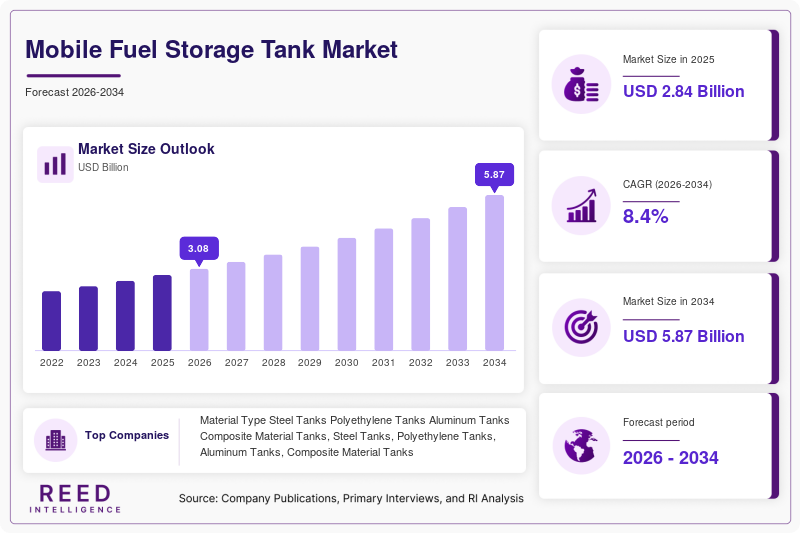
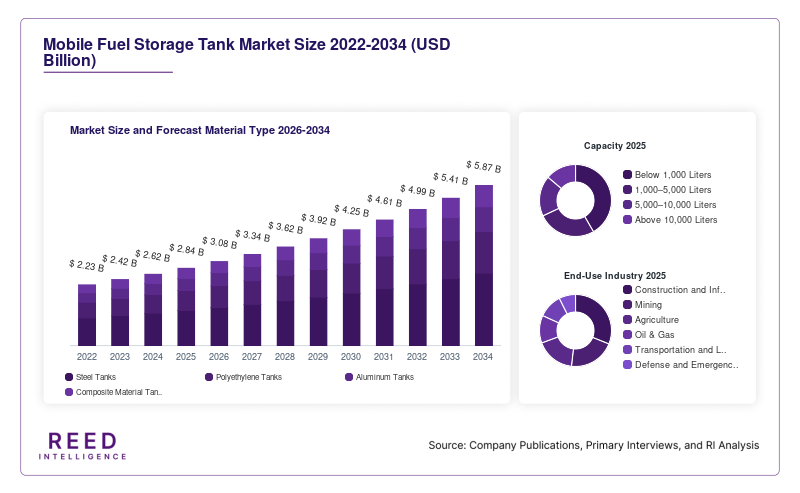
The global Mobile Fuel Storage Tank Market size was valued at USD 2.84 billion in 2026 and is projected to reach USD 5.41 billion by 2034, expanding at a CAGR of 8.4% during the forecast period. The market is witnessing stable expansion due to rising fuel transportation activities across construction, mining, agriculture, defense, and industrial sectors. Mobile fuel storage tanks are increasingly used to support uninterrupted fuel supply in remote locations where fixed infrastructure is limited. Industries operating in temporary project sites continue to depend on portable fuel systems for operational continuity and cost control.
The growth of infrastructure projects across emerging economies has created consistent demand for mobile storage equipment with enhanced durability and higher storage capacity. Mining and construction contractors are investing in advanced tanks with integrated dispensing systems, monitoring sensors, and spill protection features. Growing emphasis on fuel efficiency and workplace safety standards has also encouraged the adoption of certified mobile storage systems. In addition, increasing diesel consumption in industrial machinery and backup power applications has supported market demand in both developed and developing regions.
Key Highlights
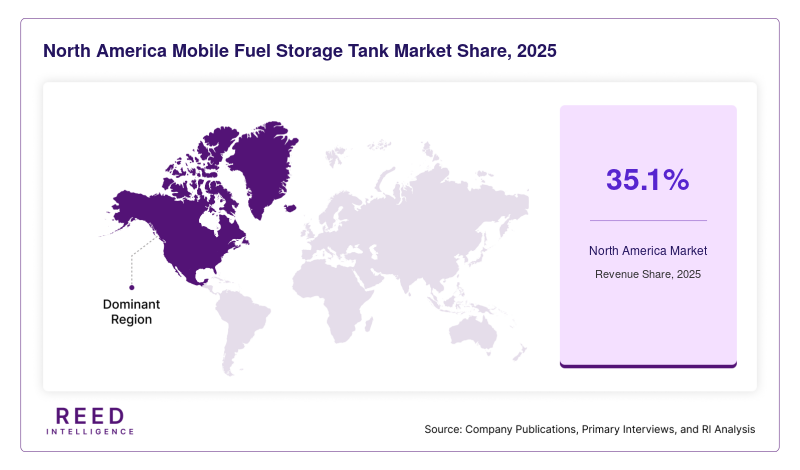
- North America dominated the market with a 35.1% share in 2025, while Asia Pacific is expected to grow at the fastest CAGR of 10.6% during 2026–2034.
- By material type, steel tanks accounted for the largest share of 48.3%, while polyethylene tanks are projected to grow at a CAGR of 11.1%.
- By capacity, tanks with 1,000–5,000 liters led with a 39.4% share, whereas tanks above 10,000 liters are expected to expand at a CAGR of 10.9%.
- By end-use industry, construction and infrastructure accounted for the largest share of 31.7%, while mining applications are projected to grow at a CAGR of 10.4%.
- The United States remained the dominant country, with market values of USD 720 million in 2024 and USD 785 million in 2025.
Market Trends
Integration of Smart Fuel Monitoring Technologies
The Mobile Fuel Storage Tank Market is experiencing increased adoption of smart monitoring technologies that improve fuel tracking and operational efficiency. Fleet operators and industrial companies are integrating GPS-enabled fuel monitoring systems, automated dispensing controls, and digital sensors into mobile storage tanks. These systems help operators monitor fuel consumption, prevent theft, and optimize refueling schedules across remote locations. Construction and mining firms are increasingly adopting cloud-connected monitoring platforms that provide real-time fuel level data and predictive maintenance alerts. The growing need for operational transparency and efficient fuel management has encouraged manufacturers to develop advanced storage tanks equipped with wireless connectivity and automated reporting features. These technologies also support compliance with environmental and safety regulations by detecting leaks and monitoring temperature fluctuations.
Rising Preference for Double-Wall and Environmentally Safer Tank Designs
Environmental protection regulations and industrial safety requirements are influencing the design and production of mobile fuel storage tanks. End users are increasingly preferring double-wall tanks with integrated spill containment systems to reduce environmental risks during transportation and storage. Industries operating in ecologically sensitive areas, including mining and oil exploration, are investing in safer storage solutions that minimize fuel leakage risks. Manufacturers are responding by introducing corrosion-resistant coatings, reinforced structures, and pressure-tested tank systems that improve operational reliability. In addition, the demand for recyclable polyethylene and lightweight composite materials is increasing because these materials support easier transportation and lower maintenance costs. This trend is becoming more visible in Europe and North America, where environmental compliance standards continue to influence industrial equipment purchasing decisions.
Market Drivers
Expansion of Construction and Infrastructure Activities
Rapid urbanization and infrastructure development across emerging economies are creating strong demand for mobile fuel storage systems. Construction projects often operate in temporary or remote locations where permanent fueling infrastructure is unavailable. Mobile fuel storage tanks provide a flexible solution for fueling heavy machinery, generators, and transportation equipment directly at job sites. Governments across Asia Pacific, the Middle East, and Latin America are increasing investments in transportation corridors, industrial zones, airports, and energy infrastructure projects, supporting market expansion. Contractors are also using portable fuel systems to reduce operational delays and improve equipment utilization. The ability of mobile tanks to support uninterrupted operations while lowering fuel transportation costs has made them a preferred solution across large-scale construction environments.
Increasing Fuel Demand in Mining and Industrial Operations
The mining sector continues to generate consistent demand for mobile fuel storage tanks due to rising mineral extraction activities in remote areas. Heavy-duty mining equipment requires continuous fuel availability to maintain productivity, especially in regions lacking established fueling infrastructure. Mobile fuel storage systems allow mining operators to transport and dispense fuel efficiently across expansive operational sites. Industrial facilities and backup power operations are also contributing to market growth because temporary fuel storage units help maintain operational continuity during power outages or emergency conditions. Rising diesel consumption across industrial applications, combined with the need for reliable fuel management systems, is encouraging companies to invest in higher-capacity mobile storage tanks with advanced safety features and automated dispensing systems.
Market Restraint
Strict Regulatory Compliance and High Maintenance Requirements
The Mobile Fuel Storage Tank Market faces challenges associated with regulatory compliance, transportation restrictions, and maintenance requirements. Governments and environmental agencies have introduced stringent rules related to fuel transportation, hazardous material storage, and spill prevention. Manufacturers must comply with multiple safety certifications and regional standards, which increases production and testing costs. End users also face higher operational expenses because mobile fuel tanks require regular inspections, leak detection procedures, corrosion monitoring, and periodic certification renewals.
Small and medium-sized businesses may delay equipment replacement due to the high cost of compliant storage systems. In addition, failure to meet transportation safety standards can result in penalties and operational disruptions. Industries operating in harsh environments, including mining and marine applications, often encounter accelerated wear and corrosion, leading to higher maintenance expenses. These factors can limit adoption rates in cost-sensitive markets where companies continue using older fuel storage equipment despite lower efficiency and safety performance.
Market Opportunities
Growing Adoption Across Agricultural Mechanization Projects
Agricultural modernization initiatives are creating new growth opportunities for mobile fuel storage tank manufacturers. Large-scale farming operations increasingly depend on tractors, harvesters, irrigation pumps, and backup generators that require uninterrupted fuel access during seasonal operations. Farmers operating across remote agricultural regions are adopting portable fuel storage solutions to reduce downtime and improve equipment efficiency. Governments in developing economies are also supporting mechanized farming programs through subsidies and infrastructure development, which is expected to increase demand for mobile fueling systems. Manufacturers are introducing compact and lightweight storage tanks designed specifically for agricultural applications, including easy mobility and simplified dispensing systems. The expansion of commercial farming and precision agriculture practices is likely to create long-term opportunities for suppliers operating in rural markets.
Expansion of Emergency and Defense Fuel Supply Applications
The increasing need for reliable emergency fuel storage systems is opening new opportunities in defense, disaster response, and humanitarian operations. Military organizations require mobile fuel storage equipment for field operations, temporary bases, and remote deployments where conventional fueling infrastructure is unavailable. Similarly, emergency management agencies use portable fuel tanks during natural disasters, floods, and power outages to support rescue operations and backup power systems. Rising investments in defense logistics modernization across North America, Europe, and Asia Pacific are expected to strengthen demand for durable and high-capacity fuel storage units. Manufacturers are focusing on rugged tank designs capable of operating under extreme environmental conditions. The growing emphasis on disaster preparedness and energy security is expected to create stable demand for specialized mobile fuel storage solutions over the forecast period.
Segmental Analysis
By Material Type
Steel tanks accounted for the largest share of the Mobile Fuel Storage Tank Market in 2024, representing 48.3% of global revenue. The dominance of steel tanks is primarily linked to their high durability, structural strength, and suitability for heavy industrial applications. Industries such as mining, oil exploration, and large-scale construction prefer steel-based storage systems because they can withstand harsh operating environments and extreme temperatures. Steel tanks are widely used for high-capacity fuel transportation and long-duration storage due to their resistance to mechanical damage. Manufacturers are increasingly introducing coated and galvanized steel designs that improve corrosion resistance and reduce maintenance costs. In addition, industrial operators continue to prefer steel tanks because they comply with stringent safety regulations related to hazardous fuel handling and transportation.
Polyethylene tanks are projected to register the fastest CAGR of 11.1% during the forecast period due to increasing demand for lightweight and corrosion-resistant storage systems. These tanks are gaining popularity across agricultural, commercial, and small-scale industrial applications because they are easier to transport and install compared to traditional steel alternatives. Polyethylene tanks also offer lower maintenance costs and improved chemical resistance, making them suitable for diverse fuel storage environments. Manufacturers are developing reinforced polyethylene tanks with improved UV protection and double-wall construction to enhance durability and safety performance. The growing focus on environmentally sustainable materials and fuel-efficient transportation systems is expected to further increase adoption of polyethylene-based mobile storage solutions.
By Capacity
Tanks with storage capacities ranging from 1,000 to 5,000 liters held the dominant market share of 39.4% in 2024. These medium-capacity tanks are widely used across construction sites, agricultural operations, and commercial transportation activities because they provide an effective balance between portability and fuel volume. Contractors and fleet operators prefer this segment because the tanks can be transported easily while supporting uninterrupted equipment operations for extended periods. Manufacturers are offering modular tank systems with integrated dispensing units, filtration systems, and fuel monitoring technologies within this capacity range. The popularity of these tanks is also supported by their compatibility with pickup trucks, trailers, and temporary industrial fueling stations. Growing infrastructure projects across emerging economies continue to strengthen demand for mid-sized portable storage systems.
Tanks above 10,000 liters are expected to grow at the fastest CAGR of 10.9% through 2034 due to increasing demand from mining, oilfield, and large infrastructure projects. Industries operating in remote regions require higher-capacity mobile fuel storage systems to reduce transportation frequency and maintain continuous operations. Large-capacity tanks are increasingly equipped with advanced safety systems, including leak detection sensors, spill containment barriers, and automated dispensing controls. The expansion of industrial megaprojects and renewable energy construction activities is also encouraging adoption of higher-volume storage units. Manufacturers are focusing on modular transportable tank designs that improve operational flexibility and simplify deployment across temporary industrial sites.
By End-Use Industry
The construction and infrastructure segment accounted for the largest market share of 31.7% in 2024. The dominance of this segment is linked to rising global investments in transportation networks, urban development projects, airports, and industrial facilities. Construction companies operating in remote or temporary locations require mobile fuel storage systems to maintain uninterrupted equipment operations. Portable fuel tanks are widely used to supply diesel for excavators, loaders, cranes, generators, and transportation fleets. Growing urbanization across Asia Pacific, the Middle East, and Latin America is increasing demand for heavy construction machinery, thereby supporting market growth. In addition, contractors are adopting advanced fuel management systems that improve fuel tracking, reduce wastage, and enhance operational efficiency across large project sites.
The mining segment is projected to witness the fastest CAGR of 10.4% during the forecast period due to rising mineral exploration and extraction activities worldwide. Mining operations typically function in isolated environments where fixed fueling infrastructure is unavailable or economically impractical. Mobile fuel storage tanks allow operators to transport and dispense fuel directly at extraction sites, reducing equipment downtime and improving productivity. Increasing demand for critical minerals used in renewable energy technologies and electric vehicle batteries is encouraging mining expansion across regions including Australia, Africa, and Latin America. Manufacturers are introducing rugged mobile tank systems designed for rough terrain and high-temperature operating conditions. The need for continuous fuel availability and efficient logistics management is expected to support strong growth within the mining application segment.
Regional Analysis
North America
North America accounted for 35.1% of the global Mobile Fuel Storage Tank Market in 2025 and is projected to expand at a CAGR of 7.9% during the forecast period. The region maintains a strong market position due to extensive mining, construction, and oilfield activities across the United States and Canada. Industrial operators continue investing in advanced mobile fuel systems with automated dispensing and remote monitoring technologies to improve fuel efficiency and operational transparency. The presence of established manufacturers and strict environmental safety regulations further supports replacement demand for certified storage systems.
The United States remained the dominant country in the regional market due to high diesel consumption across infrastructure development, transportation, and defense sectors. Growing investments in highway modernization, renewable energy construction projects, and emergency backup power systems are increasing demand for portable fuel storage equipment. The expansion of shale exploration activities and industrial logistics networks has also contributed to higher adoption of large-capacity mobile tanks with spill containment systems and real-time fuel tracking technologies.
Europe
Europe represented 24.3% of the global Mobile Fuel Storage Tank Market in 2025 and is expected to grow at a CAGR of 7.5% through 2034. The region is witnessing increased demand for environmentally compliant storage solutions as governments continue strengthening fuel handling and transportation regulations. Industrial operators are replacing older storage systems with double-wall tanks and corrosion-resistant units that support improved workplace safety. Growing renewable energy construction projects and infrastructure modernization initiatives are also supporting market expansion across Western and Northern Europe.
Germany emerged as the leading country within the European market due to its strong industrial manufacturing base and advanced logistics infrastructure. The country is investing in modern construction equipment and automated industrial operations, which require reliable mobile fueling systems. The growing emphasis on sustainable industrial practices has encouraged adoption of recyclable polyethylene tanks and advanced leak prevention technologies. In addition, expanding railway and transportation maintenance projects continue to generate demand for portable fuel storage equipment.
Asia Pacific
Asia Pacific held 21.8% of the global Mobile Fuel Storage Tank Market in 2025 and is anticipated to record the fastest CAGR of 10.6% during the forecast period. Rapid industrialization, urban development, and mining expansion across China, India, and Southeast Asia are creating substantial demand for mobile fuel storage solutions. Construction contractors operating in remote infrastructure projects are increasingly adopting portable fueling systems to improve operational continuity. Rising mechanization in agriculture and mining activities is also accelerating the use of transportable storage units with higher fuel capacities.
China remained the dominant country in the Asia Pacific market due to extensive infrastructure investments and growing industrial fuel consumption. The country continues to expand transportation corridors, renewable energy projects, and mining operations that require temporary fueling systems. Domestic manufacturers are increasing production capacity to meet rising demand for lightweight and cost-efficient storage tanks. Government support for industrial modernization and energy infrastructure development is expected to further strengthen regional market growth over the forecast period.
Middle East & Africa
The Middle East & Africa accounted for 10.2% of the global Mobile Fuel Storage Tank Market in 2025 and is projected to expand at a CAGR of 8.8% through 2034. Oil and gas exploration activities, mining operations, and large-scale infrastructure developments are supporting demand for mobile fuel storage systems across the region. Companies operating in desert and remote environments require portable fueling equipment capable of handling extreme temperatures and challenging transportation conditions. Increasing investments in industrial diversification projects are also contributing to market growth.
Saudi Arabia emerged as the dominant country within the regional market due to extensive infrastructure construction and energy sector investments. Large development projects linked to industrial diversification strategies are creating demand for construction machinery and mobile fueling systems. The country is also investing in logistics modernization and industrial transportation networks, encouraging adoption of higher-capacity storage tanks with improved safety features. In Africa, expanding mining activities in countries such as South Africa and Zambia are supporting additional market opportunities.
Latin America
Latin America captured 8.6% of the global Mobile Fuel Storage Tank Market in 2025 and is expected to grow at a CAGR of 8.1% during the forecast period. Increasing mining operations, agricultural expansion, and infrastructure development are contributing to market demand across the region. Portable fuel storage systems are becoming essential for industries operating in remote environments with limited fueling infrastructure. Construction contractors and agricultural operators are increasingly investing in mobile fuel tanks to improve operational efficiency and reduce transportation delays.
Brazil remained the leading country in the Latin American market due to its large agricultural sector and expanding mining activities. Commercial farming operations continue to adopt mobile fueling systems for tractors, irrigation equipment, and harvesting machinery. The growth of industrial transportation projects and warehouse construction activities is also creating additional demand for portable storage units. Government investments in road infrastructure and regional logistics development are expected to support long-term market expansion across the country.
Competitive Landscape
The Mobile Fuel Storage Tank Market is moderately fragmented, with manufacturers competing through product durability, safety certifications, storage capacity, and technology integration. Leading companies are focusing on strategic partnerships, regional expansion, and advanced fuel monitoring systems to strengthen market presence. Product innovation remains a major competitive factor as industrial operators increasingly demand lightweight, corrosion-resistant, and digitally connected storage solutions.
Western Global emerged as one of the leading companies in the market due to its extensive product portfolio and strong distribution network across construction, mining, and industrial sectors. The company recently introduced upgraded double-wall fuel storage systems equipped with advanced dispensing technologies and enhanced environmental protection features. Other manufacturers are also investing in automation and sensor-based monitoring technologies to improve operational efficiency and safety compliance.
Companies are increasingly targeting emerging markets in Asia Pacific, the Middle East, and Latin America where infrastructure development and industrial expansion continue to generate stable demand for portable fueling systems. Mergers, acquisitions, and manufacturing capacity expansions are expected to remain key strategies among major market participants during the forecast period.
Key Players
- Western Global
- TransCube Global
- Westeel
- Titan Fuel Tanks
- Fuel Safe Systems
- Turtle-Pac Pty Ltd
- SEI Industries Ltd.
- EmiControls
- Enduraplas
- Diesel Direct
- Polymaster Group
- Envirocube
- Elite Trailers
- ATL Fuel Cells
- Alemlube
Recent Developments
- Western Global launched an upgraded mobile fuel storage tank series in 2025 featuring integrated digital fuel monitoring systems and advanced spill containment technology for construction and mining applications.
- Kingspan Group expanded its industrial fuel storage manufacturing capacity in Europe during 2024 to address rising demand for environmentally compliant portable storage systems.
- SEI Industries Ltd. introduced lightweight transportable fuel tanks for emergency response and military operations in 2025, focusing on rapid deployment and improved durability in extreme environments.
- Polymaster Group developed a new range of reinforced polyethylene mobile fuel tanks in 2024 designed for agricultural and remote industrial applications requiring corrosion resistance and simplified transportation.
- Titan Fuel Tanks partnered with regional distributors across Asia Pacific in 2025 to strengthen supply capabilities for large infrastructure and mining projects.
Mobile Fuel Storage Tank Market Segments
Material Type
- Steel Tanks
- Polyethylene Tanks
- Aluminum Tanks
- Composite Material Tanks
Capacity
- Below 1,000 Liters
- 1,000–5,000 Liters
- 5,000–10,000 Liters
- Above 10,000 Liters
End-Use Industry
- Construction and Infrastructure
- Mining
- Agriculture
- Oil & Gas
- Transportation and Logistics
- Defense and Emergency Services
By Region
- North America
- Europe
- APAC
- Middle East and Africa
- LATAM