Mobile Gamma Camera Market Size, Share & Demand Report By Product Type (Single-Head Mobile Gamma Cameras, Dual-Head Mobile Gamma Cameras), By Application (Cardiology, Oncology, Neurology, Orthopedics), By End-Use (Hospitals, Ambulatory Surgical Centers, Diagnostic Imaging Centers), By Technology (Analog Systems, Digital Systems) By Region & Segment Forecasts, 2025–2034
USD 3950
Market Overview
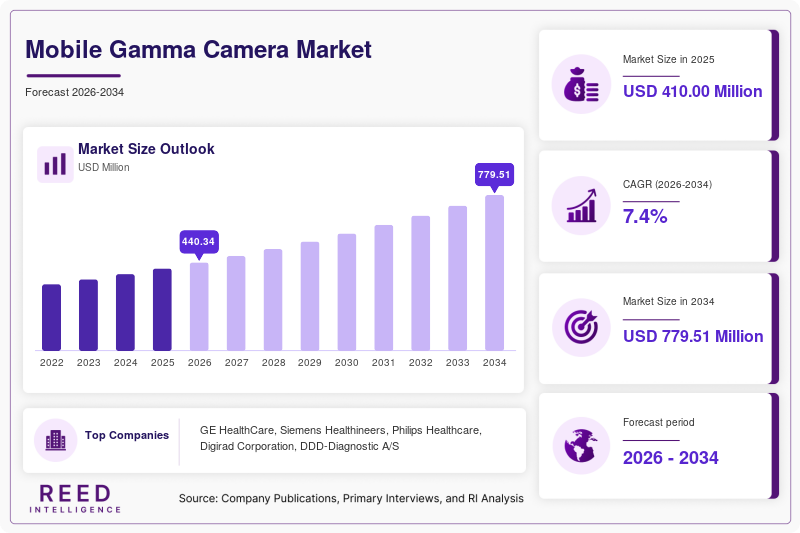
The Mobile Gamma Camera Market size was valued at approximately USD 410 million in 2025 and is projected to reach USD 785 million by 2034, expanding at a CAGR of 7.4% during the forecast period (2025–2034). The market is experiencing steady growth due to the rising adoption of portable diagnostic imaging solutions across hospitals, ambulatory surgical centers, and emergency care settings.
A key global factor supporting the expansion of the Mobile Gamma Camera Market is the increasing demand for point-of-care nuclear imaging. Healthcare providers are focusing on reducing patient transfer times and improving diagnostic efficiency, especially in critical care environments. Mobile gamma cameras enable bedside imaging, enhancing workflow efficiency and minimizing patient discomfort. Additionally, the growing burden of chronic diseases such as cancer and cardiovascular disorders has accelerated the use of nuclear imaging technologies.
Key Highlights
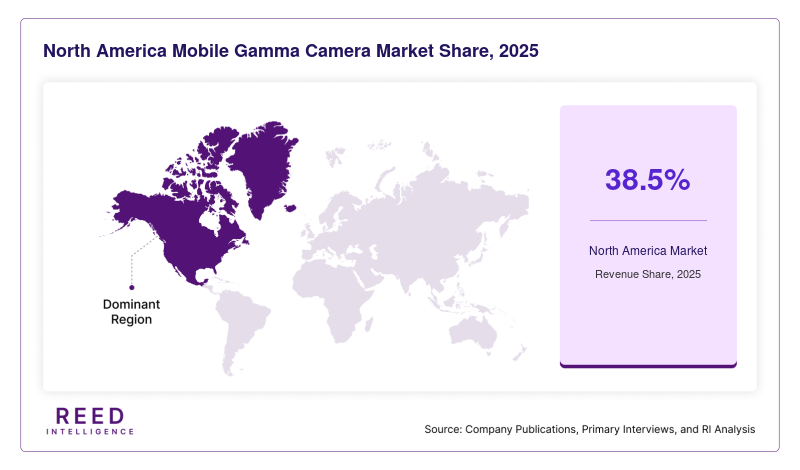
- North America dominated the market with 38.5% share in 2025, while Asia Pacific is projected to grow at a CAGR of 8.6%
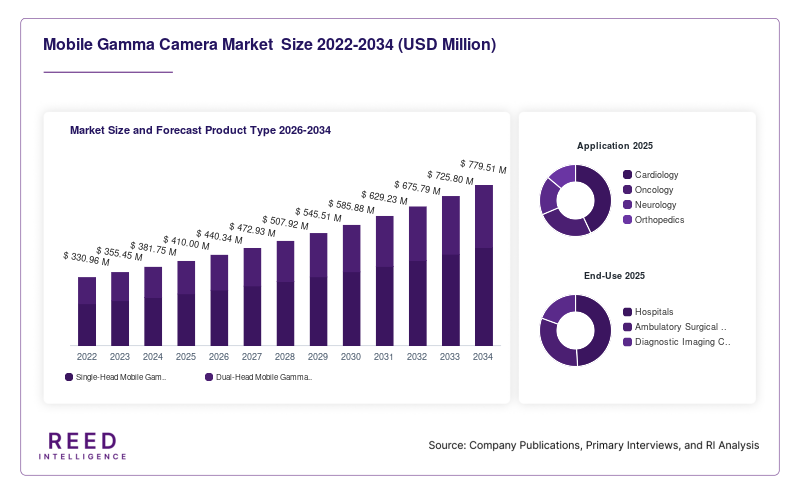
- In the product segment, single-head mobile gamma cameras led with 56% share, while dual-head systems are expected to grow at a CAGR of 8.1%
- By application, cardiology imaging dominated with 42% share, while oncology imaging is projected to grow at a CAGR of 8.8%
- The United States accounted for USD 135 million in 2025 and is estimated to reach USD 142 million in 2026
Market Trends
Integration of Hybrid Imaging Technologies
The Mobile Gamma Camera Market is witnessing a shift toward hybrid imaging systems that combine gamma cameras with other imaging modalities such as CT or ultrasound. This integration enhances diagnostic precision by providing both functional and anatomical insights in a single scan. Healthcare providers are increasingly adopting these systems to improve clinical decision-making and streamline workflows. The trend is particularly evident in oncology and cardiology applications, where accurate imaging is critical.
Growing Adoption of Compact and Lightweight Systems
Manufacturers are focusing on developing compact, lightweight, and user-friendly mobile gamma cameras to meet the evolving needs of healthcare facilities. These systems are designed for easy maneuverability in crowded hospital environments, including ICUs and operating rooms. The trend toward miniaturization is also enabling broader adoption in smaller clinics and outpatient settings, expanding the overall reach of nuclear imaging technologies.
Market Drivers
Rising Demand for Point-of-Care Diagnostics
The increasing emphasis on rapid and accurate diagnosis at the patient’s bedside is a key driver for the Mobile Gamma Camera Market. Mobile systems eliminate the need to transport patients to imaging departments, reducing delays and improving clinical outcomes. This is particularly beneficial in emergency and critical care settings where time-sensitive decisions are required.
Increasing Prevalence of Chronic Diseases
The growing incidence of chronic conditions such as cancer, cardiovascular diseases, and neurological disorders is fueling the demand for advanced imaging technologies. Mobile gamma cameras play a vital role in diagnosing and monitoring these conditions, contributing to their widespread adoption across healthcare facilities.
Market Restraint
High Cost of Mobile Gamma Camera Systems
One of the major challenges facing the Mobile Gamma Camera Market is the high initial cost associated with these systems. Advanced imaging technologies, including detectors and imaging software, contribute to the overall expense, making it difficult for smaller healthcare facilities to adopt them. Additionally, maintenance costs and the need for skilled professionals further increase the financial burden. Limited reimbursement policies in certain regions also hinder market growth, as healthcare providers may hesitate to invest in high-cost equipment without adequate financial support.
Market Opportunities
Expansion in Emerging Markets
Emerging economies present significant growth opportunities for the Mobile Gamma Camera Market. Increasing healthcare investments, improving infrastructure, and rising awareness about early disease diagnosis are driving demand in these regions. Governments and private organizations are focusing on enhancing healthcare accessibility, creating favorable conditions for market expansion.
Advancements in Digital Imaging and AI Integration
The integration of artificial intelligence and advanced digital imaging technologies is expected to create new opportunities in the market. AI-powered image analysis can improve diagnostic accuracy and reduce interpretation time, making mobile gamma cameras more efficient. These advancements are likely to attract healthcare providers seeking innovative and cost-effective diagnostic solutions.
Segmental Analysis
By Product Type
Single-head mobile gamma cameras dominated the Mobile Gamma Camera Market in 2025, accounting for 56% of the total share. Their affordability, ease of use, and suitability for routine imaging procedures contributed to their widespread adoption across healthcare facilities.
Dual-head mobile gamma cameras are expected to be the fastest-growing subsegment, with a projected CAGR of 8.1%. These systems offer improved image quality and faster scanning capabilities, making them ideal for complex diagnostic procedures. The increasing demand for high-resolution imaging will drive their growth.
By Application
Cardiology imaging held the largest share of the Mobile Gamma Camera Market in 2025, accounting for 42% of the total market. The high prevalence of cardiovascular diseases and the need for accurate diagnostic tools supported the dominance of this segment.
Oncology imaging is anticipated to grow at the fastest rate, with a CAGR of 8.8%. The rising incidence of cancer and increasing focus on early detection will drive the demand for mobile gamma cameras in oncology applications.
By End-Use
Hospitals dominated the Mobile Gamma Camera Market in 2025, accounting for 62% of the total share. The availability of advanced infrastructure and high patient volume contributed to their leading position.
Ambulatory surgical centers are expected to grow at a CAGR of 8.3%, driven by the increasing shift toward outpatient care and the need for cost-effective diagnostic solutions.
By Technology
Analog systems held a significant share in 2025 due to their lower cost and widespread availability. However, digital mobile gamma cameras are expected to grow at a faster pace, with a CAGR of 8.5%, driven by advancements in imaging technology and improved diagnostic accuracy.
Regional Analysis
North America
North America accounted for 38.5% of the Mobile Gamma Camera Market share in 2025 and is expected to grow at a CAGR of 6.9% during the forecast period. The region’s growth is driven by advanced healthcare infrastructure, high adoption of innovative medical technologies, and strong presence of key market players. Increasing healthcare expenditure and favorable reimbursement policies further support market expansion.
The United States dominated the regional market due to its well-established healthcare system and high demand for advanced diagnostic tools. The country’s focus on early disease detection and technological innovation has contributed to widespread adoption of mobile gamma cameras.
Europe
Europe held a significant share of the Mobile Gamma Camera Market in 2025 and is projected to grow steadily at a CAGR of 6.7%. The region benefits from strong government support for healthcare modernization and increasing investments in diagnostic imaging technologies.
Germany emerged as the dominant country in Europe, driven by its robust healthcare infrastructure and emphasis on research and development. The country’s focus on improving diagnostic accuracy and patient care has supported the adoption of mobile imaging solutions.
Asia Pacific
Asia Pacific captured a considerable share of the Mobile Gamma Camera Market in 2025 and is expected to witness the fastest growth at a CAGR of 8.6%. Rapid urbanization, growing healthcare awareness, and increasing investments in healthcare infrastructure are key factors driving regional growth.
China led the regional market due to its expanding healthcare sector and rising demand for advanced diagnostic technologies. Government initiatives aimed at improving healthcare access have further boosted market growth.
Middle East & Africa
The Middle East & Africa region held a smaller share of the Mobile Gamma Camera Market in 2025 but is projected to grow at a CAGR of 7.2%. Increasing healthcare investments and improving infrastructure are supporting market development.
Saudi Arabia dominated the regional market, driven by government initiatives to modernize healthcare facilities and increase access to advanced medical technologies.
Latin America
Latin America accounted for a moderate share of the Mobile Gamma Camera Market in 2025 and is expected to grow at a CAGR of 7.0%. The region is experiencing gradual improvements in healthcare infrastructure and rising demand for diagnostic imaging solutions.
Brazil emerged as the leading country, supported by increasing healthcare expenditure and growing awareness about early disease diagnosis.
Competitive Landscape
The Mobile Gamma Camera Market is moderately competitive, with several global and regional players focusing on innovation and product development. Companies are investing in advanced imaging technologies and expanding their product portfolios to strengthen their market position.
A leading player in the market is GE HealthCare, which continues to focus on technological advancements and strategic collaborations. The company recently introduced a next-generation mobile gamma camera system with enhanced imaging capabilities and improved portability, strengthening its position in the market.
Other key players are also emphasizing research and development to introduce innovative solutions and gain a competitive edge.
Key Players
- GE HealthCare
- Siemens Healthineers
- Philips Healthcare
- Digirad Corporation
- DDD-Diagnostic A/S
- Mediso Ltd.
- Spectrum Dynamics Medical
- Gamma Medica, Inc.
- MiE America, Inc.
- Crystal Photonics GmbH
- Cubresa Inc.
- Adolesco AB
- Beijing Hamamatsu Photon Techniques Inc.
- Neusoft Medical Systems
- SurgicEye GmbH
Recent Developments
- In 2024, GE HealthCare launched a compact mobile gamma camera with enhanced imaging sensitivity.
- Siemens Healthineers expanded its mobile imaging portfolio with AI-enabled features.
- Philips Healthcare introduced a lightweight system designed for ICU applications.
- Digirad Corporation announced advancements in portable nuclear imaging technology.
- Mediso Ltd. expanded its presence in emerging markets through strategic partnerships.
Mobile Gamma Camera Market Segments
Product Type
- Single-Head Mobile Gamma Cameras
- Dual-Head Mobile Gamma Cameras
Application
- Cardiology
- Oncology
- Neurology
- Orthopedics
End-Use
- Hospitals
- Ambulatory Surgical Centers
- Diagnostic Imaging Centers
Technology
- Analog Systems
- Digital Systems
By Region
- North America
- Europe
- APAC
- Middle East and Africa
- LATAM