Mobile Industrial Robots Market Size, Share & Trends Analysis Report By Product Type (Autonomous Guided Vehicles and Autonomous Mobile Robots, Mobile Manipulators, Specialized Mobile Platforms, Hybrid and Custom Configurations), By Application (Warehouse and Logistics Automation, Manufacturing and Assembly, Inspection and Maintenance) and By Region (North America, Europe, Asia Pacific, Latin America, Middle East & Africa) Forecasts, 2026–2034
USD 3950
Mobile Industrial Robots Market Size
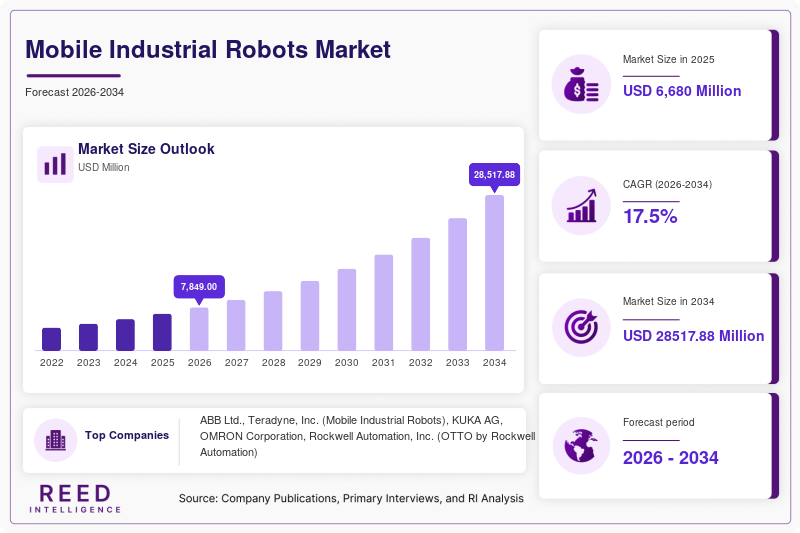
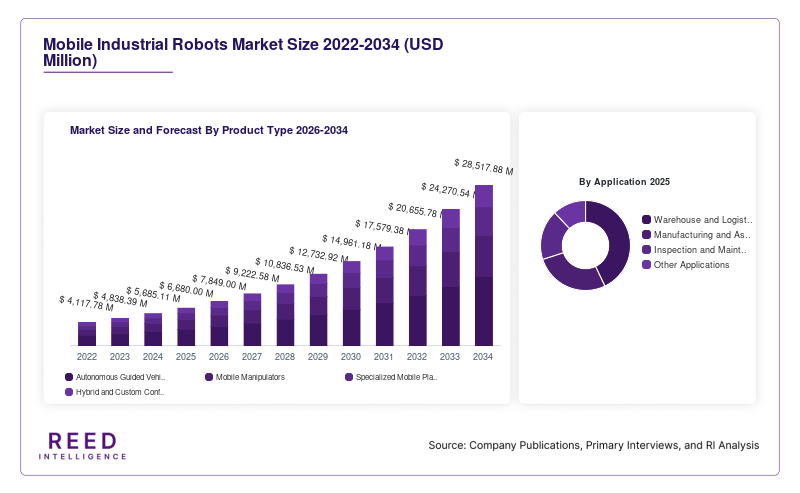
The global mobile industrial robots market was valued at USD 6,680 million in 2025 and is projected to grow from USD 7,849.00 million in 2026 to USD 28,517.88 million by 2034, registering a compound annual growth rate (CAGR) of 17.5% during the forecast period.
The Mobile Industrial Robots Market comprises autonomous and semi-autonomous robotic systems designed to transport materials, components, tools, and products across industrial facilities. These systems include autonomous mobile robots (AMRs), automated guided vehicles (AGVs), mobile manipulators, and specialized robotic platforms used in manufacturing plants, warehouses, distribution centers, and other industrial environments. Their ability to move materials with limited manual intervention makes them an important component of modern industrial automation.
Market growth is supported by increasing investments in smart manufacturing, warehouse automation, intralogistics, and flexible production systems. Manufacturers are adopting mobile robots to improve material flow, reduce repetitive manual tasks, enhance workplace safety, and optimize production efficiency. Improvements in simultaneous localization and mapping (SLAM), LiDAR sensors, machine vision, artificial intelligence, and fleet-management software are enabling robots to navigate dynamic industrial environments with greater flexibility.
Mobile Industrial Robots Market Drivers
Increasing adoption of smart manufacturing: Industry 4.0 initiatives are encouraging manufacturers to deploy connected automation systems. Mobile industrial robots support flexible production lines, automated material transportation, and coordinated workflows, helping facilities improve throughput and operational visibility.
Expansion of warehouse and logistics automation: The growth of e-commerce, distribution networks, and omnichannel fulfillment is increasing demand for automated material movement. Mobile robots help transport goods, replenish inventory, and support picking operations while reducing reliance on repetitive manual handling.
Labor shortages and workplace safety requirements: Manufacturing and logistics companies are using mobile robots to address labor availability challenges and reduce employee exposure to physically demanding transport activities. Automated material handling can also help reduce workplace injuries associated with repetitive lifting and movement of heavy loads.
Advancements in navigation and artificial intelligence: Improvements in sensors, computer vision, SLAM, and intelligent fleet management are enabling mobile robots to navigate changing environments, avoid obstacles, and coordinate tasks more effectively without requiring extensive fixed infrastructure.
Mobile Industrial Robots Market Restraints
High initial investment and integration costs: Purchasing mobile robots can require additional expenditure on software, sensors, safety systems, charging infrastructure, facility assessment, and system integration. These costs may delay adoption among smaller enterprises or businesses with limited automation budgets.
Complexity of deployment: Integrating mobile robots into existing facilities can require modifications to workflows, inventory systems, production schedules, and safety procedures. Unstructured environments and frequent changes to facility layouts can further increase implementation complexity.
Technical limitations and operational reliability: Battery performance, payload constraints, navigation challenges, connectivity interruptions, and interactions with people or conventional vehicles can affect robot productivity. Certain industrial environments require specialized hardware and additional safety measures.
Shortage of specialized technical skills: Operating and maintaining mobile robotic fleets requires expertise in automation engineering, software integration, robotics, and cybersecurity. A shortage of trained personnel can increase dependence on external system integrators and service providers.
Mobile Industrial Robots Market Opportunities
Growing demand for robotics-as-a-service: Subscription-based and usage-based deployment models can reduce upfront capital requirements and make mobile automation more accessible to smaller manufacturers and logistics operators.
Integration of mobile manipulation systems: Combining mobile platforms with robotic arms, grippers, and machine vision can expand applications beyond transportation into machine tending, inspection, picking, and flexible assembly.
Industrial automation in emerging economies: Manufacturing expansion and modernization across Asia Pacific, Latin America, and selected Middle Eastern markets are creating opportunities for suppliers offering scalable, cost-effective robotic systems.
AI-enabled fleet optimization: Artificial intelligence, predictive maintenance, digital twins, and advanced traffic-management software can improve fleet utilization and enable more complex coordination across production and warehouse operations.
Mobile Industrial Robots Market Segmental Analysis
By Product Type
Autonomous Guided Vehicles (AGVs) and Autonomous Mobile Robots (AMRs) represent the dominant product category in the Mobile Industrial Robots Market. These systems are widely used for material transportation, pallet movement, inventory replenishment, and production-line feeding. Their broad industrial applicability, ability to reduce repetitive handling tasks, and compatibility with warehouse and manufacturing workflows support their adoption. An industry-specific estimate published by Dataintelo identifies the combined AGV and AMR category as accounting for approximately 38.5% of market revenue in 2025.
Mobile manipulators are an important growth category because they combine autonomous mobility with robotic arms and end-effectors. These systems can perform tasks that require both movement and manipulation, including machine tending, component handling, and selected inspection activities. Their flexibility makes them attractive to manufacturers seeking adaptable automation. Dataintelo identifies mobile manipulators as a growing product category, although its precise comparative share and growth rate should be interpreted in the context of that source's market definition.
By Application
Warehouse and logistics automation is the dominant application segment. Mobile robots are used to move inventory, transport containers, support order fulfillment, replenish picking stations, and coordinate material flows within distribution centers. Increasing fulfillment complexity and demand for faster processing are encouraging logistics operators to adopt automated systems. Dataintelo estimates that warehouse and logistics automation represented approximately 38.5% of application demand in 2025.
Warehouse and logistics automation is also identified as the fastest-growing application in the cited market analysis, with an estimated CAGR of 19.3% through 2034. Demand is supported by e-commerce expansion, distribution-center modernization, and the need to improve operational efficiency. Manufacturing and assembly remain important applications, particularly in automotive, electronics, and industrial equipment production, where mobile robots support line feeding and flexible material movement.
Mobile Industrial Robots Market Regional Analysis
North America Mobile Industrial Robots Market
North America is an established market for mobile industrial robots, supported by investments in warehouse automation, advanced manufacturing, automotive production, and supply-chain modernization. The United States benefits from demand for automated fulfillment and industrial material handling, while Canada contributes through manufacturing automation, robotics development, and industrial technology integration. Adoption is further supported by the need to improve labor productivity and operational consistency.
The region faces challenges associated with implementation costs, legacy-system integration, and the availability of robotics specialists. Nevertheless, continued investment in smart factories, distribution centers, and flexible production systems is expected to support demand. North America's exact market share in this report's supplied market definition is not independently established here; therefore, a comparable regional percentage is unavailable.
Europe Mobile Industrial Robots Market
Europe represents a significant market for mobile industrial robots due to its advanced manufacturing base, industrial automation expertise, and established automotive, pharmaceutical, and food-processing industries. Germany, France, the United Kingdom, Italy, and the Nordic countries contribute to adoption through investments in automated production, intralogistics, and digitally integrated industrial facilities.
Demand is supported by manufacturing modernization, workplace-safety requirements, and the need for flexible production systems. Mobile robots can help manufacturers respond to changing product mixes and improve material handling across existing facilities. Dataintelo estimates Europe's share at approximately 28.5% in 2025 for its market definition; this is a third-party estimate rather than an independently verified figure.
Asia Pacific Mobile Industrial Robots Market
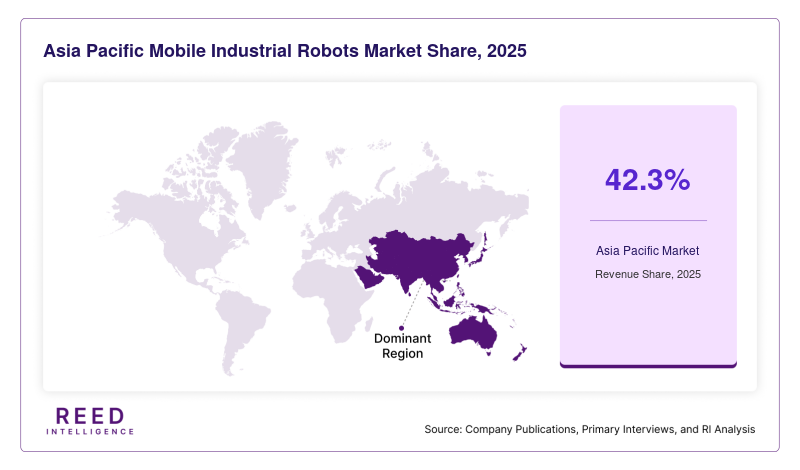
Asia Pacific is the dominant regional market for mobile industrial robots, supported by its large manufacturing base, expanding logistics infrastructure, and investments in industrial automation. China, Japan, South Korea, and India contribute to regional demand through automotive production, electronics manufacturing, warehouse development, and the adoption of connected factory technologies. The region also benefits from a broad ecosystem of robotics suppliers, component manufacturers, and system integrators.
The region's growth prospects are supported by manufacturing modernization, increasing labor-productivity requirements, and the deployment of automated material-handling systems. Dataintelo estimates that Asia Pacific accounted for approximately 42.3% of global market revenue in 2025. Applying that share to the supplied 2025 global market size of USD 6.68 billion gives an estimated regional value of approximately USD 2.83 billion, calculated as 42.3% × USD 6.68 billion. This value is derived from the cited third-party share and the supplied global valuation, rather than independently reported regional revenue.
Latin America Mobile Industrial Robots Market
Latin America is an emerging market for mobile industrial robots, with adoption opportunities in manufacturing, automotive supply chains, food processing, and logistics. Brazil and Mexico are important markets because of their industrial activities and participation in regional and international supply chains. Mobile robots can help businesses improve material movement, address repetitive handling requirements, and modernize existing production facilities.
Adoption may be constrained by capital expenditure requirements, uneven automation infrastructure, and limited access to specialized integration services in some markets. Growth opportunities are associated with warehouse modernization, manufacturing investment, and the gradual adoption of connected industrial systems.
Middle East & Africa Mobile Industrial Robots Market
The Middle East & Africa market is supported by investments in logistics infrastructure, industrial diversification, manufacturing development, and automated distribution facilities. Gulf countries are exploring advanced automation across logistics, industrial projects, and selected manufacturing operations, while South Africa and other African economies present opportunities in warehousing, mining-related operations, and industrial material handling.
Future demand will depend on industrial investment, the availability of implementation partners, workforce training, and the business case for automation. Mobile industrial robots can support operations where material movement is repetitive or where improved traceability and operational efficiency are priorities.
Mobile Industrial Robots Market Competitive Landscape
The Mobile Industrial Robots Market is characterized by competition among established industrial automation companies and specialized autonomous robotics suppliers. Companies compete on payload capacity, navigation technology, fleet-management software, safety features, system interoperability, deployment flexibility, and after-sales support. Partnerships with system integrators and software providers are important because many industrial customers require customized solutions that can operate alongside existing equipment and enterprise systems.
ABB Ltd.
ABB is a major industrial automation and robotics supplier with capabilities spanning robotic systems, motion technologies, automation software, and mobile robotics. Its portfolio and industrial customer relationships position it to address material transportation and automation requirements across manufacturing and logistics. Continued development of autonomous navigation and integrated automation solutions supports its participation in the mobile robotics ecosystem.
Key Market Players
- ABB Ltd.
- Teradyne, Inc. (Mobile Industrial Robots)
- KUKA AG
- OMRON Corporation
- Rockwell Automation, Inc. (OTTO by Rockwell Automation)
- FANUC Corporation
- Yaskawa Electric Corporation
- Toyota Industries Corporation
- JBT Corporation
- Clearpath Robotics
Mobile Industrial Robots Market Recent Developments
-
June 2026 -OMRON Robotics announces next-generation LD-150 and LD-300 autonomous mobile robots. OMRON announced that the new models would be demonstrated at Automate 2026, highlighting higher payload capacity, enhanced safety features, and improved performance for industrial material transportation. The company indicated that shipping was expected to begin in the fourth quarter of 2026. These developments reflect continued product innovation in mobile material handling.
-
June 2026 -Quasi Robotics launches the Model C2 Heavy autonomous mobile robot. Quasi Robotics announced a heavy-load variant designed for industrial transportation applications, with a stated payload capacity of up to 500 lb (227 kg). The product targets movement of heavy parts, containers, tools, and work-in-process materials in manufacturing environments.
Mobile Industrial Robots Market Segments
By Product Type
- Autonomous Guided Vehicles (AGVs) and Autonomous Mobile Robots (AMRs)
- Mobile Manipulators
- Specialized Mobile Platforms
- Hybrid and Custom Configurations
By Application
- Warehouse and Logistics Automation
- Manufacturing and Assembly
- Inspection and Maintenance
- Other Applications
By Region
- North America
- Europe
- APAC
- Middle East and Africa
- LATAM