Mobile Phone Insurance Market Size, Share, Growth & Forecast Report by Coverage Type (Accidental Damage Protection, Theft Protection, Liquid Damage Protection, Extended Warranty), by Distribution Channel (Telecom Operators, Online/Digital Platforms, Retail Stores, OEM Channels), by End-User (Individuals, SMEs, Large Enterprises) & Regional Analysis, 2026–2034
USD 3950
Market Overview
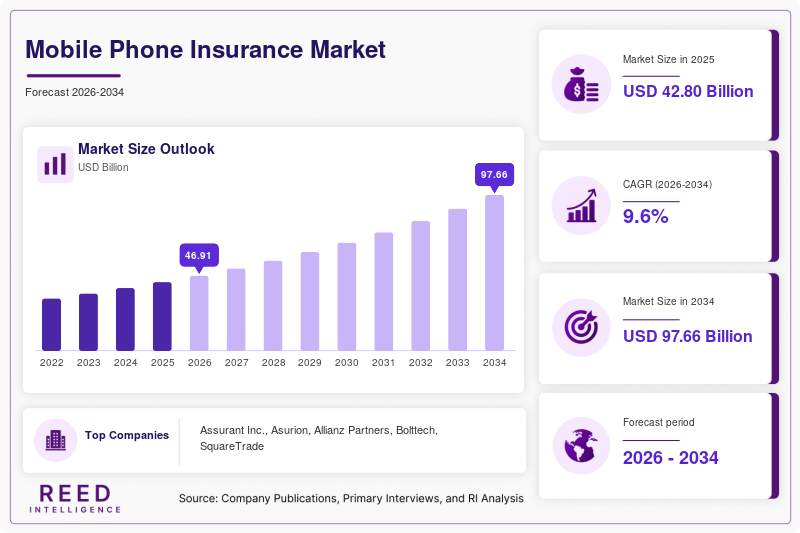
The global Mobile Phone Insurance Market is valued at approximately USD 42.8 billion in 2026 and is projected to reach nearly USD 89.6 billion by 2034, registering a CAGR of 9.6% (2026–2034). The market expansion is primarily driven by rising smartphone penetration, increasing device replacement costs, and growing consumer awareness regarding accidental damage protection and theft coverage plans. The proliferation of high-value premium smartphones across both developed and emerging economies has significantly increased demand for structured insurance solutions, particularly bundled offerings provided by telecom operators, retailers, and OEM ecosystems.
A major global factor supporting market growth is the rapid digitalization of insurance distribution channels. The adoption of AI-driven claims processing, mobile-first policy management apps, and embedded insurance at the point of smartphone purchase has improved customer experience and reduced claim settlement times. Additionally, increasing smartphone dependency for financial transactions, remote work, and entertainment has made consumers more willing to invest in protection plans, further boosting adoption rates across multiple demographic segments.
Key Highlights
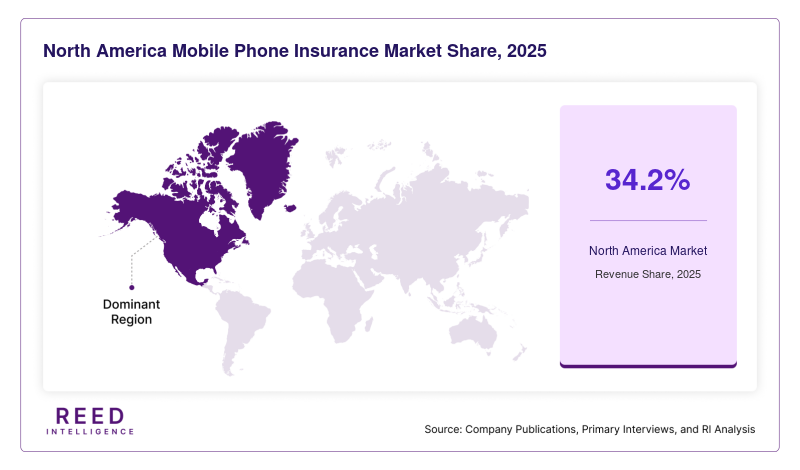
- North America dominated the market with a 34.2% share in 2025.
- Asia Pacific is expected to grow at the fastest CAGR of 11.3% during 2026–2034.
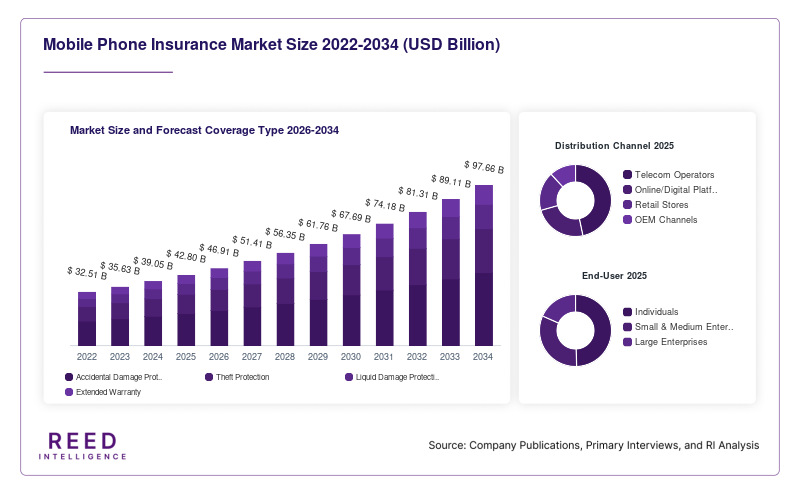
- By coverage type, accidental damage protection accounted for the largest share of 39.1%, while theft protection policies are projected to grow at a CAGR of 12.1%.
- By distribution channel, telecom operator-led insurance dominated with a 44.6% share, whereas digital/online platforms are expected to expand at a CAGR of 13.2%.
- The United States remained the dominant country, with market values of USD 7.8 billion in 2024 and USD 8.6 billion in 2025.
Market Trends
Integration of Embedded Insurance in Smartphone Ecosystems
One of the most significant trends shaping the Mobile Phone Insurance Market is the growing adoption of embedded insurance models within smartphone ecosystems. Manufacturers, telecom operators, and fintech platforms are increasingly integrating insurance products directly at the point of sale or device activation. This approach eliminates the need for third-party intermediaries and simplifies the customer journey. Consumers can now opt for insurance coverage during smartphone purchase, app setup, or SIM activation. The embedded model enhances conversion rates and reduces policy drop-offs. Additionally, OEMs are partnering with insurance providers to offer device protection plans bundled with financing schemes, making high-end smartphones more accessible while ensuring risk mitigation. This trend is also supported by API-driven insurance infrastructure that allows seamless policy issuance and claims processing within digital ecosystems.
AI and Automation in Claims Processing
Another major trend is the increasing use of artificial intelligence and automation in claims management. Insurers are leveraging machine learning algorithms to detect fraudulent claims, assess damage through image recognition, and automate settlement approvals. This significantly reduces processing time and operational costs while improving customer satisfaction. Mobile applications now allow users to upload images of damaged devices, initiate claims instantly, and track approval status in real time. Predictive analytics is also being used to evaluate risk profiles and personalize premium pricing based on user behavior, device type, and location. Furthermore, chatbots and virtual assistants are enhancing customer support services, ensuring 24/7 assistance. The integration of AI technologies is expected to redefine efficiency standards in the mobile insurance ecosystem.
Market Drivers
Rising Smartphone Replacement Costs
One of the primary drivers of the Mobile Phone Insurance Market is the increasing cost of smartphones, particularly premium models. With flagship devices from major manufacturers incorporating advanced camera systems, foldable displays, and high-performance processors, average selling prices have risen significantly. Consumers are becoming more cautious about potential repair or replacement expenses, which can represent a substantial financial burden. As a result, demand for insurance coverage against accidental damage, liquid spills, and screen breakage has increased. Additionally, financing models and installment-based smartphone purchases have encouraged users to opt for insurance protection to safeguard long-term investments. Retailers and telecom operators are also promoting insurance as a value-added service during device purchase, further strengthening market penetration.
Expansion of Digital Distribution Channels
The expansion of digital distribution channels is another key growth driver. Online platforms, mobile applications, and telecom digital stores have made insurance products more accessible than ever. Customers can compare plans, purchase coverage, and manage claims directly through their smartphones. This ease of access has significantly reduced dependency on traditional insurance agents. Furthermore, partnerships between insurers and e-commerce platforms have enabled instant policy issuance during smartphone checkout. Digital onboarding processes supported by e-KYC and automated verification systems have streamlined customer acquisition. The increasing adoption of fintech ecosystems and super apps has further accelerated insurance penetration in emerging markets, making digital channels a core driver of sustained industry expansion.
Market Restraint
High Claim Fraud and Operational Complexity
A significant restraint affecting the Mobile Phone Insurance Market is the rising incidence of fraudulent claims and operational complexities associated with verification processes. Fraudulent activities such as false damage reporting, duplicate claims, and device substitution have increased underwriting risks for insurers. This has forced companies to implement stricter validation mechanisms, including device tracking, IMEI verification, and AI-based fraud detection systems, which increase operational costs. Additionally, the fragmented nature of distribution channels across telecom operators, retailers, and online platforms creates inconsistencies in policy enforcement and claims handling. These inefficiencies often result in delayed settlements and reduced customer trust. In emerging economies, lack of standardized regulatory frameworks further complicates fraud prevention efforts. As insurers attempt to balance risk mitigation with customer convenience, maintaining profitability while ensuring smooth user experience remains a critical challenge for the industry.
Market Opportunities
Growth of Subscription-Based Insurance Models
The increasing adoption of subscription-based insurance models presents a major opportunity in the Mobile Phone Insurance Market. Instead of one-time premium payments, consumers are increasingly preferring flexible monthly or yearly subscription plans that can be bundled with telecom services or smartphone financing agreements. This model enhances affordability and encourages long-term customer retention. Telecom operators are particularly well-positioned to offer such plans, integrating insurance fees into mobile bills. Subscription-based models also enable insurers to continuously update coverage options, add value-added services, and reduce churn rates. Furthermore, dynamic pricing models based on usage patterns and device condition tracking are expected to enhance profitability. This shift toward recurring revenue structures is likely to transform traditional insurance frameworks into more scalable and predictable business models.
Expansion in Emerging Economies
Emerging economies present substantial growth opportunities due to rising smartphone adoption, increasing disposable income, and expanding digital infrastructure. Regions such as South Asia, Southeast Asia, and parts of Africa are witnessing rapid growth in mid-range and premium smartphone usage, creating demand for affordable insurance products. Many consumers in these markets are first-time smartphone users, making them more receptive to bundled insurance offerings. Additionally, the expansion of digital payment ecosystems and mobile banking services is facilitating easier premium collection and policy management. Insurers entering these regions can benefit from relatively low market saturation and high growth potential. Strategic partnerships with local telecom operators and fintech platforms will be critical for market penetration and scalability.
Segmental Analysis
By Coverage Type
Accidental damage protection dominated the segment with approximately 39.1% share in 2024, driven by high incidence of screen damage and liquid exposure cases. Consumers prefer this coverage due to its affordability and relevance to daily smartphone usage risks. Telecom operators heavily promote this segment as part of bundled device plans.
The fastest-growing subsegment is theft protection, expected to register a CAGR of 12.1%. Increasing smartphone theft incidents in urban areas and rising awareness of data security risks are driving adoption. Advanced tracking and device-locking technologies are also enhancing policy attractiveness.
By Distribution Channel
Telecom operator channels held the dominant share of 44.6% in 2024, supported by bundled offerings at the point of SIM activation or device purchase. These channels benefit from strong customer relationships and easy billing integration.
Digital/online platforms are the fastest-growing subsegment with a CAGR of 13.2%, driven by increasing mobile app usage and fintech integration. Consumers prefer self-service models that offer transparency and faster claim processing.
By End-User
Individual consumers accounted for the dominant 61.3% share in 2024, as personal smartphone usage continues to rise globally. Insurance demand is primarily driven by high repair costs and device dependency.
Small and medium enterprises represent the fastest-growing segment with a CAGR of 10.8%, as businesses increasingly rely on smartphones for communication, logistics, and digital payments, necessitating fleet protection plans.
Regional Analysis
North America
North America accounted for approximately 34.2% share in 2025, with a projected CAGR of 8.7% during 2026–2034. The region’s strong market position is supported by high smartphone penetration and widespread adoption of premium devices. Consumers in the United States and Canada demonstrate strong awareness of device protection plans, leading to high insurance uptake rates across both retail and telecom channels.
The United States remains the dominant country in the region due to its advanced insurance infrastructure and strong presence of major telecom operators. A key growth factor is the increasing integration of insurance products with smartphone financing plans offered by carriers, making coverage more accessible and financially convenient for consumers.
Europe
Europe held nearly 27.5% market share in 2025, with an expected CAGR of 8.3% (2026–2034). Strong regulatory frameworks and high smartphone replacement costs are driving insurance adoption across the region. Consumers in Western Europe are particularly inclined toward comprehensive protection plans.
Germany leads the regional market, supported by its large consumer electronics base and strong retail distribution networks. Growing demand for refurbished smartphones has also increased the need for device protection services, enhancing market expansion.
Asia Pacific
Asia Pacific accounted for 22.8% share in 2025, with the fastest CAGR of 11.3%. Rapid smartphone adoption in India, China, and Southeast Asia is driving strong demand for insurance products. Rising middle-class income levels further support market growth.
China dominates the regional market due to its massive smartphone user base and strong digital insurance platforms. Increasing partnerships between OEMs and fintech companies are enhancing penetration rates.
Middle East & Africa
Middle East & Africa held around 8.1% share in 2025, with a CAGR of 9.4%. Growing smartphone affordability and increasing youth population are key drivers. Demand for insurance is rising in urban centers with high device turnover.
The United Arab Emirates leads the region due to high smartphone penetration and strong retail ecosystems. Expanding digital insurance offerings is improving accessibility.
Latin America
Latin America accounted for 7.4% share in 2025, with a CAGR of 9.1%. Rising smartphone imports and increasing consumer awareness are supporting market expansion. Economic fluctuations still pose challenges.
Brazil is the dominant country, driven by its large population and growing telecom infrastructure. Increasing adoption of installment-based smartphone purchases is boosting insurance uptake.
Competitive Landscape
The Mobile Phone Insurance Market is moderately consolidated, with key players focusing on partnerships, digital transformation, and product innovation. Leading companies include Assurant, Asurion, Allianz Partners, Bolttech, and SquareTrade. Among these, Assurant is recognized as a market leader due to its strong telecom partnerships and global distribution network.
Recent developments include expanded collaborations between insurers and smartphone OEMs to offer embedded protection plans at the point of sale. Companies are also investing in AI-driven claims automation and mobile-first policy platforms. Additionally, insurers are focusing on expanding into emerging markets through strategic alliances with telecom operators to increase penetration and reduce acquisition costs.
Key Players
- Assurant Inc.
- Asurion
- Allianz Partners
- Bolttech
- SquareTrade
- AppleCare Services
- Samsung Care+
- Zurich Insurance Group
- AXA Partners
- Telefónica Insurance
- Orange Insurance Services
- Brightstar Corp
- Pier Insurance
- Likewize
- T-Mobile Insurance Services
Recent Developments
- Assurant expanded its embedded insurance partnership with major telecom operators to enhance bundled smartphone protection offerings.
- Bolttech introduced an AI-based claims automation platform to reduce processing time and improve fraud detection accuracy.
- Allianz Partners launched a subscription-based mobile insurance model targeting emerging Asian markets to increase affordability and penetration.
Mobile Phone Insurance Market Segments
Coverage Type
- Accidental Damage Protection
- Theft Protection
- Liquid Damage Protection
- Extended Warranty
Distribution Channel
- Telecom Operators
- Online/Digital Platforms
- Retail Stores
- OEM Channels
End-User
- Individuals
- Small & Medium Enterprises
- Large Enterprises
By Region
- North America
- Europe
- APAC
- Middle East and Africa
- LATAM