Mobile Stroke Unit Market Size, Share Demand Report By Vehicle Type (Ambulance-Based Units, Van-Based Compact Units, By Application (Ischemic Stroke Diagnosis, Hemorrhagic Stroke Management), By End User (Hospitals, Emergency Medical Service Providers, Government Health Agencies), By Technology Integration, By Ownership Model (Public Ownership, Private Ownership), By Region & Segment Forecasts, 2026–2034
USD 3950
Market Overview
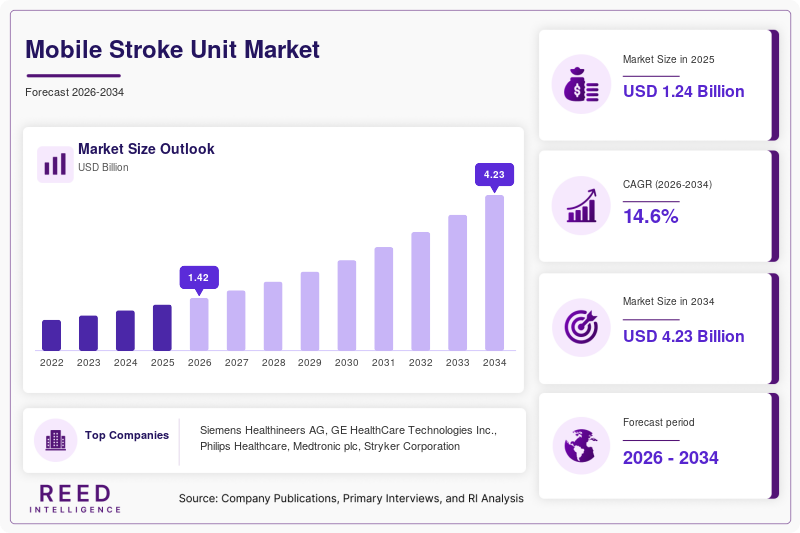
The global Mobile Stroke Unit Market size was valued at USD 1.24 billion in 2026 and is projected to reach USD 3.68 billion by 2034, expanding at a CAGR of 14.6% during the forecast period from 2026 to 2034. The market is gaining momentum as healthcare systems worldwide increasingly prioritize time-sensitive neurological emergency care. Mobile stroke units (MSUs), equipped with CT scanners, telemedicine links, and stroke-specific medications, are transforming pre-hospital stroke diagnosis and treatment pathways.
A major global factor supporting market growth has been the rising incidence of ischemic stroke associated with aging populations and lifestyle-related vascular disorders. Governments and healthcare providers are investing in rapid-response stroke infrastructure to reduce mortality and long-term disability burden. The integration of AI-assisted imaging diagnostics and tele-neurology platforms has further improved stroke triage accuracy, making MSUs a viable component of advanced emergency medical systems.
Key Highlights
- Dominant Region Share (2025): North America held 38.6% share
- Fastest-Growing Region CAGR: Asia Pacific projected at 13.8% CAGR (2026–2034)
- Leading Subsegment (Vehicle Type): Ground-based MSU accounted for 72% share in 2025
- Fastest-Growing Subsegment: Air-based MSU is expected to grow at 14.6% CAGR
- Dominant Country Value: United States recorded USD 142 million (2024) and USD 156 million (2025) in the Mobile Stroke Unit Market
Market Trends
AI-Integrated Prehospital Imaging Systems
One of the defining trends in the Mobile Stroke Unit Market is the integration of artificial intelligence into onboard imaging workflows. AI-enabled CT interpretation tools are helping emergency teams detect stroke patterns faster and support treatment decisions before hospital arrival. Automated triage alerts reduce diagnostic delay and improve coordination between neurologists and EMS teams. These systems are increasingly being adopted in North America and Europe where healthcare providers seek to shorten door-to-needle times and improve patient outcomes.
Expansion of Tele-Neurology Networks
A second major trend is the rapid expansion of tele-neurology ecosystems linked to mobile stroke units. Remote neurologists can now assess patients in real time through high-speed video and imaging transmission systems embedded in MSUs. This trend is especially relevant in regions with neurologist shortages, where remote consultation extends specialist access to underserved communities. Cloud-based telemedicine integration is also making mobile stroke fleets scalable for regional healthcare networks, improving operational efficiency and reducing stroke-related treatment disparities.
Market Drivers
Rising Global Stroke Incidence and Aging Population
The growing prevalence of stroke cases worldwide remains a primary driver for the Mobile Stroke Unit Market. Aging populations in countries such as Japan, Germany, and the United States are contributing to a higher incidence of acute neurological emergencies. Older adults are more vulnerable to stroke complications, increasing demand for immediate intervention systems that minimize treatment delays and improve recovery rates.
Increasing Government Investment in Emergency Stroke Infrastructure
Governments are allocating larger healthcare budgets toward emergency stroke preparedness and advanced ambulance care systems. National stroke response programs in developed economies are incorporating MSUs into public health frameworks to reduce hospitalization burden. Subsidies for telemedicine expansion, emergency imaging equipment, and specialized ambulance procurement are supporting sustained market adoption across public hospital networks.
Market Restraint
High Capital and Operational Costs of Mobile Stroke Units
The high acquisition and maintenance cost of mobile stroke units remains a major barrier to broader market penetration. Each MSU requires specialized CT imaging systems, onboard laboratory tools, telemedicine equipment, and trained multidisciplinary staff. Smaller hospitals and low-income healthcare systems often face budget limitations that restrict deployment. Ongoing costs related to fleet maintenance, imaging calibration, and specialized personnel training further constrain scalability, particularly in rural and resource-limited settings.
Market Opportunities
Expansion into Emerging Urban Healthcare Markets
Emerging economies are presenting strong growth opportunities as urban centers modernize emergency care systems. Cities in India, Brazil, Indonesia, and South Africa are investing in advanced ambulance infrastructure to address rising stroke burden. Increasing insurance coverage and public hospital digitization are expected to create favorable conditions for MSU adoption in these regions.
Hybrid Public-Private Stroke Response Partnerships
Collaborative models between private ambulance providers, academic hospitals, and government agencies are opening new revenue channels. These partnerships allow healthcare systems to deploy shared mobile stroke fleets without full capital ownership. Leasing-based service contracts and outcome-linked reimbursement models are likely to accelerate adoption in mid-sized healthcare networks.
Segmental Analysis
By Vehicle Type
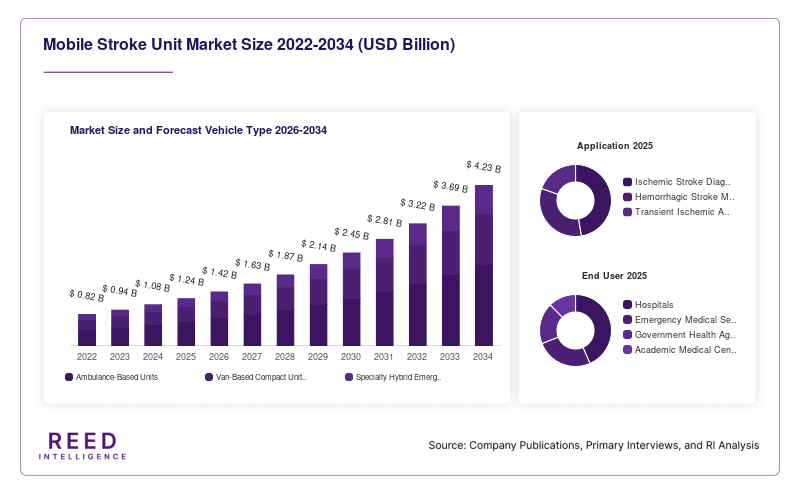
Ambulance-based mobile stroke units dominated the market in 2025 with 61.4% share due to their compatibility with existing EMS infrastructure and ability to carry advanced onboard imaging systems. These units remain preferred in large hospital-linked emergency response networks.
Van-based compact stroke units will witness the fastest CAGR of 16.8% through 2034, driven by lower procurement cost and maneuverability in dense urban areas. Their smaller footprint will make them attractive for expanding city-centered rapid stroke response programs.
By Application
Ischemic stroke diagnosis accounted for the largest share at 56.2% in 2025 because ischemic strokes represent the majority of global stroke incidents and require rapid thrombolytic assessment. MSUs are particularly effective in reducing treatment initiation time in such cases.
Hemorrhagic stroke emergency management will grow fastest at 15.7% CAGR as onboard imaging improvements enhance early bleed detection accuracy. Increasing awareness of high-fatality hemorrhagic stroke cases will support adoption.
By End User
Hospitals held the dominant share of 49.6% in 2025 as most MSUs are owned or managed through tertiary care hospital networks. Integrated neurological departments and emergency specialists make hospitals primary deployment centers.
Specialized emergency medical service providers will expand fastest at 16.2% CAGR due to outsourcing trends in ambulance fleet management. Independent EMS firms are increasingly entering advanced stroke transport partnerships.
By Technology Integration
CT imaging systems led the segment with 44.8% share in 2025 because onboard brain imaging remains central to stroke diagnosis before hospital admission. Portable high-resolution scanners are becoming standard in most MSU platforms.
Telemedicine-integrated diagnostic platforms will grow fastest at 17.1% CAGR as remote neurologist consultation becomes essential in underserved and geographically dispersed regions. Improved broadband ambulance connectivity will support this rise.
By Ownership Model
Public healthcare ownership dominated with 53.5% share in 2025 due to government-funded stroke prevention programs and municipal ambulance services. National health systems remain primary purchasers in developed markets.
Leased/shared fleet ownership models will register the fastest CAGR of 16.5%, supported by cost-sharing benefits and flexible deployment contracts. Mid-sized healthcare networks will increasingly prefer this asset-light model.
Regional Analysis
North America
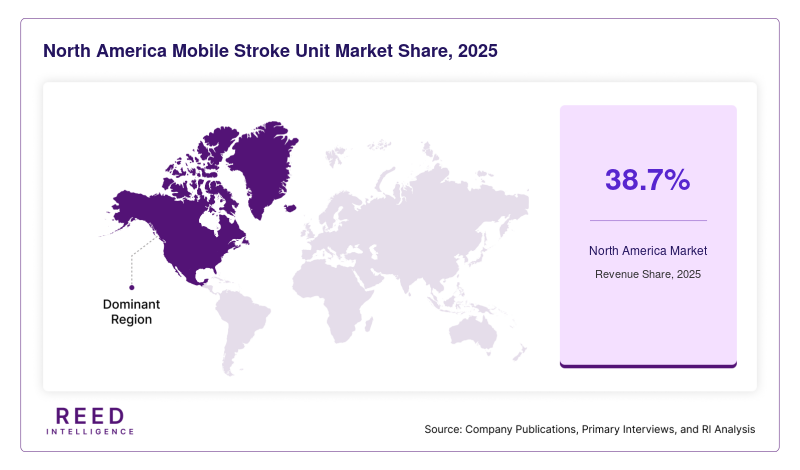
North America accounted for 38.7% of the Mobile Stroke Unit Market in 2025 and will expand at a CAGR of 13.8% through 2034. The region benefited from established emergency medical infrastructure, widespread stroke awareness campaigns, and early technology adoption in acute neurological care. Strong reimbursement systems and high per-capita healthcare spending supported deployment density across urban hospitals.
The United States dominated the region due to its advanced stroke center network and integration of AI-enabled emergency imaging in ambulance fleets. Academic medical centers are actively partnering with EMS providers to deploy MSUs across suburban corridors, improving prehospital thrombolysis access.
Europe
Europe held 26.4% market share in 2025 and is projected to grow at a CAGR of 14.1% during the forecast period. Regional growth was supported by coordinated public healthcare systems and cross-border stroke treatment guidelines. Several European countries have incorporated mobile stroke response into national neurological emergency frameworks.
Germany led the European market due to strong public investment in mobile diagnostic healthcare and advanced ambulance engineering capabilities. University hospitals are expanding tele-neurology-linked MSU fleets to improve rapid intervention coverage in semi-urban regions.
Asia Pacific
Asia Pacific captured 20.8% of the Mobile Stroke Unit Market in 2025 and will record the fastest CAGR of 17.9% through 2034. Rapid urbanization, growing stroke incidence, and hospital infrastructure modernization are driving adoption across large metropolitan populations. Expanding EMS digitization is also strengthening deployment feasibility.
China led regional demand due to rapid expansion of smart ambulance programs in tier-1 and tier-2 cities. Government-backed healthcare modernization plans are accelerating procurement of mobile imaging vehicles integrated with cloud-based diagnostic systems.
Middle East & Africa
Middle East & Africa represented 7.3% share in 2025 and is forecast to grow at a CAGR of 15.2%. Market expansion is being supported by hospital capacity upgrades and investment in specialized emergency transport services. Stroke awareness remains lower than developed markets, but adoption is increasing in urban referral centers.
Saudi Arabia dominated this region because of rising neurological care investment under healthcare diversification initiatives. Large tertiary hospitals are introducing pilot MSU programs linked to centralized stroke command systems.
Latin America
Latin America accounted for 6.8% of the market in 2025 and is expected to grow at 14.8% CAGR through 2034. Increasing non-communicable disease burden and improving emergency healthcare access are supporting regional demand. Public-private EMS modernization is creating new deployment opportunities.
Brazil remained the leading country due to expanding metropolitan ambulance reforms and stroke treatment awareness campaigns. Major city hospitals are investing in pilot fleets to reduce treatment delay in congested urban traffic zones.
Competitive Landscape
The Mobile Stroke Unit Market is moderately consolidated, with leading players focusing on vehicle innovation, imaging integration, and telemedicine partnerships. Siemens Healthineers remains the market leader due to its strong portable CT imaging portfolio and expanding partnerships with ambulance retrofit manufacturers. Recent developments include launch collaborations for AI-enabled onboard neuroimaging systems. Other major participants are strengthening regional distribution and investing in specialized emergency vehicle customization to address diverse healthcare infrastructure requirements.
Key Players List
- Siemens Healthineers AG
- GE HealthCare Technologies Inc.
- Philips Healthcare
- Medtronic plc
- Stryker Corporation
- Braun Industries Inc.
- Demers Ambulances
- Frazer Ltd.
- Mobile Healthcare Facilities LLC
- Teleflex Incorporated
- Corpuls
- Rosenbauer International AG
- Nissha Medical Technologies
- Fujifilm Healthcare Solutions
- Visionary Vehicles International
- InTouch Health
- STEMSOFT Software Inc.
Recent Developments
- Deployment of AI-integrated MSU fleets in major U.S. cities
- Expansion of 5G-enabled tele-stroke systems in Europe
- Introduction of lightweight CT scanners for ambulance integration
- Strategic partnerships between hospitals and EMS providers
- Increasing adoption of cloud-based imaging platforms
- Government funding for stroke response modernization programs
- Development of hybrid drone–MSU emergency systems
- Expansion of MSU pilot programs in Asia Pacific
- Integration of real-time neuroimaging analytics tools
- Launch of compact mobile neurodiagnostic units
- Rising investment in private emergency stroke care fleets
Mobile Stroke Unit Market Segments
Vehicle Type
- Ambulance-Based Units
- Van-Based Compact Units
- Specialty Hybrid Emergency Vehicles
Application
- Ischemic Stroke Diagnosis
- Hemorrhagic Stroke Management
- Transient Ischemic Attack Assessment
End User
- Hospitals
- Emergency Medical Service Providers
- Government Health Agencies
- Academic Medical Centers
Technology Integration
- CT Imaging Systems
- Telemedicine Platforms
- AI Diagnostic Software
- Point-of-Care Laboratory Systems
Ownership Model
- Public Ownership
- Private Ownership
- Lease/Shared Fleet Models
By Region
- North America
- Europe
- APAC
- Middle East and Africa
- LATAM