Model Train Market Size, Share & Demand Report By Type (Locomotives, Rolling Stock, Track & Accessories, Scenery & Buildings), By Application (Hobbyists & Collectors, Educational Institutions, Commercial Displays, Museums & Exhibitions) By Region & Segment Forecasts, 2026–2034
USD 3950
Model Train Market Size
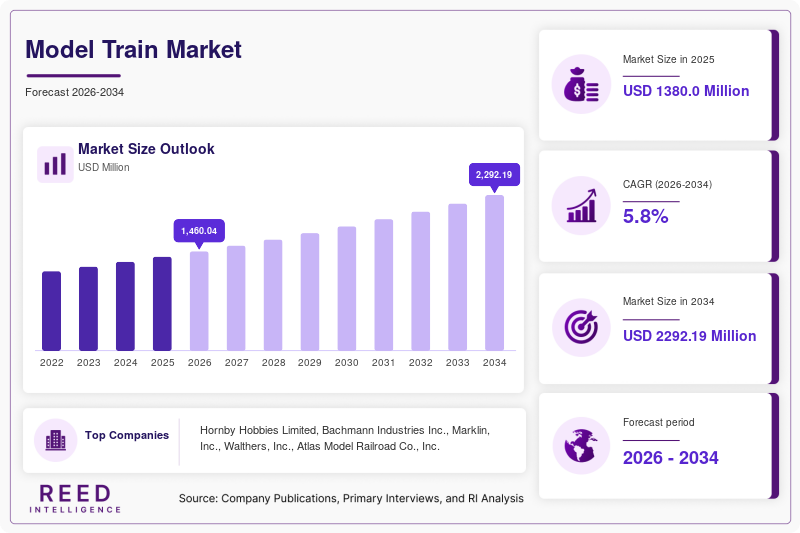
The model train market size is projected at USD 1,450.0 million in 2026 and is expected to hit USD 2,292.19 million by 2034 with a CAGR of 5.8% during the forecast period. The increasing popularity of hobbyist collecting, the growing demand for realistic and detailed model railways, and the rising adoption of digital control technologies underpin market expansion. This report delivers a comprehensive analysis of the model train market, including segmentation by type and application, competitive dynamics, and regional growth patterns, equipping stakeholders with critical intelligence to navigate this specialized hobbyist and collectibles landscape.
Model Train Market Key Takeaways
- Dominant Region: Europe leads the model train market with a 38% share, while North America is the fastest-growing region with a projected CAGR of 6.5% through 2034.
- Dominant Segment: The Locomotives type dominates the market with a 35% share, while the Hobbyists & Collectors application is the leading segment with a 62% share.
- Emerging Country: China is projected to reach USD 185.0 million by 2034, expanding at a CAGR of 8.2%.
- Key Drivers: The growing interest in heritage railways, the rising demand for premium and limited-edition models, and the increasing adoption of digital command control systems are driving market growth.
The model train market encompasses a wide range of miniature railway products, including locomotives, rolling stock, track systems, scenery, and accessories, designed for hobbyists, collectors, and educational purposes. These products are available in various scales, including HO, N, O, and G gauge, catering to different space requirements and levels of detail. Globally, the production of model trains has remained steady, with an estimated 12.5 million units manufactured in 2025 across all scales and categories. In terms of revenue, Locomotives accounted for roughly 35% of the total market share, driven by their central role in any model railway setup, while Rolling Stock and Track & Accessories followed with 25% and 22% shares, respectively. The market is further characterized by a penetration rate exceeding 45% among hobbyists in developed regions, whereas emerging markets represent a growing adoption frontier due to increasing disposable income and interest in Western hobbies. The Hobbyists & Collectors segment remains the largest application area, with educational institutions, commercial displays, and museums representing significant niche opportunities.
Model Train Market Trends
Integration of Digital Command Control and Smart Technology
The model train market is witnessing a significant trend toward the integration of digital command control (DCC) systems and smart technology features that enhance the realism and functionality of model railways. This shift is driven by the growing demand for realistic operations, including independent train control, sound effects, and lighting. Manufacturers are developing locomotives with built-in DCC decoders and sound modules that can be controlled via smartphone apps or dedicated controllers. The adoption of DCC technology has increased by 18% year-over-year, with over 55% of new locomotives sold in 2025 being DCC-ready. The development of Wi-Fi enabled control systems is gaining momentum, enabling seamless integration with home automation and voice control platforms. This trend is supported by the increasing technological sophistication of hobbyists and their desire for immersive operating experiences.
Growing Popularity of Limited Edition and Heritage Models
The increasing popularity of limited edition and heritage models is a major trend shaping the model train market. The development of highly detailed, historically accurate models of famous locomotives and trains is gaining traction, driven by the nostalgia and collector appeal of these iconic railway vehicles. The emergence of premium, limited-run models with exceptional detailing and packaging is particularly prominent in the European and North American markets. This trend is supported by the growing interest in railway history and the willingness of collectors to pay premium prices for exclusive items. The collaboration between manufacturers and heritage railways for officially licensed models is also gaining momentum, creating unique and desirable products.
Model Train Market Drivers
The model train market's expansion is primarily driven by the enduring popularity of model railroading as a hobby, with an estimated 5 million active hobbyists worldwide. The growing interest in heritage railways and the nostalgia associated with classic train travel have been major drivers, with model trains serving as a tangible connection to railway history. The rising demand for premium and limited-edition models has further fueled market demand, with collectors willing to invest in high-quality, detailed products. The increasing adoption of digital command control systems and sound modules has enhanced the operating experience and attracted new enthusiasts. Additionally, the growth of online communities and social media platforms dedicated to model railroading has supported market growth by connecting hobbyists and showcasing products.
Model Train Market Restraints
Despite favorable growth prospects, the model train market faces significant constraints, primarily related to the high costs associated with premium models and the space requirements for large layouts, which can be prohibitive for younger and urban hobbyists. The market's growth is further tempered by the competition from digital entertainment options and the declining participation in traditional hobbies among younger demographics. Additionally, the limited availability of physical hobby shops and the shift toward online retail can create challenges for manufacturers in reaching new customers. The economic sensitivity of the hobby, with purchases often discretionary, can also impact market stability during downturns.
Model Train Market Opportunities
The model train market presents significant opportunities in the rapidly expanding segment of entry-level and starter sets designed to attract new hobbyists. The development of affordable, ready-to-run sets with modern digital features represents another promising avenue. Emerging opportunities also exist in the application of model trains for educational purposes, including STEM learning and historical education. Furthermore, the integration of augmented reality and virtual reality technologies for enhanced layout visualization and operation offers potential for market differentiation and growth.
Challenges in Model Train Market
The model train market grapples with persistent challenges related to the need to attract younger generations to the hobby and compete with digital entertainment. The complexity of the hobby, including the space, time, and financial investment required, presents barriers to entry. The market is also contending with the challenge of maintaining production quality while managing costs, particularly for detailed models that require extensive hand assembly. Moreover, the need for effective marketing and community engagement to sustain interest and grow the hobby poses ongoing challenges for manufacturers and retailers.
Model Train Market Segmentation Analysis
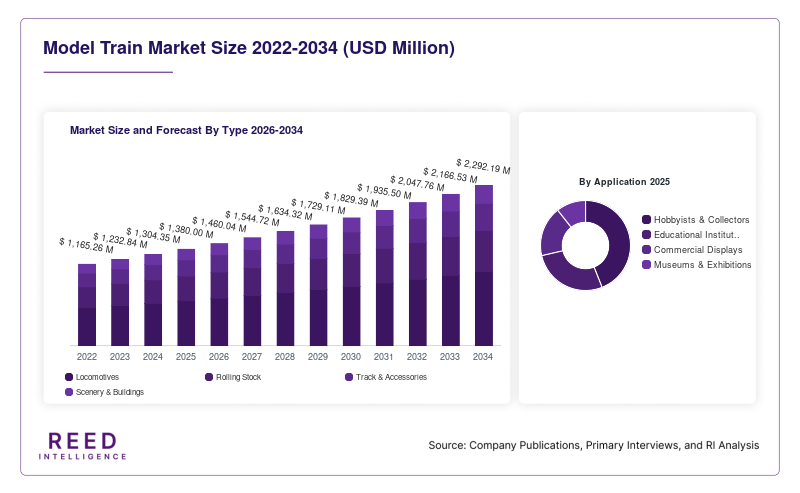
The model train market is segmented by Type and Application to provide a comprehensive market perspective. By Type, Locomotives dominate with a 35% market share, driven by their essential role in any model railway. The Application segment is led by Hobbyists & Collectors, which accounts for 62% of the market, followed by Educational Institutions at 18%, Commercial Displays at 12%, and Museums & Exhibitions at 8%.
By Type
Locomotives represent the largest segment in the model train market, commanding a 35% share, with revenue exceeding USD 507 million in 2025. These include steam, diesel, and electric locomotives in various scales. Technical specifications include scale, DCC compatibility, and detailing level. The market's Locomotives segment is driven by their central role in model railways and the constant demand for new and upgraded models.
Rolling Stock captures a 25% share of the model train market, with revenue of USD 362 million in 2025. These include passenger cars, freight cars, and cabooses. Technical specifications include scale, coupling type, and detailing. The market's Rolling Stock segment is driven by the need to build complete and realistic trains to accompany locomotives.
Track & Accessories represent 22% of the market, with revenue of USD 319 million in 2025, characterized by track systems, switches, controllers, and power supplies. Technical specifications include gauge, track geometry, and electrical compatibility. The market's Track & Accessories segment is driven by the foundational need for reliable track systems and the expansion of layouts.
Scenery & Buildings account for 18% of the market, with revenue of USD 261 million in 2025, involving landscaping materials, buildings, figures, and other scenic accessories. Technical specifications include scale compatibility, material type, and level of detail. The market's Scenery & Buildings segment is driven by the desire to create realistic and immersive model railway environments.
By Application
Hobbyists & Collectors dominates the model train market, accounting for 62% of sales, representing USD 899 million in 2025. This segment includes individual enthusiasts who build and operate model railways for personal enjoyment and collectors who acquire models for display. Usage penetration exceeds 45% in developed regions among adults aged 45 and above. The market's Hobbyists & Collectors segment is characterized by its focus on authenticity, detail, and operational realism.
Educational Institutions account for 18% of the model train market, with revenue of USD 261 million in 2025. This segment encompasses schools, universities, and educational programs that use model trains for teaching history, engineering, and STEM concepts. The segment is growing at a steady rate, driven by the integration of hands-on learning tools. The market's Educational Institutions segment is characterized by its focus on durability, ease of use, and educational value.
Commercial Displays represent 12% of the market, with revenue of USD 174 million in 2025, involving the use of model trains in shop windows, trade shows, and promotional displays. The segment's growth is fueled by the visual appeal and attention-grabbing nature of model railways. The market's Commercial Displays segment is characterized by its focus on reliability, visual impact, and ease of setup.
Museums & Exhibitions account for 8% of the market, with revenue of USD 116 million in 2025, encompassing the use of model trains in museum exhibits and public displays. The market's Museums & Exhibitions segment is driven by the need for historically accurate and visually impressive models to engage visitors and tell stories about railway history.
Model Train Market Regional Analysis
Europe Model Train Market
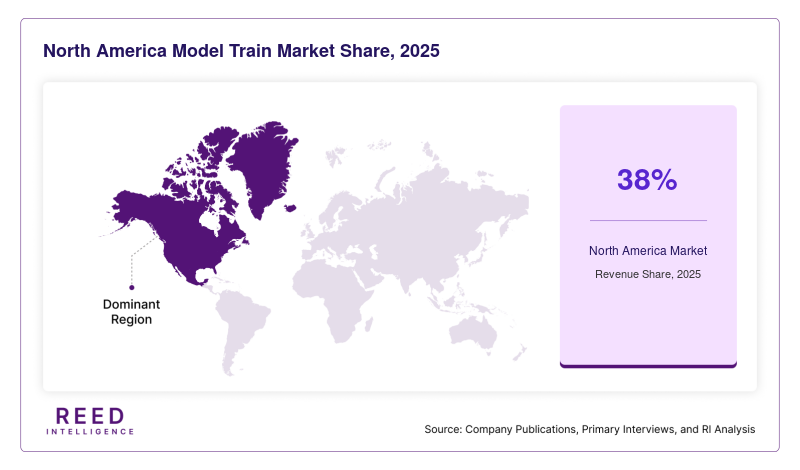
Leads the model train market, commanding a 38% share, with revenue of USD 551 million in 2025. Germany, the United Kingdom, and France are the primary drivers, together accounting for 62% of regional demand, driven by a strong railway heritage, high disposable income, and a large base of dedicated hobbyists. The European market is characterized by its focus on detail, authenticity, and premium models.
North America Model Train Market
Represents the second-largest market, capturing a 32% share with revenue of USD 464 million in 2025. The United States is the primary driver, accounting for 85% of regional demand, driven by a strong hobbyist culture, nostalgia for classic American railroads, and a growing interest in DCC technology. The North American market is projected to grow at the fastest CAGR of 6.5% through 2034, supported by innovation and community engagement.
Asia-Pacific Model Train Market
Accounts for 20% of the global model train market, with revenue of USD 290 million in 2025. Japan, China, and Australia are the primary drivers, accounting for 68% of regional demand, fueled by a strong hobbyist culture in Japan, increasing disposable income in China, and a growing interest in model railways across the region. The Asia-Pacific market is projected to grow at a significant CAGR, driven by rising interest and expanding retail availability.
Latin America and Middle East & Africa Model Train Market
Together account for the remaining 10% of the model train market, with Brazil and the UAE leading their respective regions. Both regions are projected to grow at CAGRs exceeding 5%, driven by growing hobbyist communities and increasing availability of model train products.
Top players in Model Train Market
- Hornby Hobbies Limited
- Bachmann Industries Inc.
- Marklin, Inc.
- Walthers, Inc.
- Atlas Model Railroad Co., Inc.
- Kato Precision Railroad Models
- Roco Modelleisenbahn GmbH
- Piko Spielwaren GmbH
- Lionel LLC
- MTH Electric Trains
- Accucraft Trains
- Broadway Limited Imports
- Dapol Ltd
- Heljan A/S
- Electrotren (Hornby)
Recent Developments in Model Train Market
- April 2026 – Hornby Hobbies launched a new range of DCC-ready locomotives with integrated Bluetooth control for smartphone operation.
- June 2025 – Bachmann Industries introduced a new line of highly detailed heritage diesel locomotives in HO scale.
- August 2025 – Kato Precision Railroad Models announced a new starter set with a compact track plan designed for small spaces.
- February 2026 – Marklin, Inc. released a limited-edition model of a historic steam locomotive with exceptional detailing and sound features.
- October 2025 – Lionel LLC introduced a new line of O gauge trains with enhanced digital control and realistic smoke effects.
Model Train Market Segments
By Type
- Locomotives
- Rolling Stock
- Track & Accessories
- Scenery & Buildings
By Application
- Hobbyists & Collectors
- Educational Institutions
- Commercial Displays
- Museums & Exhibitions
By Region
- North America
- Europe
- APAC
- Middle East and Africa
- LATAM