Modified Lignosulfonates Market Size, Share & Demand Report By Type (Sodium Modified Lignosulfonates, Calcium Modified Lignosulfonates, Ammonium Modified Lignosulfonates), By Application (Concrete Admixtures, Agrochemical Dispersants, Oil Drilling Additives, Animal Feed Binders), By End-Use Industry (Construction, Agriculture, Ceramics, Animal Feed, Industrial Processing) By Region & Segment Forecasts, 2026–2034
USD 3950
Market Overview
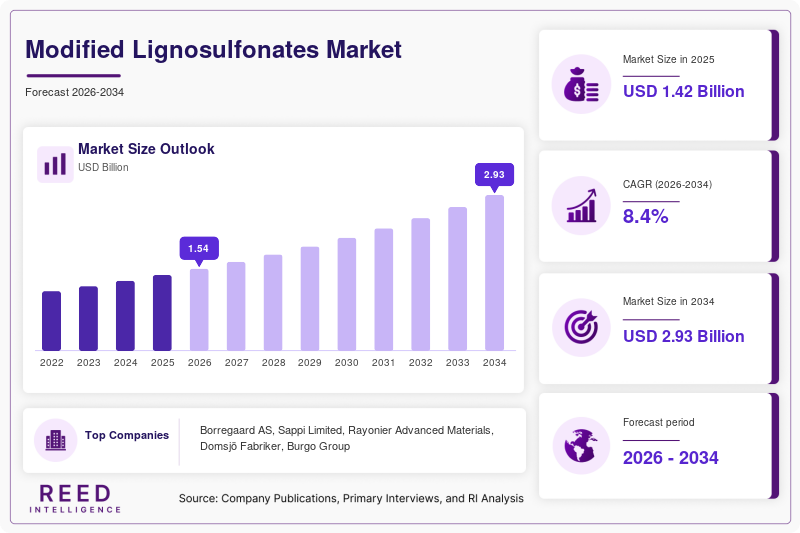
The global Modified Lignosulfonates Market size was valued at USD 1.42 billion in 2026 and is projected to reach USD 2.71 billion by 2034, expanding at a CAGR of 8.4% during the forecast period from 2026 to 2034. The market is witnessing stable expansion due to the increasing adoption of bio-based dispersants, binders, and additives across construction, agriculture, animal feed, oil drilling, and industrial processing applications. Modified lignosulfonates are derived from lignin generated during pulp and paper manufacturing and are increasingly utilized as environmentally compatible alternatives to petroleum-based chemicals.
The growth of sustainable construction materials and low-emission industrial formulations has supported broader commercial adoption of modified lignosulfonates worldwide. Governments and manufacturers are investing in renewable raw materials to reduce environmental impact and improve compliance with industrial emission regulations. The demand for concrete admixtures with improved workability and water reduction properties has particularly contributed to market expansion in infrastructure development projects. In addition, rising applications in dust suppression, ceramic additives, gypsum board manufacturing, and agrochemical dispersants continue to widen the industry landscape.
Key Highlights
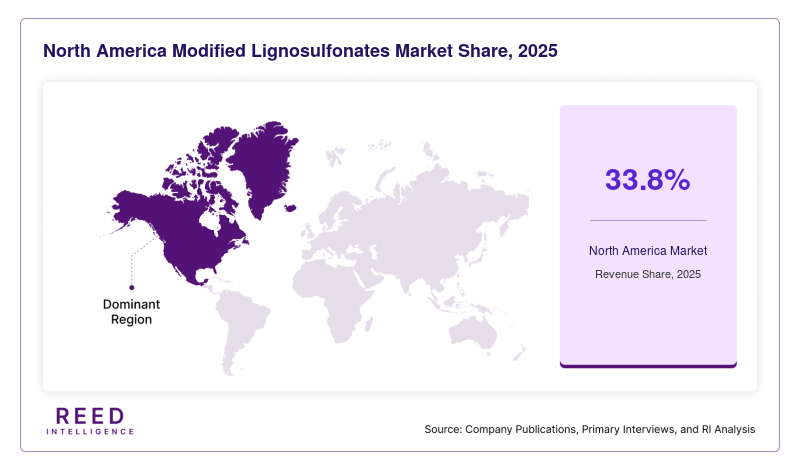
- North America dominated the market with a 33.8% share in 2025.
- Asia Pacific is expected to grow at the fastest CAGR of 10.9% during 2026–2034.
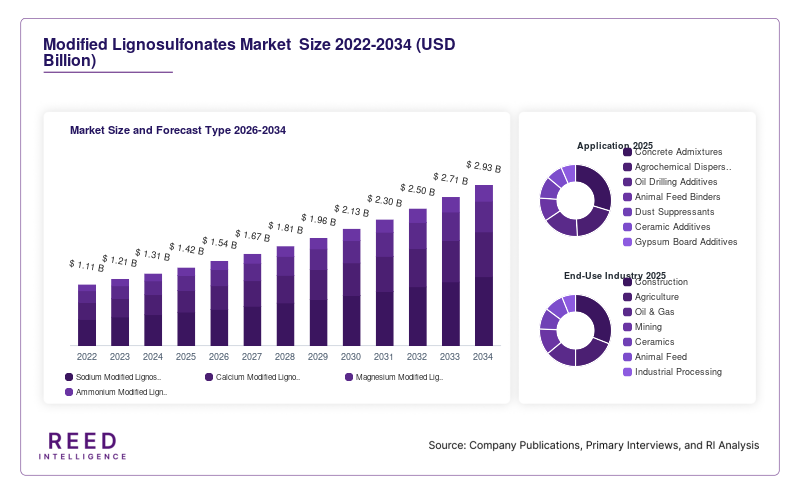
- By type, sodium modified lignosulfonates accounted for the largest share of 39.4%.
- while calcium modified lignosulfonates are projected to grow at a CAGR of 9.8%.
- By application, concrete admixtures led with a 36.7% share, whereas agrochemical dispersants are expected to expand at a CAGR of 10.4%.
- By end-use industry, construction accounted for the highest share of 42.1%, while agriculture is projected to grow at a CAGR of 10.7%.
- The United States remained the dominant country, with market values of USD 318 million in 2024 and USD 346 million in 2025.
Market Trends
Rising Demand for Sustainable Concrete Additives
The increasing use of sustainable construction chemicals is emerging as a major trend in the Modified Lignosulfonates Market. Construction companies are adopting bio-based admixtures to reduce environmental impact while maintaining operational efficiency in large infrastructure projects. Modified lignosulfonates are widely utilized in concrete mixtures because they improve workability, reduce water content, and support cost-efficient cement utilization. Rapid urbanization across Asia Pacific and the Middle East has further accelerated demand for environmentally compatible additives in commercial and residential projects. Manufacturers are introducing advanced formulations with improved dispersibility and compatibility with high-performance cement systems. This trend is expected to strengthen as governments implement stricter sustainability standards for public infrastructure development and green building certification programs.
Expansion of Bio-Based Industrial Chemicals
The transition toward renewable industrial chemicals is influencing purchasing decisions across multiple sectors, including agriculture, mining, ceramics, and oilfield chemicals. Modified lignosulfonates are increasingly viewed as substitutes for synthetic additives due to their biodegradability and lower toxicity profile. Industrial manufacturers are investing in lignin valorization technologies to convert pulp industry byproducts into higher-value specialty chemicals. Demand for modified lignosulfonates in agrochemical formulations and animal feed binders has also increased because producers are seeking naturally derived additives with stable performance characteristics. The market is additionally benefiting from collaborations between pulp manufacturers and specialty chemical producers focused on expanding commercial-scale production capacities. As industries continue to prioritize renewable feedstocks, the adoption of modified lignosulfonates is expected to increase steadily during the forecast period.
Market Drivers
Growth in Global Infrastructure and Construction Activities
Large-scale investments in transportation infrastructure, urban housing, industrial facilities, and smart city projects are driving the demand for modified lignosulfonates in construction applications. These materials are widely used as concrete plasticizers and water reducers that improve durability and handling performance. Emerging economies in Asia Pacific, Latin America, and the Middle East are experiencing strong infrastructure spending supported by population growth and industrial expansion. Modified lignosulfonates also contribute to lowering cement consumption, which aligns with sustainability goals in modern construction practices. Increased focus on cost-effective construction materials has encouraged contractors and manufacturers to integrate lignosulfonate-based additives into concrete production processes. The growing need for durable and efficient building materials is therefore expected to remain a primary market growth driver over the coming years.
Increasing Preference for Renewable and Low-Toxicity Additives
Industrial manufacturers are gradually replacing petroleum-derived additives with renewable alternatives to meet environmental regulations and sustainability objectives. Modified lignosulfonates offer advantages such as biodegradability, lower volatile emissions, and reduced environmental impact compared to conventional synthetic chemicals. Industries including agriculture, ceramics, gypsum processing, and oil drilling are increasingly incorporating these products into operational formulations. Regulatory pressure regarding hazardous chemical usage in Europe and North America has further encouraged the transition toward bio-based additives. In addition, consumer preference for sustainable agricultural and industrial products is motivating manufacturers to adopt renewable raw materials. Continuous research into lignin modification technologies has also improved product performance, supporting broader industrial acceptance and accelerating the growth trajectory of the Modified Lignosulfonates Market.
Market Restraint
Variability in Raw Material Quality and Processing Challenges
The Modified Lignosulfonates Market faces operational challenges associated with inconsistent raw material quality and complex processing requirements. Lignosulfonates are derived from sulfite pulping processes, and variations in wood species, pulping conditions, and extraction methods can influence product composition and performance characteristics. Such inconsistencies create difficulties for manufacturers attempting to maintain standardized industrial formulations across multiple end-use applications. Industries such as construction and agrochemicals require highly stable additive performance, making quality consistency an important operational factor.
Additionally, advanced modification technologies often involve significant capital investment and specialized processing infrastructure. Small and medium-scale manufacturers may face limitations in upgrading production facilities or implementing high-efficiency purification systems. Transportation and storage challenges related to moisture sensitivity and formulation stability can also increase operational costs. In some regions, limited availability of sulfite pulping facilities restricts local production capacity, resulting in supply chain dependency on imports. These factors collectively restrain rapid market penetration, particularly in price-sensitive developing economies where low-cost synthetic alternatives remain commercially competitive.
Market Opportunities
Expanding Applications in Agricultural Formulations
The increasing adoption of sustainable agricultural chemicals presents substantial growth opportunities for modified lignosulfonate manufacturers. These materials are extensively used as dispersants, binders, and chelating agents in pesticide and fertilizer formulations. Agricultural producers are focusing on improving nutrient delivery efficiency while minimizing environmental contamination associated with synthetic additives. Modified lignosulfonates support better dispersion of active ingredients and improve product stability in liquid and powdered formulations. Growing concerns regarding soil health and environmental sustainability are encouraging agrochemical companies to integrate renewable additives into commercial products. Emerging agricultural economies in Asia Pacific and Latin America are expected to create additional demand due to rising crop production activities and modernization of farming practices. As sustainable agriculture initiatives continue to expand globally, manufacturers are likely to increase investments in specialized lignosulfonate formulations for agricultural applications.
Development of Advanced Bio-Refinery Integration Models
The integration of lignin valorization technologies within bio-refinery operations is creating new commercial opportunities across the modified lignosulfonates industry. Pulp and paper companies are increasingly exploring value-added applications for lignin byproducts to improve operational profitability and resource utilization efficiency. Advanced separation and chemical modification technologies are enabling manufacturers to produce high-purity lignosulfonates suitable for specialty industrial applications. Strategic partnerships between chemical producers and pulp manufacturers are accelerating innovation in renewable industrial ingredients. In addition, rising interest in circular economy models is encouraging industries to convert waste streams into commercially viable products. The development of integrated production systems can reduce manufacturing costs, improve supply stability, and support large-scale commercialization. These factors are expected to create long-term opportunities for market participants focused on sustainable specialty chemical production.
Segmental Analysis
By Type
Sodium modified lignosulfonates accounted for the largest market share of 39.4% in 2024 due to their extensive utilization in concrete admixtures, oil drilling fluids, and ceramic processing applications. These products offer strong dispersing properties, improved water reduction performance, and better compatibility with industrial formulations compared to conventional alternatives. Construction companies prefer sodium-based formulations because they enhance concrete workability while reducing cement consumption. The segment has also benefited from increased infrastructure development activities across Asia Pacific and North America. In addition, sodium modified lignosulfonates are widely used in industrial cleaning agents and dust suppression systems because of their stable chemical behavior and cost-efficient performance. Manufacturers continue to invest in advanced processing technologies to improve product consistency and application flexibility across diverse industrial sectors.
Calcium modified lignosulfonates are expected to register the fastest CAGR of 9.8% during the forecast period owing to rising demand in agricultural formulations and animal feed applications. These products are increasingly used as binders and dispersants because they provide stable formulation performance and improved biodegradability. Agricultural producers are integrating calcium-based additives into fertilizers and pesticides to enhance nutrient distribution efficiency. The growing emphasis on environmentally sustainable farming practices has further supported segment growth. Manufacturers are also developing customized formulations with enhanced thermal stability and moisture resistance for specialized industrial applications. Increased adoption in gypsum board manufacturing and mining operations is expected to create additional commercial opportunities. As renewable industrial additives gain wider acceptance, calcium modified lignosulfonates are projected to experience strong demand growth across emerging economies.
By Application
Concrete admixtures represented the dominant application segment with a market share of 36.7% in 2024. Modified lignosulfonates are extensively used in concrete formulations because they improve fluidity, reduce water usage, and support cost-efficient cement performance. Rapid urbanization and rising investments in transportation infrastructure have significantly contributed to segment expansion. Construction companies are increasingly utilizing lignosulfonate-based admixtures to improve concrete durability and operational efficiency in large-scale projects. The segment has additionally benefited from growing adoption of sustainable construction materials across developed and emerging economies. Manufacturers are focusing on product innovations that enhance compatibility with high-performance cement systems and low-carbon concrete technologies. The demand for advanced construction chemicals in residential, commercial, and industrial infrastructure projects is expected to sustain long-term segment growth.
Agrochemical dispersants are anticipated to grow at the fastest CAGR of 10.4% during 2026–2034 due to rising demand for sustainable agricultural inputs. Modified lignosulfonates are used in pesticide and fertilizer formulations to improve dispersion, stability, and application efficiency. Agricultural producers are increasingly adopting renewable additives to minimize environmental impact and enhance crop productivity. Population growth and rising food demand are encouraging investments in advanced agricultural chemicals across Asia Pacific and Latin America. Manufacturers are introducing specialized dispersant formulations tailored for liquid fertilizers and micronutrient blends. The growing focus on precision farming and sustainable agriculture practices is also accelerating demand for bio-based agrochemical ingredients. As regulatory pressure regarding synthetic chemical usage increases, agrochemical dispersants derived from renewable lignin sources are expected to gain broader commercial adoption.
By End-Use Industry
The construction industry accounted for the largest share of 42.1% in 2024 because modified lignosulfonates are widely utilized in concrete admixtures and dust suppression applications. Growing infrastructure investments across transportation, residential housing, and commercial development projects have significantly supported segment demand. These additives improve workability, reduce water requirements, and contribute to lower overall construction costs. Governments and private developers are increasingly emphasizing sustainable building materials to comply with environmental standards and energy-efficient construction practices. Modified lignosulfonates are also being integrated into road stabilization and mining infrastructure applications due to their binding and dispersing properties. Continuous urban expansion and industrialization across developing economies are expected to maintain stable demand for lignosulfonate-based construction chemicals during the forecast period.
The agriculture industry is projected to expand at the fastest CAGR of 10.7% during the forecast period owing to increasing adoption of bio-based dispersants and soil conditioning additives. Modified lignosulfonates are gaining popularity in fertilizers, pesticides, and animal feed formulations because they improve ingredient stability and nutrient delivery efficiency. Agricultural producers are seeking environmentally compatible additives that support sustainable farming operations while maintaining productivity. Rising food demand and expanding commercial farming activities across Asia Pacific, Latin America, and Africa are contributing to segment growth. Manufacturers are developing advanced agricultural formulations with improved biodegradability and enhanced field performance. Government initiatives supporting sustainable agriculture and reduced chemical contamination are expected to create additional growth opportunities for modified lignosulfonate suppliers in the coming years.
Regional Analysis
North America
North America accounted for 33.8% of the global Modified Lignosulfonates Market share in 2025 and is projected to expand at a CAGR of 7.9% during the forecast period. The region benefits from strong demand across construction chemicals, oilfield additives, and industrial processing applications. Growing adoption of environmentally compatible admixtures in infrastructure modernization projects has contributed to higher product utilization. The United States and Canada are also witnessing increased investments in renewable industrial materials, supporting market expansion. Regulatory frameworks encouraging lower industrial emissions and sustainable manufacturing practices continue to strengthen the regional demand outlook.
Europe
Europe represented 27.6% of the global market share in 2025 and is anticipated to grow at a CAGR of 8.1% through 2034. The region has emerged as a significant consumer of renewable specialty chemicals due to strict environmental regulations and sustainability targets. Modified lignosulfonates are increasingly used in construction additives, ceramic processing, and agricultural formulations throughout the region. The transition toward bio-based industrial ingredients has accelerated product adoption among manufacturers seeking compliance with emission reduction policies. European construction companies are also integrating sustainable admixtures into green infrastructure and energy-efficient building projects.
Asia Pacific
Asia Pacific held 24.3% of the global Modified Lignosulfonates Market share in 2025 and is expected to register the fastest CAGR of 10.9% during 2026–2034. Rapid industrialization, urban development, and infrastructure investments are contributing significantly to regional market expansion. Countries including China, India, Japan, and South Korea are witnessing increased utilization of concrete additives and agricultural dispersants derived from renewable sources. The construction sector remains a major consumer due to extensive residential and commercial development activities. Expanding industrial manufacturing and rising environmental awareness are also encouraging broader adoption of bio-based specialty chemicals.
Middle East & Africa
The Middle East & Africa accounted for 7.2% of the global market share in 2025 and is projected to expand at a CAGR of 8.7% over the forecast period. The region is experiencing increased demand for construction chemicals due to large-scale infrastructure and urban development projects. Modified lignosulfonates are gaining traction in concrete admixtures, dust suppressants, and oil drilling additives. Governments across Gulf countries are investing in industrial diversification strategies that encourage adoption of sustainable specialty chemicals. Rising construction activities linked to transportation, tourism, and energy infrastructure projects are further contributing to market growth.
Latin America
Latin America captured 7.1% of the global Modified Lignosulfonates Market share in 2025 and is expected to grow at a CAGR of 8.3% through 2034. The market is benefiting from increasing infrastructure investments and agricultural modernization activities across regional economies. Modified lignosulfonates are widely utilized in agrochemical formulations, construction materials, and mining operations. Rising demand for renewable industrial additives and improved crop productivity solutions has encouraged broader market penetration. Governments in several countries are also supporting industrial sustainability initiatives aimed at reducing dependence on petroleum-derived chemicals.
Competitive Landscape
The Modified Lignosulfonates Market is moderately consolidated, with major players focusing on product innovation, production expansion, and strategic partnerships to strengthen market presence. Companies are investing in advanced lignin modification technologies to improve product consistency, performance efficiency, and industrial compatibility. Sustainability initiatives and renewable chemical development strategies are also influencing competitive positioning across global markets.
Borregaard AS remains one of the leading companies in the market due to its extensive lignin processing capabilities and diversified specialty chemical portfolio. The company has expanded production efficiency initiatives focused on renewable industrial ingredients. Sappi Limited, Rayonier Advanced Materials, and Domsjö Fabriker are also strengthening their market positions through investments in bio-refinery integration and sustainable product development.
Key Players
- Borregaard AS
- Sappi Limited
- Rayonier Advanced Materials
- Domsjö Fabriker
- Burgo Group
- Nippon Paper Industries Co., Ltd.
- Shenyang Xingzhenghe Chemical Co., Ltd.
- Tembec Inc.
- Green Agrochem
- LignoTech USA
- Abelin Polymers
- Flambeau River Papers
- Wuhan Xinyingda Chemicals Co., Ltd.
Recent Developments
- Borregaard AS expanded its lignin specialty chemicals production capacity in Europe to support rising demand for renewable industrial additives in 2025.
- Sappi Limited introduced an advanced modified lignosulfonate formulation designed for high-performance concrete admixture applications in 2024.
- Rayonier Advanced Materials announced a strategic collaboration with agricultural chemical manufacturers to develop bio-based dispersant technologies in 2025.
- Nippon Paper Industries Co., Ltd. invested in lignin valorization research programs aimed at improving industrial-scale production efficiency in 2024.
Modified Lignosulfonates Market Segments
Type
- Sodium Modified Lignosulfonates
- Calcium Modified Lignosulfonates
- Magnesium Modified Lignosulfonates
- Ammonium Modified Lignosulfonates
Application
- Concrete Admixtures
- Agrochemical Dispersants
- Oil Drilling Additives
- Animal Feed Binders
- Dust Suppressants
- Ceramic Additives
- Gypsum Board Additives
End-Use Industry
- Construction
- Agriculture
- Oil & Gas
- Mining
- Ceramics
- Animal Feed
- Industrial Processing
By Region
- North America
- Europe
- APAC
- Middle East and Africa
- LATAM