Modular Refineries Market Size, Share & Demand Report By Type (Topping Refineries, Hydro-Skimming Refineries, Conversion Refineries), By Application (Diesel Production, Gasoline Production, Kerosene & Jet Fuel, Others), By End-Use (Oil & Gas Companies, Independent Refiners, Government & Public Sector), By Region & Segment Forecasts, 2025–2034
USD 3950
Market Overview
The Modular Refineries Market size was estimated at USD 2.85 billion in 2025 and is projected to reach USD 3.15 billion in 2026. With increasing investments in decentralized refining infrastructure, the market is forecasted to grow to USD 6.95 billion by 2034, registering a CAGR of 9.2% during the forecast period (2025–2034). Modular refineries offer advantages such as shorter construction timelines, lower capital expenditure, and scalability, making them suitable for emerging economies and remote oil-producing regions.
One of the primary growth factors driving the market is the rising demand for refined petroleum products in regions with limited access to large-scale refineries. Modular systems allow countries to reduce dependency on imports while utilizing local crude resources efficiently. Additionally, increasing crude oil discoveries in remote and offshore locations are creating demand for portable refining solutions that can be deployed quickly.
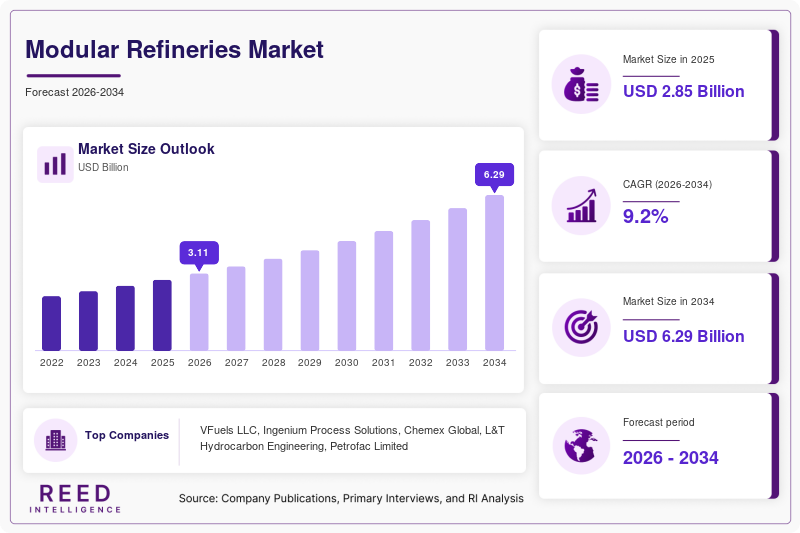
Key Highlights
- Market size reached USD 2.85 billion in 2025 and is expected to grow to USD 3.15 billion in 2026, driven by rising demand for decentralized refining solutions.
The shift toward flexible, small-scale refining units is helping reduce dependency on large centralized refineries and imports. - The market is projected to reach USD 6.95 billion by 2034, supported by infrastructure investments and regional energy needs.
Growing emphasis on local fuel production and improved energy accessibility is accelerating investments in modular refinery projects. - A CAGR of 9.2% from 2025 to 2034 reflects strong adoption across emerging economies and remote production sites.
Technological advancements and increasing crude oil exploration in remote regions are further supporting consistent market growth.
Market Trends
Increasing Adoption of Containerized and Skid-Mounted Refinery Units
The Modular Refineries Market is witnessing a shift toward containerized and skid-mounted units that offer enhanced mobility and ease of installation. These systems are pre-fabricated and assembled off-site, allowing for rapid deployment in challenging environments such as offshore platforms or remote inland oil fields. Companies are increasingly opting for such designs to reduce construction timelines and minimize operational disruptions. This trend is particularly evident in regions with underdeveloped infrastructure, where traditional refinery construction is not feasible. Additionally, containerized units provide flexibility in scaling operations based on production requirements, making them suitable for both small and medium-scale oil producers.
Integration of Digital Monitoring and Automation Technologies
Another notable trend shaping the Modular Refineries Market is the integration of advanced digital monitoring and automation systems. Operators are leveraging real-time data analytics, IoT-enabled sensors, and remote monitoring tools to optimize refinery performance and ensure safety. These technologies allow for predictive maintenance, reducing downtime and operational costs. Automation also enhances process efficiency by maintaining consistent output quality and reducing human error. As digital transformation continues across the energy sector, modular refinery providers are incorporating smart technologies to improve system reliability and competitiveness, particularly in regions with limited skilled labor availability.
Market Drivers
Rising Demand for Decentralized Energy Infrastructure
The increasing need for decentralized energy solutions is a major driver of the Modular Refineries Market. Many developing countries face challenges in establishing large-scale refining facilities due to high capital requirements and logistical constraints. Modular refineries offer a practical alternative by enabling localized production of refined products such as diesel, gasoline, and kerosene. This reduces reliance on imports and enhances energy security. Governments are actively promoting such solutions to support rural and industrial development. The ability to deploy modular units in phases further adds to their appeal, allowing operators to align investments with demand growth and resource availability.
Cost Efficiency and Faster Deployment Compared to Conventional Refineries
Cost efficiency remains a critical factor driving market growth. Traditional refineries require significant capital investment and long construction periods, often spanning several years. In contrast, modular refineries can be installed and commissioned within months, significantly reducing time-to-market. This advantage is particularly valuable in volatile oil price environments, where quick returns on investment are essential. Additionally, modular systems reduce labor and engineering costs due to standardized designs and prefabrication. These economic benefits are encouraging both private and public sector players to adopt modular refining solutions, especially in regions with budget constraints.
Market Restraint
Limited Processing Capacity and Economies of Scale
Despite their advantages, modular refineries face limitations in terms of processing capacity and economies of scale. These units are typically designed for small to medium-scale operations, which may not meet the demands of large industrial markets. As a result, they may produce higher per-unit costs compared to large conventional refineries that benefit from economies of scale. This limitation can restrict their adoption in regions with high consumption of refined petroleum products. For example, countries with established large-scale refining infrastructure may find it less economical to invest in modular systems. Additionally, the complexity of integrating multiple modular units to achieve higher capacity can increase operational challenges and costs, impacting overall efficiency.
Market Opportunities
Expansion in Emerging Economies with Untapped Oil Resources
Emerging economies with untapped or underutilized oil reserves present significant growth opportunities for the Modular Refineries Market. Countries in Africa, Southeast Asia, and Latin America are increasingly exploring modular solutions to process locally produced crude oil. These regions often lack the infrastructure and financial resources required for large-scale refineries, making modular systems an attractive option. By enabling localized refining, governments can reduce fuel imports, improve trade balances, and stimulate economic development. The growing focus on energy independence is expected to drive investments in modular refinery projects across these regions in the coming years.
Development of Hybrid and Renewable-Compatible Refinery Systems
The transition toward cleaner energy sources is opening new avenues for modular refinery manufacturers. There is increasing interest in developing hybrid systems that can process both crude oil and renewable feedstocks such as bio-oils. This approach allows operators to diversify their product portfolios and align with environmental regulations. Modular refineries are well-suited for such innovations due to their flexible design and scalability. As governments implement stricter emission standards, the demand for environmentally friendly refining solutions is expected to grow. This creates opportunities for companies to invest in research and development and introduce advanced modular systems that support sustainable energy goals.
Segmental Analysis
By Type
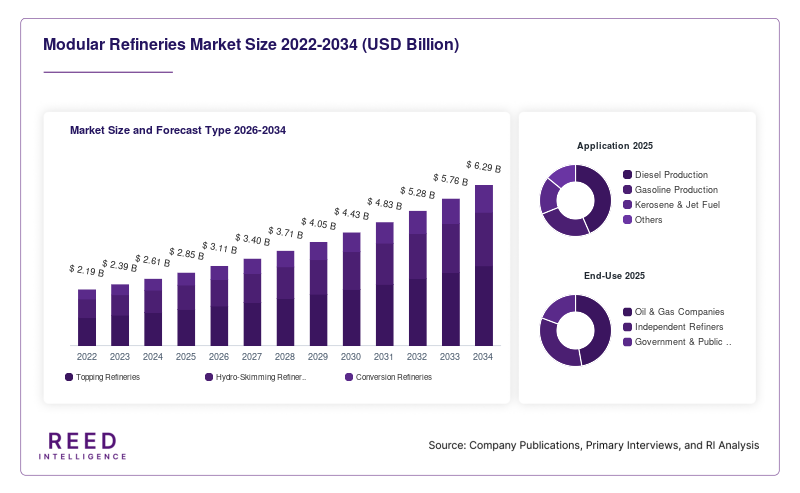
The topping modular refinery segment dominated the market in 2024, accounting for approximately 42% of the total share. These refineries are designed to separate crude oil into basic fractions without complex processing, making them suitable for small-scale operations. Their simplicity and lower capital requirements make them a preferred choice in emerging markets. Additionally, topping refineries are easier to install and operate, reducing the need for specialized labor. This segment continues to benefit from strong demand in regions with limited refining infrastructure.
The hydro-skimming modular refinery segment is expected to be the fastest-growing, with a CAGR of 10.1% during the forecast period. These systems offer improved processing capabilities compared to topping refineries, producing higher-quality fuels. The growth is driven by increasing demand for refined products that meet international quality standards. As regulatory requirements become stricter, operators are shifting toward hydro-skimming solutions to enhance product output and compliance.
By Application
The diesel production segment held the largest share of around 38% in 2024, driven by high demand for diesel fuel in transportation and industrial sectors. Modular refineries are widely used to produce diesel due to its consistent demand and relatively simple processing requirements. This segment is particularly strong in developing regions where diesel is a primary fuel for power generation and transportation.
The gasoline production segment is projected to grow at the fastest CAGR of 9.8% during the forecast period. Rising vehicle ownership and urbanization are driving demand for gasoline, especially in emerging economies. Modular refineries are being upgraded to produce higher-quality gasoline that meets emission standards. This trend is expected to support segment growth over the coming years.
By End-Use
The oil & gas companies segment dominated the market in 2024, accounting for approximately 55% of the share. These companies are the primary users of modular refineries, leveraging them to optimize production and reduce transportation costs. The ability to deploy modular units near extraction sites provides significant operational advantages, driving adoption in this segment.
The independent refiners segment is expected to witness the highest growth, with a CAGR of 10.4% during the forecast period. These players are increasingly investing in modular refineries to enter the refining market with lower capital investment. The flexibility and scalability of modular systems enable independent refiners to expand operations gradually, aligning with market demand.
Regional Analysis
North America
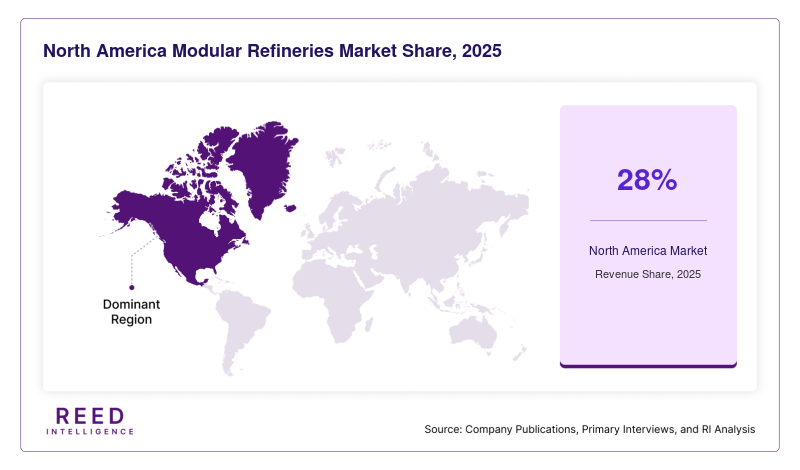
North America accounted for a notable share of the Modular Refineries Market in 2025, supported by technological advancements and strong investments in energy infrastructure. The region held approximately 28% of the global market share and is expected to grow at a CAGR of 7.8% through 2034. The presence of established oil and gas companies and increasing focus on optimizing refining operations are driving demand for modular solutions.
The United States dominates the regional market due to its extensive shale oil production and focus on operational efficiency. A key growth factor is the adoption of modular refineries in remote production areas to reduce transportation costs. This trend is further supported by advancements in modular engineering and automation technologies.
Europe
Europe held around 20% of the Modular Refineries Market share in 2025 and is projected to grow at a CAGR of 8.1% during the forecast period. The region is characterized by stringent environmental regulations and a focus on sustainable energy solutions. Modular refineries are gaining attention as a flexible option for smaller-scale refining operations.
Germany leads the European market, driven by its strong industrial base and commitment to energy efficiency. A unique growth factor is the integration of modular refineries with renewable energy systems, enabling hybrid operations that align with environmental goals. This approach is expected to drive innovation in the region.
Asia Pacific
Asia Pacific emerged as the largest regional market in 2025, accounting for approximately 32% of the global share. The region is expected to register the highest CAGR of 10.5% through 2034, driven by rapid industrialization and increasing energy demand. Governments are investing in modular refineries to support local refining capacity.
China dominates the Asia Pacific market due to its expanding oil and gas sector and infrastructure development initiatives. A key growth factor is the rising demand for refined products in rural and industrial areas, which is encouraging the deployment of modular refining units across the country.
Middle East & Africa
The Middle East & Africa region held about 12% of the market share in 2025 and is projected to grow at a CAGR of 9.7%. The presence of abundant crude oil reserves and increasing focus on value addition are driving the adoption of modular refineries. Governments are promoting these solutions to enhance local refining capacity.
Nigeria is a leading market in this region, supported by its efforts to reduce fuel imports and utilize domestic crude resources. A unique growth factor is the government’s support for modular refinery projects aimed at boosting economic development and reducing dependency on imported petroleum products.
Latin America
Latin America accounted for nearly 8% of the Modular Refineries Market in 2025 and is expected to grow at a CAGR of 9.0% during the forecast period. The region is witnessing increased investments in oil and gas exploration, creating demand for flexible refining solutions.
Brazil leads the regional market, driven by its growing oil production and infrastructure development. A key growth factor is the adoption of modular refineries in remote areas to support local industries and reduce transportation challenges, enhancing overall efficiency.
Competitive Landscape
The Modular Refineries Market is moderately fragmented, with several global and regional players competing based on technology, pricing, and customization capabilities. Companies are focusing on product innovation, strategic partnerships, and regional expansion to strengthen their market position. The competitive environment is characterized by the presence of engineering firms, equipment manufacturers, and oilfield service providers.
One of the leading players in the market is VFuels LLC, known for its modular refinery solutions and global project execution capabilities. The company has been actively expanding its portfolio through technological advancements and partnerships. A recent development includes the introduction of advanced modular systems with enhanced automation features, aimed at improving operational efficiency and reducing downtime. Other key players are also investing in research and development to offer more efficient and environmentally friendly solutions.
Key Players List
- VFuels LLC
- Ingenium Process Solutions
- Chemex Global
- L&T Hydrocarbon Engineering
- Petrofac Limited
- Fluor Corporation
- Honeywell UOP
- Technip Energies
- McDermott International
- KBR Inc.
- Saipem S.p.A.
- Samsung Engineering
- Wison Engineering
- Toyo Engineering Corporation
- Axens SA
Recent Developments
- In 2024, VFuels LLC launched a new generation of modular refineries with integrated digital monitoring systems to enhance operational efficiency.
- In 2023, Technip Energies partnered with regional governments in Africa to develop modular refinery projects aimed at reducing fuel imports.
- In 2024, Honeywell UOP introduced advanced refining technologies designed for modular systems, improving fuel quality and environmental compliance.
Modular Refineries Market Segments
Type
- Topping Refineries
- Hydro-Skimming Refineries
- Conversion Refineries
Application
- Diesel Production
- Gasoline Production
- Kerosene & Jet Fuel
- Others
End-Use
- Oil & Gas Companies
- Independent Refiners
- Government & Public Sector
By Region
- North America
- Europe
- APAC
- Middle East and Africa
- LATAM