Molecular Forensics Market Size, Share Demand Report By Technology (PCR-Based Analysis, Next-Generation Sequencing, Capillary Electrophoresis, Microarray Technology), By Application (Criminal Investigation, Paternity Testing, Biodefense and Pathogen Tracing, Food Authentication, Wildlife Forensics), By End Use (Government Forensic Laboratories, Private Forensic Laboratories, Academic and Research Institutions, Healthcare and Biosurveillance Agencies), By Region & Segment Forecasts, 2026–2034
USD 3950
Market Overview
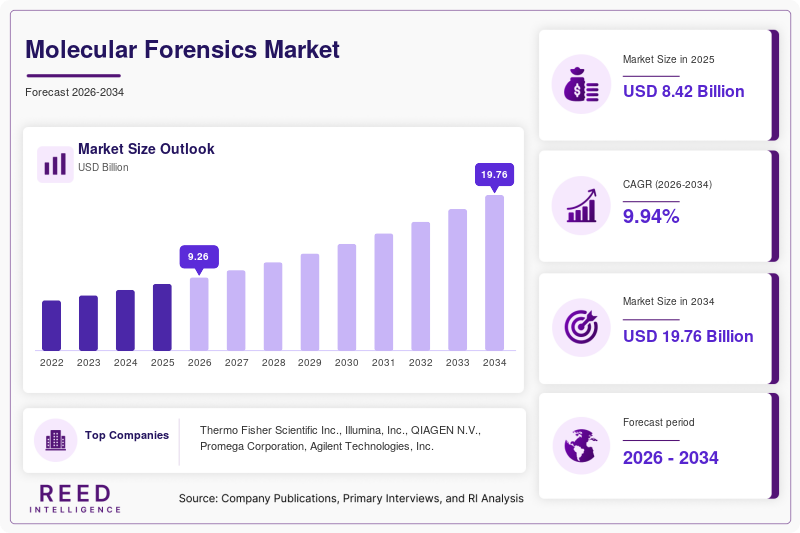
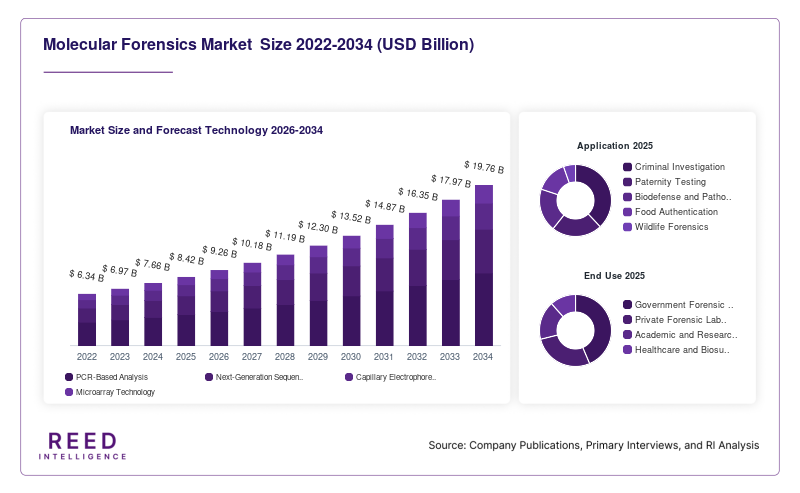
The Molecular Forensics Market size was valued at USD 8.42 billion in 2026 and is projected to reach USD 17.96 billion by 2034, expanding at a CAGR of 9.94% during the forecast period from 2026 to 2034. Molecular forensics integrates advanced genomic sequencing, polymerase chain reaction technologies, bioinformatics tools, and biomarker profiling into criminal justice, biodefense, food authentication, and human identification systems. The market is gaining traction as governments, law enforcement agencies, and healthcare institutions prioritize rapid and precise biological evidence analysis. A major global factor supporting market growth is the rising demand for DNA-based criminal investigation and transnational security modernization. Increasing cross-border crime, cyber-biosecurity concerns, and disaster victim identification needs have accelerated investment in next-generation forensic laboratories. In addition, public and private institutions are funding innovations in portable DNA analyzers, automated extraction systems, and forensic genomics software to reduce case turnaround times. Expanding legal acceptance of molecular evidence in judicial systems has further strengthened industry growth. The adoption of forensic sequencing in paternity testing, wildlife conservation, anti-counterfeiting, and pathogen source tracing also broadens commercial applications. As molecular biology technologies become more cost-effective and standardized, forensic institutions are increasingly transitioning from traditional serology to molecular platforms, creating long-term demand for equipment, reagents, and analytical services.
Key Highlights
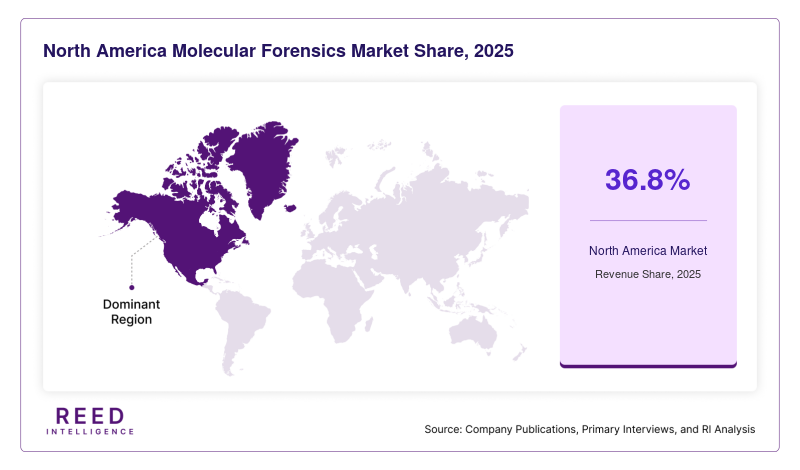
- North America dominated the market with a 36.8% share in 2025.
- Asia Pacific is expected to grow at the fastest CAGR of 11.8% during 2026–2034.
- By technology, PCR-based analysis accounted for the largest share of 39.6%, while next-generation sequencing is projected to grow at a CAGR of 13.1%.
- By application, criminal investigation led with a 44.3% share, whereas biodefense and pathogen tracing is expected to expand at a CAGR of 12.6%.
- The United States remained the dominant country, with market values of USD 2.41 billion in 2024 and USD 2.66 billion in 2025.
Market Trends
Expansion of next-generation sequencing in forensic laboratories
A major trend shaping the Molecular Forensics Market is the integration of next-generation sequencing (NGS) into public and private forensic workflows. Traditional STR profiling remains widely used, but forensic agencies are increasingly investing in NGS for enhanced genetic discrimination, ancestry inference, and degraded sample analysis. NGS platforms allow simultaneous examination of mitochondrial DNA, SNPs, and phenotypic markers, which improves case-solving accuracy in complex investigations. Governments in developed economies are allocating larger forensic modernization budgets to establish genomic evidence systems, while private laboratories are commercializing forensic sequencing panels. The declining cost of sequencing and software automation is also making advanced molecular methods more accessible to mid-sized forensic institutions.
Growth of portable and rapid DNA technologies
Portable DNA analysis systems are emerging as a transformative trend, enabling near real-time molecular forensic analysis outside centralized laboratories. Mobile forensic platforms are increasingly deployed at border checkpoints, military operations, and disaster response zones to support immediate human identification. These devices combine microfluidics, PCR miniaturization, and cloud-based analytics for faster sample processing. The trend is particularly relevant for time-sensitive criminal cases and mass casualty events. Commercial vendors are developing field-deployable systems with improved contamination control and legal chain-of-custody compliance. This trend is expanding market opportunities by bringing molecular forensics into operational environments where speed and portability are essential.
Market Drivers
Rising crime rates and judicial dependence on DNA evidence
The increasing complexity of violent crimes, cyber-enabled biological threats, and unidentified human remains cases has intensified reliance on molecular forensic technologies. DNA-based evidence is now considered a foundational component in criminal prosecution across many jurisdictions due to its scientific reliability and legal admissibility. Law enforcement agencies are expanding forensic budgets to improve case closure rates and reduce evidence backlog. Molecular tools are particularly critical in sexual assault investigations, homicide cases, and missing persons identification. The use of genomic databases and familial DNA matching is also improving suspect identification. As justice systems continue emphasizing evidence precision, molecular forensics adoption is expected to accelerate globally.
Growth in biodefense, public health surveillance, and food authentication
Molecular forensics is increasingly applied beyond criminal justice into pathogen source attribution, food fraud prevention, and bioterrorism defense. Governments are deploying molecular analytical platforms to trace disease outbreaks, detect genetically modified contamination, and secure supply chains. This diversification has expanded the market from a narrow forensic niche into a broader biosurveillance ecosystem. Public health emergencies have highlighted the importance of genomic tracing capabilities, prompting higher investment in forensic-grade sequencing tools. Food safety regulators are also using molecular forensics to verify species origin and prevent adulteration, creating substantial demand for specialized reagents and software solutions.
Market Restraint
High operational costs and regulatory standardization challenges
Despite technological advancement, the Molecular Forensics Market faces notable restraint from high capital investment requirements and inconsistent regulatory frameworks. Advanced sequencing instruments, contamination-controlled laboratories, and skilled forensic geneticists involve significant expenditure, limiting adoption in low-resource regions. Maintenance costs, validation protocols, and software licensing also raise operational barriers. In addition, varying standards for evidence admissibility and genetic data privacy across countries complicate international market expansion. Smaller forensic institutions often struggle to justify replacing legacy systems with advanced molecular infrastructure. For example, many developing countries still rely heavily on traditional fingerprinting due to budget limitations. Data security concerns around genomic databases further create legal and ethical barriers, slowing implementation in some jurisdictions.
Market Opportunities
Integration of artificial intelligence in forensic genomic analysis
Artificial intelligence presents a major growth opportunity by improving speed, pattern recognition, and predictive capability in molecular forensic analysis. AI-enabled software can automate genotype interpretation, ancestry prediction, and mixture deconvolution while reducing human error. These capabilities are increasingly valuable for processing large genomic databases and solving cold cases. AI can also support phenotype reconstruction from DNA, enabling advanced suspect profiling. As machine learning tools become more accurate and compliant with legal standards, vendors can expand software revenue streams. The fusion of AI with molecular forensics may significantly improve laboratory productivity and case throughput.
Emerging markets modernization of forensic infrastructure
Developing economies across Asia, Latin America, and parts of Africa are investing in judicial modernization and biosurveillance, creating new opportunities for molecular forensic providers. National security reforms, urbanization, and rising organized crime are pushing governments to improve forensic science capabilities. International grants and public-private collaborations are funding new forensic laboratories, training centers, and genomic databases. These markets often lack established molecular infrastructure, making them attractive for instrument manufacturers, reagent suppliers, and cloud software firms. Localization strategies and affordable platform design could unlock substantial future growth in underserved regions.
Segmental Analysis
By Technology
PCR-based analysis dominated the Molecular Forensics Market in 2024 with a 39.6% share due to its affordability, speed, and strong judicial acceptance. PCR technologies are widely used for DNA amplification, STR profiling, and casework involving degraded biological samples. Public forensic institutions prefer PCR because of validated workflows, lower equipment costs, and compatibility with existing legal frameworks. The segment’s broad use in paternity testing, criminal justice, and food authentication reinforces market leadership.
Next-generation sequencing is projected to grow at the fastest CAGR of 13.1% through 2034. Growth is fueled by improved precision, broader genomic coverage, and ability to analyze complex or mixed DNA samples. Sequencing platforms enable ancestry prediction, phenotyping, and pathogen source tracing. Declining sequencing costs and software advancements are increasing institutional transition from traditional methods.
By Application
Criminal investigation represented the leading application segment in 2024, holding 44.3% market share. This dominance reflects extensive use in homicide, sexual assault, cyber-biosecurity, and missing persons investigations. Judicial reliance on DNA evidence has expanded forensic laboratory demand for molecular technologies. National criminal databases and legal reforms have further institutionalized this segment globally.
Biodefense and pathogen tracing is forecast to expand at a CAGR of 12.6% during 2026–2034. Growth is driven by public health preparedness, outbreak investigation, and anti-bioterrorism capabilities. Molecular forensics tools are increasingly used to identify pathogen origins, contamination pathways, and genetically engineered biological threats, broadening industry scope.
By End Use
Government forensic laboratories led the market in 2024 with a 46.8% share, supported by national justice systems, public funding, and criminal investigation mandates. These laboratories remain central to DNA profiling, legal evidence generation, and public security operations. Large-scale procurement of PCR and sequencing platforms reinforces their dominant role.
Private forensic service providers are expected to witness the fastest CAGR of 11.9% through 2034. Outsourcing trends, insurance investigations, paternity testing, and food authenticity services are driving expansion. Private firms benefit from specialized expertise, faster turnaround, and commercialization of niche molecular services.
Regional Analysis
North America
North America held the largest share of the Molecular Forensics Market in 2025, accounting for 36.8% of global revenue, and is forecast to grow at a CAGR of 8.9% through 2034. Strong institutional adoption, mature judicial systems, and extensive genomic database integration support regional dominance. The region benefits from advanced forensic laboratory networks, substantial federal investment, and widespread deployment of automated DNA profiling systems.
The United States dominates North America due to large-scale criminal DNA indexing programs and biodefense initiatives. A unique growth factor is the country’s continued investment in forensic backlog reduction programs, which fund laboratory upgrades and advanced sequencing integration. Government agencies and private sector innovation partnerships are accelerating adoption of molecular analytics.
Europe
Europe captured 27.1% of the global market in 2025 and is expected to expand at a CAGR of 9.1% during the forecast period. Growth is supported by stringent food traceability laws, strong legal frameworks, and forensic collaboration among EU member states. Molecular forensics is increasingly used in criminal justice, counterfeit prevention, and environmental investigations.
Germany remains the dominant European country due to its robust biotechnology sector and judicial modernization programs. A unique growth factor is Europe’s regulatory focus on food origin authentication and anti-adulteration enforcement, which broadens molecular forensics beyond criminal applications into consumer safety and trade compliance.
Asia Pacific
Asia Pacific represented 21.6% of the global Molecular Forensics Market in 2025 and is forecast to register the fastest CAGR of 11.8% through 2034. Rapid urbanization, increasing crime complexity, and government modernization of forensic science are driving expansion. Investments in public health genomics and disaster victim identification also strengthen demand.
China leads the Asia Pacific region through extensive genomic technology deployment and expanding public security infrastructure. A unique growth factor is the integration of molecular forensics into national smart city surveillance and public security systems, supporting broad adoption in both law enforcement and civil administration.
Middle East & Africa
Middle East & Africa accounted for 8.1% of market share in 2025 and is projected to grow at a CAGR of 9.7% over the forecast period. Demand is rising due to security concerns, border protection needs, and healthcare genomics expansion. Wealthier Gulf countries are investing in forensic modernization to strengthen homeland security.
Saudi Arabia dominates the regional market because of increasing national security investments and advanced laboratory infrastructure development. A unique growth factor is the use of molecular forensics in religious pilgrimage security and mass gathering management, where rapid identification technologies support public safety.
Latin America
Latin America held 6.4% of global market revenue in 2025 and is expected to grow at a CAGR of 10.2% through 2034. Crime reduction programs, judicial reform, and anti-trafficking initiatives are key market drivers. Governments are gradually increasing investments in DNA laboratories and criminal database systems.
Brazil remains the leading country due to expanding forensic institution capacity and rising criminal investigation demand. A unique growth factor is regional anti-narcotics enforcement, where molecular evidence is increasingly used for trafficking network disruption and cross-border law enforcement collaboration.
Competitive Landscape
The Molecular Forensics Market is moderately consolidated, with major players competing through innovation, software integration, and regional expansion. Thermo Fisher Scientific leads the market due to its broad forensic portfolio and continued investment in rapid DNA systems. Illumina maintains strong presence in sequencing applications, while QIAGEN focuses on sample preparation and bioinformatics. Promega is recognized for STR kits and forensic reagents, and Agilent Technologies supports advanced analytical instrumentation. A recent industry development includes Thermo Fisher’s expansion of portable forensic DNA solutions for law enforcement field deployment, strengthening rapid identification capabilities.
Key Players
- Thermo Fisher Scientific
- Illumina Inc.
- QIAGEN N.V.
- Promega Corporation
- Agilent Technologies
- Bio-Rad Laboratories
- Danaher Corporation
- PerkinElmer Inc.
- Eurofins Scientific
- Verogen Inc.
- GE Healthcare
- Abbott Laboratories
- LGC Forensics
- Norgen Biotek
- Hamilton Company
Recent Developments
- Thermo Fisher Scientific introduced enhanced portable DNA identification systems for field investigations.
- Illumina expanded forensic sequencing panels targeting ancestry and phenotypic analysis.
- QIAGEN launched upgraded forensic bioinformatics software to improve mixture interpretation and case processing efficiency.
Molecular Forensics Market Segments
Technology
- PCR-Based Analysis
- Next-Generation Sequencing
- Capillary Electrophoresis
- Microarray Technology
Application
- Criminal Investigation
- Paternity Testing
- Biodefense and Pathogen Tracing
- Food Authentication
- Wildlife Forensics
End Use
- Government Forensic Laboratories
- Private Forensic Laboratories
- Academic and Research Institutions
- Healthcare and Biosurveillance Agencies
By Region
- North America
- Europe
- APAC
- Middle East and Africa
- LATAM