Molten Carbonate Fuel Cells Market Size, Share & Demand Report By Type (Stationary, Portable), By Application (Power Generation, Combined Heat and Power, Industrial Use), By End-Use (Utilities, Industrial, Commercial), By Region & Segment Forecasts, 2026–2034
USD 3950
Market Overview
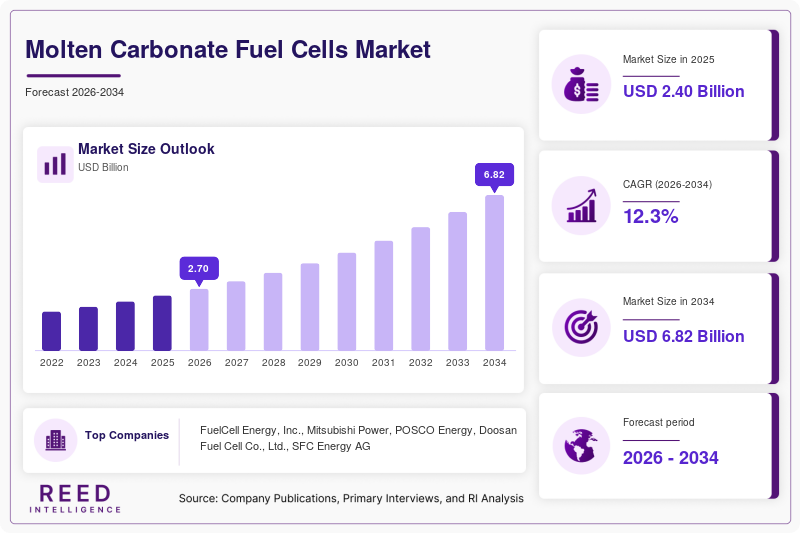
The Molten Carbonate Fuel Cells Market size was valued at approximately USD 2.4 billion in 2026 and is projected to reach around USD 6.1 billion by 2034, expanding at a CAGR of 12.3% during the forecast period of 2026–2034. The market growth is primarily driven by the increasing demand for efficient and low-emission power generation technologies across industrial and utility-scale applications. Molten carbonate fuel cells (MCFCs) are gaining traction due to their ability to utilize a variety of fuels, including natural gas and biogas, while delivering higher electrical efficiency compared to conventional combustion-based systems.
A key global factor supporting market expansion is the rising emphasis on decarbonization and clean energy transition. Governments and private organizations are investing in advanced fuel cell technologies to reduce greenhouse gas emissions while maintaining grid stability. MCFC systems, with their capability for combined heat and power (CHP) generation, are increasingly deployed in distributed energy systems, particularly in regions facing energy security challenges. Additionally, technological advancements in electrolyte materials and stack durability are enhancing system performance and lifespan, further supporting adoption.
Key Highlights
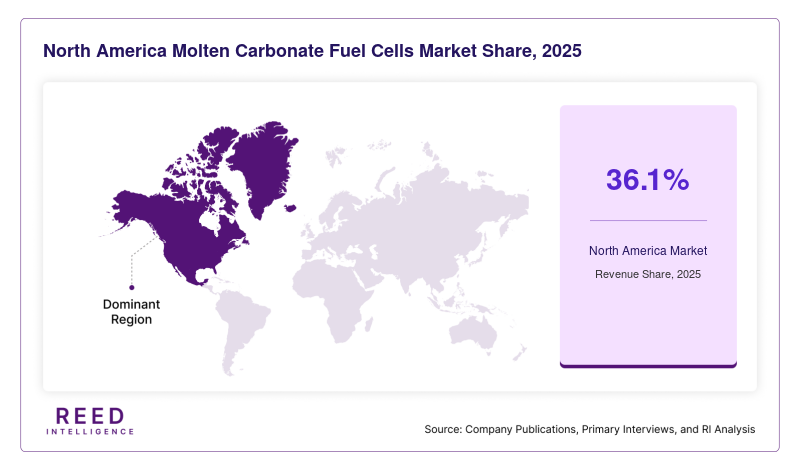
- North America dominated the market with a 36.1% share in 2025.
- Asia Pacific is expected to grow at the fastest CAGR of 13.4% during 2026–2034.
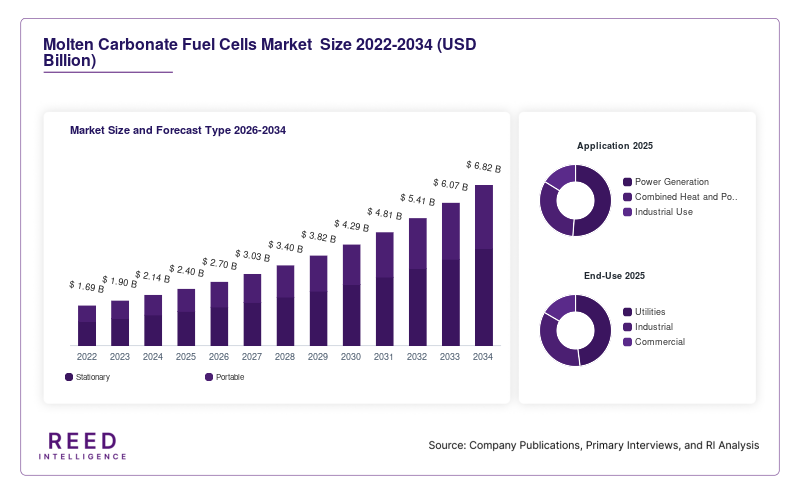
- By type, stationary fuel cells accounted for the largest share of 62.8%, while portable systems are projected to grow at a CAGR of 14.1%.
- By application, power generation led with a 54.3% share, whereas industrial CHP is expected to expand at a CAGR of 13.6%.
- The United States remained the dominant country, with market values of USD 640 million in 2024 and USD 710 million in 2025.
Market Trends
Increasing Integration of Fuel Cells in Distributed Energy Systems
The adoption of molten carbonate fuel cells is rising within distributed energy systems due to their efficiency and flexibility in fuel usage. These systems are increasingly deployed in urban and industrial clusters where centralized grid expansion is challenging or costly. MCFCs offer stable baseload power along with heat recovery capabilities, making them suitable for hospitals, data centers, and manufacturing units. Utilities are also integrating these systems to support grid resilience and reduce dependency on fossil fuel-based peak power plants. This trend is further reinforced by the growing need for energy independence and localized power generation solutions in both developed and developing economies.
Advancements in Carbon Capture Integration
Another notable trend is the integration of MCFC technology with carbon capture systems. Unlike other fuel cells, MCFCs can inherently capture carbon dioxide during operation, making them attractive for industries aiming to reduce emissions. Companies are investing in hybrid systems that combine fuel cell technology with carbon capture and storage (CCS) processes. This approach not only generates power but also reduces industrial carbon footprints, particularly in sectors such as cement, steel, and chemical manufacturing. The increasing focus on net-zero targets is accelerating research and pilot projects in this domain, contributing to long-term market growth.
Market Drivers
Rising Demand for Clean and Efficient Power Generation
The global push toward reducing carbon emissions is a major driver for the molten carbonate fuel cells market. Governments are implementing stricter environmental regulations and offering incentives for adopting clean energy technologies. MCFCs provide higher efficiency compared to traditional thermal power plants, often exceeding 60% efficiency when used in combined heat and power configurations. This efficiency translates into lower fuel consumption and reduced operational costs over time. Industries are increasingly adopting these systems to meet sustainability goals while maintaining reliable power supply, especially in regions where grid reliability is inconsistent.
Expansion of Industrial Combined Heat and Power Applications
Industrial sectors are increasingly adopting MCFCs for combined heat and power applications due to their ability to generate both electricity and thermal energy from a single fuel source. This dual-output capability enhances overall energy utilization efficiency, making it a cost-effective solution for energy-intensive industries. Facilities such as refineries, chemical plants, and food processing units benefit from reduced energy costs and improved operational efficiency. Additionally, the ability of MCFCs to operate on various fuels, including waste gases, makes them an attractive option for industries seeking to optimize energy use and reduce emissions simultaneously.
Market Restraint
High Initial Capital Investment and Infrastructure Requirements
One of the primary challenges limiting the widespread adoption of molten carbonate fuel cells is the high initial investment required for system installation and infrastructure development. MCFC systems involve complex components, including high-temperature electrolytes and specialized materials, which contribute to elevated manufacturing and installation costs. Additionally, the need for skilled personnel and maintenance infrastructure further increases operational expenses. For small and medium enterprises, these costs can be prohibitive, delaying adoption despite long-term efficiency benefits. For example, industrial facilities considering MCFC deployment often compare upfront costs with alternative technologies such as gas turbines or solar systems, which may offer lower initial investment despite lower efficiency.
Market Opportunities
Growing Adoption in Hydrogen Economy Initiatives
The transition toward a hydrogen-based energy ecosystem presents significant opportunities for the molten carbonate fuel cells market. MCFCs can operate on hydrogen-rich fuels and play a role in hydrogen production and utilization systems. Governments and energy companies are investing in hydrogen infrastructure, including production, storage, and distribution networks. MCFC technology can complement these initiatives by providing efficient power generation solutions that align with hydrogen utilization strategies. As hydrogen adoption expands across transportation and industrial sectors, the demand for compatible fuel cell technologies is expected to rise.
Increasing Deployment in Emerging Economies
Emerging economies in Asia, Latin America, and Africa present untapped growth potential for MCFC deployment. Rapid industrialization and urbanization are driving energy demand in these regions, often outpacing the expansion of traditional power infrastructure. MCFC systems offer a viable solution for decentralized power generation, reducing reliance on centralized grids. Governments in these regions are also introducing policies to promote clean energy adoption, creating favorable conditions for market entry. Additionally, international collaborations and funding initiatives are supporting the deployment of advanced energy technologies in developing markets.
Segmental Analysis
By Type
The stationary segment held the largest share of the molten carbonate fuel cells market in 2024, accounting for approximately 62.8% of the total market. These systems are widely used in large-scale power generation and industrial applications due to their high efficiency and reliability. Stationary MCFCs are particularly suitable for continuous operation, making them ideal for utilities, manufacturing facilities, and commercial buildings. Their ability to generate both electricity and heat enhances overall energy efficiency, which is a key factor driving their adoption. Additionally, advancements in system design and materials are improving durability and reducing maintenance requirements, further supporting the dominance of this segment.
The portable segment is expected to witness the fastest growth, with a projected CAGR of 14.1% during the forecast period. This growth is driven by increasing demand for compact and efficient power solutions in remote and off-grid locations. Portable MCFC systems are being developed for applications such as military operations, disaster relief, and remote industrial sites. The ability to operate on multiple fuel types enhances their versatility, making them suitable for diverse environments. Technological innovations aimed at reducing system size and weight are also contributing to the rapid expansion of this segment.
By Application
Power generation emerged as the dominant application segment, accounting for 54.3% of the market share in 2024. MCFC systems are widely used for utility-scale and distributed power generation due to their high efficiency and low emissions. They are increasingly deployed in urban areas to support grid stability and reduce reliance on fossil fuel-based power plants. The ability to integrate with renewable energy sources further enhances their appeal, making them a key component of modern energy systems.
Industrial combined heat and power applications are expected to grow at the fastest CAGR of 13.6% during the forecast period. This growth is driven by the need for efficient energy utilization in industrial processes. MCFC systems provide both electricity and heat, reducing overall energy costs and improving operational efficiency. Industries such as chemicals, food processing, and refining are adopting these systems to optimize energy use and meet sustainability targets.
By End-Use
The utilities segment dominated the market in 2024, accounting for approximately 48.7% of the total share. Utilities are increasingly adopting MCFC systems to enhance grid reliability and support distributed energy generation. These systems provide a stable and continuous power supply, making them suitable for base-load applications. The integration of MCFCs with renewable energy sources is also gaining traction, enabling utilities to reduce carbon emissions while maintaining energy security.
The industrial segment is projected to grow at the fastest CAGR of 13.2% during the forecast period. This growth is driven by increasing energy demand and the need for cost-effective and efficient power solutions in industrial operations. MCFC systems offer significant advantages in terms of fuel flexibility and efficiency, making them an attractive option for industries seeking to optimize energy use. Additionally, the ability to utilize waste gases as fuel further enhances their value proposition.
Regional Analysis
North America
North America held a significant share of the molten carbonate fuel cells market, accounting for approximately 36.1% in 2025, with a projected CAGR of 11.5% during the forecast period. The region benefits from strong government support for clean energy technologies and the presence of established fuel cell manufacturers. The United States and Canada are investing in distributed energy systems and grid modernization, which is driving demand for MCFC installations across commercial and industrial sectors.
The United States dominates the regional market, supported by favorable policies and funding programs aimed at reducing carbon emissions. A key growth factor is the increasing adoption of fuel cells in data centers and healthcare facilities, where uninterrupted power supply is critical. Additionally, partnerships between private companies and government agencies are accelerating the deployment of large-scale MCFC projects.
Europe
Europe accounted for around 27.4% of the market share in 2025 and is expected to grow at a CAGR of 12.1% through 2034. The region’s strong commitment to achieving carbon neutrality is driving investments in advanced fuel cell technologies. Countries such as Germany, the UK, and Italy are focusing on integrating MCFC systems into renewable energy frameworks to enhance grid stability and reduce emissions.
Germany leads the European market, driven by its robust industrial base and emphasis on sustainable energy solutions. A unique growth factor in the region is the integration of MCFC systems with renewable energy sources such as wind and solar. This hybrid approach enhances energy reliability and supports the transition toward a low-carbon economy.
Asia Pacific
Asia Pacific is the fastest-growing region, with a CAGR of 13.4% and a market share of approximately 22.8% in 2025. Rapid industrialization, urbanization, and increasing energy demand are key factors driving market growth. Countries such as China, Japan, and South Korea are investing heavily in fuel cell technologies as part of their clean energy strategies.
China dominates the regional market, supported by government initiatives aimed at reducing air pollution and promoting clean energy adoption. A significant growth factor is the large-scale deployment of MCFC systems in industrial parks and urban infrastructure projects. Additionally, collaborations between domestic and international companies are enhancing technology transfer and market expansion.
Middle East & Africa
The Middle East & Africa region accounted for about 7.3% of the market share in 2025 and is projected to grow at a CAGR of 11.8%. The region’s focus on diversifying energy sources and reducing dependence on fossil fuels is driving interest in fuel cell technologies. Countries in the Gulf Cooperation Council (GCC) are exploring MCFC deployment for industrial and utility applications.
Saudi Arabia is the leading market in the region, supported by its strategic initiatives to develop sustainable energy solutions. A unique growth factor is the integration of MCFC systems in oil and gas operations, where they can utilize associated gases for power generation. This approach enhances energy efficiency while reducing flaring and emissions.
Latin America
Latin America held a market share of approximately 6.4% in 2025 and is expected to grow at a CAGR of 12.0% during the forecast period. The region is gradually adopting clean energy technologies to address growing energy demand and environmental concerns. Countries such as Brazil and Mexico are leading the adoption of fuel cell systems.
Brazil dominates the regional market, driven by its expanding industrial sector and focus on renewable energy integration. A key growth factor is the use of MCFC systems in agricultural and bioenergy applications, where biogas can be utilized as a fuel source. This approach supports sustainable energy production and reduces waste.
Competitive Landscape
The molten carbonate fuel cells market is moderately consolidated, with a mix of established players and emerging companies competing to expand their market presence. Key companies are focusing on technological advancements, strategic partnerships, and capacity expansion to strengthen their position. FuelCell Energy, Inc. is considered a leading player in the market, with a strong portfolio of MCFC systems and ongoing investments in research and development. The company has recently announced the expansion of its manufacturing capacity to meet growing demand for clean energy solutions.
Other major players are also investing in innovation and collaborations to enhance their product offerings. Companies are exploring new applications for MCFC technology, including carbon capture and hydrogen production. Strategic alliances with utilities and industrial players are enabling companies to deploy large-scale projects and gain a competitive edge. The market is expected to witness increased competition as new entrants leverage advanced technologies to capture market share.
Key Players
- FuelCell Energy, Inc.
- Mitsubishi Power
- POSCO Energy
- Doosan Fuel Cell Co., Ltd.
- SFC Energy AG
- Ballard Power Systems
- Bloom Energy Corporation
- Ceres Power Holdings plc
- AFC Energy plc
- Plug Power Inc.
- Nuvera Fuel Cells, LLC
- Elcogen AS
- Horizon Fuel Cell Technologies
- PowerCell Sweden AB
- Toshiba Energy Systems & Solutions
Recent Developments
- FuelCell Energy, Inc. announced the launch of an advanced MCFC system integrated with carbon capture technology to support industrial decarbonization.
- Mitsubishi Power entered into a strategic partnership with a European utility company to deploy large-scale MCFC systems for distributed power generation.
- POSCO Energy expanded its fuel cell manufacturing facility to increase production capacity and meet rising demand in Asia Pacific.
Molten Carbonate Fuel Cells Market Segments
Type
- Stationary
- Portable
Application
- Power Generation
- Combined Heat and Power
- Industrial Use
End-Use
- Utilities
- Industrial
- Commercial
Region
- North America
- Europe
- Asia Pacific
- Middle East & Africa
- Latin America
By Region
- North America
- Europe
- APAC
- Middle East and Africa
- LATAM