Molten Salt Reactors Market Size, Share & Demand Report By Reactor Type (Thermal Spectrum Reactors, Fast Spectrum Reactors, Epithermal Reactors), By Application (Power Generation, Industrial Heat, Hydrogen Production, Research and Testing), By End Use (Utility Companies, Industrial Enterprises, Research Institutes, Government Organizations), By Region & Segment Forecasts, 2026–2034
USD 3950
Market Overview
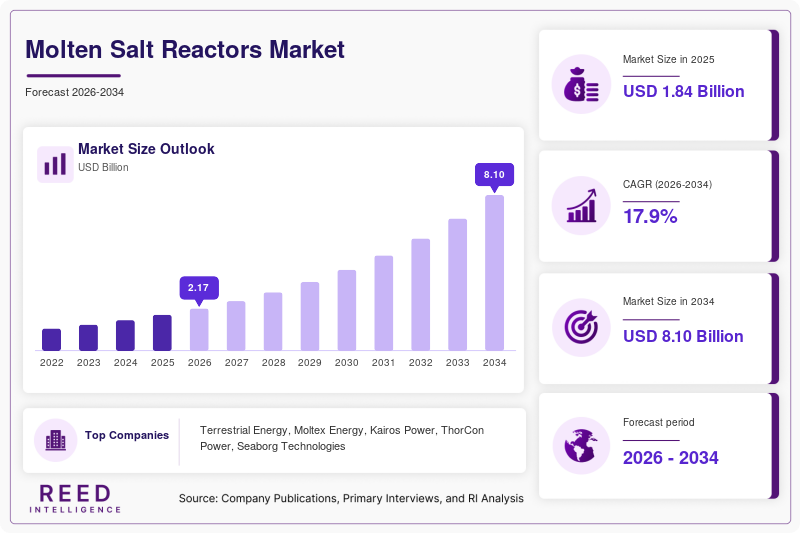
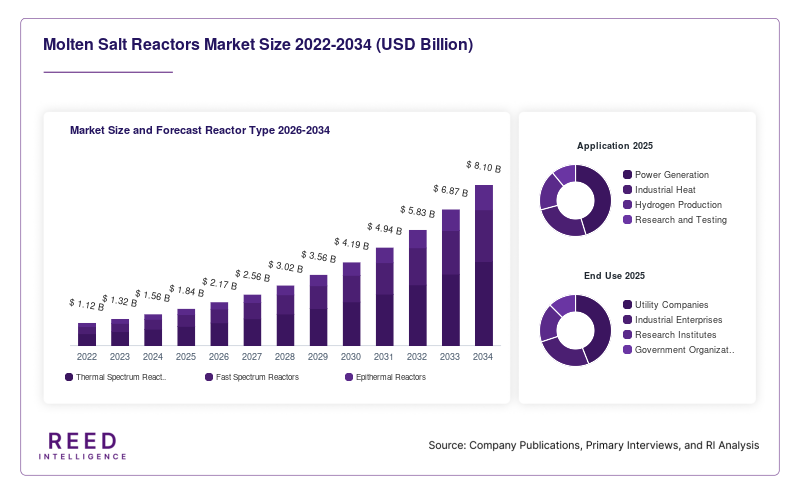
The global Molten Salt Reactors Market size was valued at USD 1.84 billion in 2026 and is projected to reach USD 6.92 billion by 2034, expanding at a CAGR of 17.9% during the forecast period from 2026 to 2034. The market is gaining momentum as governments, energy developers, and utility operators continue to invest in next-generation nuclear technologies that offer improved thermal efficiency, lower waste generation, and enhanced operational safety. Molten salt reactors are being explored as an alternative to conventional light water reactors due to their ability to operate at atmospheric pressure and support flexible fuel cycles. Growing pressure to reduce carbon emissions across industrial and power generation sectors has further strengthened long-term demand for advanced nuclear systems.
One of the primary global factors supporting market growth is the increasing transition toward low-carbon baseload energy infrastructure. Countries across North America, Europe, and Asia Pacific are introducing policies focused on energy diversification and clean electricity production. Rising energy consumption from electric vehicles, industrial electrification, and data centers has created demand for reliable and continuous power generation technologies. Molten salt reactors are receiving greater attention because they can deliver stable power output while supporting decarbonization goals. In addition, public and private investments in small modular reactor programs are accelerating commercialization activities and pilot reactor deployment.
Key Highlights
- North America dominated the market with a 36.4% share in 2025.
- while Asia Pacific is expected to grow at the fastest CAGR of 19.6% during 2026–2034.
- By reactor type, thermal spectrum reactors accounted for the largest share of 42.1%.
- while fast spectrum reactors are projected to grow at a CAGR of 20.8%.
- By application, power generation led with a 58.7% share.
- whereas industrial heat applications are expected to expand at a CAGR of 18.9%.
- The United States remained the dominant country, with market values of USD 640 million in 2024 and USD 760 million in 2025.
Market Trends
Expansion of Small Modular Nuclear Programs
The increasing development of small modular nuclear technologies is emerging as a major trend within the Molten Salt Reactors Market. Several public energy agencies and private reactor developers are focusing on compact reactor systems that can be deployed in remote locations, industrial clusters, and regional power grids. Molten salt reactors are becoming part of these programs because of their scalable design, passive safety systems, and lower cooling requirements compared to conventional nuclear plants. Energy utilities are also evaluating modular deployment strategies to reduce construction timelines and improve financing flexibility. Pilot projects in the United States, Canada, China, and the United Kingdom are contributing to commercialization activities and encouraging supply chain partnerships across reactor engineering, materials manufacturing, and thermal system integration.
Growing Integration of Advanced Materials and Digital Monitoring
Another important trend influencing the Molten Salt Reactors Market is the increasing use of advanced corrosion-resistant materials and digital monitoring technologies. Reactor developers are investing in nickel-based alloys, ceramic coatings, and high-temperature composites that can improve reactor durability under extreme thermal conditions. At the same time, digital reactor monitoring systems supported by artificial intelligence and predictive analytics are being integrated into next-generation reactor platforms. These technologies help operators monitor salt chemistry, thermal performance, and structural integrity in real time. As nuclear operators seek higher operational reliability and lower maintenance costs, demand for intelligent monitoring solutions and advanced reactor materials is expected to rise steadily across commercial and research-based molten salt reactor projects.
Market Drivers
Rising Demand for Low-Carbon Baseload Power Generation
The rising global demand for low-carbon baseload electricity generation is a significant growth driver for the Molten Salt Reactors Market. Renewable energy sources such as solar and wind are expanding rapidly, but grid operators continue to require stable and uninterrupted power generation to maintain energy reliability. Molten salt reactors are increasingly viewed as a viable solution because they can deliver continuous electricity output with minimal greenhouse gas emissions. Governments are also promoting nuclear innovation programs to support long-term energy security and carbon reduction targets. The ability of molten salt reactors to operate at high thermal efficiency levels further strengthens their attractiveness for utility operators and industrial power consumers seeking cleaner energy alternatives.
Increasing Government Funding for Advanced Reactor Research
Government support for advanced nuclear reactor research and commercialization is accelerating the development of molten salt reactor technologies worldwide. Several national energy departments and research institutions are allocating funding for prototype reactor construction, fuel cycle development, and safety testing programs. Financial incentives, licensing support, and public-private partnerships are helping emerging reactor companies scale their technologies and attract additional investment. Countries including China, the United States, France, and Canada are expanding nuclear innovation frameworks to strengthen domestic clean energy capabilities. These initiatives are improving investor confidence and encouraging engineering firms, fuel suppliers, and utility companies to participate in molten salt reactor development programs, thereby supporting broader market expansion during the forecast period.
Market Restraint
Complex Regulatory Approval and High Development Costs
Complex regulatory approval procedures and high capital development costs remain major restraints for the Molten Salt Reactors Market. Advanced reactor technologies require extensive safety evaluations, fuel testing, and environmental assessments before commercial deployment can begin. Since molten salt reactors differ significantly from traditional nuclear systems, many national regulatory frameworks are still adapting licensing standards for these technologies. This creates delays in project approvals and increases uncertainty for investors and reactor developers. In addition, molten salt reactors require specialized materials, advanced cooling systems, and highly skilled engineering expertise, resulting in elevated research and construction expenses. Smaller reactor startups often face challenges in securing long-term financing for demonstration projects. Delays in supply chain development and limited availability of commercial-grade fuel processing infrastructure can further affect deployment timelines. These barriers may slow large-scale commercialization efforts in emerging nuclear markets, particularly in countries with limited regulatory experience in advanced reactor technologies.
Market Opportunities
Expansion of Industrial Heat and Hydrogen Production Applications
The increasing use of molten salt reactors for industrial heat generation and hydrogen production presents substantial opportunities for market participants. Heavy industrial sectors such as chemicals, steel, refining, and cement manufacturing require high-temperature heat for processing operations. Molten salt reactors can provide continuous thermal energy while reducing dependence on fossil fuels. In addition, high-temperature reactor systems are being explored for clean hydrogen production through advanced electrolysis and thermochemical processes. As governments promote hydrogen economies and industrial decarbonization strategies, demand for reliable nuclear-based heat generation technologies is expected to increase. Reactor developers that establish partnerships with industrial manufacturers and hydrogen producers may gain long-term commercial advantages in this evolving energy landscape.
Increasing Energy Demand in Emerging Economies
Rapid industrialization and electricity demand growth across emerging economies are creating new opportunities for the Molten Salt Reactors Market. Countries in Asia Pacific, the Middle East, and parts of Latin America are expanding investments in energy infrastructure to support manufacturing growth, urbanization, and digital transformation. Many of these regions are seeking alternatives to coal-based electricity generation while maintaining grid reliability. Molten salt reactors offer potential benefits for regions with limited freshwater availability because they can operate with alternative cooling systems. Governments are also exploring advanced nuclear technologies to diversify energy portfolios and reduce exposure to fossil fuel price volatility. As international nuclear cooperation agreements expand, reactor technology providers may secure new opportunities for licensing, engineering services, and reactor deployment projects.
Segmental Analysis
By Reactor Type
Thermal spectrum reactors accounted for the largest share of the Molten Salt Reactors Market in 2024, representing approximately 42.1% of total revenue. These reactor systems gained widespread attention because of their relatively mature technological framework and compatibility with existing nuclear fuel research programs. Thermal spectrum molten salt reactors are being widely studied for utility-scale electricity generation due to their ability to maintain efficient neutron moderation and stable thermal output. Several research institutions and reactor developers are prioritizing thermal reactor concepts for pilot deployment because they can support safer operational conditions and lower pressure requirements. Growing investment in prototype demonstration facilities across North America and Europe further strengthened the adoption of thermal spectrum reactor systems. In addition, their ability to integrate with long-term clean energy strategies and industrial power generation projects has supported consistent market demand across both public and private energy sectors.
Fast spectrum reactors are expected to witness the highest CAGR of 20.8% during the forecast period due to increasing interest in advanced fuel utilization and nuclear waste reduction technologies. These reactor systems can operate with fast neutrons and support improved fuel efficiency compared to conventional reactor designs. Governments and research organizations are exploring fast spectrum molten salt reactors because they offer the potential to recycle spent nuclear fuel and reduce long-term radioactive waste volumes. Rising concerns regarding sustainable nuclear fuel management are encouraging greater investment in fast reactor development programs. In addition, advancements in high-temperature materials and fuel salt chemistry are improving the commercial feasibility of fast spectrum designs. Several emerging nuclear startups are also focusing on fast reactor concepts for future industrial heat applications and high-efficiency power generation systems, supporting accelerated growth opportunities within this segment.
By Application
Power generation represented the dominant application segment in the Molten Salt Reactors Market in 2024, accounting for nearly 58.7% of global revenue. Increasing global demand for low-carbon electricity generation and grid stability has driven strong adoption of advanced reactor technologies for utility-scale power production. Molten salt reactors are being evaluated as reliable baseload energy sources capable of supporting renewable energy integration while maintaining continuous electricity output. Several national energy programs are funding research focused on replacing aging coal-fired power plants with advanced nuclear alternatives. In addition, utility operators are exploring molten salt reactors because of their potential for improved thermal efficiency and lower operational pressure. The expansion of electrification across transportation, manufacturing, and digital infrastructure sectors has further increased the need for stable electricity generation systems, strengthening the market position of the power generation application segment.
Industrial heat applications are projected to register the fastest CAGR of 18.9% during the forecast period due to increasing industrial decarbonization initiatives across energy-intensive sectors. Industries including chemicals, steel, refining, and cement manufacturing require continuous high-temperature heat for production processes. Molten salt reactors are emerging as a promising solution because they can deliver thermal energy with lower carbon emissions compared to fossil fuel-based systems. Governments and industrial operators are also investing in clean hydrogen production technologies supported by advanced nuclear heat generation. The growing emphasis on reducing industrial emissions while maintaining operational efficiency is accelerating demand for reactor systems capable of supplying both electricity and process heat. Furthermore, advancements in compact reactor deployment and thermal storage integration are improving the commercial viability of molten salt reactors within industrial environments.
By End Use
Utility companies accounted for the largest share of the Molten Salt Reactors Market in 2024, contributing approximately 46.8% of total revenue. Large utility operators are actively exploring advanced nuclear technologies to diversify electricity generation portfolios and strengthen long-term grid reliability. Molten salt reactors are gaining traction among utilities because they can provide stable baseload power while supporting carbon reduction targets. Utilities in North America, Europe, and Asia Pacific are partnering with reactor developers and research institutions to evaluate pilot deployment opportunities and future commercial projects. Rising electricity demand from urban infrastructure, electric vehicle charging networks, and digital services has further encouraged utility investment in advanced reactor technologies. Additionally, supportive government policies and financing programs for clean energy infrastructure are helping utilities accelerate research and feasibility studies related to molten salt reactor deployment.
Industrial enterprises are anticipated to witness the fastest CAGR of 19.3% from 2026 to 2034 due to growing demand for reliable on-site power generation and high-temperature process heat. Manufacturing facilities, mining operations, petrochemical plants, and hydrogen production facilities are increasingly evaluating molten salt reactors as part of long-term energy transition strategies. Industrial enterprises are seeking energy systems capable of reducing carbon emissions while maintaining stable operational performance under continuous production conditions. The ability of molten salt reactors to provide combined heat and power generation is creating attractive opportunities for energy-intensive industries. In addition, rising fossil fuel price volatility and stricter industrial emission regulations are encouraging businesses to diversify energy sources. Technological advancements in modular reactor deployment are also improving the practicality of using molten salt reactors in remote industrial locations and large-scale processing facilities.
Regional Analysis
North America
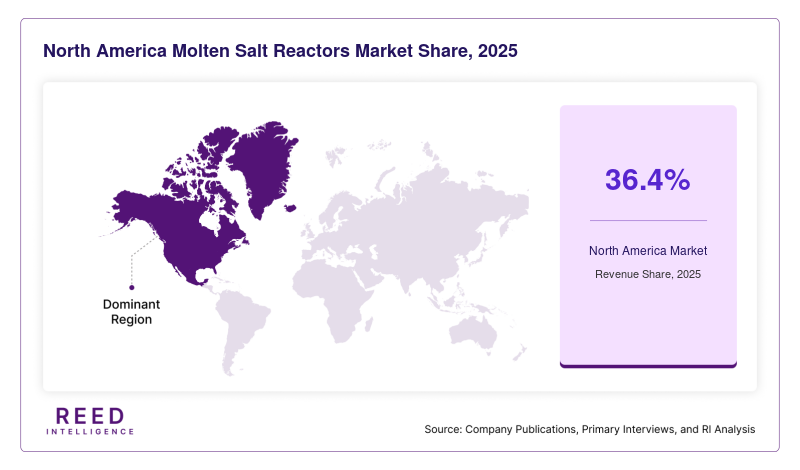
North America accounted for the largest share of the Molten Salt Reactors Market in 2025, representing 36.4% of global revenue. The region is projected to expand at a CAGR of 17.1% during the forecast period due to strong investments in advanced nuclear innovation and clean energy infrastructure. Public funding for next-generation reactors, combined with the presence of established nuclear engineering companies, has accelerated research and commercialization activities. Several utility operators are evaluating molten salt reactor systems as part of long-term decarbonization strategies. Growing energy demand from industrial electrification and large-scale data center expansion is also contributing to regional market growth.
The United States remained the dominant country in North America due to its advanced nuclear research ecosystem and active participation from private reactor developers. The country recorded strong investment activity across reactor prototype programs, fuel cycle development, and thermal materials research. One unique growth factor supporting the market is the increasing collaboration between national laboratories and private energy companies. These partnerships are accelerating reactor testing programs and reducing commercialization barriers. Canada is also supporting regional expansion through small modular reactor policy frameworks and nuclear innovation funding initiatives.
Europe
Europe held a significant share of the Molten Salt Reactors Market in 2025 and is expected to register steady growth through 2034. The regional market is benefiting from aggressive carbon reduction policies and growing interest in stable low-emission electricity generation. Several European governments are incorporating advanced nuclear technologies into long-term energy transition plans to complement renewable energy expansion. Research organizations across France, the United Kingdom, and the Netherlands are participating in molten salt reactor feasibility studies and demonstration projects. Increasing concerns regarding energy security and fossil fuel dependency are further supporting market demand across the region.
France emerged as the dominant country within the European market due to its established nuclear power infrastructure and extensive reactor engineering expertise. The country is focusing on advanced reactor research to modernize its nuclear fleet and maintain long-term electricity reliability. A unique growth factor in France is the integration of advanced nuclear systems into industrial decarbonization strategies. Industries requiring continuous heat and electricity supply are evaluating molten salt reactors for future applications. The United Kingdom is also investing in advanced reactor licensing programs and collaborative nuclear research partnerships.
Asia Pacific
Asia Pacific is anticipated to witness the fastest growth in the Molten Salt Reactors Market, with a projected CAGR of 19.6% from 2026 to 2034. Rising electricity demand, industrial expansion, and government-backed clean energy initiatives are supporting strong regional growth. Countries across the region are increasing investments in advanced nuclear research to reduce coal dependency and improve energy security. Large population growth and urbanization trends are creating pressure on electricity infrastructure, encouraging the adoption of stable baseload energy technologies. Several regional governments are also expanding funding for pilot reactor deployment and nuclear engineering education programs.
China dominated the Asia Pacific market due to its large-scale investment in advanced nuclear technologies and reactor demonstration projects. The country is actively developing experimental molten salt reactor facilities and expanding domestic nuclear manufacturing capabilities. One unique growth factor supporting China’s market leadership is the strong integration between state-owned energy companies and national research institutions. This coordinated development approach has accelerated technology testing and commercialization efforts. India and Japan are also exploring advanced reactor partnerships to diversify energy resources and strengthen long-term electricity generation capacity.
Middle East & Africa
The Middle East & Africa region is gradually increasing its participation in the Molten Salt Reactors Market as countries seek diversified and sustainable energy systems. The market is projected to record moderate growth during the forecast period due to increasing industrial development and long-term energy transition plans. Governments in the Gulf region are exploring advanced nuclear technologies to reduce dependence on oil-based electricity generation and support economic diversification. Growing desalination requirements and industrial energy consumption are also contributing to interest in high-efficiency nuclear systems. International nuclear cooperation agreements are further supporting regional market development.
The United Arab Emirates emerged as the dominant country in the regional market because of its active nuclear energy expansion strategy and investment in clean power infrastructure. The country is focused on developing a diversified energy mix that includes advanced nuclear technologies for long-term electricity stability. A unique growth factor driving regional demand is the growing requirement for energy-intensive desalination facilities. Molten salt reactors are being evaluated for their ability to provide stable thermal energy and electricity for integrated water and power applications. South Africa is also investing in advanced nuclear feasibility studies to support future energy diversification goals.
Latin America
Latin America represented a smaller but developing share of the Molten Salt Reactors Market in 2025. The region is expected to experience gradual growth through 2034 as governments evaluate alternative low-carbon energy solutions. Rising electricity demand from industrial sectors, mining operations, and urban infrastructure projects is supporting interest in advanced nuclear systems. Countries across the region are also seeking to reduce exposure to fossil fuel price fluctuations and hydropower-related climate risks. Collaborative agreements with international nuclear organizations are improving technical expertise and encouraging long-term market participation.
Brazil remained the dominant country within the Latin American market due to its established nuclear research capabilities and growing energy diversification initiatives. The country is examining advanced reactor technologies to support future industrial expansion and improve energy reliability. One unique growth factor supporting the Brazilian market is the increasing electricity demand from mining and mineral processing industries, which require stable power generation in remote locations. Argentina is also contributing to regional market growth through ongoing nuclear technology research programs and government-backed innovation initiatives focused on advanced reactor systems.
Competitive Landscape
The Molten Salt Reactors Market is characterized by increasing collaboration between nuclear technology developers, engineering companies, government research organizations, and utility operators. Market participants are focusing on reactor design optimization, advanced fuel technologies, safety system enhancement, and commercialization partnerships to strengthen competitive positioning. Several companies are expanding investments in pilot reactor construction and licensing programs to accelerate market entry. Strategic partnerships with national laboratories and academic institutions are also supporting technological advancement and material testing activities.
Terrestrial Energy remains one of the leading companies in the market due to its active development of integral molten salt reactor technology and growing partnerships with industrial energy providers. The company has expanded engineering collaborations focused on commercial reactor deployment and industrial heat applications. Kairos Power, Moltex Energy, Seaborg Technologies, and ThorCon are also strengthening their market presence through advanced reactor research and international development agreements. Recent market developments include increased government funding for demonstration projects, licensing approvals for experimental reactor testing, and partnerships focused on nuclear hydrogen production technologies. Competitive intensity is expected to increase as more countries establish advanced nuclear commercialization frameworks and clean energy investment programs.
Key Players
- Terrestrial Energy
- Moltex Energy
- Kairos Power
- ThorCon Power
- Seaborg Technologies
- Copenhagen Atomics
- Flibe Energy
- Elysium Industries
- TerraPower
- General Atomics
- Southern Company
- Idaho National Laboratory
- Rosatom
- China National Nuclear Corporation
- EDF
Recent Developments
- Terrestrial Energy announced expanded engineering collaboration agreements in 2025 to accelerate deployment planning for commercial integral molten salt reactor facilities in North America.
- Kairos Power initiated additional testing activities for advanced fluoride salt cooling technologies aimed at improving reactor efficiency and long-term thermal stability in 2025.
- China National Nuclear Corporation increased investment in experimental molten salt reactor research infrastructure to support pilot-scale reactor development and clean energy integration projects.
- Moltex Energy entered a partnership with industrial energy companies in 2024 to evaluate advanced reactor applications for hydrogen production and industrial heat generation.
- Seaborg Technologies expanded international cooperation initiatives focused on floating compact molten salt reactor systems designed for coastal and remote energy applications.
Molten Salt Reactors Market Segments
Reactor Type
- Thermal Spectrum Reactors
- Fast Spectrum Reactors
- Epithermal Reactors
Application
- Power Generation
- Industrial Heat
- Hydrogen Production
- Research and Testing
End Use
- Utility Companies
- Industrial Enterprises
- Research Institutes
- Government Organizations
By Region
- North America
- Europe
- APAC
- Middle East and Africa
- LATAM