Mom And Baby Products Market Size, Share & Growth Report By Product Type (Baby Care Products, Nutrition Products, Baby Gear), By Application (Newborns and Infants, Toddlers, Mothers), By Region & Segment Forecasts, 2026–2034
USD 3950
Mom And Baby Products Market Size
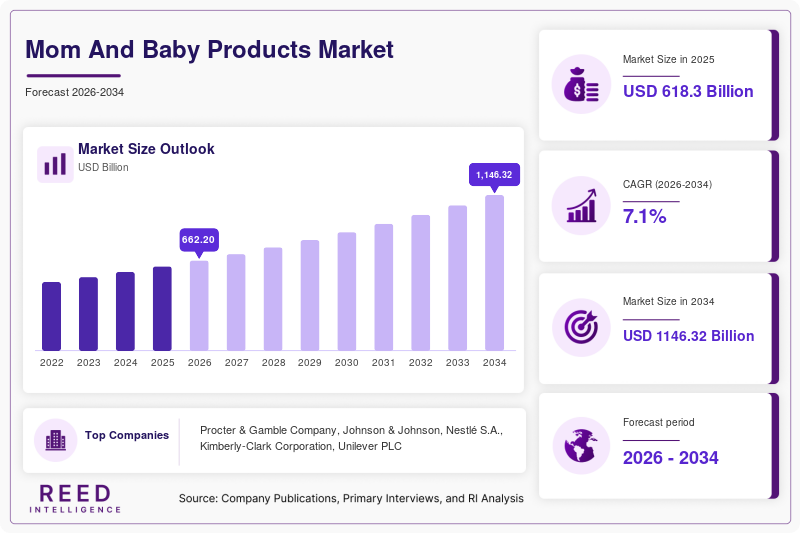
Global Mom And Baby Products market size is projected at USD 618.3 billion in 2026 and is expected to hit USD 1,146.32 billion by 2034 with a CAGR of 7.1%. The market encompasses maternal-care, infant-care, nutrition, hygiene, feeding, apparel, nursery, mobility, and safety products. Comprehensive market data covering 2022–2024 historical performance, 2025 baseline estimates, product segmentation, regional demand, distribution channels, production volumes, and competitive positioning is increasingly important as manufacturers respond to premiumization, e-commerce penetration, safety requirements, and changing parental preferences.
Key Takeaways
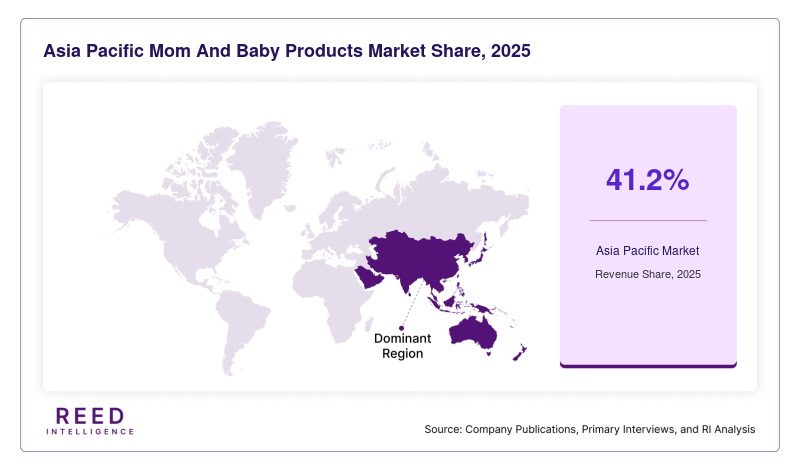
- Asia Pacific dominated the global landscape with approximately 41.2% revenue share in 2025 and is expected to remain the fastest-growing major region at about 9.2% CAGR through 2034.
- Baby Care Products represented the largest product category at approximately 42.1% share, while premium nutrition and specialized baby gear are among the fastest-growing areas.
- Newborns and infants represented approximately 48% of application demand in 2025, supported by high recurring consumption of diapers, wipes, feeding products, skincare, and nutrition.
- India is emerging as a high-growth country, supported by expanding urban populations, rising digital commerce, and increasing expenditure on premium maternal and infant products, with growth estimated above 8% annually through 2034.
- North America and Europe remain high-value markets, collectively accounting for more than 40% of global revenue, supported by premium products, established retail infrastructure, and strong safety standards.
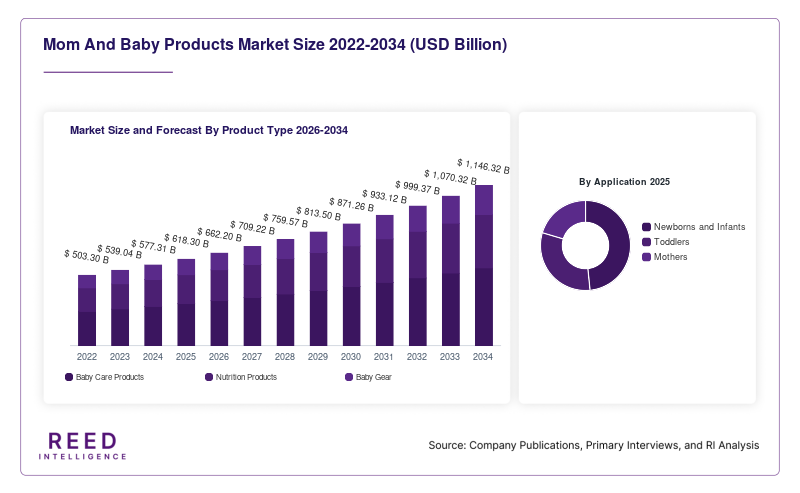
The global Mom And Baby Products market includes products designed to support mothers during pregnancy, postpartum care, and infant and toddler development. The industry covers personal care, hygiene, nutrition, feeding, clothing, nursery products, transportation, safety equipment, toys, and maternal wellness. In 2025, global industry revenue was estimated at approximately USD 580.4 billion, with baby care products contributing about 42.1%, nutrition products 21.5%, baby gear 15.8%, toys and play equipment 11.7%, and maternity products 8.9%. Global production spans billions of diapers, wipes, feeding accessories, apparel units, and packaged nutrition products annually, while online purchasing continues to expand penetration across urban households.
Mom And Baby Products Market Trends
Technology-Enabled and Premium Product Market Innovation
Technology is increasingly influencing product development through advanced absorbent materials, breathable diaper structures, smart baby monitors, connected feeding devices, wearable safety products, and digital parenting platforms. Premium formulations featuring probiotics, HMOs, natural ingredients, fragrance-free compositions, and dermatologically tested materials are gaining traction. Manufacturers are also adopting recyclable packaging, lightweight materials, and precision manufacturing to reduce material usage while improving comfort and performance.
Sector-specific demand is shifting toward convenient, multifunctional, and personalized products that reduce the workload for parents. E-commerce, subscription purchasing, direct-to-consumer brands, and social-commerce channels are increasing accessibility. In nutrition, science-based formulations and specialized products are gaining importance, while baby gear demand is increasingly centered on compact strollers, convertible furniture, ergonomic carriers, and products suitable for smaller urban living spaces.
Mom And Baby Products Market Drivers
Rising Spending on Infant Health, Hygiene, and Nutrition
Growing parental awareness of infant hygiene, nutrition, safety, and developmental needs is a major growth driver. Increasing disposable income in emerging economies is expanding spending on premium diapers, baby skincare, feeding accessories, nutritional products, and nursery equipment. The recurring nature of essential products also supports stable consumption, with hygiene and nutrition categories generating substantial repeat purchases throughout the first years of childhood.
Mom And Baby Products Market Restraints
High Product Costs and Regulatory Compliance
Premium raw materials, advanced formulations, packaging expenses, logistics, and stringent product-safety requirements can increase manufacturing costs. Infant nutrition and safety-related products require particularly rigorous testing and compliance. Price-sensitive consumers in developing economies may therefore prioritize mass-market alternatives, limiting premium-product penetration. Supply-chain volatility involving polymers, specialty chemicals, pulp, packaging materials, and food ingredients can further pressure manufacturer margins.
Mom And Baby Products Market Opportunities
Expansion of Premium, Natural, and Digital-First Products
Significant opportunities exist in organic baby care, sustainable diapers, fragrance-free skincare, specialized maternal nutrition, smart nursery equipment, and personalized nutrition. Online channels allow emerging brands to reach consumers without extensive physical retail infrastructure. The Asia Pacific region provides particularly strong expansion potential as urbanization, digital payments, organized retail, and household expenditure on infant products continue to increase.
Challenges in Mom And Baby Products Market
Changing Birth Rates and Complex Supply Chains
Declining birth rates across several developed and large Asian economies create structural pressure on volume growth in certain categories. Manufacturers must offset lower birth cohorts through premiumization, geographic expansion, and increased consumption per child. At the same time, fragmented regulations, changing ingredient requirements, import restrictions, transportation costs, and counterfeit products create operational challenges for companies seeking consistent global distribution.
Mom And Baby Products Market Segmentation Analysis
Product type represents the principal segmentation structure, with Baby Care Products estimated to account for approximately 42.1% of 2025 revenue. Nutrition Products contributed about 21.5%, while Baby Gear accounted for nearly 15.8%. Application demand was concentrated among newborns and infants, representing approximately 48% of consumption, followed by toddlers at 32% and mothers at 20%. Recurring hygiene and feeding purchases create high unit volumes across the industry.
By Type
Baby Care Products
Baby Care Products represented approximately 42.1% of global revenue in 2025 and remained the largest product category. The segment includes diapers, wipes, skincare, bathing products, toiletries, and hygiene accessories. Global production reaches tens of billions of units annually, with modern diapers incorporating multilayer absorbent cores, elasticized waistbands, breathable back sheets, leak barriers, and wetness-management technologies. Premium and dermatologically tested products are expanding faster than conventional formulations.
Nutrition Products
Nutrition Products accounted for approximately 21.5% of global market revenue and include infant formula, baby cereals, toddler nutrition, supplements, and specialized pediatric nutrition. Global production encompasses millions of tonnes of packaged nutrition products each year. Manufacturers increasingly utilize probiotics, prebiotics, HMOs, fortified micronutrients, and reduced-sugar formulations. Science-based nutrition is particularly important in premium markets where parents increasingly evaluate ingredient composition, nutritional density, and product claims.
Baby Gear
Baby Gear generated approximately 15.8% of global revenue in 2025 and includes strollers, car seats, carriers, high chairs, cribs, nursery furniture, monitors, and safety products. Production spans tens of millions of units annually. Lightweight aluminum frames, five-point harness systems, adjustable seating, foldable structures, impact-management materials, and modular designs are increasingly incorporated into products. Demand is strongest for multifunctional equipment suited to urban households.
By Application
Newborns and Infants
Newborns and infants represented approximately 48% of application demand in 2025, making this the largest consumer group. Demand is concentrated in diapers, wipes, infant nutrition, feeding bottles, skincare, clothing, sleeping products, and safety equipment. Annual global consumption reaches billions of hygiene and feeding units. Parents increasingly prioritize hypoallergenic materials, breathable fabrics, fragrance-free formulations, ergonomic feeding products, and clinically informed nutrition solutions.
Toddlers
Toddlers accounted for nearly 32% of application demand. The category includes training diapers, toddler nutrition, footwear, apparel, educational toys, safety equipment, feeding products, and developmental play products. Production volumes remain substantial because toddlers transition across multiple product categories within a short period. Manufacturers are emphasizing adjustable sizing, washable materials, spill-resistant designs, developmental features, and convenient packaging formats to address active lifestyles.
Mothers
Maternal applications contributed approximately 20% of overall demand and include maternity apparel, breastfeeding accessories, postpartum products, personal care, nutritional supplements, and pregnancy-support equipment. Demand is increasingly shifting toward premium and specialized products. Digital commerce is particularly influential in this segment, enabling discreet purchasing and access to specialized products. Manufacturers are also integrating ergonomic design, natural ingredients, reusable components, and personalized product formats.
Mom And Baby Products Market Outlook
Asia Pacific
Asia Pacific represented approximately 41.2% of global revenue in 2025 and is expected to remain the fastest-growing major regional market. China, India, Japan, South Korea, and Southeast Asian economies collectively account for the majority of regional consumption. Baby care contributes the largest sector share, followed by nutrition and baby gear. Rising urbanization, e-commerce adoption, premiumization, and expanding organized retail are supporting regional growth.
China remains a major contributor because of its large consumer base and premium-product demand, while India is emerging as one of the highest-growth countries. Japan and South Korea demonstrate strong demand for technologically advanced, compact, and premium products. Southeast Asia is benefiting from improving household incomes, expanding digital commerce, and increasing access to branded infant-care products.
North America
North America accounted for approximately 25% of global baby-products revenue in 2025. The United States represents the largest country market, supported by established retail networks, high per-child expenditure, premium nutrition, advanced baby gear, and strong demand for convenience products. Canada contributes through premium and sustainable product adoption. Baby care and nutrition remain the leading sectors, while connected nursery products are gaining traction.
Europe
Europe contributed approximately 22% of global revenue, supported by established maternal and infant-care infrastructure and strong consumer interest in natural, organic, sustainable, and safety-certified products. Germany, the United Kingdom, France, Italy, and Spain are important contributors. Baby skincare, premium nutrition, sustainable diapers, maternity products, and eco-conscious nursery goods represent major demand areas, while stringent regulations influence product formulation and packaging.
Latin America
Latin America accounted for approximately 7% of global revenue. Brazil and Mexico are the principal contributors, supported by large consumer populations and growing modern retail penetration. Baby hygiene and nutrition represent major sectors, while e-commerce is expanding rapidly. Premiumization is developing alongside strong demand for affordable mass-market products, resulting in a two-tier competitive environment across the region.
Middle East and Africa
The Middle East and Africa represented approximately 6% of global revenue. Gulf countries show strong demand for premium baby care, imported nutrition, and high-quality nursery products, while South Africa, Egypt, and other African markets provide long-term volume opportunities. Hygiene products account for a significant sector share, with growth increasingly supported by organized retail, urbanization, rising awareness, and online distribution.
Top players in Mom And Baby Products Market
- Procter & Gamble Company
- Johnson & Johnson
- Nestlé S.A.
- Kimberly-Clark Corporation
- Unilever PLC
- Danone S.A.
- Abbott Laboratories
- Reckitt Benckiser Group PLC
- Beiersdorf AG
- Unicharm Corporation
- Artsana Group
- Newell Brands Inc.
- Pigeon Corporation
- Carter's, Inc.
- FridaBaby
Recent Developments in Mom And Baby Products Market
- March 2026: Nestlé introduced Compleat Paediatric Oral Blends, an on-the-go nutritional solution for children with special medical nutrition needs in selected European markets.
- February 2026: P&G Japan announced Pampers Ultra Absorb Airy, designed with a lightweight construction and up to 12-hour absorption performance, with nationwide launch planned from March 2026.
- June 2026: Pampers announced that Swaddlers diapers in the United States had transitioned to fragrance-free formulations in response to evolving parental preferences.
- November 2025: Pampers introduced the Swaddlers Pxxs preemie diaper, designed specifically for extremely small premature babies and positioned as the brand's smallest preemie diaper.
- June 2025: Nestlé announced the international expansion of NAN Sinergity, combining probiotics with six human milk oligosaccharides across additional markets in Latin America, the Middle East, and Asia.
Mom And Baby Products Market Segments
By Product Type
- Baby Care Products
- Nutrition Products
- Baby Gear
By Application
- Newborns and Infants
- Toddlers
- Mothers
By Region
- North America
- Europe
- APAC
- Middle East and Africa
- LATAM