Monkeypox Testing Market Size, Share & Demand Report By Technology (PCR Testing, Rapid Antigen Testing, Serological Testing), By Product Type (Test Kits, Reagents & Consumables, Instruments), By End-Use (Hospitals, Diagnostic Laboratories, Research Institutes), By Sample Type (Lesion Swabs, Blood Samples, Others), By Region & Segment Forecasts, 2025–2033
USD 3950
Market Overview
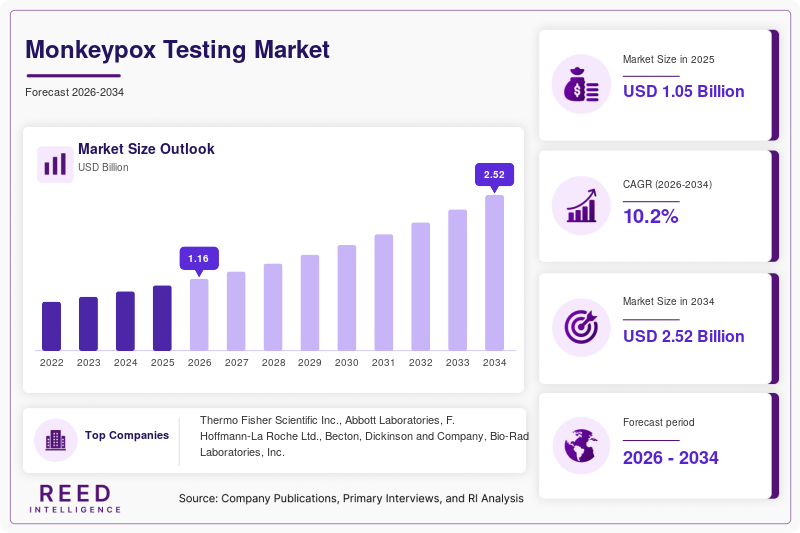
The global Monkeypox Testing Market size was valued at approximately USD 1.05 billion in 2025 and is projected to reach around USD 2.48 billion by 2033, expanding at a CAGR of 10.2% during the forecast period (2025–2034). The increasing prevalence of zoonotic diseases and the re-emergence of viral outbreaks have significantly contributed to the expansion of diagnostic testing infrastructure worldwide. Governments and healthcare organizations have been investing in early detection systems, which has accelerated the adoption of advanced molecular diagnostic tools.
A major global factor supporting market growth has been the strengthening of infectious disease surveillance systems. Post-pandemic healthcare reforms have led to increased laboratory capacities, improved funding for public health initiatives, and the integration of rapid diagnostic technologies, which collectively boosted the demand for monkeypox testing solutions.
Key Highlights
- North America dominated the market with a 38.6% share in 2025, while Asia Pacific is expected to grow at the fastest CAGR of 12.1% through 2034.
- PCR-based testing accounted for the leading subsegment under technology with a 52.4% share, whereas rapid antigen tests are projected to grow at a CAGR of 13.4%.
- Hospitals represented the dominant end-use segment with a 46.8% share, while diagnostic laboratories are anticipated to register the fastest growth at a CAGR of 11.8%.
- The United States led the market with USD 420 million in 2025 and is estimated to reach USD 455 million in 2026.
Market Trends
Expansion of Point-of-Care Testing
The market is witnessing a steady shift toward decentralized diagnostic solutions, particularly point-of-care (POC) testing. Healthcare providers are increasingly adopting portable and rapid diagnostic kits that deliver results within minutes, enabling quicker isolation and treatment decisions. This trend is particularly relevant in remote and resource-limited settings where access to centralized laboratories is limited. The integration of compact PCR devices and lateral flow assays has enhanced accessibility, making POC testing a key growth driver in the Monkeypox Testing Market.
Integration of Multiplex Diagnostic Platforms
Another notable trend is the development of multiplex assays capable of detecting multiple pathogens simultaneously. With overlapping symptoms between monkeypox and other viral infections, multiplex testing improves diagnostic accuracy and reduces turnaround time. These platforms are being increasingly adopted in advanced healthcare systems to streamline workflows and optimize resource utilization. The trend reflects a broader shift toward comprehensive infectious disease diagnostics, supporting more efficient outbreak management.
Market Drivers
Rising Incidence of Viral Zoonotic Diseases
The increasing frequency of zoonotic disease outbreaks has heightened the need for robust diagnostic capabilities. Monkeypox, being a viral infection with global transmission potential, has prompted governments to enhance testing infrastructure. This growing awareness has directly increased the demand for accurate and scalable testing solutions, thereby driving market growth.
Technological Advancements in Molecular Diagnostics
Advancements in molecular testing technologies, particularly polymerase chain reaction (PCR), have significantly improved the sensitivity and specificity of monkeypox detection. Innovations such as real-time PCR and automated diagnostic systems have reduced testing time and improved throughput. These technological improvements have encouraged healthcare providers to adopt advanced testing platforms, contributing to the expansion of the Monkeypox Testing Market.
Market Restraint
Limited Testing Accessibility in Low
Despite growing global awareness, limited access to diagnostic facilities in low- and middle-income countries remains a key challenge. Many regions lack adequate laboratory infrastructure, trained personnel, and financial resources to implement widespread testing programs. Additionally, the high cost associated with advanced molecular diagnostic tools restricts their adoption in resource-constrained settings.
This disparity creates uneven market penetration and limits the overall growth potential of the Monkeypox Testing Market. While international organizations are working to improve access, the gap between developed and developing regions continues to hinder comprehensive disease surveillance and early detection efforts.
Market Opportunities
Expansion of Rapid Diagnostic Kits in Emerging Markets
Emerging economies present a significant opportunity for the deployment of cost-effective rapid diagnostic kits. As governments in these regions prioritize healthcare infrastructure development, the demand for affordable and easy-to-use testing solutions is expected to rise. Companies focusing on low-cost innovations can capitalize on this untapped market potential.
Integration of Digital Health and AI in Diagnostics
The integration of digital technologies and artificial intelligence in diagnostic workflows offers promising growth opportunities. AI-powered platforms can enhance diagnostic accuracy, enable real-time data analysis, and support outbreak monitoring. The adoption of digital health tools in laboratory and point-of-care settings is expected to transform testing capabilities and improve disease management outcomes.
Segmental Analysis
By Technology
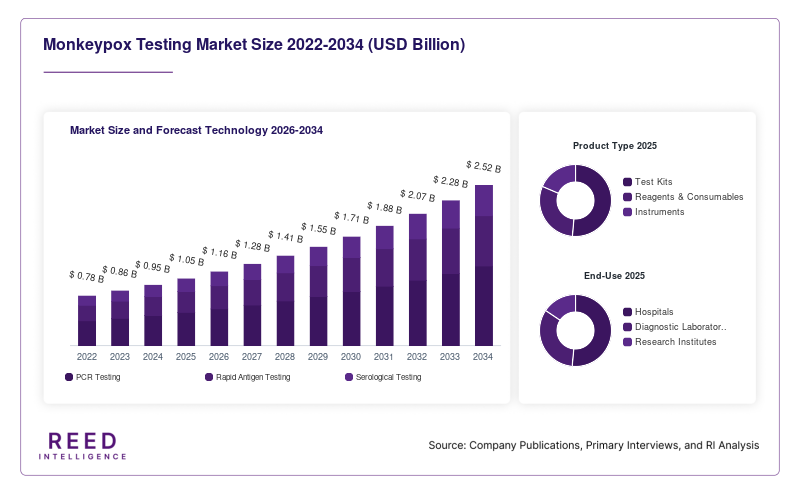
PCR-based testing dominated the Monkeypox Testing Market in 2025, accounting for 52.4% of the total share. This dominance was attributed to its high accuracy, reliability, and widespread adoption in clinical laboratories.
Rapid antigen testing is expected to be the fastest-growing subsegment, with a projected CAGR of 13.4%. Its growth will be driven by the increasing demand for quick and cost-effective diagnostic solutions, particularly in decentralized healthcare settings.
By Product Type
Test kits held the largest share of 48.7% in 2025 due to their widespread use in both laboratory and point-of-care settings. Their ease of use and availability contributed to their dominance.
Reagents and consumables are anticipated to grow at the fastest CAGR of 11.6%, supported by the increasing volume of diagnostic tests and continuous need for replenishment in laboratories.
By End-Use
Hospitals dominated the market with a 46.8% share in 2025, as they serve as primary centers for diagnosis and treatment. The availability of advanced diagnostic equipment and skilled professionals supported their leading position.
Diagnostic laboratories are projected to grow at the fastest CAGR of 11.8%, driven by the rising outsourcing of testing services and increasing demand for specialized diagnostic capabilities.
By Sample Type
Lesion swab samples accounted for the largest share of 54.2% in 2025 due to their high diagnostic accuracy and standard usage in monkeypox detection.
Blood samples are expected to grow at a CAGR of 10.9%, supported by advancements in serological testing and increasing research activities.
Regional Analysis
North America
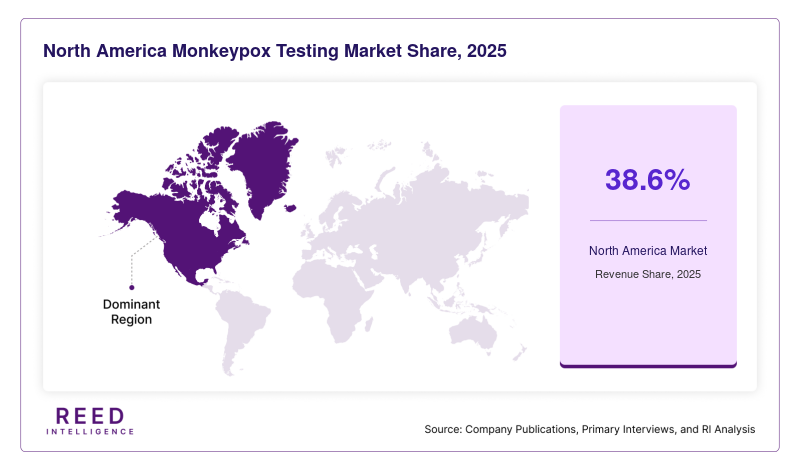
North America accounted for 38.6% of the Monkeypox Testing Market share in 2025 and is expected to grow at a CAGR of 9.4% during the forecast period. The region benefited from well-established healthcare infrastructure and strong funding for infectious disease research.
The United States dominated the regional market due to its advanced diagnostic capabilities and widespread availability of testing kits. The presence of leading biotechnology companies and continuous investment in public health initiatives contributed to sustained market growth.
Europe
Europe held a 27.3% share of the Monkeypox Testing Market in 2025 and is projected to expand at a CAGR of 9.8% through 2034. The region experienced steady growth driven by increased government focus on disease surveillance and preparedness.
Germany emerged as the dominant country in Europe, supported by its robust healthcare system and emphasis on early disease detection. National health policies promoting diagnostic innovation have further strengthened market expansion.
Asia Pacific
Asia Pacific captured 18.9% of the market share in 2025 and is anticipated to register the fastest CAGR of 12.1% over the forecast period. Rapid urbanization and increasing healthcare investments have played a crucial role in regional growth.
China led the region due to its expanding diagnostic infrastructure and growing focus on infectious disease control. Government initiatives aimed at strengthening laboratory networks have accelerated market development.
Middle East & Africa
The Middle East & Africa region accounted for 8.1% of the Monkeypox Testing Market in 2025 and is expected to grow at a CAGR of 10.6%. The region has been gradually improving its healthcare systems, which has supported market growth.
South Africa dominated the regional market due to increased awareness of infectious diseases and improving access to diagnostic services. Efforts to enhance healthcare infrastructure have contributed to market expansion.
Latin America
Latin America held a 7.1% share of the market in 2025 and is projected to grow at a CAGR of 10.2% during the forecast period. The region has shown moderate growth due to increasing healthcare investments and rising awareness of viral infections.
Brazil emerged as the leading country, supported by government initiatives to strengthen diagnostic capabilities and expand laboratory networks. The growing demand for early detection solutions has driven market growth.
Competitive Landscape
The Monkeypox Testing Market is moderately competitive, with several global and regional players focusing on product innovation and strategic collaborations. Companies are investing in research and development to enhance diagnostic accuracy and reduce turnaround times.
A leading player in the market is Thermo Fisher Scientific Inc., which has strengthened its position through continuous product innovation and expansion of its diagnostic portfolio. The company recently introduced advanced PCR-based testing solutions designed for high-throughput laboratories.
Other key players are actively expanding their market presence through partnerships, mergers, and geographic expansion strategies. The competitive landscape is expected to evolve further as new entrants introduce innovative testing technologies and existing players enhance their offerings.
Key Players List
- Thermo Fisher Scientific Inc.
- Abbott Laboratories
- F. Hoffmann-La Roche Ltd.
- Becton, Dickinson and Company
- Bio-Rad Laboratories, Inc.
- Danaher Corporation
- Qiagen N.V.
- Siemens Healthineers AG
- PerkinElmer, Inc.
- Hologic, Inc.
- OraSure Technologies, Inc.
- Seegene Inc.
- SD Biosensor, Inc.
- BioMérieux SA
- GenScript Biotech Corporation
Recent Developments
- In 2025, Thermo Fisher Scientific launched a high-throughput monkeypox PCR testing kit to enhance laboratory efficiency.
- Abbott Laboratories expanded its rapid diagnostic portfolio with new antigen-based testing solutions.
- Roche introduced automated diagnostic platforms to improve testing accuracy and reduce turnaround time.
- Qiagen partnered with regional healthcare providers to expand testing access in emerging markets.
- Bio-Rad Laboratories developed advanced reagents to support high-sensitivity monkeypox detection.
Monkeypox Testing Market Segments
Technology
- PCR Testing
- Rapid Antigen Testing
- Serological Testing
Product Type
- Test Kits
- Reagents & Consumables
- Instruments
End-Use
- Hospitals
- Diagnostic Laboratories
- Research Institutes
Sample Type
- Lesion Swabs
- Blood Samples
- Others
By Region
- North America
- Europe
- APAC
- Middle East and Africa
- LATAM