Mooring Ropes Market Size, Share & Demand Report By Material Type (Polyester, Polypropylene, Nylon, HMPE, Others), By Application (Ship Mooring, Offshore Platform Mooring, Fishing Vessels, Floating Renewable Energy, Others), By End Use (Commercial Shipping, Oil & Gas, Offshore Renewable Energy, Defense & Naval, Fishing Industry), By Region & Segment Forecasts, 2026–2034
USD 3950
Market Overview
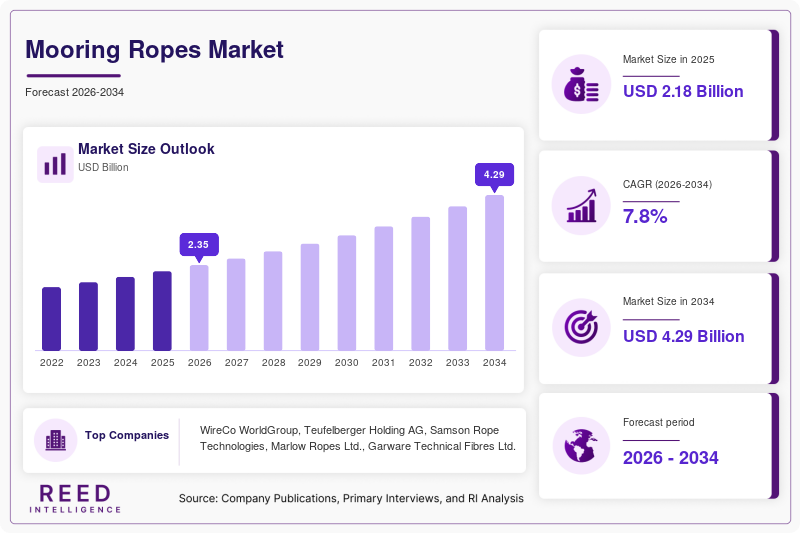
The global Mooring Ropes Market size was valued at USD 2.18 billion in 2026 and is projected to reach USD 3.97 billion by 2034, expanding at a CAGR of 7.8% during the forecast period from 2026 to 2034. The market continues to witness stable expansion due to increasing maritime trade activities, offshore energy investments, and rising demand for durable synthetic rope solutions across commercial shipping and port infrastructure sectors. Growing investments in deepwater oil exploration and floating production systems have also strengthened product adoption in offshore marine operations.
The increasing movement of cargo vessels, LNG carriers, cruise ships, and offshore support vessels has accelerated the need for high-performance mooring systems that provide durability, abrasion resistance, and improved tensile strength. Synthetic mooring ropes made from polypropylene, polyester, nylon, and high-modulus polyethylene are increasingly replacing conventional steel wire ropes due to lower maintenance requirements and improved operational flexibility. Rising port modernization programs across Asia Pacific and the Middle East are further contributing to market expansion.
Key Highlights
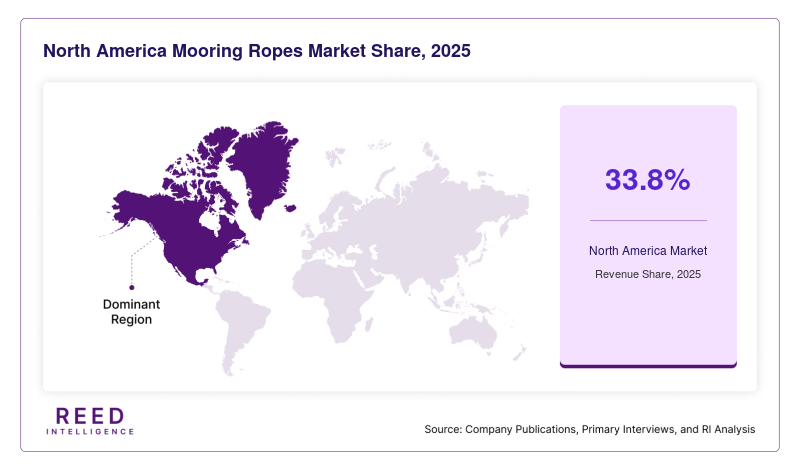
- North America dominated the market with a 33.8% share in 2025.
- Asia Pacific is expected to grow at the fastest CAGR of 9.6% during 2026–2034.
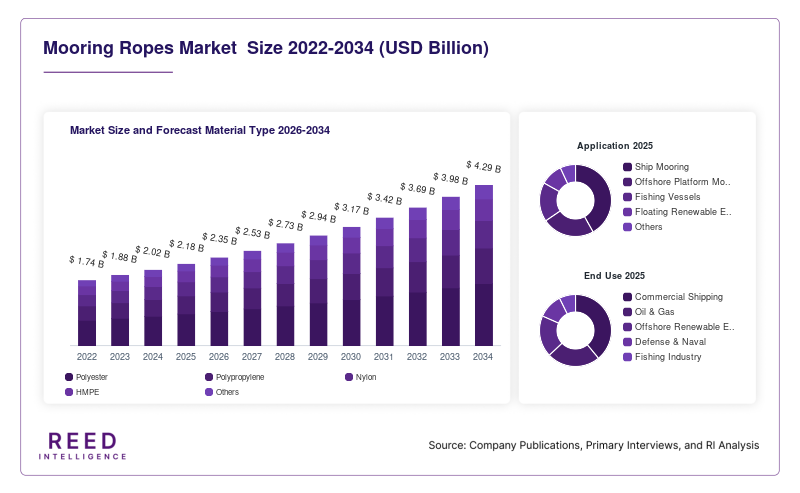
- By material type, polyester ropes accounted for the largest share of 36.4%, while HMPE ropes are projected to grow at a CAGR of 10.8%.
- By application, ship mooring led with a 44.1% share, whereas offshore platform mooring is expected to expand at a CAGR of 9.9%.
- By end use, commercial shipping accounted for the largest share of 39.5%, while offshore renewable energy is projected to grow at a CAGR of 11.4%.
- The United States remained the dominant country, with market values of USD 420 million in 2024 and USD 455 million in 2025.
Market Trends
Adoption of High-Performance Synthetic Fiber Ropes
The Mooring Ropes Market is experiencing a significant shift toward high-performance synthetic fiber ropes due to their operational efficiency and lower lifecycle costs. Marine operators are increasingly replacing traditional steel wire ropes with lightweight alternatives such as polyester, nylon, and high-modulus polyethylene ropes. These materials offer enhanced flexibility, corrosion resistance, and reduced handling complexity, making them suitable for offshore vessels, LNG carriers, and floating production systems. Shipping companies are also prioritizing ropes that improve fuel efficiency by lowering vessel weight and reducing maintenance downtime.
The growing focus on vessel automation and operational safety has encouraged manufacturers to integrate advanced coatings and fatigue-resistant structures into synthetic rope products. Offshore drilling operators are adopting hybrid mooring systems capable of performing under deepwater pressure conditions and extreme weather environments. Increasing demand for floating offshore wind projects has further accelerated the adoption of high-strength synthetic mooring solutions across global marine infrastructure developments.
Expansion of Smart Mooring and Monitoring Technologies
Digitalization in maritime operations has emerged as an important trend supporting innovation within the Mooring Ropes Market. Fleet operators and port authorities are increasingly deploying smart mooring systems equipped with sensors and monitoring technologies to improve operational visibility and reduce accident risks. Real-time monitoring of rope tension, wear conditions, and environmental stress factors helps operators improve predictive maintenance and reduce unplanned failures during vessel docking operations.
The integration of Internet of Things platforms and remote diagnostics is becoming more common in advanced port infrastructure projects across Europe and Asia Pacific. Smart mooring solutions also assist shipping companies in complying with stricter maritime safety standards introduced by international marine authorities. Increasing investment in autonomous vessels and digitally connected ports is expected to strengthen demand for technologically advanced mooring rope systems over the forecast period.
Market Drivers
Growth in Global Maritime Trade and Port Expansion
The steady rise in global maritime trade activities continues to support demand growth in the Mooring Ropes Market. International cargo transportation remains heavily dependent on marine shipping due to its cost efficiency for large-scale trade operations. Expanding import-export activities across Asia Pacific, North America, and Europe have increased the number of commercial vessels operating globally. As a result, ports are investing in modern docking infrastructure and advanced mooring systems to improve operational safety and vessel turnaround efficiency.
Several emerging economies are expanding container terminals and deepwater ports to accommodate larger cargo ships and LNG carriers. These developments are increasing the need for durable mooring ropes capable of withstanding high loads and harsh environmental conditions. Rising investments in cruise tourism and commercial fishing operations are also contributing to product demand across various marine applications. The increasing frequency of vessel movement is expected to maintain long-term market expansion.
Increasing Offshore Energy and Renewable Projects
Rapid growth in offshore oil exploration and renewable energy projects has become another major factor supporting the Mooring Ropes Market. Offshore production platforms require highly durable mooring systems to maintain structural stability under severe ocean conditions. The expansion of floating production storage units and subsea infrastructure projects has accelerated the use of high-strength synthetic ropes with improved fatigue resistance and operational flexibility.
The offshore wind energy sector is also creating new demand opportunities for advanced mooring technologies. Floating wind farms installed in deeper waters require specialized rope systems capable of supporting dynamic environmental loads. Governments across Europe, Asia Pacific, and North America are increasing investments in offshore renewable infrastructure to reduce dependence on fossil fuels. This transition is encouraging marine equipment manufacturers to develop customized mooring rope solutions designed for renewable energy applications and long-term offshore operations.
Market Restraint
Volatility in Raw Material Prices and Operational Challenges
Fluctuating raw material prices remain a significant challenge affecting profitability within the Mooring Ropes Market. Synthetic ropes are primarily manufactured using petroleum-based materials such as polypropylene, polyester, and nylon. Variations in crude oil prices directly influence manufacturing costs and create pricing uncertainty for rope producers. Smaller manufacturers often face difficulties maintaining stable supply chains and competitive pricing during periods of raw material inflation.
Operational limitations associated with rope degradation and environmental exposure also restrict market growth in certain applications. Continuous exposure to ultraviolet radiation, seawater corrosion, and heavy mechanical loads can reduce rope lifespan and increase replacement frequency. Offshore operators working in extreme climatic conditions often require frequent inspections and maintenance to ensure operational safety. In addition, high-performance synthetic ropes involve elevated initial procurement costs compared to conventional alternatives, which may discourage adoption among cost-sensitive marine operators in developing economies.
Market Opportunities
Rising Investments in Offshore Wind Infrastructure
The increasing deployment of offshore wind farms presents a strong growth opportunity for the Mooring Ropes Market. Several countries are expanding renewable energy targets and investing in floating wind platforms to improve clean energy generation capacity. Floating wind installations require highly durable mooring systems that can operate effectively under dynamic ocean conditions and varying water depths. This trend is creating demand for advanced synthetic ropes with superior fatigue resistance and lightweight construction.
Manufacturers are increasingly focusing on customized mooring solutions specifically designed for offshore renewable projects. Advanced fiber technologies and hybrid rope systems are helping improve operational reliability while reducing maintenance costs for floating wind operators. Europe and Asia Pacific are expected to remain key investment hubs for offshore renewable infrastructure, creating long-term demand for technologically advanced mooring rope systems across marine energy applications.
Development of Smart Ports and Automated Marine Operations
The global transition toward smart ports and automated marine operations is expected to generate additional opportunities for market participants. Port authorities are increasingly integrating automated docking systems, digital monitoring platforms, and intelligent vessel traffic management technologies to improve operational efficiency. These developments require advanced mooring rope systems capable of supporting automated handling and real-time condition monitoring.
Shipping companies are also investing in digitally connected vessels and predictive maintenance systems to reduce downtime and improve operational safety. Smart mooring technologies integrated with sensors and remote analytics are expected to witness growing adoption in commercial shipping and offshore operations. Emerging economies investing in modern maritime infrastructure are likely to create favorable conditions for advanced mooring rope manufacturers during the forecast period.
Segmental Analysis
By Material Type
Polyester ropes accounted for the largest share of the Mooring Ropes Market in 2024, representing approximately 36.4% of total revenue. The dominance of this segment is primarily linked to the material’s high durability, low stretch properties, and strong resistance to seawater degradation. Polyester ropes are widely used in offshore platform mooring and commercial shipping applications where long operational life and fatigue resistance are essential. Marine operators prefer polyester-based products because they provide improved stability under varying environmental conditions while reducing maintenance requirements. Increasing deployment of floating production systems and offshore drilling platforms has further strengthened demand for polyester mooring solutions across deepwater operations.
By Application
Ship mooring represented the dominant application segment in the Mooring Ropes Market, accounting for 44.1% of total market share in 2024. The increasing movement of cargo vessels, container ships, LNG carriers, and cruise liners continues to support substantial demand for reliable mooring systems. Commercial ports require high-strength ropes capable of handling larger vessels and improving docking safety under varying weather conditions. Synthetic ropes have gained significant popularity within this segment due to their lightweight structure, corrosion resistance, and reduced maintenance costs compared to steel wire alternatives. Expanding global maritime trade and investments in smart port infrastructure are further strengthening segment growth across both developed and emerging economies.
By End Use
Commercial shipping accounted for the largest share of the Mooring Ropes Market in 2024, contributing nearly 39.5% of total revenue. The segment benefits from increasing international trade volumes and the continued expansion of global shipping networks. Shipping operators are increasingly adopting synthetic mooring ropes to improve vessel handling efficiency and reduce operational downtime. Large container terminals and cargo ports require advanced mooring systems that can safely accommodate larger commercial vessels under high-load conditions. Rising investments in marine logistics infrastructure and smart port development programs are also contributing to stronger product demand across the commercial shipping industry.
Regional Analysis
North America
North America accounted for 33.8% of the global Mooring Ropes Market share in 2025 and is projected to maintain stable growth at a CAGR of 7.1% during the forecast period. The region benefits from extensive commercial shipping activities, established offshore oil infrastructure, and strong investments in maritime safety technologies. The presence of advanced ports and high adoption of synthetic mooring solutions across offshore platforms continue to support market demand throughout the region.
The United States remained the dominant country within North America due to rising offshore energy exploration and modernization of commercial port facilities. Increasing LNG export operations across the Gulf Coast have accelerated demand for durable mooring systems capable of handling larger vessels. Growing investments in floating offshore wind projects are also encouraging the adoption of advanced high-performance rope technologies throughout the country.
Europe
Europe represented a significant share of the Mooring Ropes Market in 2025 and is anticipated to expand at a CAGR of 7.4% during the forecast period. Strong maritime trade activities, strict marine safety regulations, and increasing offshore renewable energy projects continue to support regional market expansion. Countries across the region are investing in sustainable marine infrastructure and advanced port automation systems to improve operational efficiency and environmental compliance.
Norway emerged as the dominant country within Europe due to its strong offshore oil and gas industry and growing offshore wind investments. The country has developed extensive expertise in deepwater marine operations, encouraging demand for advanced mooring rope systems capable of performing under extreme ocean conditions. Rising deployment of floating production units has further contributed to stable product adoption across Norwegian offshore projects.
Asia Pacific
Asia Pacific is expected to register the fastest CAGR of 9.6% in the global Mooring Ropes Market during 2026–2034. Rapid industrialization, expanding maritime trade networks, and increasing port development projects are driving strong regional demand. Countries across the region are investing heavily in container terminals, shipbuilding facilities, and offshore infrastructure to strengthen international trade capabilities and improve marine logistics efficiency.
China dominated the Asia Pacific market due to its extensive shipping industry and large-scale port infrastructure investments. The country continues to expand commercial shipbuilding operations and offshore exploration projects, creating substantial demand for advanced mooring solutions. Government initiatives supporting maritime trade modernization and offshore renewable energy development are also accelerating the adoption of high-strength synthetic ropes across various marine applications.
Middle East & Africa
The Middle East & Africa region demonstrated steady growth within the Mooring Ropes Market and is projected to expand at a CAGR of 7.8% during the forecast period. Increasing offshore oil exploration activities and investments in marine logistics infrastructure are supporting product demand throughout the region. Countries with major oil export operations continue to invest in advanced offshore terminals and floating production systems that require reliable mooring technologies.
Saudi Arabia remained the dominant country in the region due to expanding offshore energy operations and port modernization initiatives. The country is strengthening maritime infrastructure to support rising energy exports and industrial diversification programs. Investments in large-scale coastal development projects and marine logistics corridors are further contributing to increased demand for high-performance mooring rope systems.
Latin America
Latin America accounted for a moderate share of the Mooring Ropes Market in 2025 and is anticipated to grow at a CAGR of 6.9% during the forecast period. The region benefits from expanding offshore oil production, increasing commercial shipping activities, and gradual improvements in port infrastructure. Several countries are investing in marine transportation systems to support regional trade growth and improve export efficiency across industrial sectors.
Brazil emerged as the dominant country within Latin America due to its strong offshore oil industry and expanding deepwater exploration activities. The country continues to develop floating production infrastructure in offshore reserves, creating demand for advanced mooring technologies capable of operating under complex ocean conditions. Rising investments in coastal shipping and offshore support vessels are also contributing to market growth across Brazil.
Competitive Landscape
The Mooring Ropes Market remains moderately consolidated, with major companies focusing on product innovation, strategic partnerships, and offshore energy contracts to strengthen market positioning. Manufacturers are investing in advanced synthetic fiber technologies and smart monitoring solutions to improve operational efficiency and product durability. Companies are also expanding manufacturing capacity to address growing demand from commercial shipping, offshore oil exploration, and renewable energy sectors.
WireCo WorldGroup emerged as one of the leading companies in the global market due to its diversified marine rope portfolio and strong offshore industry presence. The company recently introduced enhanced synthetic mooring systems designed for deepwater energy applications with improved fatigue resistance and lower operational weight. Other major participants are focusing on regional expansion strategies and customized solutions for offshore renewable energy projects.
Key Players
- WireCo WorldGroup
- Timm Ropes
- Teufelberger Holding AG
- Cortland Company
- Bridon-Bekaert
- Samson Rope Technologies
- Marlow Ropes Ltd.
- Southern Ropes
- English Braids Ltd.
- LANEX a.s.
- Lankhorst Ropes
- Yale Cordage Inc.
- Kiswire Ltd.
- Usha Martin Ltd.
- Garware Technical Fibres Ltd.
Recent Developments
- In January 2026, WireCo WorldGroup expanded its high-performance synthetic mooring rope manufacturing facility in the United States to meet rising demand from offshore wind and deepwater oil projects.
- In August 2025, Teufelberger Holding AG introduced a new HMPE-based mooring rope series designed for enhanced fatigue resistance and lightweight vessel handling applications.
- In November 2025, Garware Technical Fibres Ltd. announced a strategic partnership with a marine engineering company to develop advanced mooring solutions for floating renewable energy platforms across Asia Pacific.
- In April 2026, Samson Rope Technologies launched an upgraded smart mooring rope monitoring system integrated with real-time tension tracking and predictive maintenance capabilities for commercial ports and offshore operators.
Mooring Ropes Market Segments
Material Type
- Polyester
- Polypropylene
- Nylon
- HMPE
- Others
Application
- Ship Mooring
- Offshore Platform Mooring
- Fishing Vessels
- Floating Renewable Energy
- Others
End Use
- Commercial Shipping
- Oil & Gas
- Offshore Renewable Energy
- Defense & Naval
- Fishing Industry
By Region
- North America
- Europe
- APAC
- Middle East and Africa
- LATAM