Mortar System Market Size, Share & Demand Report By Type (Light Mortar Systems, Medium Mortar Systems, Heavy Mortar Systems), By Range (Short Range, Medium Range, Long Range), By Mounting Type (Ground Mounted, Vehicle Mounted), By Caliber (Small Caliber, Medium Caliber, Large Caliber), By Region & Segment Forecasts, 2026–2034
USD 3950
Market Overview
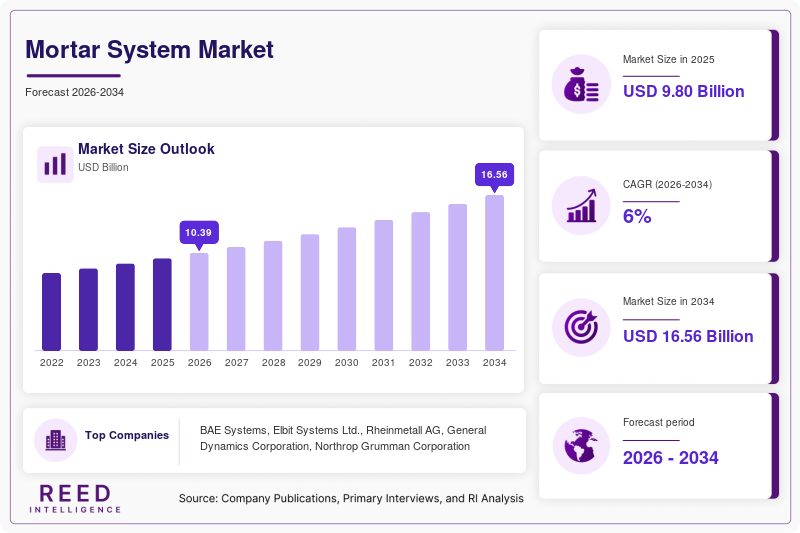
The global Mortar System Market size was valued at approximately USD 9.8 billion in 2026 and is projected to reach USD 15.6 billion by 2034, expanding at a CAGR of 6.0% during the forecast period (2026–2034). The market growth reflects a steady rise in demand across defense modernization programs and evolving battlefield requirements that emphasize mobility, precision, and rapid deployment capabilities.
A key global factor supporting market expansion has been the increasing emphasis on lightweight, mobile artillery systems. Modern armed forces are prioritizing adaptable weapon systems that can be rapidly deployed across varied terrains. Mortar systems, known for their portability and flexibility, have gained prominence as they provide indirect fire support in both conventional and asymmetric warfare scenarios. Additionally, advancements in targeting systems, fire control technologies, and integration with digital command systems have enhanced operational efficiency, further driving adoption.
Key Highlights
- Dominant region: North America accounted for approximately 34.5% market share in 2025, while Asia Pacific is projected to be the fastest-growing region with a CAGR of 7.2%.
- Leading subsegments:
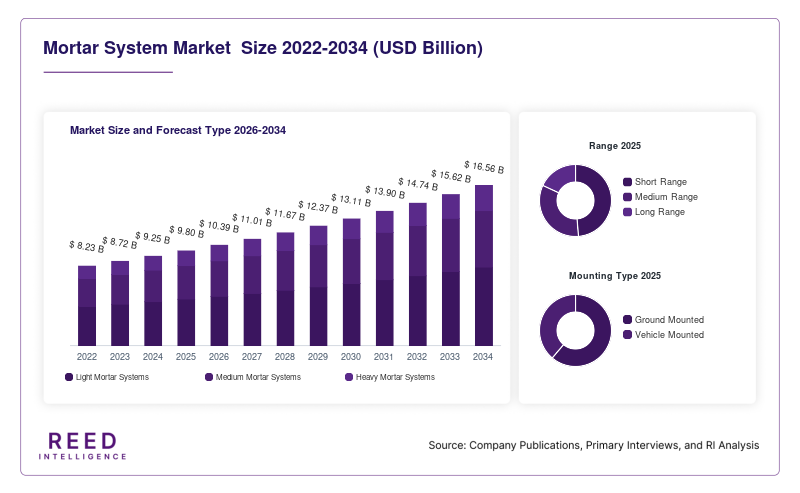
- By Type: Heavy Mortar Systems led with 41% share, while Medium Mortar Systems are expected to grow fastest at 6.8% CAGR.
- By Range: Short-range mortars dominated with 46% share, while long-range mortars are anticipated to grow at 7.1% CAGR.
- Dominant country: The United States recorded market values of USD 2.1 billion in 2024 and USD 2.2 billion in 2025, maintaining leadership due to continuous defense investments.
Market Trends
Integration of Digital Fire Control Systems
The Mortar System Market is increasingly shaped by the adoption of advanced fire control systems integrated with digital technologies. Modern mortar platforms now incorporate GPS-guided targeting, automated aiming, and real-time battlefield data sharing. These systems improve accuracy, reduce response time, and minimize collateral damage. Defense forces are investing in network-centric warfare capabilities, where mortar systems are connected with command and control infrastructure. This trend enhances situational awareness and allows coordinated operations across multiple units, contributing to operational efficiency and strategic effectiveness.
Growing Demand for Lightweight and Vehicle-Mounted Mortars
Another notable trend is the rising demand for lightweight and vehicle-mounted mortar systems. Armed forces are focusing on mobility and rapid deployment, especially for expeditionary missions and urban combat scenarios. Lightweight mortar systems reduce logistical burdens, while vehicle-mounted variants offer improved stability and faster repositioning. Technological innovations in materials, such as high-strength alloys and composite components, are enabling the development of lighter systems without compromising durability. This trend is particularly prominent in regions with evolving security dynamics, where rapid response capabilities are critical.
Market Drivers
Increasing Defense Budgets and Modernization Programs
A primary driver of the Mortar System Market is the consistent rise in global defense spending. Governments are allocating substantial budgets toward modernizing military equipment to enhance combat readiness. Mortar systems are a critical component of infantry support, offering cost-effective firepower compared to larger artillery systems. Modernization programs often include upgrading legacy systems with advanced targeting and control technologies, further boosting market demand.
Rising Demand for Indirect Fire Support in Asymmetric Warfare
The growing prevalence of asymmetric warfare has increased the need for versatile and effective indirect fire systems. Mortars provide a strategic advantage in complex terrains, such as mountainous regions and urban environments, where direct line-of-sight weapons are less effective. Their ability to deliver high-angle fire makes them suitable for targeting concealed or fortified positions. As military strategies evolve to address unconventional threats, the demand for reliable mortar systems continues to rise.
Market Restraint
High Maintenance and Operational Costs
One of the major challenges limiting the growth of the Mortar System Market is the high maintenance and operational costs associated with advanced systems. While modern mortar systems offer enhanced capabilities, they also require specialized training, regular maintenance, and sophisticated support infrastructure. These factors increase the total cost of ownership, particularly for developing countries with constrained defense budgets.
Additionally, the integration of digital and automated technologies introduces complexities in system upkeep. Ensuring compatibility with existing military infrastructure and maintaining cybersecurity standards further adds to operational expenses. Smaller defense organizations may face difficulties in adopting advanced mortar systems due to these financial constraints. As a result, procurement decisions may be delayed or scaled down, affecting overall market growth. Addressing cost-related challenges through modular designs and lifecycle cost optimization remains a key focus area for manufacturers.
Market Opportunities
Development of Smart and Precision-Guided Mortars
The emergence of precision-guided munitions presents significant growth opportunities in the Mortar System Market. Smart mortars equipped with guidance systems enable highly accurate targeting, reducing collateral damage and improving mission outcomes. These systems are particularly valuable in urban warfare and peacekeeping operations, where precision is critical. Ongoing research and development efforts aimed at enhancing guidance technologies are expected to create new revenue streams for market participants.
Expansion in Emerging Defense Markets
Emerging economies are increasingly investing in strengthening their defense capabilities, creating new opportunities for mortar system manufacturers. Countries in Asia, Africa, and Latin America are focusing on upgrading their military equipment to address evolving security challenges. These regions offer untapped potential due to growing defense budgets and the need for cost-effective weapon systems. Strategic partnerships, technology transfers, and localized manufacturing initiatives are expected to facilitate market entry and expansion in these regions.
Segmental Analysis
By Type
Heavy mortar systems dominated the Mortar System Market in 2025, accounting for approximately 41% of the total share. Their widespread adoption has been driven by their ability to deliver high firepower and extended range capabilities. These systems are commonly used in large-scale military operations where sustained fire support is required. Their robustness and compatibility with various ammunition types have contributed to their leading position.
Medium mortar systems are expected to be the fastest-growing subsegment, with a projected CAGR of 6.8% during the forecast period. Their balanced combination of mobility and firepower will make them increasingly attractive for modern military operations. The flexibility of medium mortars in both offensive and defensive scenarios will support their growing adoption.
By Range
Short-range mortar systems held the largest share in 2025, accounting for approximately 46% of the market. Their dominance has been attributed to their effectiveness in close combat situations and ease of deployment. These systems are widely used for infantry support in confined environments.
Long-range mortar systems are anticipated to witness the fastest growth, with a CAGR of 7.1%. Their ability to provide extended coverage and improved targeting capabilities will drive demand. Advancements in propulsion and targeting technologies will enhance their operational efficiency.
By Mounting Type
Ground-mounted mortar systems dominated the market in 2025 with a share of approximately 52%. Their reliability and widespread use in traditional military operations have supported their leading position.
Vehicle-mounted mortar systems are projected to grow at the fastest rate, with a CAGR of 7.0%. Their mobility and rapid deployment capabilities will make them increasingly relevant in modern warfare scenarios. Integration with armored vehicles will further enhance their effectiveness.
By Caliber
Large-caliber mortars accounted for around 44% of the market share in 2025, driven by their ability to deliver high-impact firepower. These systems are preferred in operations requiring significant destructive capability.
Small-caliber mortars are expected to grow at a CAGR of 6.9%, supported by their portability and ease of use. Their suitability for lightweight and mobile units will drive adoption.
Regional Analysis
North America
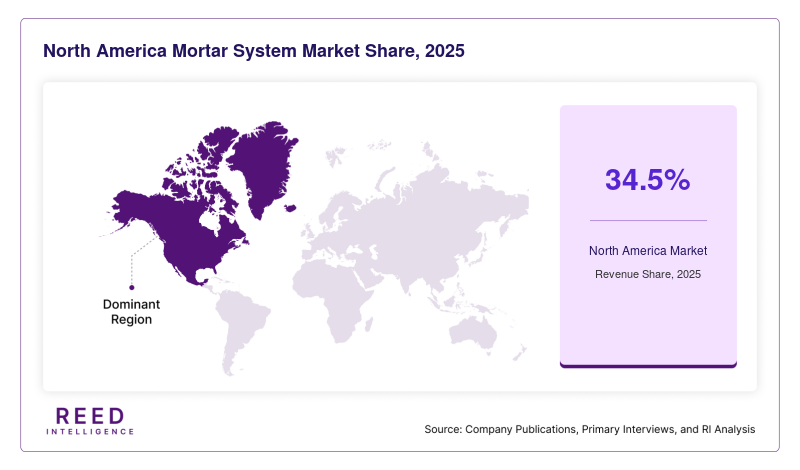
North America held approximately 34.5% of the Mortar System Market share in 2025 and will continue to maintain a strong position, with a projected CAGR of 5.4% during 2026–2034. The region’s dominance has been driven by sustained investments in advanced defense technologies and continuous upgrades of military equipment.
The United States remained the dominant country, supported by its focus on technological innovation and integrated defense systems. The country’s emphasis on enhancing operational efficiency through advanced targeting and automation technologies has strengthened its position in the market. Continuous procurement programs and investments in research and development have contributed to steady growth.
Europe
Europe accounted for approximately 27.0% of the market share in 2025 and is expected to grow at a CAGR of 5.8% during the forecast period. The region has shown consistent demand for modern mortar systems due to evolving security dynamics and defense collaborations.
Germany emerged as a leading country, driven by its emphasis on strengthening defense capabilities and adopting advanced military technologies. The country’s focus on enhancing interoperability within allied forces has supported the adoption of modern mortar systems.
Asia Pacific
Asia Pacific held around 22.5% of the market share in 2025 and is anticipated to register the fastest growth, with a CAGR of 7.2%. The region’s expansion is influenced by increasing defense expenditures and modernization initiatives.
China dominated the regional market, supported by its extensive investments in military infrastructure and indigenous production capabilities. The country’s focus on enhancing its defense capabilities has driven demand for advanced mortar systems.
Middle East & Africa
The Middle East & Africa region accounted for approximately 9.5% of the market share in 2025 and is projected to grow at a CAGR of 6.3%. The region has experienced steady demand due to ongoing security concerns and defense investments.
Saudi Arabia led the market, driven by its efforts to strengthen military capabilities and diversify defense procurement. Investments in modern weapon systems have supported market growth.
Latin America
Latin America held about 6.5% of the market share in 2025 and is expected to grow at a CAGR of 5.6%. The region’s growth is influenced by gradual defense modernization efforts.
Brazil emerged as the dominant country, supported by its focus on enhancing military readiness and domestic production capabilities. The country’s investments in defense infrastructure have contributed to market expansion.
Competitive Landscape
The Mortar System Market is moderately consolidated, with key players focusing on technological advancements and strategic collaborations. Leading companies are investing in research and development to enhance system performance and integrate advanced features.
A prominent market leader, BAE Systems, has strengthened its position through continuous innovation and the development of advanced mortar platforms. The company’s focus on integrating digital fire control systems and enhancing mobility has contributed to its leadership.
Other major players, including Elbit Systems, Rheinmetall AG, and General Dynamics Corporation, are actively expanding their product portfolios and global presence. Strategic partnerships, contracts, and product launches remain key strategies adopted by these companies to maintain competitiveness. The market is expected to witness further consolidation as companies seek to strengthen their capabilities and expand into emerging markets.
Key Players
- BAE Systems
- Elbit Systems Ltd.
- Rheinmetall AG
- General Dynamics Corporation
- Northrop Grumman Corporation
- ST Engineering
- Denel Land Systems
- Saab AB
- Nexter Group
- Hanwha Aerospace
- Rosoboronexport
- L3Harris Technologies
- KMW (Krauss-Maffei Wegmann)
- Hirtenberger Defence Systems
- Expal Systems
Recent Developments
- Recent developments in the Mortar System Market reflect a focus on technological innovation and strategic expansion. Several companies have introduced advanced mortar systems with improved targeting accuracy and mobility features. The integration of digital fire control systems and precision-guided munitions has been a key area of development.
- Manufacturers are also engaging in partnerships with defense organizations to enhance product capabilities and expand their global footprint. Additionally, investments in research and development have led to the introduction of lightweight and modular mortar systems, catering to evolving military requirements. These developments are expected to shape the future growth trajectory of the market.
Mortar System Market Segments
Type
- Light Mortar Systems
- Medium Mortar Systems
- Heavy Mortar Systems
Range
- Short Range
- Medium Range
- Long Range
Mounting Type
- Ground Mounted
- Vehicle Mounted
Caliber
- Small Caliber
- Medium Caliber
- Large Caliber
Region
- North America
- Europe
- Asia Pacific
- Middle East & Africa
- Latin America
By Region
- North America
- Europe
- APAC
- Middle East and Africa
- LATAM