Mortuary Bag Market Size, Share & Demand Report By Material Type (Polyethylene Mortuary Bags, PVC Mortuary Bags, Biodegradable Mortuary Bags, Heavy-Duty Reinforced Mortuary Bags), By Application (Hospital Use, Disaster Management, Forensic Use, Military and Emergency Response), By End Use (Healthcare Institutions, Forensic Laboratories, Emergency Services, Mortuaries and Funeral Homes) By Region & Segment Forecasts, 2026–2034
USD 3950
Market Overview
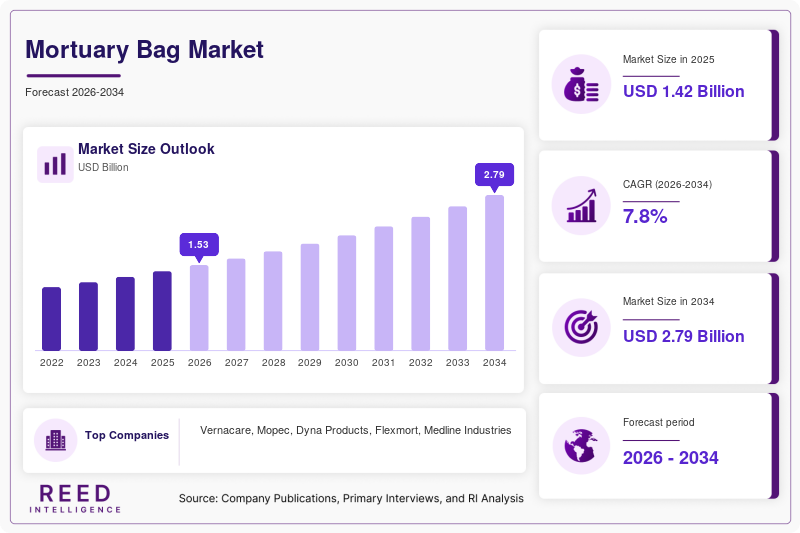
The global Mortuary Bag Market size is projected to be valued at USD 1.42 billion in 2026 and is anticipated to reach USD 2.61 billion by 2034, registering a CAGR of 7.8% during the forecast period (2026–2034). The market growth is primarily driven by increasing demand for safe and hygienic handling of deceased bodies across hospitals, disaster management units, and forensic departments. Rising global mortality rates, coupled with stricter regulations regarding biohazard containment, are strengthening the adoption of advanced mortuary handling solutions such as leak-proof, antimicrobial, and heavy-duty body bags.
A significant global factor supporting market expansion is the modernization of healthcare infrastructure, particularly in emerging economies. Governments are investing in improved emergency response systems and hospital hygiene protocols, which is accelerating the procurement of mortuary equipment. Additionally, rising awareness regarding infection control in post-mortem handling procedures has encouraged healthcare facilities to adopt standardized mortuary packaging solutions.
Key Highlights
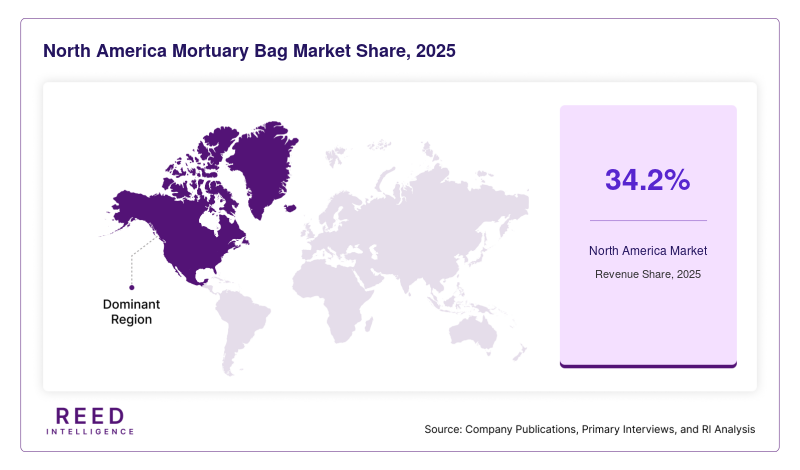
- North America dominated the market with a 34.2% share in 2025.
- Asia Pacific is expected to grow at the fastest CAGR of 11.2% during 2026–2034.
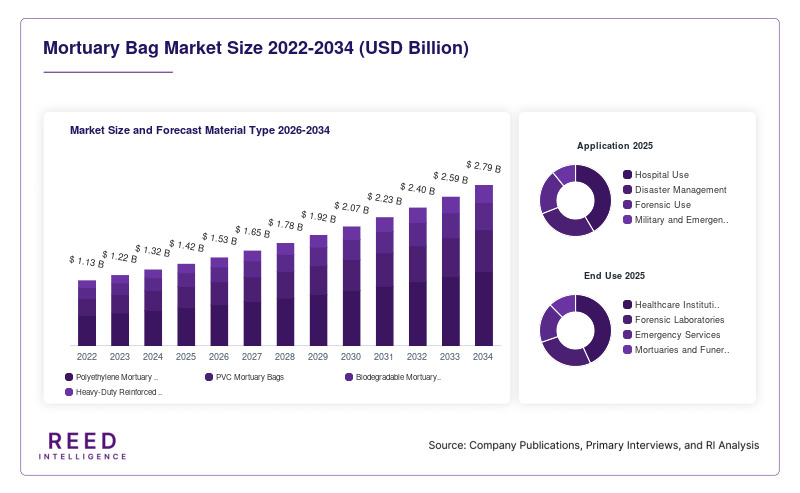
- By material type, polyethylene-based mortuary bags accounted for the largest share of 42.6%, while biodegradable mortuary bags are projected to grow at a CAGR of 13.1%.
- By application, hospital use led with a 46.3% share, whereas disaster management applications are expected to expand at a CAGR of 12.5%.
- The United States remained the dominant country, with market values of USD 610 million in 2024 and USD 665 million in 2025.
Market Trends
Rising Adoption of Biodegradable Mortuary Bags
A notable trend in the Mortuary Bag Market is the increasing shift toward biodegradable and eco-friendly mortuary bags. Environmental sustainability concerns have pushed healthcare systems and government agencies to adopt materials that reduce long-term ecological impact. These bags are manufactured using compostable polymers and natural fiber reinforcements that degrade under controlled conditions. Hospitals and disaster relief organizations are increasingly integrating these solutions into their procurement policies to align with global sustainability goals. Moreover, regulatory pressure in Europe and North America is accelerating the transition from conventional plastic-based mortuary bags to environmentally responsible alternatives, especially in mass casualty management scenarios.
Integration of Antimicrobial and Smart Material Technologies
Another key trend shaping the market is the incorporation of antimicrobial coatings and advanced smart materials in mortuary bags. These innovations help prevent bacterial growth, odor emission, and fluid leakage during transportation and storage of deceased bodies. Manufacturers are also experimenting with temperature-sensitive indicators and RFID-enabled tracking systems to enhance identification accuracy in forensic and hospital environments. Such technological advancements improve operational efficiency and reduce contamination risks. The growing emphasis on healthcare safety standards and forensic precision is expected to further drive the adoption of technologically enhanced mortuary bags across both developed and emerging markets.
Market Drivers
Increasing Demand from Healthcare and Hospital Infrastructure
The expansion of global healthcare infrastructure is a major driver of the Mortuary Bag Market. Hospitals, trauma centers, and emergency care facilities require reliable mortuary handling systems to manage increasing patient mortality cases. With rising hospitalization rates due to chronic diseases, pandemics, and aging populations, the need for standardized body containment solutions has grown significantly. Mortuary bags ensure safe, hygienic, and dignified handling of deceased individuals, reducing infection risks for healthcare professionals. Governments are also mandating strict biohazard management protocols, further strengthening demand for certified mortuary bags in medical institutions.
Growth in Disaster Management and Emergency Response Activities
Another key driver is the rising frequency of natural disasters, pandemics, and mass casualty incidents worldwide. Earthquakes, floods, industrial accidents, and disease outbreaks have increased the need for rapid and efficient body management solutions. Mortuary bags play a critical role in disaster response by enabling safe transportation and identification of deceased individuals under extreme conditions. Emergency response agencies, military units, and humanitarian organizations are increasingly stockpiling mortuary supplies to improve readiness. This rising emphasis on disaster preparedness is significantly boosting market growth across multiple regions.
Market Restraint
Limited Awareness and Budget Constraints in Developing Regions
One of the major restraints affecting the Mortuary Bag Market is limited awareness and budget constraints in low-income and developing regions. Many small healthcare facilities and local authorities still rely on traditional body handling methods due to financial limitations. Advanced mortuary bags with antimicrobial or biodegradable features often come at a higher cost, making adoption difficult in resource-constrained environments. Additionally, lack of training and awareness regarding infection control practices further restricts market penetration. This disparity in adoption rates between developed and developing economies continues to create an uneven global market landscape, slowing overall growth potential.
Market Opportunities
Expansion of Public Health Emergency Preparedness Programs
A major opportunity in the Mortuary Bag Market lies in the expansion of global public health emergency preparedness initiatives. Governments and international health organizations are increasingly investing in disaster readiness programs, which include procurement of mortuary supplies. Stockpiling of body bags for pandemic response and mass casualty incidents is becoming a standard protocol in many countries. This creates consistent demand for durable, high-capacity mortuary bags. Additionally, partnerships between healthcare agencies and manufacturers are expected to improve distribution networks and ensure rapid availability during emergencies.
Technological Advancements in Material Engineering
Another significant opportunity is the advancement of material engineering in mortuary bag production. Innovations such as reinforced polymer blends, odor-lock technology, and heat-resistant materials are enhancing product performance. These advancements improve durability, leak resistance, and usability under extreme conditions. Manufacturers investing in R&D are expected to gain competitive advantages by offering differentiated products. Furthermore, the integration of smart tracking features and digital identification systems presents new growth avenues in forensic and hospital applications, supporting long-term market expansion.
Segmental Analysis
By Material Type
Polyethylene-based mortuary bags dominated the market with a 48.9% share in 2024, driven by their durability, cost-effectiveness, and resistance to leakage. These bags are widely used across hospitals and disaster management operations due to their reliability in high-risk environments. Their widespread availability and compliance with medical safety standards further strengthen their dominance in the segment.
Biodegradable mortuary bags are expected to register the fastest CAGR of 13.1% due to rising environmental concerns and regulatory support. Increasing demand from healthcare institutions focusing on sustainability is accelerating adoption. These products are gaining traction in Europe and North America, where environmental compliance standards are stricter.
By Application
Hospital applications accounted for a 50.2% share in 2024, making them the dominant subsegment. Hospitals rely heavily on mortuary bags for safe handling and transportation of deceased patients, particularly in ICU and emergency departments. Increasing patient admissions and mortality rates further support demand.
Disaster management is projected to grow at a CAGR of 12.5%, driven by rising natural disasters and pandemic preparedness initiatives. Government agencies and humanitarian organizations are increasingly investing in emergency mortuary supplies to improve response efficiency.
By End Use
Healthcare institutions dominated with a 45.6% share in 2024, supported by consistent demand from hospitals, clinics, and morgues. These facilities require standardized mortuary solutions for daily operations and emergency cases.
Forensic laboratories represent the fastest-growing subsegment with a CAGR of 10.8%, driven by advancements in forensic science and increasing criminal investigations. Demand is rising for specialized mortuary bags designed for evidence preservation and secure transport.
Regional Analysis
North America
North America accounted for approximately 34.2% of the global Mortuary Bag Market share in 2025 and is expected to grow at a steady CAGR of 6.9% during the forecast period. The region benefits from a highly developed healthcare system and strict regulatory frameworks governing biohazard management. Demand is consistently high across hospitals, forensic laboratories, and emergency response units.
The United States dominates the regional market due to advanced disaster preparedness infrastructure and strong procurement systems in healthcare institutions. A key growth factor is the increasing investment in pandemic preparedness programs, which has significantly boosted the stockpiling and usage of mortuary handling equipment across federal and state agencies.
Europe
Europe held around 27.5% market share in 2025, with a projected CAGR of 7.2% through 2034. The region is characterized by strong environmental regulations and a growing preference for sustainable mortuary solutions. Healthcare systems across Germany, France, and the United Kingdom are increasingly adopting eco-friendly mortuary bags.
Germany leads the European market due to its advanced healthcare infrastructure and strict compliance with waste management regulations. A unique growth driver is the rising adoption of biodegradable mortuary bags aligned with the European Union’s sustainability policies.
Asia Pacific
Asia Pacific is emerging as the fastest-growing region, expected to register a CAGR of 11.2% during 2026–2034, accounting for 22.8% market share in 2025. Rapid urbanization, expanding healthcare infrastructure, and increasing disaster frequency are driving demand.
China dominates the regional market due to large-scale hospital expansion and government investment in emergency healthcare systems. A major growth factor is the rising number of public health initiatives aimed at improving mortality management systems in densely populated urban areas.
Middle East & Africa
The Middle East & Africa region held approximately 8.1% market share in 2025, with a CAGR of 8.3% forecasted. Growth is supported by increasing healthcare investments and disaster preparedness initiatives in countries such as the UAE and South Africa.
Saudi Arabia leads the region due to strong government funding in healthcare modernization. A key growth factor is the expansion of emergency medical services in response to rising urban population and infrastructure development.
Latin America
Latin America accounted for 7.4% market share in 2025, with a projected CAGR of 7.6% during the forecast period. Growth is driven by improving healthcare infrastructure and increasing adoption of standardized mortuary practices in Brazil and Mexico.
Brazil dominates the regional market due to its large population base and expanding hospital network. A major growth driver is the increasing government focus on improving emergency response systems and forensic infrastructure.
Competitive Landscape
The Mortuary Bag Market is moderately fragmented, with key players focusing on product innovation, material enhancement, and strategic distribution partnerships. Leading companies include Vernacare, Mopec, Dyna Products, Flexmort, and Medline Industries. These players are investing in antimicrobial technologies and sustainable materials to strengthen market positioning. Vernacare remains a leading company due to its strong healthcare product portfolio and global distribution network. A recent development includes expansion of biodegradable product lines targeting European healthcare facilities.
Key Players
- Vernacare
- Mopec
- Dyna Products
- Flexmort
- Medline Industries
- Mopec Group
- Frigid Fluid Company
- Polcreative Group
- Shree Hospital Equipments
- CEABIS
- Blauer Manufacturing
- KUGEL Medical
- Angelus Medical and Optical
- Leak-B-Gone Products
- Shanghai Bosheng Medical Equipment
Recent Developments
- Introduction of antimicrobial-coated mortuary bags by leading manufacturers to improve infection control standards.
- Expansion of biodegradable mortuary bag production facilities in Europe to meet rising sustainability demand.
- Strategic partnerships between healthcare agencies and manufacturers to strengthen emergency stockpiling systems for disaster response readiness.
Mortuary Bag Market Segments
Material Type
- Polyethylene Mortuary Bags
- PVC Mortuary Bags
- Biodegradable Mortuary Bags
- Heavy-Duty Reinforced Mortuary Bags
Application
- Hospital Use
- Disaster Management
- Forensic Use
- Military and Emergency Response
End Use
- Healthcare Institutions
- Forensic Laboratories
- Emergency Services
- Mortuaries and Funeral Homes
By Region
- North America
- Europe
- APAC
- Middle East and Africa
- LATAM