Mortuary Refrigerator Market Size, Share & Trends Analysis Report By Product Type (Body Box Refrigerators, Walk-In Mortuary Refrigerators, Mortuary Freezers), By Capacity (1–4 Bodies, 5–10 Bodies, Above 10 Bodies), By Application (Hospitals & Clinics, Funeral Homes & Cemeteries), By End User (Healthcare Institutions, Funeral Service Providers) and By Region (North America, Europe, APAC, Middle East and Africa, LATAM) Forecasts, 2026–2034
USD 3950
Mortuary Refrigerator Market Size
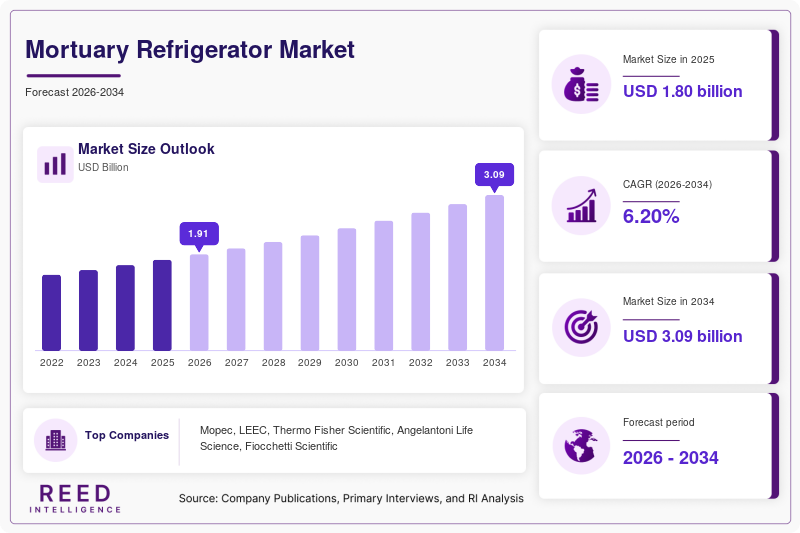
The global Mortuary Refrigerator Market size was valued at USD 1.80 billion in 2025 and is projected to grow from USD 1.91 billion in 2026 to USD 3.09 billion by 2034, registering a CAGR of 6.20% during the forecast period from 2026 to 2034.
The Mortuary Refrigerator Market supplies temperature-controlled equipment used to preserve deceased bodies before funeral arrangements, forensic examination, post-mortem procedures, repatriation or long-term storage. The equipment ranges from single- and multi-body cabinets to modular cold rooms, freezer units and mobile refrigerated systems.
The commercial requirement is closely linked to storage capacity, temperature control and continuity of operation. The UK's Human Tissue Authority recommends refrigeration of bodies at approximately 4°C, while freezer storage is generally operated around -20°C. It also requires facilities to maintain sufficient capacity for bodies, organs and tissue samples and to plan for peak activity.
Capacity planning is becoming an important purchasing issue. The HTA specifically requires contingency arrangements for power failures and insufficient refrigerated spaces, while its guidance notes that establishments should regularly review fridge and freezer capacity.
Current procurement activity illustrates this need. In 2026, public authorities in India issued tenders for mortuary freezers, cold-room installations and maintenance of multi-body mortuary cooling systems. A government tender in Deoghar sought four mortuary freezers for Sadar Hospital, while West Bengal's public-works system tendered comprehensive maintenance for six-body and ten-body mortuary cooler plants.
Mortuary Refrigerator Market Drivers
Growing Need for Reliable Mortuary Capacity
Mortuary refrigeration demand is ultimately tied to the number of deaths requiring managed storage and the capacity of hospitals, forensic institutions and funeral facilities. WHO maintains a global mortality database containing cause-of-death information from more than 120 countries and areas, while noting that death registration remains incomplete in many countries.
Population ageing provides an additional structural factor. WHO reports that global life expectancy reached 73.3 years in 2024 and that the number of older people continues to increase as mortality at older ages improves. The UN projects that the global population aged 65 and above will exceed 1.6 billion by 2050.
For equipment suppliers, the commercial mechanism is not simply higher mortality. Hospitals, funeral homes and forensic facilities must maintain enough refrigerated capacity for normal workloads and seasonal or unexpected peaks. The HTA explicitly states that storage capacity should account for predicted peaks and contingency events.
This supports recurring demand for new units, replacement equipment, additional storage bays and maintenance services.
Expansion and Modernization of Hospitals and Forensic Infrastructure
Hospitals, medical colleges, forensic laboratories and public-health facilities require mortuary infrastructure as part of their broader healthcare estate. Modernization becomes necessary when existing refrigerators become unreliable, capacity is insufficient, or facilities need separate areas for routine storage, forensic work and long-term preservation.
The 2026 procurement activity in India provides a direct market signal. Jharkhand's Deoghar district health authority sought four mortuary freezers for Sadar Hospital, while Punjab's Department of Medical Education and Research sought bids for installation of a mortuary cold room in S.A.S. Nagar.
A separate Maharashtra PWD tender in September 2026 called for replacement of the existing mortuary refrigeration room and stainless-steel racks at Sir J.J. Group of Hospitals in Mumbai.
These projects demonstrate a replacement-and-expansion cycle: institutions do not only purchase individual refrigerators but also upgrade complete cold-storage rooms, racks, refrigeration systems and supporting infrastructure.
Higher Requirements for Temperature Control, Monitoring and Contingency Storage
Mortuary refrigerators must maintain stable temperatures because uncontrolled warming can accelerate deterioration and compromise post-mortem procedures. The HTA recommends approximately 4°C for refrigerated storage and around -20°C for freezer storage. It also emphasizes documented contingency plans for equipment failure and insufficient capacity.
Modern systems therefore increasingly incorporate temperature displays, alarms, data logging, backup refrigeration and remote monitoring. Fiocchetti offers mortuary refrigerators with temperature-control and recording accessories and provides both positive and negative-temperature configurations. Bionics Scientific similarly offers digital controllers, high- and low-temperature alarms, data loggers and temperature chart recorders.
The commercial impact is higher equipment value per installation and stronger demand for preventive maintenance. Facilities are increasingly purchasing systems based not only on storage capacity but also on operational reliability and documentation.
Mortuary Refrigerator Market Restraints
High Capital and Installation Requirements for Large Mortuary Systems
Large mortuary installations are more complex than conventional refrigeration cabinets. Multi-body rooms require insulated panels, refrigeration units, racks, doors, drainage, electrical systems, monitoring and sometimes backup power. Hygeco offers modular cold rooms and mobile refrigerated units that can accommodate up to 50 bodies, illustrating the infrastructure scale involved in larger facilities.
For smaller hospitals and funeral homes, the capital requirement can restrict adoption of high-capacity systems. Institutions may instead maintain smaller cabinets or use agreements with nearby facilities when local capacity is insufficient.
The HTA recognizes this practical constraint by allowing contingency arrangements while still requiring appropriate storage capacity and documented plans.
Maintenance, Energy Consumption and Equipment Reliability
Mortuary refrigeration operates continuously, making compressor reliability, insulation, temperature control and preventive maintenance important operating considerations. A failure can immediately reduce available storage capacity.
Public procurement illustrates the recurring service requirement. West Bengal's 2026 tender covered comprehensive maintenance of multiple six-body and ten-body mortuary cooling plants, including compressors, condensers, motors, control panels, cooling coils and temperature checks. Bangladesh's Ministry of Health also issued a 2026 tender for repair and servicing of mortuary coolers at public hospitals with a two-year comprehensive warranty.
Consequently, buyers increasingly evaluate suppliers based on after-sales service and spare-parts availability as well as initial equipment price.
Mortuary Refrigerator Market Opportunities
Modular and Mobile Mortuary Refrigeration
Modular cold rooms can expand capacity without requiring a complete permanent building redesign. Fiocchetti offers modular mortuary chambers in configurations ranging from one to twelve bodies, while Hygeco offers mobile refrigerated units with capacities of up to 50 bodies and temperatures down to -20°C.
This creates an opportunity in hospitals undergoing renovation, regions experiencing temporary capacity shortages and emergency-response planning. Mobile units can also support mass-fatality preparedness.
The HTA specifically recommends contingency arrangements where refrigerated storage is insufficient or equipment fails, strengthening the operational case for flexible capacity.
Digital Monitoring and Connected Mortuary Systems
Temperature monitoring provides an opportunity to move from basic refrigeration toward documented, continuously monitored storage. Digital controllers, alarms, remote monitoring and data logging can alert operators before a temperature deviation causes deterioration.
Bionics Scientific already offers high/low temperature alarms and optional data loggers, while Fiocchetti provides accessories for temperature control and recording.
For hospitals and forensic institutions, the commercial value is linked to risk reduction and operational documentation. A connected system can support preventive maintenance, demonstrate temperature compliance and provide evidence during inspections.
Bariatric and Specialized Storage Capacity
Mortuary facilities increasingly need equipment capable of accommodating different body sizes. The UK's post-mortem standards require sufficient capacity for bodies and specifically call for adequate provision for bariatric bodies.
Hygeco's modular cold chambers can include larger locations for bariatric bodies, while its cold-room systems can be configured around different room layouts.
This creates a product-development opportunity around reinforced trays, wider compartments, higher load capacities, ergonomic loading equipment and configurable rack systems.
Segmental Analysis
By Product Type
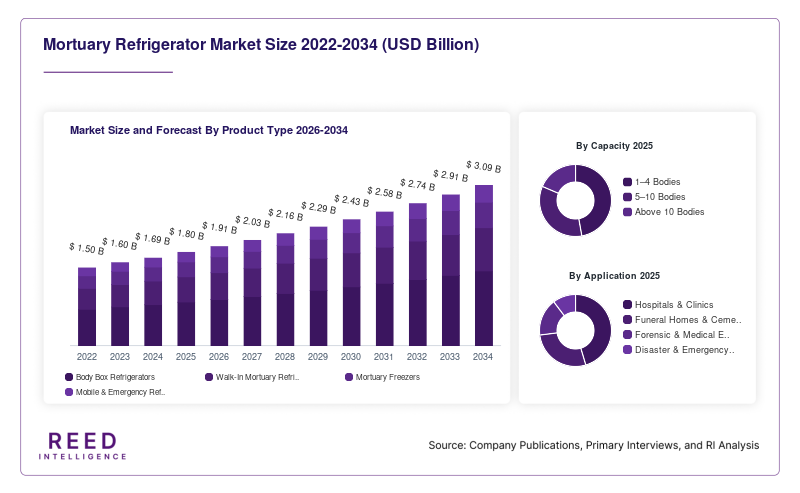
Body Box Refrigerators represent approximately 43% of the global market in 2025, making them the dominant product segment. Their compact configuration allows hospitals, funeral homes and smaller forensic facilities to add body-storage capacity without constructing a full walk-in room. Current Mopec systems are available in one- to nine-body configurations with two-, three- and four-tier options.
Walk-In Mortuary Refrigerators account for approximately 32% and are preferred by large hospitals, medical examiners and high-volume mortuaries where higher storage capacity and customized layouts are required.
Mortuary Freezers represent approximately 15%, primarily supporting longer-term storage and facilities that experience delayed release or exceptional forensic requirements. NHS England recommends freezer storage at approximately −20°C for bodies held beyond 30 days.
Mobile & Emergency Refrigeration Systems account for approximately 10% but are the fastest-growing product category, with a CAGR of approximately 8.1%. Disaster preparedness, temporary capacity and emergency response support demand for refrigerated trailers and containerized systems.
By Capacity
5–10 Bodies represents approximately 39% of the market in 2025. This capacity range fits many medium-sized hospitals, funeral facilities and regional forensic centers because it balances storage requirements with available floor space.
1–4 Bodies accounts for approximately 29%, particularly among smaller funeral homes, clinics and low-volume facilities.
Above 10 Bodies represents approximately 32% and is the fastest-growing capacity category, with a CAGR of approximately 7.0%. Large hospitals, centralized forensic facilities and regional mortuaries increasingly require high-density storage. Current commercial systems can exceed 20 bodies per refrigeration configuration.
By Application
Hospitals & Clinics represent approximately 35% of the global market in 2025. Hospitals require controlled short-term storage before funeral transfer, post-mortem examination or release to families. NHS guidance specifically addresses mortuary body stores within healthcare facilities and recommends capacity planning around local demand and length of stay.
Funeral Homes & Cemeteries account for approximately 29%, supported by routine body storage before funeral services, burial or cremation.
Forensic & Medical Examiner Facilities represent approximately 24%. These facilities have more demanding requirements because bodies may need to remain available for identification, autopsy, toxicology or other investigations.
Disaster & Emergency Response represents approximately 12% but is the fastest-growing application, with approximately 8.4% CAGR, supported by government preparedness and the availability of mobile refrigeration solutions.
By End User
Healthcare Institutions account for approximately 36% of the market in 2025, making hospitals and healthcare networks the largest institutional buyers.
Funeral Service Providers represent approximately 30%, including funeral homes and cemetery operators.
Government & Forensic Agencies account for approximately 25% and include medical examiner offices, police mortuaries, public-health agencies and disaster-response authorities.
Research & Academic Institutions represent approximately 9%.
Government & Forensic Agencies are the fastest-growing end-user category, with a CAGR of approximately 7.1%, supported by investments in forensic infrastructure, public mortuary facilities and emergency preparedness.
Regional Analysis
North America Mortuary Refrigerator Market
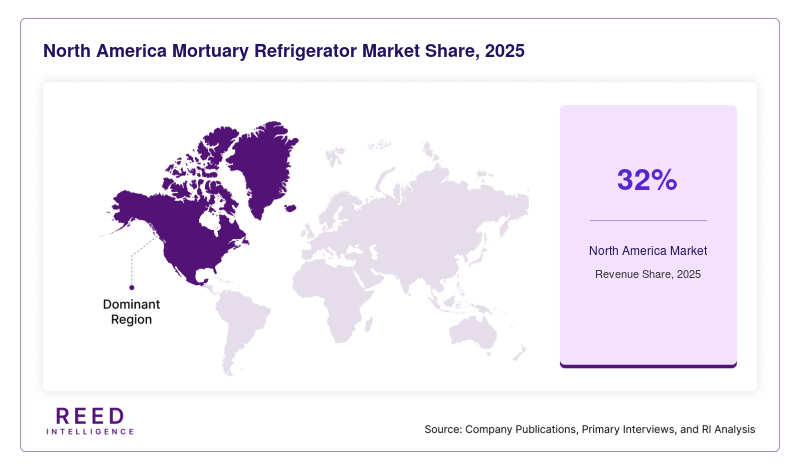
North America represents approximately 32% of the global Mortuary Refrigerator Market in 2025. The region benefits from established hospital systems, large funeral-service networks, medical examiner infrastructure and mature forensic facilities.
The U.S. recorded more than 3.07 million resident deaths in 2024 and an estimated 3.09 million in 2025, creating a large recurring requirement for body storage across hospitals, funeral homes, medical examiners and public facilities.
The region also has a developed market for specialized mortuary equipment. Mopec's current portfolio includes body-box refrigeration, walk-in coolers, mobile trailers, emergency containers, racks and digital temperature-monitoring systems.
Product purchasing is increasingly influenced by capacity density, bariatric accommodation, hygiene and remote monitoring. Mopec's current Mortech systems offer one- to nine-body configurations, while larger systems sold through laboratory-equipment channels can exceed 20-body capacity.
North America is projected to grow at approximately 5.6% CAGR through 2034. Replacement demand remains important because refrigeration equipment requires continuous operation, while medical examiner offices and hospitals also need surge capacity.
Europe Mortuary Refrigerator Market
Europe accounts for approximately 28% of the global market in 2025. The region has mature mortuary infrastructure and detailed facility-design guidance, particularly through NHS England and national healthcare systems.
NHS England's Health Building Note 16-01 provides detailed planning requirements for mortuaries, including refrigeration temperatures, body-store capacity, bariatric dimensions and the relationship between storage capacity and local demographic and operational conditions.
The recommended refrigerated range of 4–6°C for short-term storage creates a clear equipment specification, while longer-term cases can require −20°C freezer storage.
The European market is projected to expand at approximately 5.3% CAGR. Replacement of older systems with energy-efficient, digitally monitored refrigeration represents an important demand mechanism. Large hospitals and forensic centers are also more likely to require customized walk-in systems rather than standardized body-box units.
The main constraint is that many European markets have mature mortuary infrastructure, which limits new-unit demand and shifts purchasing toward replacement, refurbishment and capacity optimization.
APAC Mortuary Refrigerator Market
APAC represents approximately 23% of the global market in 2025 and is the fastest-growing region, with a CAGR of approximately 8.0%.
The region combines large populations, substantial mortality volumes, rapid healthcare infrastructure development and significant differences in mortuary capacity between urban and rural areas. India's 2024 Civil Registration System report provides a nationwide framework for registered deaths and is used by government authorities for public-service planning.
India also provides direct evidence of equipment procurement. In 2026, Sadar Hospital Deoghar sought four mortuary freezers, while VIMSAR Burla sought annual maintenance for its mortuary coolers. AIIMS Bhopal previously tendered for a cold room for its skin bank and mortuary.
These purchases illustrate a mixed demand pattern: new equipment for facilities expanding capacity and maintenance contracts for installed equipment. Hospitals in rapidly developing urban areas are particularly relevant customers.
Japan, South Korea, China, Australia and Southeast Asia provide additional demand through established hospital and funeral infrastructure. The regional market is expected to remain the fastest-growing because modernization can add refrigeration capacity where existing facilities are inadequate.
Middle East and Africa Mortuary Refrigerator Market
Middle East and Africa represents approximately 10% of the global market in 2025 and is projected to grow at approximately 6.9% CAGR.
The region has varied levels of mortuary infrastructure. Major hospitals and forensic institutions in the Gulf states typically require modern temperature-controlled facilities, while developing markets may rely on smaller cabinet systems or centralized public facilities.
The demand mechanism is linked to hospital construction, forensic-service development, population growth and public-health infrastructure. Mobile and modular refrigeration can also be relevant where permanent facilities have limited capacity or where disaster preparedness is being strengthened.
WHO's guidance on mass-fatality management identifies refrigerated containers as the preferred temporary storage option when normal systems are overwhelmed.
The region's key constraints include high import dependence for specialized equipment, service availability, electricity reliability in some markets and differences in regulatory and facility standards. Suppliers that provide installation, maintenance and spare parts alongside refrigeration equipment can therefore improve market access.
LATAM Mortuary Refrigerator Market
LATAM represents approximately 7% of the global market in 2025 and is expected to expand at approximately 6.5% CAGR.
Brazil, Mexico, Argentina, Colombia and Chile represent important healthcare and funeral-service markets. Demand is concentrated around major hospitals, forensic institutions, funeral homes and metropolitan areas where centralized mortuary capacity is required.
The market is influenced by both new healthcare construction and replacement of older refrigeration systems. Smaller facilities tend to favor body-box refrigerators, while large urban hospitals and forensic centers can justify walk-in systems.
Emergency preparedness provides an additional opportunity. Modular refrigeration can be deployed when permanent capacity is disrupted or temporarily exceeded, aligning with WHO recommendations for refrigerated temporary storage during mass-fatality events.
LATAM's main constraints are currency volatility, import costs, uneven maintenance infrastructure and differences in public procurement cycles.
Competitive Landscape
The Mortuary Refrigerator Market contains specialist mortuary-equipment manufacturers, laboratory-equipment suppliers, cold-room manufacturers and distributors. Competition is primarily based on temperature stability, body capacity, construction quality, hygiene, energy performance, monitoring, customization, installation and after-sales service.
Mopec has one of the broadest dedicated mortuary refrigeration portfolios, covering body-box refrigerators, walk-in coolers, freezers, mobile trailers, emergency containers and the MERC portable cooling system. Its current systems incorporate high-R-value insulation, digital temperature controls, heated door frames, vapor-proof lighting and optional bariatric configurations.
Mopec is also moving toward connected refrigeration. Its Cooler Command platform provides 24/7 remote temperature monitoring and integration with building-management systems, while LightGuard UV provides an additional disinfection layer for compatible walk-in systems.
Fisher Scientific provides an important distribution channel for mortuary refrigeration and currently lists a broad selection of Mopec and other suppliers. Its catalog includes body-box systems ranging from small units to configurations exceeding 20 bodies.
Key Market Players
Recent Market Developments
- May–June 2026 – Sadar Hospital Deoghar sought four mortuary freezers. The Government of Jharkhand procurement specified four units for the mortuary/post-mortem house for the 2026–27 year, providing a direct example of public-hospital capacity expansion.
- April 2026 – VIMSAR Burla issued a tender for comprehensive annual maintenance of mortuary coolers. The procurement shows that the installed equipment base is generating recurring service and maintenance demand in addition to new-unit sales.
Mortuary Refrigerator Market Segments
By Product Type
- Body Box Refrigerators
- Walk-In Mortuary Refrigerators
- Mortuary Freezers
- Mobile & Emergency Refrigeration Systems
By Capacity
- 1–4 Bodies
- 5–10 Bodies
- Above 10 Bodies
By Application
- Hospitals & Clinics
- Funeral Homes & Cemeteries
- Forensic & Medical Examiner Facilities
- Disaster & Emergency Response
By End User
- Healthcare Institutions
- Funeral Service Providers
- Government & Forensic Agencies
- Research & Academic Institutions
By Region
- North America
- Europe
- APAC
- Middle East and Africa
- LATAM