Mosquito Repellent Paints Market Size, Share Demand Report By Type (Water-Based Mosquito Repellent Paints, Solvent-Based Mosquito Repellent Paints, Eco-Friendly/Natural Ingredient Paints), By Application (Residential, Commercial, Industrial), By Distribution Channel (Retail Stores, Online Platforms, Direct Sales), By End-Use (Households, Healthcare Facilities, Educational Institutions, Hospitality Sector) By Region & Segment Forecasts, 2026–2034
USD 3950
Market Overview
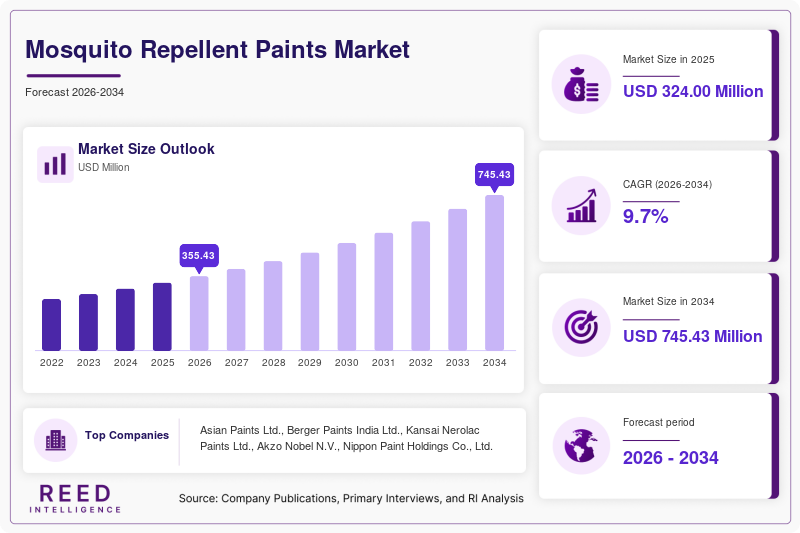
The Mosquito Repellent Paints Market size was valued at USD 324 million in 2026 and is projected to reach USD 682 million by 2034, expanding at a CAGR of 9.7% during the forecast period (2026–2034). The market is gaining momentum as consumers and institutions seek long-lasting and passive mosquito control solutions integrated into building materials. These paints contain active ingredients such as insect-repelling compounds and microencapsulated additives that help reduce mosquito presence on treated surfaces.
A key global factor supporting the growth of the Mosquito Repellent Paints Market is the rising prevalence of mosquito-borne diseases and the increasing focus on preventive healthcare measures. Governments, healthcare organizations, and households are adopting innovative solutions to minimize disease transmission risks, thereby boosting demand for mosquito repellent paints.
Key Highlights
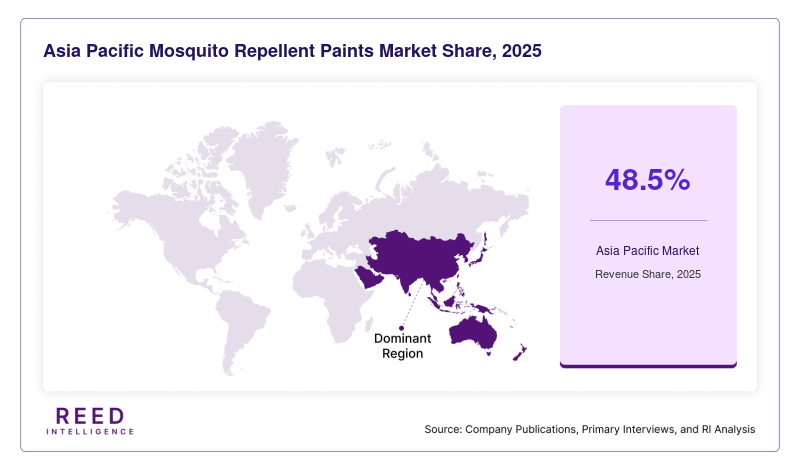
- Dominant region: Asia Pacific held 48.5% market share in 2025, while Latin America is projected to grow fastest at a CAGR of 10.3% (2026–2034).
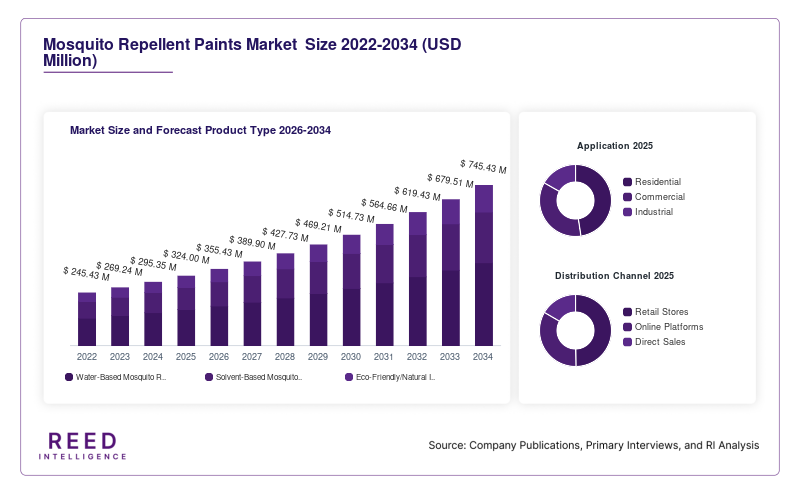
- Leading subsegments: Water-based mosquito repellent paints dominated the type segment with 61.4% share in 2025, while eco-friendly/natural ingredient paints are expected to grow fastest at a CAGR of 10.8%.
- Application insights: Residential applications accounted for 55.7% share in 2025, while commercial applications are projected to grow at a CAGR of 9.9%.
- Distribution insights: Retail stores held 49.2% share in 2025, while online distribution is expected to grow at a CAGR of 11.2%.
- Dominant country: India market was valued at USD 58 million in 2024 and USD 64 million in 2025.
Market Trends
Rising Adoption of Eco-Friendly Formulations
Manufacturers are increasingly focusing on plant-based and low-toxicity ingredients in mosquito repellent paints. This trend aligns with growing consumer awareness regarding environmental sustainability and indoor air quality.
Integration of Microencapsulation Technology
Advanced microencapsulation techniques are being used to release active repellent agents over an extended period. This improves product efficiency and durability, making such paints more attractive for long-term applications.
Market Drivers
Increasing Incidence of Mosquito-Borne Diseases
The rising cases of diseases such as dengue, malaria, and chikungunya are encouraging the adoption of preventive solutions. Mosquito repellent paints provide a passive and long-lasting method to reduce mosquito exposure.
Growth in Residential and Commercial Construction
The expansion of housing projects, offices, and public infrastructure is driving demand for functional coatings. Builders and consumers are incorporating mosquito repellent paints into construction projects to enhance safety and comfort.
Market Restraint
Higher Cost Compared to Conventional Paints
Mosquito repellent paints are relatively more expensive than standard paints due to the inclusion of specialized ingredients and technologies, which may limit adoption in price-sensitive markets.
Market Opportunities
Expansion in Emerging Economies
Developing regions with high mosquito prevalence present strong growth opportunities. Increasing urbanization and awareness campaigns are expected to drive demand in these markets.
Innovation in Multi-Functional Coatings
The development of paints that combine mosquito repellency with additional features such as antibacterial and anti-fungal properties is expected to create new market opportunities.
Segmental Analysis
By Type
The Mosquito Repellent Paints Market is segmented into water-based paints, solvent-based paints, and eco-friendly/natural ingredient paints.
- Dominant Subsegment: Water-based paints held 61.4% share in 2025 due to low odor, ease of application, and environmental benefits.
- Fastest-Growing Subsegment: Eco-friendly/natural ingredient paints are expected to grow at a CAGR of 10.8%, driven by increasing demand for sustainable products.
By Application
The market includes residential, commercial, and industrial applications.
- Dominant Subsegment: Residential applications accounted for 55.7% share in 2025 due to widespread use in homes and apartments.
- Fastest-Growing Subsegment: Commercial applications are projected to grow at a CAGR of 9.9%, supported by adoption in offices, schools, and healthcare facilities.
By Distribution Channel
The market is segmented into retail stores, online platforms, and direct sales.
- Dominant Subsegment: Retail stores held 49.2% share in 2025 due to strong offline presence and consumer preference for physical inspection.
- Fastest-Growing Subsegment: Online platforms are expected to grow at a CAGR of 11.2%, driven by increasing e-commerce adoption.
By End-Use
Segments include households, healthcare facilities, educational institutions, and hospitality sector.
- Dominant Subsegment: Households held 51.3% share in 2025 due to direct consumer usage.
- Fastest-Growing Subsegment: Healthcare facilities are expected to grow at a CAGR of 10.1%, driven by infection control measures.
Regional Analysis
Asia Pacific
Asia Pacific accounted for 48.5% of the Mosquito Repellent Paints Market share in 2025. The region is expected to grow at a CAGR of 9.5% during 2026–2034. India dominated the region due to high incidence of mosquito-borne diseases and growing construction activities.
North America
North America held 17.6% market share in 2025 and is projected to grow at a CAGR of 8.7%. The United States dominated the region due to increasing awareness of preventive healthcare and adoption of innovative home improvement products.
Europe
Europe represented 14.8% share in 2025 and is anticipated to grow at a CAGR of 8.4%. Germany led the region, supported by rising demand for eco-friendly and functional coatings.
Middle East & Africa
The region captured 10.2% market share in 2025 and is expected to grow at a CAGR of 9.1%. South Africa dominated due to increasing efforts to control mosquito-borne diseases.
Latin America
Latin America accounted for 8.9% share in 2025 and is forecast to grow at the fastest CAGR of 10.3%. Brazil led the region, driven by high mosquito population and government initiatives for disease prevention.
Competitive Landscape
The Mosquito Repellent Paints Market is characterized by increasing competition among paint manufacturers and specialty coating companies. Asian Paints is recognized as a leading player, offering innovative products tailored to regional needs. The company recently introduced advanced mosquito repellent paint formulations with improved durability and effectiveness.
Other key players include Berger Paints India Ltd., Kansai Nerolac Paints Ltd., Akzo Nobel N.V., and Nippon Paint Holdings Co., Ltd. These companies are focusing on product innovation, strategic partnerships, and expansion into emerging markets to strengthen their market position.
Manufacturers are investing in research and development to enhance product performance and introduce eco-friendly solutions. Marketing strategies emphasize health benefits and long-term cost savings. Competitive dynamics are shaped by pricing strategies, brand reputation, and distribution networks.
Key Players List
- Asian Paints Ltd.
- Berger Paints India Ltd.
- Kansai Nerolac Paints Ltd.
- Akzo Nobel N.V.
- Nippon Paint Holdings Co., Ltd.
- Pidilite Industries Ltd.
- Shalimar Paints Ltd.
- DuluxGroup Ltd.
- Jotun Group
- Hempel A/S
- Sherwin-Williams Company
- BASF Coatings
- RPM International Inc.
- DAW SE
- Teknos Group
Recent Developments
- In 2025, Asian Paints launched upgraded mosquito repellent coatings with extended protection duration.
- Berger Paints India Ltd. expanded its product portfolio with eco-friendly variants.
- Kansai Nerolac introduced new formulations targeting urban housing projects.
- Akzo Nobel focused on sustainable coating technologies for functional paints.
- Nippon Paint expanded distribution channels in Asia Pacific markets.
Mosquito Repellent Paints Market Segments
Product Type
- Water-Based Mosquito Repellent Paints
- Solvent-Based Mosquito Repellent Paints
- Eco-Friendly/Natural Ingredient Paints
Application
- Residential
- Commercial
- Industrial
Distribution Channel
- Retail Stores
- Online Platforms
- Direct Sales
End-Use
- Households
- Healthcare Facilities
- Educational Institutions
- Hospitality Sector
By Region
- North America
- Europe
- APAC
- Middle East and Africa
- LATAM