Motorcycle Helmet Head-Up Display Market Size, Share Demand Report By Technology (Augmented Reality (AR) HUD, Conventional HUD), By Application (Navigation, Speed Monitoring, Communication, Safety Alerts), Regional Insights & Segment Forecasts, 2026–2034
USD 3950
Motorcycle Helmet Head-Up Display Market Size
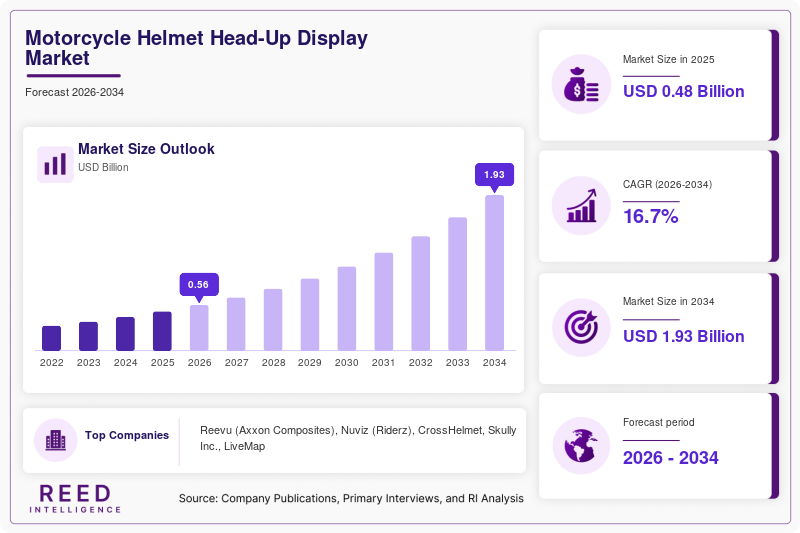
The Motorcycle Helmet Head-Up Display market size is projected at USD 185.6 million in 2026 and is expected to hit USD 485.3 million by 2034 with a CAGR of 12.8% during the forecast period. The increasing demand for enhanced rider safety and situational awareness, coupled with the growing adoption of smart helmet technologies and the rising popularity of motorcycles for commuting and leisure, underpins market expansion. This report delivers a comprehensive analysis of the Motorcycle Helmet Head-Up Display market, including segmentation by technology and application, competitive dynamics, and regional growth patterns, equipping stakeholders with critical intelligence. The Motorcycle Helmet Head-Up Display market continues to demonstrate strong growth potential, fueled by the increasing focus on rider connectivity, the growing integration of IoT and AR technologies, and continuous innovation in display and sensor technologies.
Key Takeaways
- Dominant Region: Europe leads the Motorcycle Helmet Head-Up Display market with a 35% share, while Asia-Pacific is the fastest-growing region with a projected CAGR of 14% through 2034.
- Dominant Segment: The Augmented Reality (AR) HUD technology dominates the market with a 55% share, while the Navigation application is the leading segment with a 35% share.
- Emerging Country: The United States is projected to reach USD 85.6 million by 2034, expanding at a CAGR of 12.5%.
- Key Drivers: The increasing focus on motorcycle safety, the rising adoption of smart helmets, and the growing demand for rider connectivity are driving market growth.
Motorcycle Helmet Head-Up Display Market Trends
Growing Integration of Augmented Reality (AR) and AI Technologies
The Motorcycle Helmet Head-Up Display market is witnessing a significant trend toward the integration of Augmented Reality (AR) and Artificial Intelligence (AI) technologies. This is driven by the need for more advanced and intuitive rider interfaces that enhance situational awareness and safety. AR HUDs are capable of overlaying real-time navigation information, traffic alerts, and other relevant data onto the rider's field of view, creating a more immersive and safer riding experience. AI integration is also being explored for features like predictive safety alerts and personalized riding recommendations.
Increasing Demand for Connected and Smart Helmet Solutions
The increasing demand for connected and smart helmet solutions is a major trend shaping the Motorcycle Helmet Head-Up Display market. The integration of HUDs with Bluetooth, Wi-Fi, and cellular connectivity is enabling features such as hands-free calling, music streaming, group intercom, and real-time vehicle diagnostics. The use of HUDs in connected motorcycle ecosystems for fleet management, rider safety monitoring, and emergency response is also gaining momentum.
Motorcycle Helmet Head-Up Display Market Drivers
The Motorcycle Helmet Head-Up Display market's expansion is primarily driven by the increasing focus on motorcycle safety and the growing demand for advanced rider assistance systems. The need to reduce rider distraction and improve situational awareness has been a major driver, with HUDs offering a solution by projecting critical information directly into the rider's line of sight. The rising adoption of smart helmet technologies and the growing popularity of motorcycle commuting and leisure riding have also fueled market demand. Additionally, the increasing integration of IoT and connectivity features in motorcycles has spurred growth.
Motorcycle Helmet Head-Up Display Market Restraints
Despite favorable growth prospects, the Motorcycle Helmet Head-Up Display market faces significant constraints, primarily related to the high cost of HUD technology, which can make helmets more expensive and less accessible to a wider consumer base. The complexity of integrating electronics into helmets while maintaining safety standards and comfort can also be a limitation. The Motorcycle Helmet Head-Up Display market's growth is also tempered by the competition from aftermarket HUD devices and smartphone-based navigation solutions.
Motorcycle Helmet Head-Up Display Market Opportunities
The Motorcycle Helmet Head-Up Display market presents significant opportunities in the rapidly expanding market for smart and connected motorcycle accessories, where HUD-integrated helmets can offer a seamless and integrated riding experience. The development of more affordable, lighter, and energy-efficient HUD technologies is expected to drive mass-market adoption. Emerging opportunities also exist in the integration of HUDs with advanced driver-assistance systems (ADAS) for motorcycles and the use of HUDs in training and simulation for motorcyclists.
Challenges in Motorcycle Helmet Head-Up Display Market
The Motorcycle Helmet Head-Up Display market faces persistent challenges related to the need for continuous innovation to reduce costs, improve battery life, and enhance display clarity and brightness. The complexity of ensuring safety and reliability of electronic components in helmet environments can also be a challenge. The market is also contending with the challenge of standardizing interfaces and ensuring compatibility with different motorcycle models and smartphone platforms.
Motorcycle Helmet Head-Up Display Market Segmentation Analysis
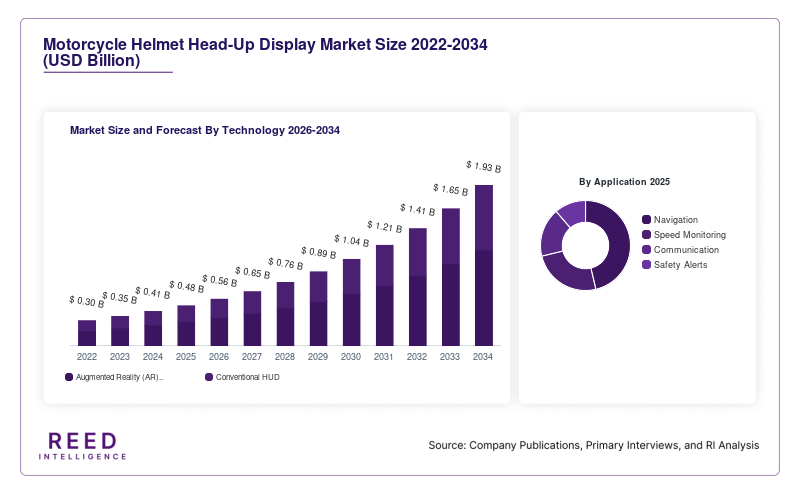
The Motorcycle Helmet Head-Up Display market is segmented by Technology and Application to provide a comprehensive market perspective. By Technology, Augmented Reality (AR) HUD dominates with a 55% market share, driven by its advanced features and immersive experience. The Application segment is led by Navigation, which accounts for 35% of the market, followed by Speed Monitoring at 25%, Communication at 22%, and Safety Alerts at 18%.
By Technology
Augmented Reality (AR) HUD represent the largest segment in the Motorcycle Helmet Head-Up Display market, commanding a 55% share, with revenue exceeding USD 102 million in 2025. These are characterized by their use of AR technology to overlay digital information onto the real-world view, offering an immersive and intuitive rider experience. Technical specifications include display resolution, field of view, and brightness. The Motorcycle Helmet Head-Up Display market's AR HUD segment is driven by its use in premium and high-end smart helmets.
Conventional HUD capture a 45% share of the Motorcycle Helmet Head-Up Display market, with revenue of USD 84 million in 2025. These are characterized by their use of basic display technology to project information such as speed and navigation directions. Technical specifications include display type, size, and visibility. The Motorcycle Helmet Head-Up Display market's Conventional HUD segment is driven by its use in mid-range and entry-level smart helmets.
By Application
Navigation dominates the Motorcycle Helmet Head-Up Display market, accounting for 35% of sales, representing USD 65 million in 2025. This segment includes use in providing turn-by-turn directions, route planning, and location-based services. Usage penetration exceeds 25% in touring and adventure riding. The Motorcycle Helmet Head-Up Display market's Navigation segment is characterized by its focus on rider guidance and convenience.
Speed Monitoring accounts for 25% of the Motorcycle Helmet Head-Up Display market, with revenue of USD 46 million in 2025. This segment encompasses use in displaying current speed, speed limits, and RPM information. The segment is growing at a steady CAGR, driven by the need for speed awareness. The Motorcycle Helmet Head-Up Display market's Speed Monitoring segment is characterized by its focus on rider safety and regulatory compliance.
Communication represents 22% of the market, with revenue of USD 41 million in 2025, involving use in hands-free calling, intercom, and group communication features. The segment's growth is fueled by the increasing demand for connected riding. The Motorcycle Helmet Head-Up Display market's Communication segment is characterized by its focus on rider connectivity.
Safety Alerts accounts for the remaining 18% of the market, with revenue of USD 33 million in 2025, used in providing collision warnings, lane departure alerts, and emergency notifications. The Motorcycle Helmet Head-Up Display market's Safety Alerts segment is characterized by its focus on rider safety and accident prevention.
Motorcycle Helmet Head-Up Display Market Regional Analysis
Europe Motorcycle Helmet Head-Up Display Market
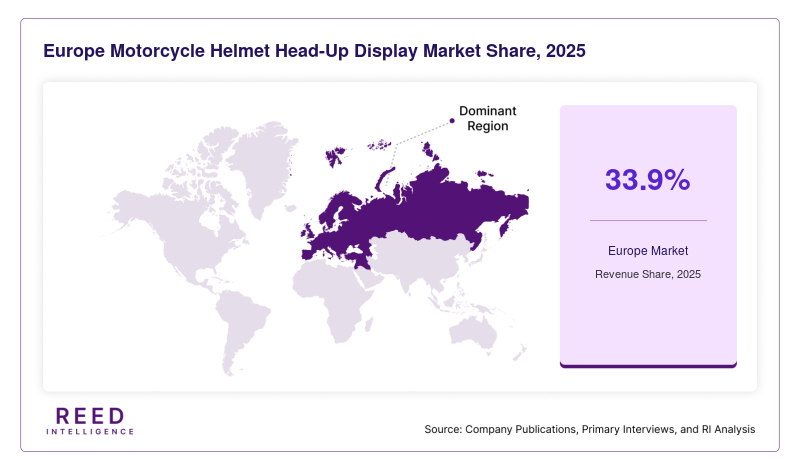
Leads the Motorcycle Helmet Head-Up Display market, commanding a 35% share, with a revenue of USD 65 million in 2025. Germany, Italy, and the UK are the primary drivers, collectively accounting for 55% of regional demand, driven by the strong motorcycle culture, high adoption of technology, and focus on rider safety. The European Motorcycle Helmet Head-Up Display market is characterized by its focus on innovation and premium products.
Asia-Pacific Motorcycle Helmet Head-Up Display Market
Represents the second-largest market, capturing a 28% share with a revenue of USD 52 million in 2025. China, Japan, and India are the primary drivers, together accounting for 65% of regional demand, driven by the large motorcycle population, growing middle class, and increasing adoption of smart technologies. The Asia-Pacific Motorcycle Helmet Head-Up Display market is projected to grow at the fastest CAGR of 14% through 2034.
North America Motorcycle Helmet Head-Up Display Market
Accounts for 22% of the global Motorcycle Helmet Head-Up Display market, with a revenue of USD 41 million in 2025. The United States is the primary driver, accounting for 85% of regional demand, driven by the rising popularity of motorcycle touring and the growing demand for advanced safety features. The North America Motorcycle Helmet Head-Up Display market is characterized by its focus on rider safety and lifestyle.
Middle East & Africa and Latin America Motorcycle Helmet Head-Up Display Market
Together account for the remaining 15% of the Motorcycle Helmet Head-Up Display market, with the UAE and Brazil leading their respective regions. Both regions are projected to grow at CAGRs exceeding 11%, driven by increasing motorcycle sales and growing awareness of rider safety.
Top players in Motorcycle Helmet Head-Up Display Market
- Reevu (Axxon Composites)
- Nuviz (Riderz)
- CrossHelmet
- Skully Inc.
- LiveMap
- NUUO (Diamond Tech)
- Bell Helmets
- Sena Technologies, Inc.
- Cardo Systems
- Shoei Co., Ltd.
- Arai Helmet Ltd.
- Schuberth GmbH
- HJC Helmets
- AGV (Dainese)
- Givi S.r.l.
Motorcycle Helmet Head-Up Display Market Segments
By Technology
- Augmented Reality (AR) HUD
- Conventional HUD
By Application
- Navigation
- Speed Monitoring
- Communication
- Safety Alerts
By Region
- North America
- Europe
- APAC
- Middle East and Africa
- LATAM